the power of retreat


The bay window of a friend’s Muskoka kitchen.

Giant black Newfoundland pup snoring by the back door. Green tea.

No one else around. I sit on pillows, watch blue herons flaap flaap by; a black squirrel travels down a long path, jumps onto the deck of the boathouse, peeks around the corner, realizes it’s a dead end, not to mention a poor place to hide nuts. He comes back up, disappears. I have some tea, open the book I’ve brought. I have two hours to read before I need to be anywhere. I close the book. Reach for a stack of typed pages—the chapter I’ve been working on for a month and which somewhere along the line has turned into cement, an ugly confusion that just stares back at me, obstinate, exactly what you’d expect from cement. I should throw it out but I have optimistic moments when I think there’s something in there—I just don’t know where, or how, to make the crack to let it out.

I reach for the book again.

The squirrel, the herons, are gone. The view remains. My tea is cold but still good. I put the book down and my hand reaches for the typed pages even as part of me shouts You fool… you’re about to waste two perfectly good hours in Shangri-la on GD cement…

I make notes, draw arrows. I jot “Insert A”  then write a scene and call it A. I find B within the existing mess. Then C. I mark it, move it to a better place. The dog is still snoring as I re-write what becomes D, and find E. I print “Insert E”. More arrows. And then, checking the clock, I jot a final scene and christen it F and I know—despite the tangle of lines and notes, inserts and cross outs—that a bouncing baby chapter has been born.

I’m stunned at first, that I could do in two hours what I hadn’t been able to crack in weeks. I’m inclined to put it down to the view, the solitude, the drowsy dog—all of which is great, all of which has set a mood—but it occurs to me that what is really powerful is the way my friend’s house makes no demands of me—how my thoughts are allowed the freedom to just ‘be’.

Because, truthfully, I have peace and solitude at home also. But laundry winks. Floors scowl. And the squirrels don’t mind their own business on long paths, they knock on windows and complain that they’re out of bird food. I can work at home of course—it’s where I’m happiest—but sometimes what’s necessary—for clarity, for permission to colour outside the lines, the courage to smash the cement… not merely find a ‘crack’—isn’t the familiar, but the bountiful disentanglements of  ‘away’.

That, and an unfamiliar window.

the harvest hokey pokey

There’s a sense of urgency at this time of year. Something primal, a scrap of DNA left over from hunter-gatherer days that makes us forget there are grocery stores [and, bonus, they’re open all winter!]. We see produce, feel a chill in the air, think: uh oh, frost, starvation, scurvy, ice storms, must stock up, and before we know it we’re surrounded by heads of cauliflower and cabbage, bunches of beets and carrots, more green beans than seems right, zucchini and peppers, potatoes, eggplant, onions, broccoli, did I say carrots?, celery—celery root for god’s sake. And it has to be hauled home all at once because next week might be the week the farmers are no longer at the market or all they’re selling is those crocheted toilet paper roll dresses.

It starts small. You put up the odd jar of relish, quince jelly, pear and apple butter, you feel organized in that way you feel in the garden in spring—when the weeds are just starting to show, when plucking one here and there is enough to keep things tidy and every year you think: heck, this isn’t so bad, I must be getting better at being organized  [uh huh]and then suddenly there’s so much fresh food in the house it’s impossible to imagine eating it all and one day it seems entirely normal—what? what’s the problem?—to be making vats of borscht in your pyjamas at six on Sunday mornings, all day spaghetti sauces, cranberry, rum and raisin conserves before lights out; jars of pickles and marmalades taking precedence over everything, over reading. The pop of lids is both a joy to behold and annoying and your back throbs and the vinegar makes your eyes water but the good news is that should you fancy a bit of cheddar one December evening, you will be able to eat it with a green tomato and apple chutney. Not to mention a rosemary infused carrot if the mood takes you.

And that, dear friends, is what it’s all about.

So happy harvest trails and best of the season!

GREEN TOMATO AND APPLE CHUTNEY
(makes about 6 – 7 8oz (250 mL) jars

(from Well Preserved, by Mary Anne Dragan)

1 lemon
5 C finely chopped green tomatoes (1.2L)
2 C finely chopped apples (457 mL)
1 C finely chopped onions (240 mL)
2 cloves garlic, peeled and minced
1 C currants (240 mL)
1 C brown sugar (240 mL)
1 C cider vinegar (240 mL)
1 TBSP mustard seeds (15 mL)
1 1/2 tsp dried chili flakes (7.5 mL)
1 tsp salt (5 mL)
1 tsp ginger (5 mL)

Prepare the preserving jars.

Slice the lemon very thinly, discarding the ends and seeds. Chop very finely.

Combine all the ingredients in your preserving pot. Simmer over medium heat for 25-30 minutes, or until thickened. Stir often to prevent sticking, especially during the last 10 minutes of cooking time.

Remove from the heat. Spoon the chutney into hot, sterilized jars, leaving 1/2 inch (1.2 cm) head space. Wipe the rims clean. Seal according to manufacturer’s directions. Process the jars in a boiling water bath for 10 minutes.

(A traditional English condiment, this chutney is excellent in a sandwich with any type of meat or cheese. It is a great accompaniment to beef dishes such as meat loaf, scrambled eggs or macaroni and cheese.) ~ from Well Preserved, by Mary Anne Dragan

a new category is born: *judy sightings

*Judy: a long-suffering (make-the-best-of-it) dame of a certain vintage, usually attached to a male of a similar vintage.

~

MORNING AT TIM HORTON’S, PENTICTON

Judy, shoulder length brassy blonde hair, wears a white blouse, black slacks, name tag—My name is Judy—pale blue cardigan. Sits with sturdy, well fed man in race car driver sunglasses, football shirt, jeans and gold windbreaker. They begin their day in silence, blowing synchronicity onto their tea.

DEPARTURE LOUNGE, KELOWNA AIRPORT

Judy in crimson cardigan, black polyester tee, black purse rests on knees and what look like long johns poke out from the bottom of black slacks. Bare feet in black shoes. She files her nails beside a guy, a slow but incessant talker, in navy cap, navy golf shirt worn and faded, khakis, white socks, black sensible-sneaker-shoes. They both wear eye-glasses. Both have small carry-ons; hers, striped, crimson, white and black; his, royal blue with red trim. She rarely speaks and then in a high pitch, like a child, like her voice is seven decades younger than the rest of her. He answers in a way that whatever she has said, he’s setting her straight. He has all the answers. He knows. She listens, continues to file her nails, sometimes swings her feet that, if she turns her toes up just a titch, don’t quite reach the floor. He keeps his firmly crossed and locked—right mid-calf resting on left knee. She has been filing her nails beside him for 50 years.

CALGARY AIRPORT

Judy, short and squarish with grey hair, also short and square, glasses, maybe some hip issues, ortho type white sneakers, limping along the concourse with her guy, each pulling trollies, he in a lumber jacket (red and black), she stopping, making him stop too, placing a raccoon hat, grabbed from a display, on his head. Too small. She laughs. Hat clerk laughs too. Guy smiles, shakes his raccoon’d head. She is a riot everywhere they go.

today’s colour

Another reminder this morning of how closely linked are the processes of gardening and writing—all that pruning and timing and structure-is-important-or-the-whole-thing-goes-to-hell-pretty-quickly-no-matter-how-nice-it-looks-when-you-plant-it.  Not to mention the yanking of weeds, watering, muttering about what needs to be moved, propped up, filled out, eliminated. Deadlines. Frost warnings.

It never fails. I go outside to air my brain, get away from the pages but they follow me and what I end up doing in the garden turns out to be some parallel version of what I’m working on at my desk.

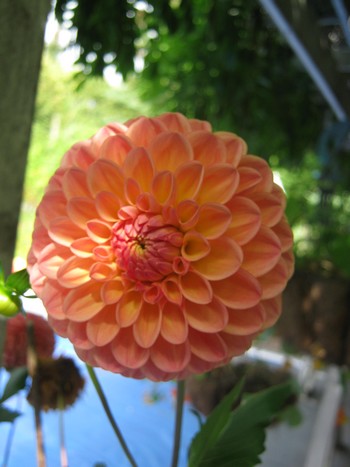
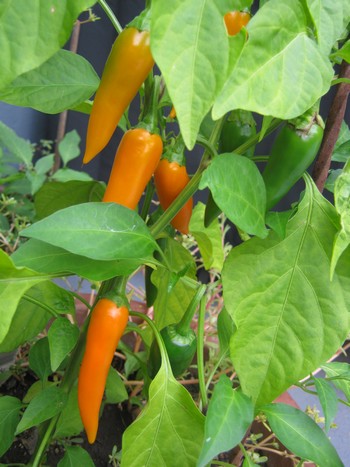
So this morning, after cleaning up some edges along a stone path, I decided to do a colour post; I was taking pictures of red things, tomatoes, bee balm, unripe blackberries, but none of it was grabbing me. Then I noticed the nasturtiums and they looked nice so I changed my focus to orange. I had no idea how much of it was out there, hadn’t seen it til I started looking (to my surprise, I was even wearing an orange shirt). I took these pictures then went back inside, inserted an orange scarf into a scene I’d been struggling with and, well, not exactly presto—there’s much more to write—but it changed the direction of the whole chapter for the better.  It was the colour, the ‘orange’ that did it: a red scarf, or blue or green, wouldn’t have worked. And yet I couldn’t see it…

Weird.

And wonderful.

Moral of the story: air your brain.   [and when all else fails, employ scarf trick]

i know that she is growing…

In the context of Robin Black’s story ‘Gaining Ground’—in the context of serendipity or cooincidence, of insight and knowing yet not understanding, of not wanting yet being obsessed, of the death of a woman’s father on the night electricity runs in her child’s bathwater—in that context, or on its own—this is beautiful:

Because I see my father. I do see him there. I see him standing outside of that tunnel, in the dark. And I see myself at that moment dipping my beautiful naked child into her bath. I know exactly where they found him. I know the path he walked from the Place. And I know the ripples of water around her small body as she plays. I know the slight gray tinge of daily dirt that falls around her, and rings that bathtub. And I know how he got out. Which nurse had her back turned. Which orderly thought he knew that my father was tucked into bed. And I know the smell of my daughter’s shampoo. The way her ears emerge as her hair rises into lather. I know what my father was wearing, his gray wool pants I mail-ordered him last month, a white T-shirt bought by my mother God knows when, no shoes. The last time I saw him, he’d lost so much weight. His food was all poisoned, he believed. I know that. The air was growing harder for him to breathe. The air that Allison breathes. I know that he couldn’t breathe her air anymore. I know he was diminishing. I know that she is growing. The nurses were pouring toxins into his room with their words. I know the songs I sing to her as she bathes. The songs she begs me for. He wouldn’t let anyone speak around him. He had forbidden even me to speak. Every word was deadly. Every breath was painful for him.” ~ from the collection If I Loved You, I Would Tell You This, by Robin Black [Random House]