Author: carin
just to clarify…

thirty truths: 30
I was eighteen, my dad walked across a whole room to ask me to dance, I was with friends, I said “No thanks, not right now.”
Stupid.
Understandable, I guess, but stupid.
He’d have been 91 next week.
The truth is he was a great dancer.
don’t be a silly goose

thirty truths: 29
I said I didn’t care, that it was just a wedding, a couple kids getting married, what’s the big deal? All that money down the pan. Who cares about The Dress? The whole thing’s a little too ‘too’ for my taste. I said I wouldn’t watch.
The truth? Ah well… didn’t they look happy?
Balcony kiss still to come.
And much to my own bewilderment, I’ll be there.
day at the beach




thirty truths: 28
Truth #28: Wine corks make a very good mulch.
thirty truths: 27
Truth #27: You never see hamsters in dove grey rooms.
Occasionally, when the piles of magazines and papers get a bit much, I daydream about having a house that looks like an In Style double page spread, dove grey rooms and linen cupboards straight out of Martha Stewart Living, a makeover kitchen in toasted almond and cookie crumb. In this dream I swan about all day in a cashmere bathrobe and turban towel and at night friends come by, sit on a perfect couch next to a perfect coffee table from which vantage point they covet our contemporary art collection composed of all the right things while sipping a perfectly shaken (or stirred) martini in the most current and fashionable flavour.
Strangely, this is about where the daydream starts to fall apart. Not only do I hate the idea of having to find space in the cupboards for martini glasses, and a shaker, no one in this scenario ever says anything of interest. It’s all about finishes and flooring and poured cement lofts and I stop dreaming and begin wondering: where are the shoes in these dove grey rooms? And the shopping and the keys and all those flyers from the mailbox and the mail that has yet to be looked at much less dealt with. And where in the double page spread do you put the weeds your slightly demented wheelchair-bound mother insists you pick as you push her about the neighbourhood because she thinks they’re so beautiful and she wants you to have them and even though they’re prickly roadside weeds covered in roadside dust you pick them, thinking you’ll throw them out later and she’ll never know—and indeed, she has forgotten about them, but by then they’re in a jar on a table and every time you look at them they make you smile.
And where are the cat’s catnip toys? And if we had a dog, a very big dog, where would it eat in the cookie crumb kitchen? And never mind dogs, what if we had a hamster? Where would its cage go with all those woodshavings and slopped water dishes—you never see hamster cages on the In Style pages—and and why in every single dove grey room is there nothing to read that looks interesting and where are the fridge magnets? The kind that say I ♥ the Cook—bought the first time somebody made somebody else a meal ten thousand years ago and that has been on at least one other fridge before this and is still relevant—or the one with those words of comfort and fear by Somerset Maugham about how there are three rules for writing a novel but no one knows what they are, or the homemade one: a collage of four faces in a photo booth in San Juan.
Despite all those excellent questions, the other day I found myself in the grip of another dove grey delusion and began clearing off the fridge door once and for all. Peter walked by as I was stripping the thing of Peanuts and Bizarro and a red tulip drawn by my niece, a collection of photos: young nephew in oversized swimming goggles, wrapped in towel by edge of pool, looking like a large chilly insect; the elegant tail of a friend’s cat; a donkey in Algiers.
What are you doing, he said.
I explained the naked fridge zen of Martha Stewart. I said something about martinis.
To which he replied: How can you do that? The fridge door is who we are.
My reaction of course was mild insult. After all, a fridge door is a far cry from a cashmere robe. I made a small sound that suggested he couldn’t possibly understand my delusions and carried on until I’d removed every photo, every cartoon, including the one where Michaelangelo is putting the finishing touches on the ceiling of the Sistine Chapel and his dad shouts up to him, pointing: you missed a spot! Then I spritzed the door with my lovely new eco-bio-cleanser and stood back to take in the gleaming ‘space’ of it. Then, after admiring its whiteness for about a second, I put (most of) the stuff back where it belongs. Because who am I kidding—I’m a fridge door.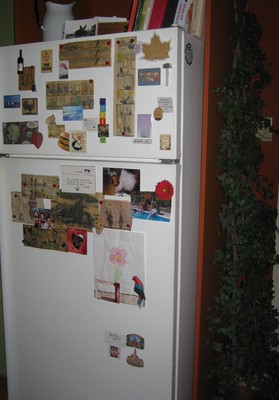
thirty truths: 26
The truth of my coffee drinking history and why I now drink tea:
The first time I heard the word my dad yelling it from his workshop in the basement: coffffeeee!! It meant he’d like one, pdq. A slice of cake wouldn’t hurt either. And while you’re at it, bring him a cigarette willya…
As a teenager I found, bought, won or was given a blue coffee mug with the word Coffee printed on it, from which I drank triple triples.
In my twenties I went camping with friends and someone forgot to bring the sugar—might have been me—so all weekend I tried to drink coffee with only milk but it was so awful I preferred it black. I liked it so much, in fact, that I continued to drink it black and sans sucre ever after.
Then one day at what was then the Bellair Cafe, I had a cup of coffee that made my heart beat so loud it scared me.
I chose decaf but it was never the same.
In France I once asked for a decaf cafe au lait. Just once. I got the message [via The Look] loud and clear.
Then in England I discovered black tea. (Different from the herbal teas my mother made.) I drank it with milk and sugar and chocolate covered digestive biscuits until a few years later I was sitting on a rooftop in Aspen, Colorado, with the lad formerly known as the Chef and two large paper cups of take-out orange pekoe. He’d forgotten to ask for milk and neither of us wanted to run down five flights so I drank it black with sugar, which I discovered was much nicer. (I’ve since discovered stevia, which is nicer still.)
I never returned to coffee and eventually lost the ability to make a decent cup for anyone else. I’ve since given up on it entirely.
So if you come to my house now you will be offered tea—green, orange, chamomile, lapacho bark, east friesan, rooibos, peach flavoured oolong, mount everest black, jasmine phoenix pearls, pear cream, yerba mate, ginseng, mint, fresh raspberry leaves when in season, or calendula, sage, sumach, even cedar if that’s up your street.
If none of those strike your fancy, there’s plenty more.
There is no coffee.
thirty truths: 25
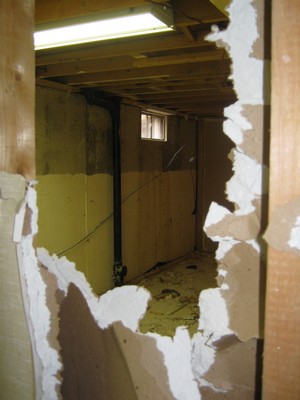
I’d be proud to know one tenth of what the guys who are doing our basement reno know.
Drywall, for instance.
I’ve learned that the old stuff is noisy coming down and the new stuff is equally noisy, but in a different way, going up.
Then there’s mudding—which means applying drywall compound to cover all the little imperfections and studs and nail holes and edges and general blips and wows (‘wow’ being the technical term for blip, I’ve been told). Once the mud dries, the walls are sanded to a smooth finish that’s ready for paint.
Sounds better than it is.
When they’re applying the wet compound (mud) the air becomes damp and sauna-like. When they sand, it gets so hazy with drywall dust they have to run fans and a suction machine that pulls it out the window. In other words, they’re never working in what might be considered a pleasant environment. They don’t even get the stress-relieving therapy of tearing down walls or hammering in new ones.
It strikes me as the biggest and ugliest job I’ve seen so far. Two guys have been at it for three days and at the end of each day they emerge covered in either plaster or white dust, literally from head to foot—the only thing semi-clean is the area around their eyes and nose from wearing a serious mask.
They do this every day. It’s all they do. They are mudders.
The amazing part is they don’t seem to go insane. In fact, they seem like very nice people, which is a far cry from what I’d be called after an eight hour day in somebody’s basement either feeling clammy or breathing dust.
Maybe they drink heavily when they get home.
Or maybe it’s like anything else, that once you understand the intricacies of the work, it becomes craft, and craftsmenn enjoy their work, take pride in what they do, and done from that vantage point, with that attitude, anything can become absorbing, no matter how mind-numbing or physically taxing or just downright horrible it appears from the outside.
In other words, I doubt the mudders would want to trade me for eight hour days of comma rearrangement.
Who knows for what reason people end up doing the various jobs they do. It’s not always for love of the work, that’s certain, but maybe the key isn’t so much what we choose to do, but with what kind of energy we choose to do it.
Today when I delivered the mudders a plate of homemade brownies to go with their coffee, they were grateful.
Me too.