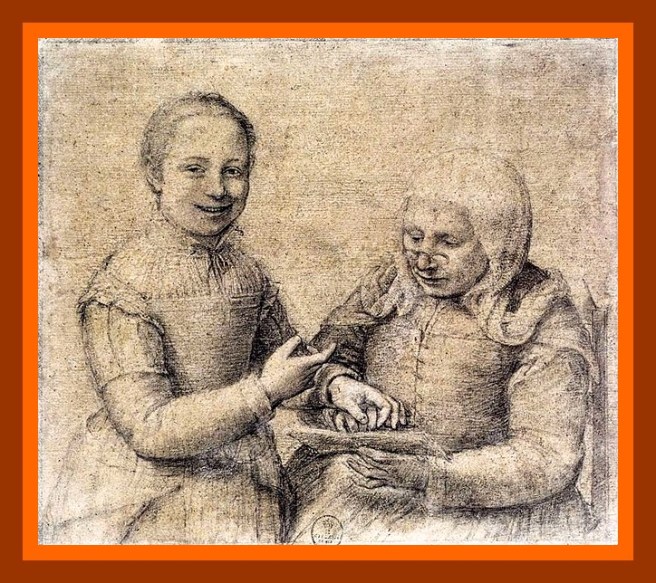
summer postcards: autobiography of an elderly lady, aka, ever thus?

Some many years ago I bought a funky old book with a tattered cloth cover called ‘Autobiography of an Elderly Woman’ because a) I like memoirs, and b) I like elderly women. They seem wise. And I suppose I am one now. So, yeah, they’re so damn wise.

Inside the front cover in pencil is written the name Olive Robertson, to whom the book once belonged, I’m assuming. Also in pencil, the price I paid: $4.75. It’s a first edition, published in 1911, with tons of marginalia throughout (presumably thanks to Olive) and likely one reason for the bargain price. Honestly, I would pay MORE for marginalia. I do love a book with notes for me to read and try to figure out the who of who has read it before me and on what scenes and sentences we both land in the same way and where are we different.

Two things surprised me about this cloth-bound, gold-embossed, rather beaten up book:

The title would have you believe it’s an autobiography. Turns out it’s a novel. Though, I daresay the (transparent) kind of fiction that isn’t really. Which is always slightly annoying, when you can tell it’s not quite fiction, but neither is it ‘true’. It’s a fine line.

Also, nowhere in the book does the author’s name appear. Olive, apparently, was perturbed by this and made reference to it as well. I’m guessing that dear Olive read it before it was possible to search such things on the internets (something about the quality of her name in pencil suggests this). But in these modern times, a quick visit to Wikipedia tells me the author is one Mary Heaton Vorse.

Mary Heaton Vorse (October 11, 1874 – June 14, 1966) was an American journalist and novelist with commitments to the labor and feminist movements. She established her reputation as a journalist reporting the labor protests of a largely female and immigrant workforce in the east-coast textile industry. Her later fiction drew on this material profiling the social and domestic struggles of working women. Unwilling to be a disinterested observer, she participated in labor and civil protests. After returning as correspondent from Bolshevik Russia, she was for a period the subject of regular U.S. Justice Department surveillance.

A most notable aspect of the book is how the author describes experiences of women and girls in (1900 era) society as being gobsmackingly similar to today’s experiences. GOBSMACKINGLY SIMILAR> Not the least of which in terms of how women of various ages see each other, and how judgment has been ever present.

“These young women know so definitely what an older woman may and may not say and do and wear!

Each generation permits a different type of young girl, but the older woman must not change.

Which makes this elderly woman (i.e. me) (and maybe Olive too) smile… partly because I so clearly remember being on the dewy-eyed side of the fence of knowing everything yet none too bright about bigger pictures, and certainly nothing about elderly women. But this is the smile-making brilliance of THIS side of the fence… knowing the fence is irrelevant. And a disservice to women on any side and therefore ourselves at every and all ages.

Society will only change its view of women and girls in time with women and girls changing their view of themselves, and each other.

summer postcard: i remember flamingos

Cleaning out old journals, I come across an entry made during lunch with one of my nieces on a summer patio where we gave each other words to write about and then read our responses to each other over iced tea and fries.

I wrote about yellow and light and a few other things but I don’t know what words I gave her. I wonder if she still has her journal too.

Another thing we did was play off the Joe Brainard riff of “I Remember” where you write fast, never pausing, listing and listing all the things you remember in one or two minutes.

Here is my list from that long ago iced tea and fries patio…

I remember a cat named Inky.

I remember potato salad in a tree and pop bottles in ditches.

I remember black licorice and how I thought I liked it better than red but didn’t really.

I remember flamingoes.

I remember feeling sad for elephants at the zoo, and polar bears too.

I remember making radish soup which was really just radishes boiled in water and how my mum and dad pretended it was edible.

I remember carving pumpkins.

I remember making snow forts.

I remember shovelling the driveway.

I remember the cottage we used to go to and how I was pretty sure one of the rooms was haunted but how it didn’t really matter.

I remember the National Gallery in Ottawa and excellent lunches in the cafeteria.

I, of course, don’t remember writing any of this —

— but I do remember every one of the remembers.

summer postcards: field feathers

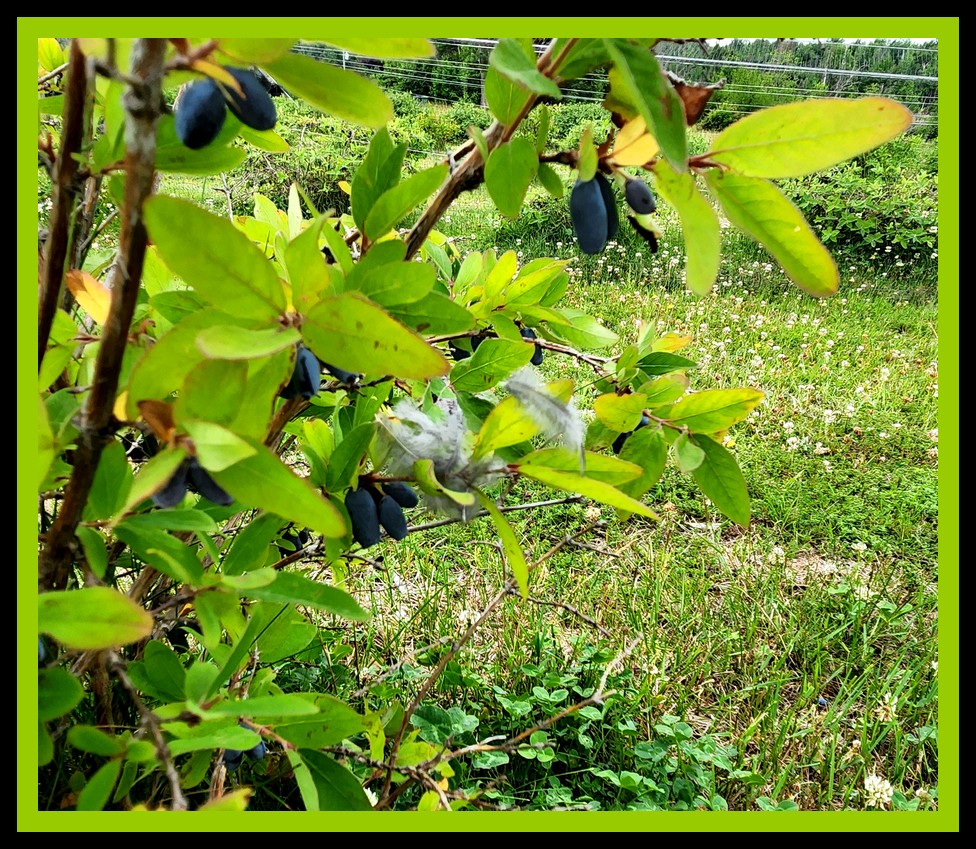
We’re getting close to finishing our harvest of haskaps, the first of the berries to ripen in our berry fields. Today, overcast, and thunder rumbles in the distance and eventually rain falls, through which we continue to pick until we’re done, always leaving a few berries for the birds.

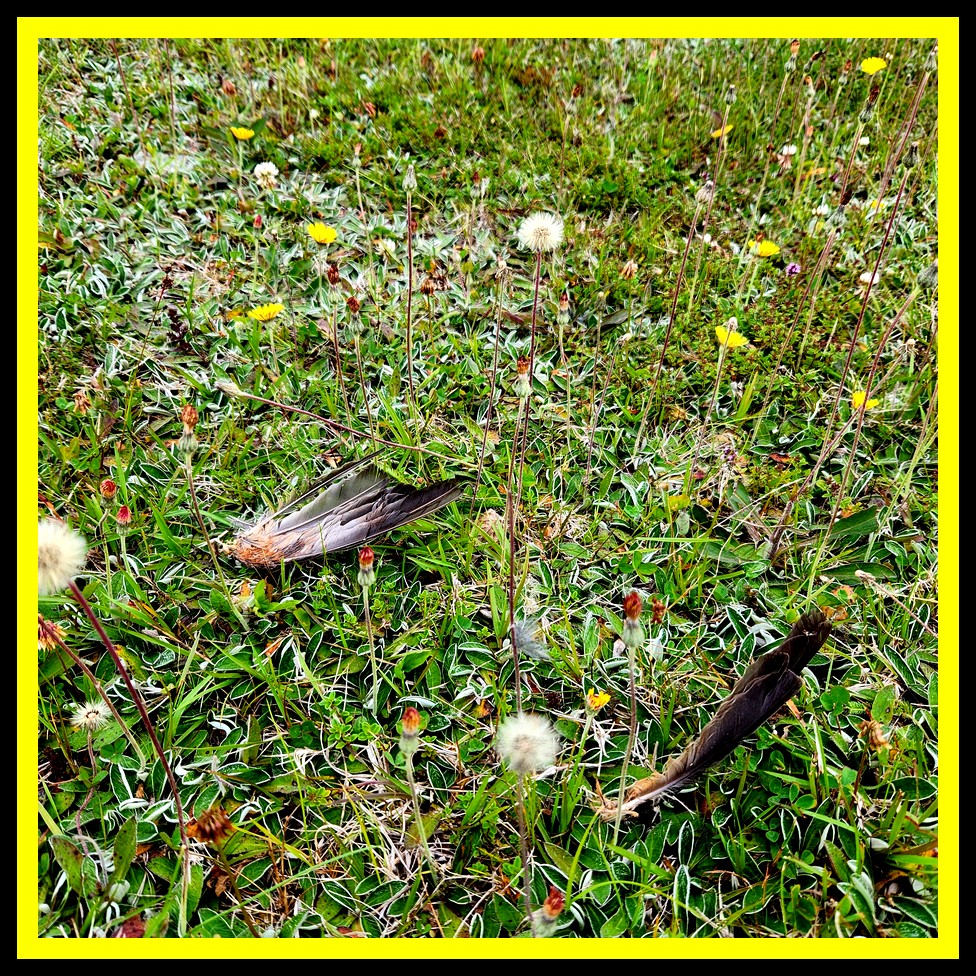
This morning, feathers and pieces of bone and wing around some of the bushes tell a story that probably involves the foxes who were born under the barn in early spring, a couple of them still sleep there and hunt in our meadows and forest. We have become very fond of them, each having a name and as time goes on, we’re able to notice a difference in their behaviours, one from the other. But I’m fond of the crows too, who also have names and behaviours, and it was the crows who were angry yesterday, grack grack gracking madly for ages. I knew something was up and I suspected it had to do with the foxes. When they were just kits, I worried about their safety, worried every time mum went hunting, would she come back with enough for them to eat. I once watched her arrive with a baby raccoon in her mouth, which the kits devoured. A dead baby to feed babies, yet I was glad they had nourishment. My callousness surprised and appalled me. But then, I didn’t know the raccoon family, hadn’t watched them grow up, and I saw the offering only as food for young, not violence.

Looking at today’s feathers, I’m confronted again with the fact of killing as a daily necessity, how very normal it is, and after taking a moment to recognize the lives of both the foxes and the crows and the place they hold in this world I’m privileged to share, I think how so little of this is taught to us as children, how so much is sanitized, Disneyfied, and I find myself grateful to have been raised on Grimms rather than Disney. Some residual memory of those pull-no-punches stories surely helps put into perspective the impossible heartbreak of this very real world—

— in all its wisdom and beauty, and sadness. 

summer postcards: man oh mango

Have not eaten an Alphonso mango (the ONLY mango for me) since moving to an island where such exotic things aren’t always easy to find. That said, I haven’t yet looked because, truthfully, I didn’t think of them until the other day when I stumbled upon a poem written I can’t remember when (although I’m assuming it was when I lived on a different island, where mangos literally grew on trees).

Unripe mango cut from tree,

“Take she,” man says, handing

me fruit. “It go ripe,” he says as I

receive the weight of it and his face

beaded with sweat like jewels, eyes

I’ll never see again except every time

I bite deeply into cool mango flesh,

& feel those smooth orange slices

slide down my throat.

The poem is a lie. I have never once recalled his face, much less with every mango since, and I’m now thinking this might be down to my discovery of the Alphonso, whose smooth SAFFRON slices magnificently obliterated all memory of mere smooth orange ones… even those cut directly from trees.

Alphonso season is late March to end of June.

Eat ’em if you’ve got ’em!

summer postcards: not just a rug

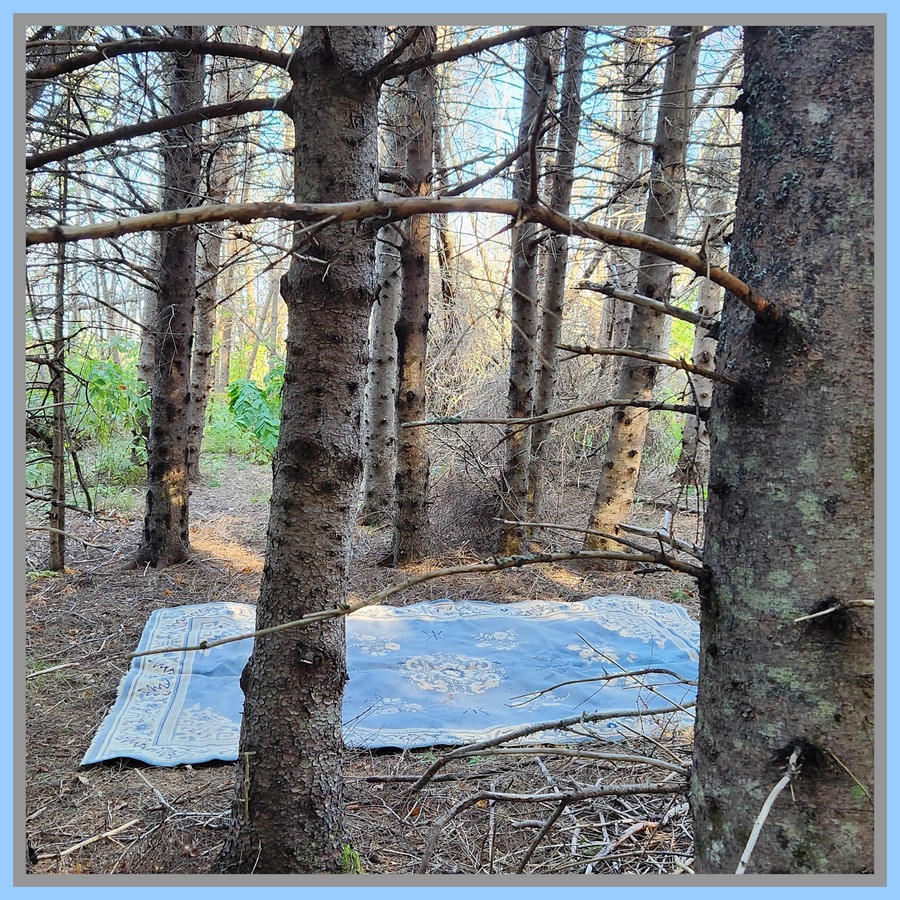
Once upon a time in a once upon a time house, a carpet lived for almost thirty years, playing silent host to the footsteps of friends and family, to six cats, countless hairballs (and worse), where I would sit each morning, on a particular part of its pattern, facing east as the sun rose, until one day we moved toward that rising sun, bringing the carpet with us, to a house where it didn’t fit and to a forest where it did.

summer postcards: company

I am doing yoga on the beach with a visiting two and half year old who is in charge of the doings and I am learning lots of new-to-me poses while enjoying tacos and mushroom soup made of sand and the other day we discovered our shadows and that made one of us laugh a thousand times and made the other one smile in gratitude for such excellent company.

and sow it begins

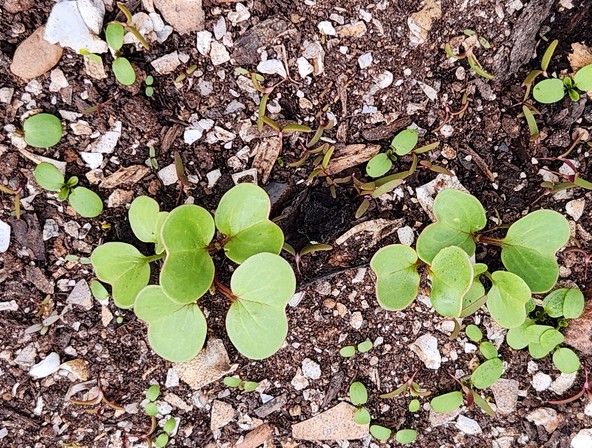
I sow radishes because of how they are with butter on slices of bread I make with almond flour and because of that night a half dozen decades ago when in a rainy cabin there was nothing to eat but radishes, butter, a rye loaf my mother made, and I ate and ate and ate and because it instantly became, and remains all these decades later, one of my most precious culinary experiences.

rosehips

Every year my mother went to the beach to pick the hips of wild roses. Only a short drive from our house, the beach was somewhere we spent a lot of time as a family, swimming, picnic suppers, walking in the rain, collecting stones for a new rockery. The rosehip outings, though, were just the two of us, and always later in the year, in the fall when the hips were ‘ripe’. Not that I helped with the picking, I just liked any excuse to be at the beach. I picked shells and danced barefoot on cool sand while she, some distance away, stood, back slightly bent, leaning over thorny bushes that formed a long line parallel to the shore, filling her apron, or maybe a bag or a pillowcase, holding it open to receive each fat red hip. She would dry them for tea, mixing them with handpicked calendula, chamomile and linden, to make her own special blend kept in tins to enjoy all winter.

I remember how the hips turned the water pink. Magic.

It wouldn’t have occurred to her to buy tea, even if such blends were available then. ‘Making her own’ was a way of being… a farm girl from the Austrian alps, where there were no shops nearby and where everything was homegrown and homemade and medicine came from the garden, the fields, or the forest. Teas were medicine. Even after moving to a medium sized city in Canada with shops at every corner, her way remained homegrown and homemade, our medicine cabinet was the garden.

Someone mentioned roses the other day.

It doesn’t take much.

Another kind of magic.

I think of her whenever I see wild roses anywhere but it’s only those that grow on beaches that come with a memory made in a millisecond a thousand years ago when a child looked up from her barefoot dance and in the distance saw a woman she knew so well but would never truly know, holding open an apron, or was it a bag or possibly a pillowcase…

some saturdays ago

There used to be a little book shop in Toronto, near the corner of Yonge and Eglinton. This was back in the early 80’s. I lived near enough to ride my bike over on a Saturday morning. The shop was above a bakery and I may or may not be imagining that you were allowed to take your goodies upstairs and sit on one of the couches or at little tables (my imagination also recalls a fireplace) and browse the bookshelves. I’d buy the Saturday Star there and a few croissants, which I’d bring home in the basket of my bike. Home being a postage sized single room in the attic of a big old house on a tree-lined street of big old houses. It wasn’t ritzy then. Many of those houses had been divided into apartments and rooms. I lived with my best pal, a black cat named Joshua, who’d spend the day outside and when I came home from work he’d be there to greet me and we’d trot up three (four?) flights of stairs together and settle in for the night. My apartment (a room really) was teensy. Big enough only for a mattress on the floor and a dresser. No couch, no table, a beanbag instead of a chair. and a sewing machine for making most of my clothes while sitting on said beanbag. I had a small television, a shelf for plants and books. A stove, fridge and sink against one wall. It was enough. The bathroom was shared with the teensy apartment next door, where T, who worked for the CBC, lived alone surrounded by giant, unwieldy stacks of old newspapers he couldn’t bear to get rid of and (apparently) mice. (No mice problem at my place given four-legged roommate.) He made a mean kedgeree, T did, and almost always made extra for me and I swear I can still remember the smell and the promise of it as Josh and I walked up those stairs.

All this from a picture that crossed my path the other day. I don’t even know who the artist is, but thank you.

Also… feeling a strong yen for smoked fish and rice.

and this…

…. when checking on my scarves, which are daily feeling like metaphors blowing in the wind, I find a nest I assume is a hummingbird’s so I ask an island expert on such things and she tells me that, no, not a hummingbird but a vireo made this beauty, which delights me because I’ve heard what I dared to fancy were vireos chorusing in this particular neck of the woods and now I wonder if this little place will be returned to like a swallow’s box because the very truth of it having withstood the heavy snow, pelting ice, and winds of winter is astonishing and if the vireo owners are maybe thinking of subletting, I’d like to suggest that ‘durable’ would not be an overstatement in any ad.

The picture distorts size. Imagine the cupped hand of a small child. Also, know that it’s hanging in mid-air, fixed to thin branches by spit, grasses, and hope.

A hummingbird, I’m told, makes a nest the size of thimble.

my scarves