this is not a review: ‘a serious widow’, by constance beresford-howe

Like many people, I fell in love with Beresford-Howe’s work after reading her gorgeous The Book of Eve. She writes so well about the experience of womanhood, of middle age and beyond, freedom often being a theme. Like ‘Eve’ (a senior citizen who reinvents herself)… the title character of A Serious Widow  (Rowena) finds herself suddenly ‘free’ of a loveless marriage. Unlike Eve, however, Rowena is more bitter than celebratory and that seems to make at least some of the difference.519ty8GB2NL._SY346_

Turns out that Rowena’s husband has for decades been leading a double life and has a whole other very normal family in Ottawa, where he spent one week a month ‘on business’. Rowena discovers this only after his death. The other family is equally clueless about the duplicity but, unlike Rowena, the other wife was The First Wife, making that family more legit. At least as far as the estate goes.

To further complicate matters, no will can be found.

The premise of the book is pretty much to find the will and in the process Rowena finds her sense of self. As with Eve, she takes up with a few unlikely-but-nice, usually older, frumpy chaps but who surprise her sometimes in Fabio-like ways.

I thoroughly enjoy Beresford-Howe’s writing and her style and respect her feminist leanings at a time when such leaning may not have been entirely popular (I read somewhere that she was a tiny innocuous-appearing firecracker of a thing who quietly, yet fiercely, stood for what she believed in— including Canadian spelling when publishers tried to convince her to go U.S.). While I’d recommend the book, I’d add that I’d have liked it better as a novella. Not everything needs to be a full length novel. (And do not get me started on foie gras books, i.e. those stuffed mercilessly with fatty content…)

However…

Despite my opinion on the unnecessary word count, there is indeed much loveliness in the book. Relationships mostly between older people, and parents and grown children. It would appeal to anyone who liked Hotel du Lac, for example, by Anita Brookner or, more recently, And The Birds Rained Down, by Jocelyne Saucier, where themes of change, aging, loss are not seen as a negative but merely part of life to be lived with as much pleasure as the bits that preceded it. And often more.

This from a scene where one of Rowena’s lovers tells her what it was like entering his mother’s room after her death.

“She looked exactly as she did when I left her just a few hours before, as if she were asleep. But it was different, because she wasn’t there anymore, Rowena. She’d gone—somewhere. For good. No mistake about that. Nothing could possibly be more empty than that room”

And later, in the same scene, this from Rowena’s pov after her bereaved lover has finally found sleep:

“With care I draw off his glasses and tuck the afghan around him. Outside like another voice the November wind shakes the windowpane. Wiping my own eyes, I turn out all the lights and leave him sleeping there. Sooner or later, one way or another, I think, we’re all orphans. It should make us kinder to each other than it does.”

I’ve been reading and re-reading Beresford-Howe for years and was sad when she died in 2016 at age 93. I’d always meant to write her a note to thank her for her work. (I wonder now, what was my plan? To wait until she was 94?) Ah well, this post will have to do instead.

summer postcards: what stays

swings - Copy

When asked about books that have stayed with me forever, what comes to mind immediately is a childhood collection of stories (can’t recall the title but something totally obscure; I remember those obscure stories still, the one about the farmer who sent his son to deliver three perfect cherries on a velvet pillow to the king but the son ate two of them en route and when the king read the accompanying note from the farmer saying here’s three perfect cherries for you, he asked the boy what happened to the other two and the lad said he ate them — I remember loving this kid’s honesty, how he had no sense of being afraid of the king — and the king said you ate them!!! how could you have done that?? and without missing a beat the boy picked the last one off the velvet pillow, popped it into his mouth and said, in all innocence, like this! I mean, how does a story like that NOT stay with you forever?). Also Nancy Drew mysteries, which I remember devouring but not as voraciously as a girl in my class who used to boast about how quickly she read them and for a wee moment in time I was jealous, thinking how grand to be able to read a thousand books a week but fast reading has never been my thing and over the decades I’ve come to accept and embrace a sloooow read. Girl of the Limberlost (I coveted her forest life and the contents of her lunch pail); Fires of Spring, by James Michener (it felt so grown up), I was thirteen and it was summer and I’d been biking through the orchards of Niagara near my home; I read it in the shade of a giant maple or similar while eating stolen peaches; The Velveteen Rabbit (only discovered as an adult and with possibly the best life lesson ever); The Little Prince (ditto about discovery); The Stone Angel; Roughing it in the Bush; Hotel du Lac; Animal Farm, The Road Past Altamont, the best book about home (regardless of where home is) I’ve ever read, The Book of Eve (a different view of home), Drinking the Rain (home as self)…

But this is meant to be a postcard, and a quick top of mind answer to the question.

What has ACTUALLY stayed with me is probably… everything. And that would take at least a letter.

summer postcards: lingering skies

Dear Moody Mornings that conspire to keep skies grey long enough to insist I linger in bed fluffed with pillows and layered with pages instead of leaping up to embrace a sunrise or walk in your morning magnificence and while I am grateful for the joy of leaping I remind myself to bow down too to the yang of your yin and accept the colour of your sky as the kindness it is. A bucket of thanks is what I’m trying to send you.

img_20210929_1659357 (2) - Copy

summer postcards: red


DSC01747_1

Red is the colour of berries I can’t eat and of cherries I can. Of apple skin and lipstick I don’t wear. The colour of certain leaves in Fall and sometimes of boats and toys and rubber boots. Red is the colour of a tee shirt I wear to bed and a girl’s fairy tale cape. It’s the name of people with red hair and a homonym for read. A sound relative of rid and rad and rudder. Red is the colour of hot peppers and robin breast, of cardinal feather and crayons and less commonly chalk. It’s the colour of roses and drama and paint (a woman once told me she painted her garage door bright red after her husband died, she doesn’t know why) and nail polish and rouge. Is rouge still a thing by some other name and why do women (not men) rouge their cheeks, paint their faces like a garage, is it because they’re so disillusioned and pale from the weight of injustice, of patriarchal society, of the news of the world, their own world, that they have to fake a happy glow?

But back to boats — I’m glad mine is turquoise.


summer postcards: road trips

bertha

Bertha Benz, was the first person to make a long distance road trip (106 km in an ‘experimental’ Benz ‘motorwagon’, maximum speed, 16 km/hour). She made the trip with her two sons “and without the permission of her husband Karl,” inventor of the world’s first car. Her reason, she said afterwards, was that she wanted to visit her mother but the truth of course was that she wanted to show Karl, and the world, that road trips can be jolly good fun.

May I just add that the the only thing missing from the account of Bertha’s historic outing is what she ate en route because the best part of any road trip is surely the stopping to eat. This is certainly true from memories of my own radishes-and-homemade-rye-bread-koolaid-in-one-thermos-coffee-for-my-parents-in-another-climb-the-granite-boulders-for-a-nice-picturesque-spot-to-eat-overlooking-highway-11-on-the-way-to-Muskoka roadside picnics when such stops were possible… to the can’t-go-anywhere-so-eat-cheese-sandwiches-in-a-cemetery version of more recent times, and a thousand in between and because I honestly can hardly remember a meal in any resto that I’ve loved more than some of those impromptu noshes.

I’m suddenly feeling compelled to write a more complete version of Bertha’s story, one that includes a hamper.

summer postcards: the joy of wallflowers

wall1

I am the happy wallflower who stands by the cheese table trying not to make eye contact and when someone bounds over all breathless gaiety (about???? I never know) and absolutely no interest in cheese (because I would LOVE to talk about cheese), asking some ridiculously inane question such as how are you? while looking past me to see if they’re already missing something on the other side of the room I pretend they’ve asked me something interesting, something about cheese perhaps, and answer that instead and they soon go away.

p.s. I realize the picture looks like a floor but it’s actually a wall and I regret not taking a wider shot to make that obvious so this postcard could have been sent without a p.s.


summer postcards: sometimes, on a friday night, when you are very young, you learn a thing that lasts forever, only at the time you have no idea that’s what’s happening

moonshellA million years ago when I first left home and moved to Toronto I met a woman, a potter. She had her own studio. I wasn’t yet twenty and she might have been twenty-four, twenty-six, something ancient…. I remember she was ancient.
A group of us were having dinner somewhere and at some point that seemed still early to me, the potter announced she had work in the morning so she would be heading out. But we were having such fun, and it was Friday, why would she want to leave? And what did she mean: work in the morning?  Tomorrow was Saturday and she worked for herself, no one was telling her what to do. I said as much, hoping it would convince her to stay but she explained (in the way of ancient people) that that was just the point, that if she didn’t impose discipline on herself there was no one out there who would. And then she’d get nothing done.

She wasn’t defensive or condescending about it and she didn’t say it from any kind of *aren’t-I-clever* place. It was simply the way it was.

I never saw this person again and have no memory of what she looked like, but I’ve never forgotten what she said and it wasn’t until decades later when I began working from home that her words, still rattling around my head, suddenly rang crystal clear.

“When I think about what sort of person I would most like to have on a retainer, I think it would be a boss. A boss who could tell me what to do, because that makes everything easy when you’re working.” — Andy Warhol


summer postcards: I saw these questions somewhere and answered them because I love everything about the Where and the How of the places each of us live and could talk about it almost endlessly (but not to worry… I’ve kept this short)

curtains - Copy

One thing you love about your house.

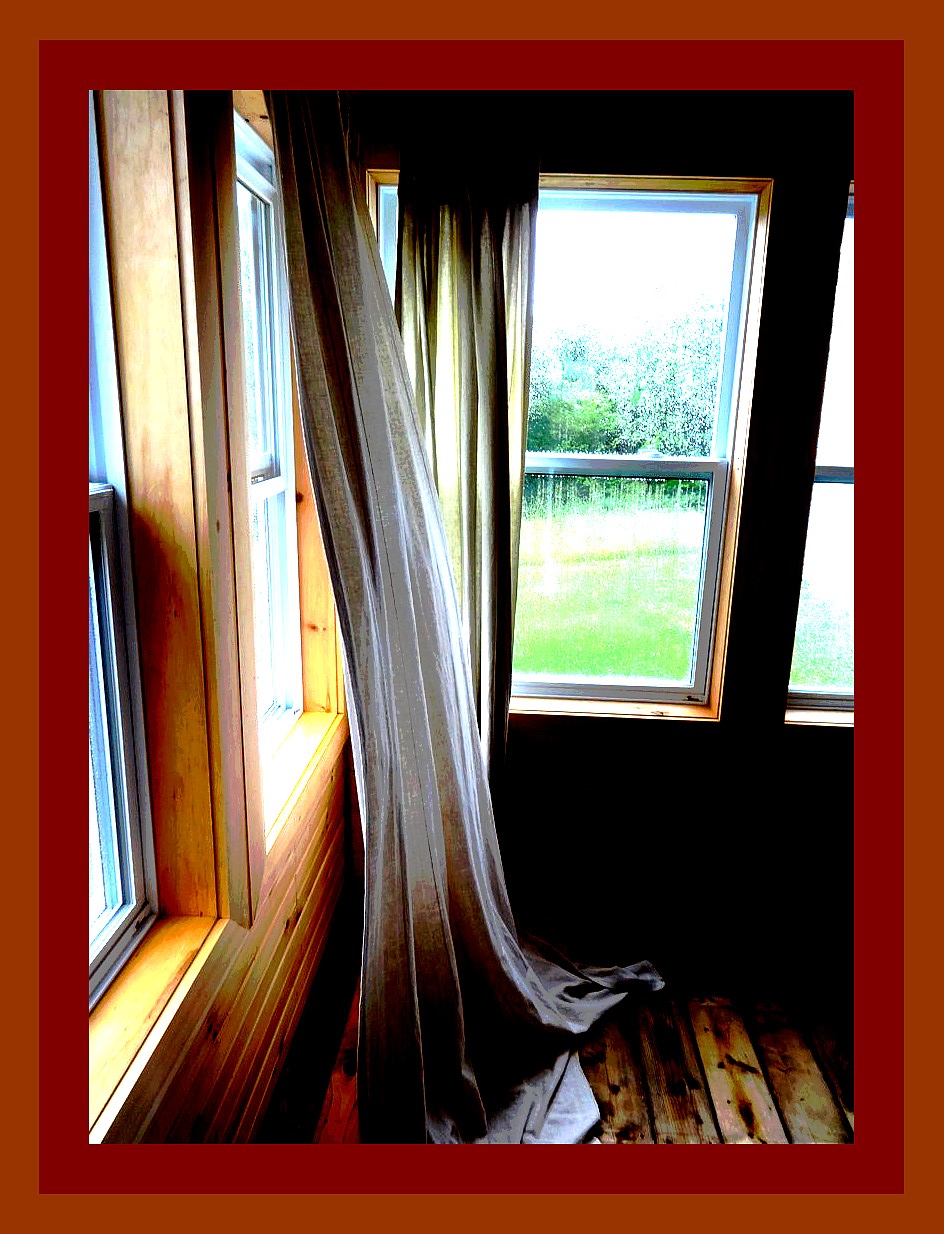
The curtains billow in a breeze.

One thing you’d like to change about it (that is changeable).

If my bathroom was bright green and white or turquoise and white (or possibly bright yellow and white) tiles I wouldn’t complain.

And one thing you’d like to change about it (that is not changeable).

A place to put up an indoor winter clothesline (but that would require a proper basement and one of the things I love is the rather improper basement).

Where does the sun rise and set?

Rises behind the forest across the road where I’m told there used to be a mill — the millpond is just around the corner and has a bench for sitting and trout for fishing. I can see the sun rise from my bedroom and the light also floods the living room and greets me in a most delightful way when I go downstairs. It rises above 200 berry bushes and a meadow of wild thyme.

What does your kitchen most often smell like?

Currently possibly cat food as our cat recently had dental work and there are sometimes six bowls of different flavours and textures (pate, gravy, gravy and chunks) spread out for her to nibble on as she fancies. This is the equivalent of giving ice cream after tonsils.

Where to do you like to sit (or be) when it rains?

In the cottage, attached to the kitchen. The cottage is where the curtains billow.

Do you have a small sanctuary of your own, a chair, a window, a room?

Many. Each serving a different purpose.

How do you know you’re home?

I read something once that said the trick is to find a place where you fit. That’s the whole enchilada right there. When you fit, everything feels right and looks beautiful. And the thought of bathroom tiles is insignificant to the pleasure of being able to breathe. When you fit, so does everything else.


this is not a review: (summer edition, wherein even blue skies and gentle breezes demand quality reading or crankiness quickly sets in)


Under no circumstances will I name this book so don’t bother sending bribes in the form of fresh baked anything or even exquisite cheese.

However, I will say this.

It was published in the last ten years. The author is a man. Or possibly a woman. Canadian. Lives east of Alberta. The book is a collection of stories. Some of which are pleasant enough reading. Too many are carbon copies of one another with teensy alterations of character or place or circumstance, which hardly disguises the sameness. Because we’ll never notice, right?

Yawn.

The women are ALL flakey.

Yawn.

Too many people are having affairs.

YawnYawnYawn.

Most of the couplings have big age gaps, which is always highlighted as if it means something to the story but it never does.

Characters DO things but no one knows why. (In every story I have to ask this question: who are these people? In every story I have no idea.)

I swear that if you changed the main character in (any) story midway with the main character in (any other) story I wouldn’t notice this sleight of hand.

Nor would I care.

Have I mentioned voice?

EXACTLY the same. Every time. And worse than ‘just same’, it’s quirky-same. Different stories, different characters, different ages. Yet everyone speaks as one, adding to the sense of interchangeability. (If this were a theme or important to the overall vibe of the collection that would be great, but it isn’t.) A common trait many characters have is that way of speaking where the sentence is left dangling, meant as emphasis but when over-used is just plumb annoying. So awful you can’t. So awful you almost.

(And no, this isn’t some clever intentional use of sameness to make a commentary of ANY kind.)

Are you kidding? Oh… if only!

All of which to say this is a writer whose work I have admired in the past, a writer who knows how to write exceedingly well and who has received much attention for their work, and (and this is the unfortunate bit) is lauded for all of it as if all of it is equally laudable.

And, yes, of course, publishers need to survive and writers such as this one are integral to the industry and fans are loyal and will buy much and forgive even more while waiting for The Next Great Thing…

…but.

What’s sad is that there are so many others writing really good stuff, being innovative, taking chances, saying things that matter, that go unread, even when published. Sadder still, that a writer of this caliber can (easily I suspect) publish a book that would be rejected coming from an unknown.

And rejected for good reason.

I know very little about the economics of publishing but am heartened to know there still exist houses who respect the work of creativity and literature itself, enough to take chances more often than merely selling out with main stream names and less than fine work. 

On that note… 

…rant over.

& my lips remain sealed.

cheese