



The clean ones anyway.
MORE WINDOW RELATED PIFFLE…
The clean ones anyway.
MORE WINDOW RELATED PIFFLE…
I didn’t spring from a literary family. Our shelves didn’t contain the classics or even the near classics—more like a strange collection of mistakes from The Book of the Month Club, discards from the library, or sometimes outright thefts books that somebody forgot to return. These were the days when withdrawals were noted in ink on slips of cardboard tucked into tiny pockets on the inside back cover. Easy for the odd book to fall through the cracks.
Our incomplete set of encyclopedia came from the various weekly promotions at Food City. Buy enough laundry detergent and you, too, could go home with The World Book of Knowledge [C through N], unmatched towels or flower-stamped dinner plates.
I remember a Reader’s Digest anthology, a fat wine-coloured Websters, an atlas with full-page colour pictures of gemstones, ocean life, constellations, that my dad and I would pore over at the kitchen table after dinner. After supper. We’d look at maps and I’d flip those huge pages, ask daft questions, revel in his answers, true or made up. We sometimes lingered for hours.
There were no kid books, no one read stories out loud. But I discovered the library early and dragged home stacks of things and don’t feel deprived in the slightest. The memory of choosing books, the way they smelled, the joy of surrounding myself with them in my room… I’m sure I missed out on something by not having them read to me, but fortunately I have no idea what that might be.
The only book I owned as a kid was a ‘Laidlaw Reader’ called Stories We Like. There were some Aesop fables and condensed Grimm’s among its contents, but mostly it was a collection of crazy little things about pillow eating geese, mud turtles, mornings on a farm, a talking brass kettle, what kittens dream about, a homesick monkey, flower fairies, and one delicious story about a boy sent to deliver three perfect cherries to the king but the cherries looked so good and it was so hot that he ate two of them en route and when the king read the accompanying note that mentioned three cherries, he said: Well, where the bloody hell are the rest? Or words to that effect. The boy, bless his heart, admitted he ate them, prompting the king to say: You ate them? How the hell did you do that? To which the boy replied, “Like this!” and popped the last one into his mouth.
God, I loved that story.
Still think of it every time I eat cherries.
I found the book the other day, among the many kid books I’ve collected as an adult. Lovely to open it again, immediately felt about eight. For the first time, I wondered about the authors—Louise Abney, Eleanor V. Sloan, Gerald Yoakam, M. Madilene Veverka, Margery Clark. Googling them only brought me to a lot of ‘Laidlaw Reader’ links that amounted to zip information. I suspect they were pseudonyms anyway. They have that ‘Ernest Hemingwaithe’ ring to them.
It’s beat up and written on inside and out, my name all over it, The Monkees etched into the cover, then I notice a stamp with the name of my elementary school. Uh oh. A bit late to take it back. Does anyone even read ‘Readers’ anymore? And who writes them? Are there still a team of Eleanor V. Sloans and Gerald Yoakams out there? It might actually be fun to show up at the Principal’s office, book in hand, apologize, admit to being a bit of a slow reader.
But, nah, I’m pretty sure it was a discard.
That’s my story anyway, and I’m sticking to it…

Anyone else feel like confessing questionably attained books of youth?
“There was a sense of school, I suppose. An ‘Island of Misfit Toys’ sort of thing. We were young, only a very few even in their thirties, and we had never felt we belonged anywhere else. We came from religious backgrounds, mostly Jewish and Catholic, but we were not religious. We were sports fanatics who had never been successful in participation. We were television addicts. Virtually every one of us drank, smoked, and used drugs. We lived in small, dark, under-furnished apartments. For the most part, we were unmarried. We had tempers and psychological problems. We did not like to share. We had prodigious memories for facts large and small, particularly small. Many had lived nomadic lives. We loved the Beatles, Monty Python, Saturday Night Live, David Letterman. Very few grew up in poverty. We were resolutely middle-class. We had a few close friends and talked a lot about people we hated. We were incredibly insecure, champions of low self-esteem. We didn’t just like attention, we lusted after it, chased it until we were breathless. We lived onstage. Off stage, we waited. We stayed up all night and slept in all day. Instead of laughing we would say, “That’s funny.” We had no idea where our next meal was coming from. We were only as good as our next show.”
~ from When the Red Light Goes On, Get Off: A Life in Comedy, by John Wing (Black Moss Press, 2008)
What is the good of your stars and trees, your sunrise and the wind, if they do not enter into our daily lives? —E.M. Forster





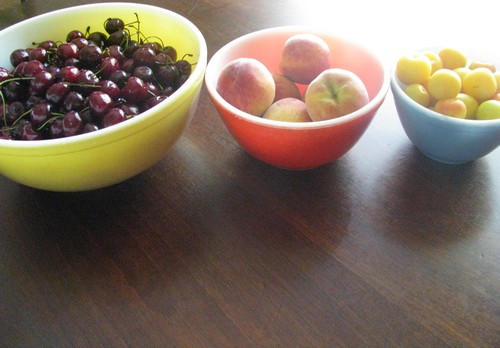
I’m
a Niagara girl
wherever I roam
and this kinda stuff
makes my house
smell like home.
Several years ago I was picking my mum up from the hairdresser and as I waited in the parking lot of a small plaza, a huge green pick-up truck pulled in beside me. The window was open and the guy driving was heavily bearded, ruddy-faced, plaid-shirted, the kind of guy you just know spends a lot of time outdoors; you could almost smell the pine boughs and bait—I guessed fisherman, hunter, lumberjack. Maybe all three. When he opened the door I expected a giant to emerge but what happened was he lowered a tiny step-stool attached to a rope, then turned and slid himself off the seat and onto the running board and, with a cane for balance, hopped down to the step stool and onto the pavement. Then he tossed the stool back into the truck, shut the door and made his way into the plaza.
He was maybe three feet something tall.
A few minutes later he was back, walking just ahead of my mum and her fresh perm. He reversed the stool routine and got into his truck as my mum sat down beside me.
Poor man, she said. It must be terrible to be handicapped.
Had I just glanced at him I might have agreed, but I’d had time to watch, time to think what it means to be handicapped, because this man certainly wasn’t. He was a short man functioning very well in a world designed for people who fall into certain categories, certain heights.
I wondered how well I’d do in a world designed for his height. A whole world where everything, everything, was way too low. My back aches just thinking of it.
The word handicapped just doesn’t seem right somehow, the way we use it, except to suggest that anyone could be handicapped in a situation not ideally suited; we, who thrive in this world, would be handicapped in a world not constructed for us—not by our limitations, but by the limitations imposed on us by awkward ‘constructions’.
It seems that in our narrow view of what’s ‘normal’ we’ve built a rather limited world, one for sighted, right-handed, hearing people of a certain size. I suppose it’s a ‘majority rules’ kind of thing, which really isn’t a good answer but if that’s the best we’ve got then you’d think at least we could get our perceptions straight and see things for what they are—that very normal people who happen to be blind or smaller than the ‘majority’ are seriously inconvenienced as a result of those ‘majority’ rules.
They are not handicapped.
If anything, our thinking is.
—
I’ve been meaning to write about this guy ever since I saw him. He came to mind again when, the other morning, I heard about Oscar Pistorius qualifying for the Summer Olympics.
“My disability is that I can’t use my legs. My handicap is your negative perception of that disability and thus of me.” – Rick Hansen, Man in Motion, 1987
Did I say green?
I meant she’s outside.
Which rather surprised me and it shouldn’t have. I’ve met her before, always outside—at the beach or the ravine or in the sunrise or sunset on Goose Hill (yes, it gets both, this magical place at the end of my street). She’s often on the streets and sidewalks that run through my neighbourhood and once I found her in a little patch of milkweed that’s easy to overlook.
But mostly she’s in the garden right outside the back door, among the weeds.
It’s with a hoe that I find her every time.
She speaks through fistfuls of creeping charlie and chickweed and pretty soon—no matter how daunting, no matter how much needs to be dealt with before it’s done and no matter that I won’t get it done today—just doing whatever I can, an hour’s worth, a half hour—makes an enormous difference to the whole thing, allows me to move around inside it a bit better, see it all that much more clearly.
Less chickweed, more clarity.
It never fails.
And she is never not there.
Yet, fool that I am, I forget… and wait for her at my desk.

Where do you find yours?
Because we know who we are…
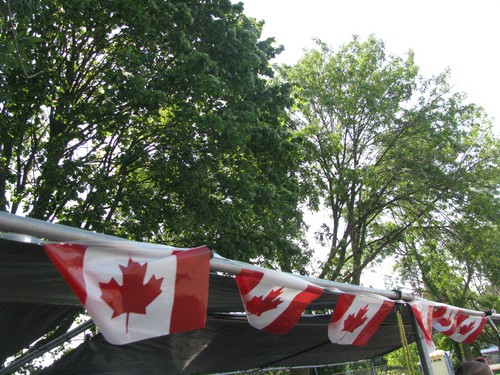
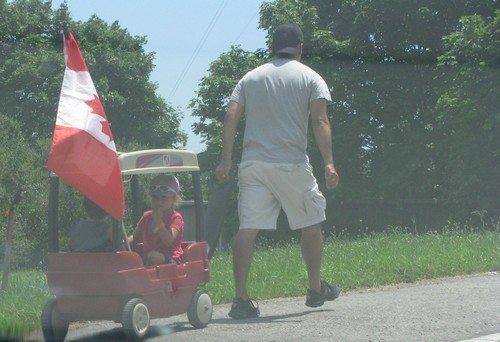

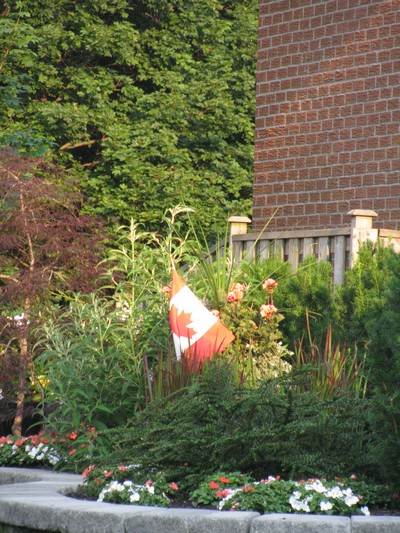

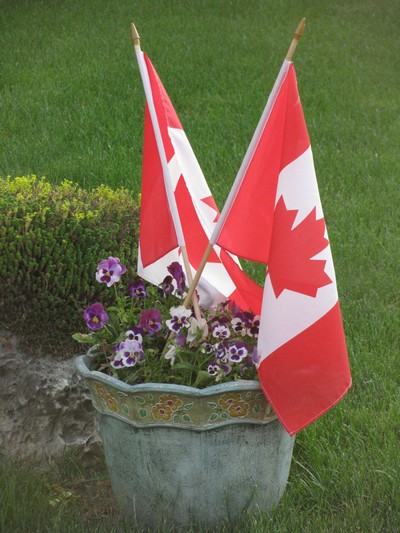

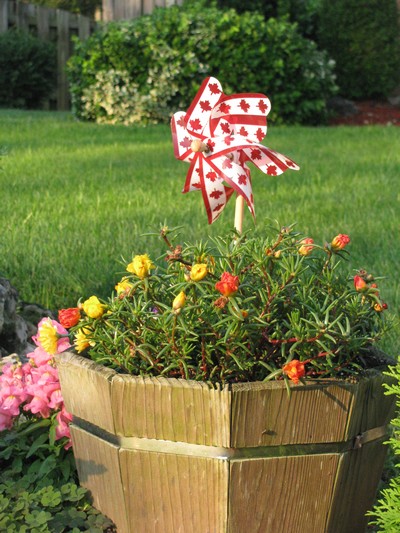

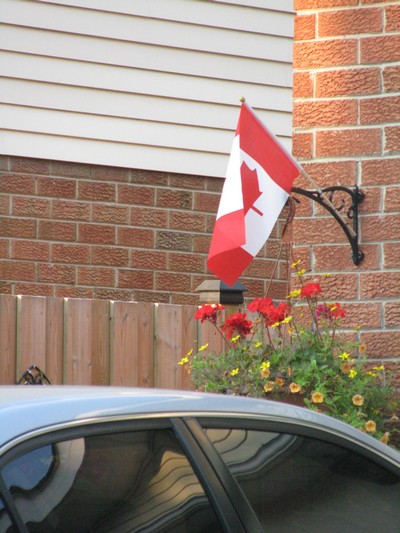

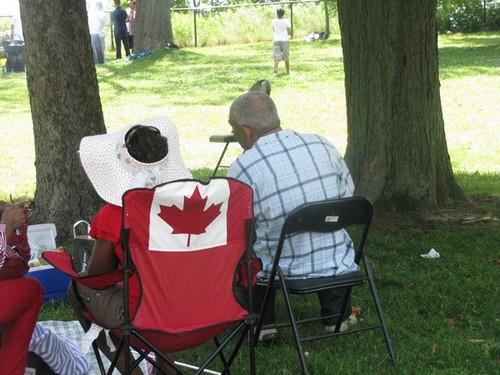




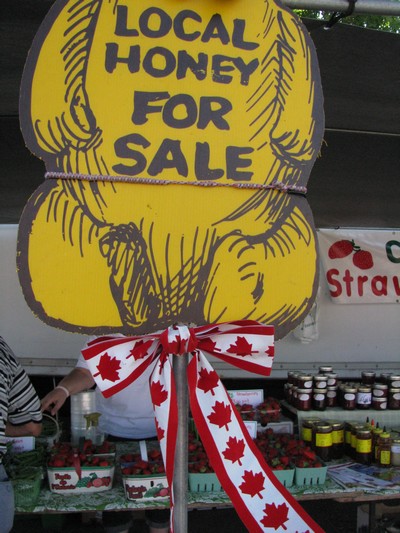
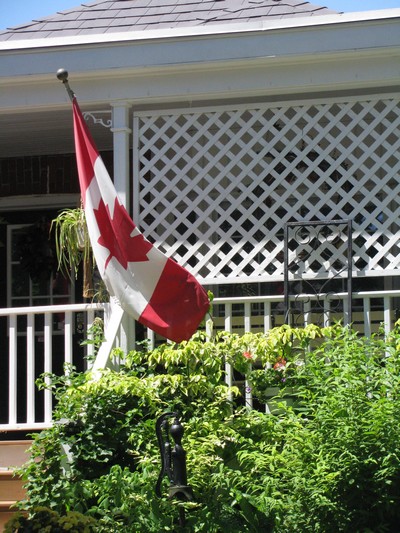
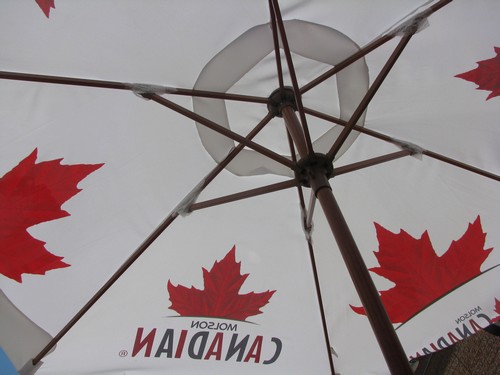 (Technically not a flag but it seemed wrong not to include it.)

Happy you-know-what day…








 Matilda Magtree