heart beats and a contrail

Ten thousand geese fly over my house at dusk, honking madly as I set out for a walk. And the moon (and is it Venus?) hangs over a fat white contrail in the not yet completely dark sky.

I consider the heart beats, the energy above me; do they notice things like juxtapositon of moon and man made cloud?

Christmas lights are on and cars pass, faces in my direction, possibly wondering why I’m standing in the street, writing on a scrap of paper in the now almost dark.

Because of the geese, I want to say.
And Venus, if that’s what it is.
Because of the moon and… everything.

I want to say look up!
I want to point.

But the contrail has been blown away and the last of the vees has passed by. The sky has turned black leaving only the sound of the wind and tires on the road. Just the moon and maybe Venus to see— and anyone can see them anytime. No need to point.

I put away my pen and carry on walking.

solitude en masse

 
At the beach where I go to walk among the gulls and mutter about darlings that won’t take a hint, where I write sometimes in my car or at a picnic table if the weather allows it, or simply breathe and gather pictures, I am rarely alone.

There are the gulls of course.

Now and then joggers.

And yesterday a woman in a headscarf eating a MacDonald’s burger in her car as she read something I couldn’t see.

Maybe because the day was sunny, or maybe because of the recent holidays and all that family and turkey and Auntie So-and-So’s Marshmallow’d sweet potatoes that render even the strongest among us a little queasy but is a tradition so must be taken with a mmmmm, that sure is good, Auntie So-and-So as you try to disguise the stuff under a pyramid of wing bones—maybe because of that, there is also a man in his car next to mine, eating a whole pizza from the box on the passenger seat.

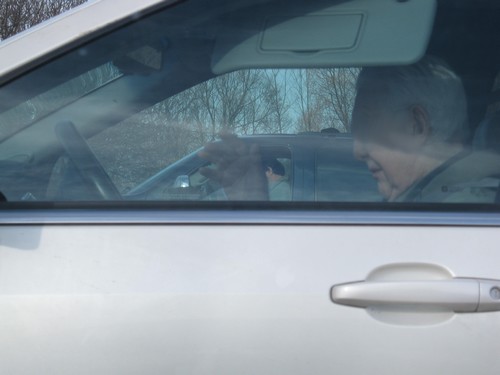
Another man, this one elderly, stares out the window of his medium sized silver sedan, one hand held in the air over his head. I consider dementia, an open-eyed cat nap with sleep paralysis, loneliness turned eccentric, but then, as he remains focused on the lake, his fingers begin to move ever so slightly, more and more until with a dramatic swoosh his whole hand is swaying back and forth, then stops—and his fingers again…fluttering, graceful. I realize he’s listening to music and I wonder if it’s on radio or CD or just in his head. I turn the ignition, flip the dial until I land on CBC 2. A symphony. I glance back at the man who is still conducting, eyes open, now closed—his movements, the pauses, the dips, the quick tilt of his hand as the violins come in, match what’s being played. It’s a long piece and gives me time to consider why he’s there. I decide it’s a solemn day, an anniversary—of what though, his wife’s birthday, their wedding, her death, the death of their first child perhaps (was that child a disappointment or a joy?); is this the date he was taken prisoner of war sixty something years ago or is it a year to the day that his wife announced she was leaving him for the guy that runs the Saturday night films at the Senior Centre?

Who knows, maybe he’s celebrating.

Later, a couple arrive in a small red truck. The man is driving. The woman’s head is down, facing her lap. When he turns off the ignition she looks up but her eyes are vacant, she could be anywhere. She stays in the truck while he gets out, lights a cigarette and walks toward a few gulls perched on a railing. He stands facing the water and I’m pretty sure I see his shoulders drop at least a few inches as he exhales.

diana athill, let’s have lunch…

 
Because lunch is what you want to do with someone who looks out at you from the cover in such a saucy Oh do I have a few stories up my sleeve sort of way. And in that necklace.

And when that lunch turns out to be just you and the book and maybe a salad at a corner table in a cafe, it’s really okay because Diana Athill’s Somewhere Towards the End reads like a chat, the tone is casual as she shares her philosophy of life (which includes a lovely riff on tree ferns). And while you munch on your croutons she goes easily from one thing to the other: memories of painter friends, writer friends, thoughts on loyalty, faith, death, genes — both good ones and not so good—  sex, London, night school, religion, gardening, driving, love, reading, writing and books — never focussing overly on opinions or even offering any of this from the perspective of age, but merely from the perspective of someone who’s paid attention.

At the end of your salad you close the book, look at that face, that DaVinci-style grin, and all you can hope is that you might grow up to be even one tenth as interesting and wear big jewellery with that kind of panache.

“There would be an agreeable sort of itchy feeling, a first sentence would appear from nowhere, and blip, out would come a story. One of them won the Observer’s  short story competition, an intoxicating thrill in that it showed I had been putting down words in the right way, but it didn’t  make any more stories come after a tenth had fizzled out after two pages. That was followed by a lull of almost a year. Then, looking for something in a rarely opened drawer, I happened on those two pages, and read them. Perhaps, I thought, something could be made of them after all, so the next day I put paper in my typewriter and this time it wasn’t blip, it was whoosh! — and Instead of a Letter, my first book, began. Those stories had been no more than hints of what was accumulating in the unconscious part of my mind, and the purpose of that accumulation, which I hadn’t known I needed, was healing.” ~ from Somewhere Towards the End, by Diana Athill