yo rocko

I was walking in the park the other day when a big yellow dog ran over, all gallumpy and jumping; a woman followed, shouting Rocko stop that!  I told her not to worry, that I was used to dogs, I didn’t mind enthusiasm. She looked relieved.

I said there’s so much concern these days about animals—squirrels eating the bird seed, raccoons checking the bins, cats weeing on the turnips—dear oh dear oh dear where will it all end??  

“Frankly,” I continued, “it’s people I find scariest; it’s us that have the most annoying habits overall. Don’t you think?”  

She backed away a little, smiled in a way that suggested no, she didn’t think. She looked around for the dog, then apropos of nothing, informed me that Rocko was a Labradoodle.

“A cross between a lab and a poodle,” she said, as if  this bit of info was so valuable I might want to tuck it away for safekeeping.

I returned the smile and said aren’t we all to some extent Labradoodles… some weird experiment just trying to do our gallumping best?

The woman seemed confused.

But I’m pretty sure Rocko got it.
if it’s not one thing…

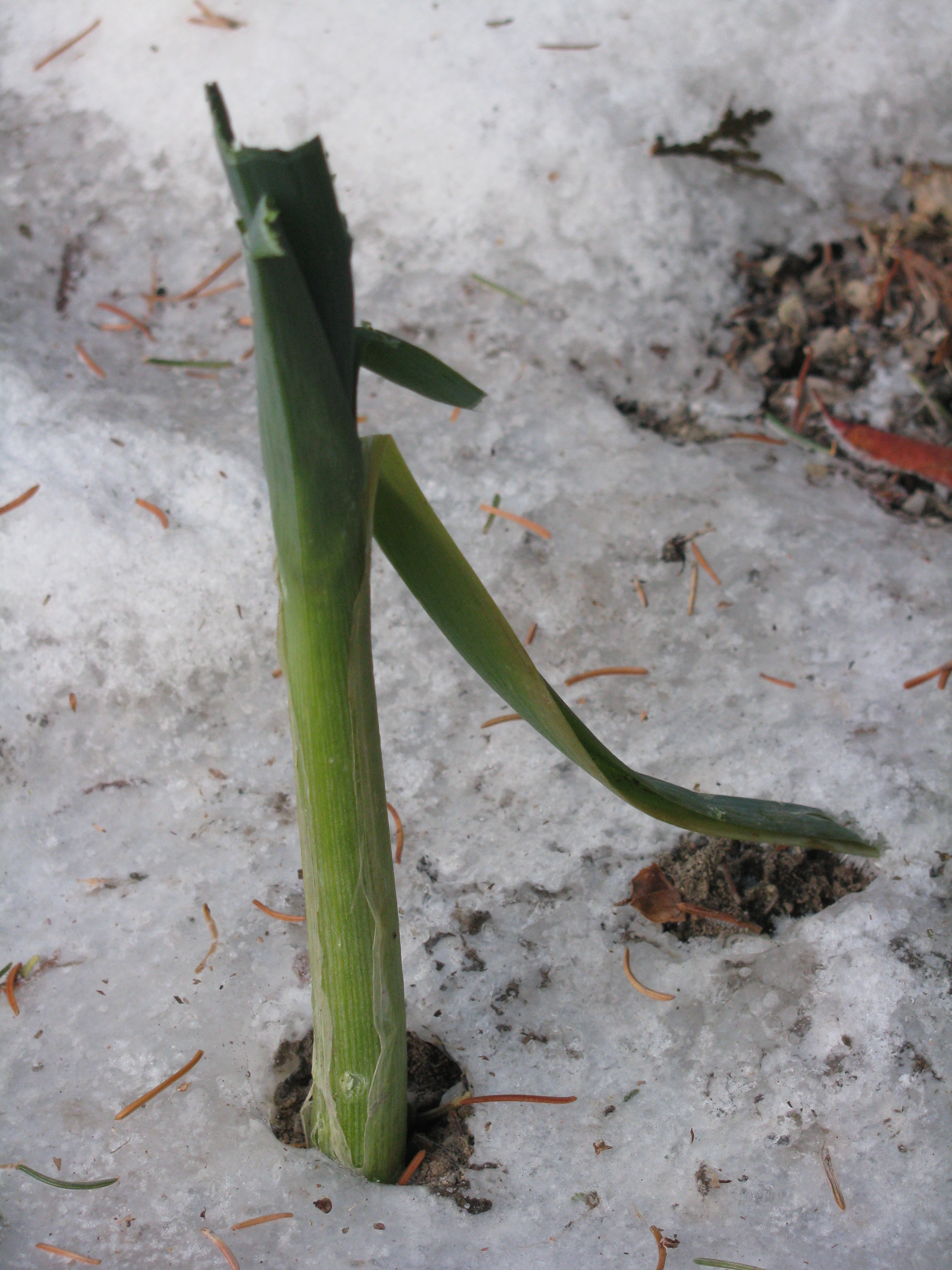
The good news is the leeks I didn’t dig up before the freeze have turned out to be just what our resident garden rabbit was looking for.

Strolling about the estate yesterday morning I was thrilled to find almost all of them ‘topped’. As soon as the ground warms up a bit (today??) I’ll dig out the roots and make soup as promised.

So there I was feeling all warm and happy about how nature has this brilliant way of not calling anything a mistake—

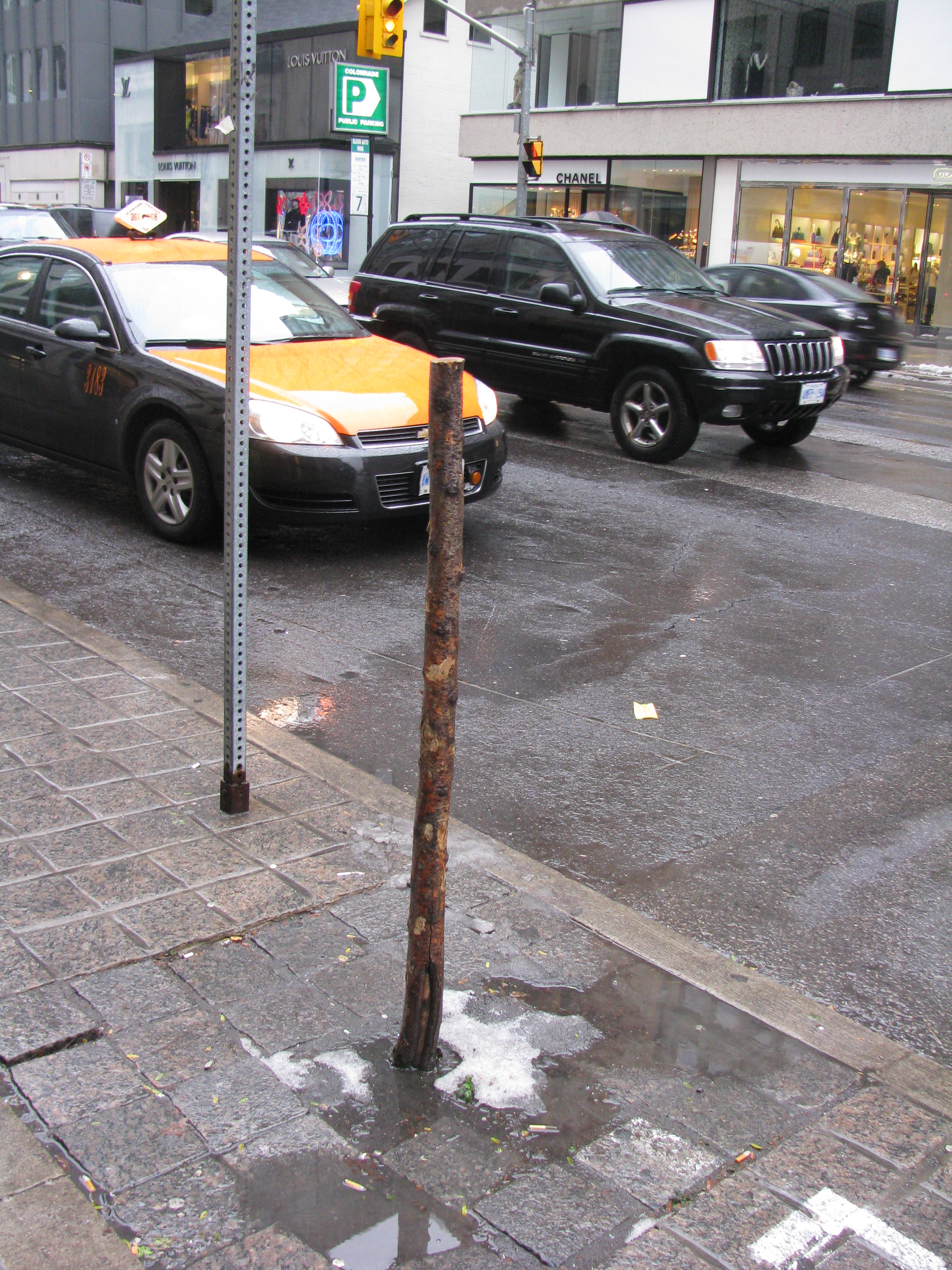
—and then I went into Toronto and found that ALL the trees, on both sides of  Bloor between (at least Avenue Road and Bay) were being cut down.

They were just young trees with trunks maybe four, five inches in diameter.

I asked one of the guys doing the cutting: Why? and was told that it’s not natural for trees to grow in an urban setting and they were going to die and it was cheaper to replace them than keep them healthy. 

Yeah, well, whoever made that brainwave decision will presumabley also die one day. I wonder if it’s occurred to him/her  that it may well be cheaper to replace him/her than keep him/her healthy…

But that’s not really the answer, is it?

Furthermore, I wondered: every tree between Avenue Road and Bay was in imminent danger of death?? 

Odd.

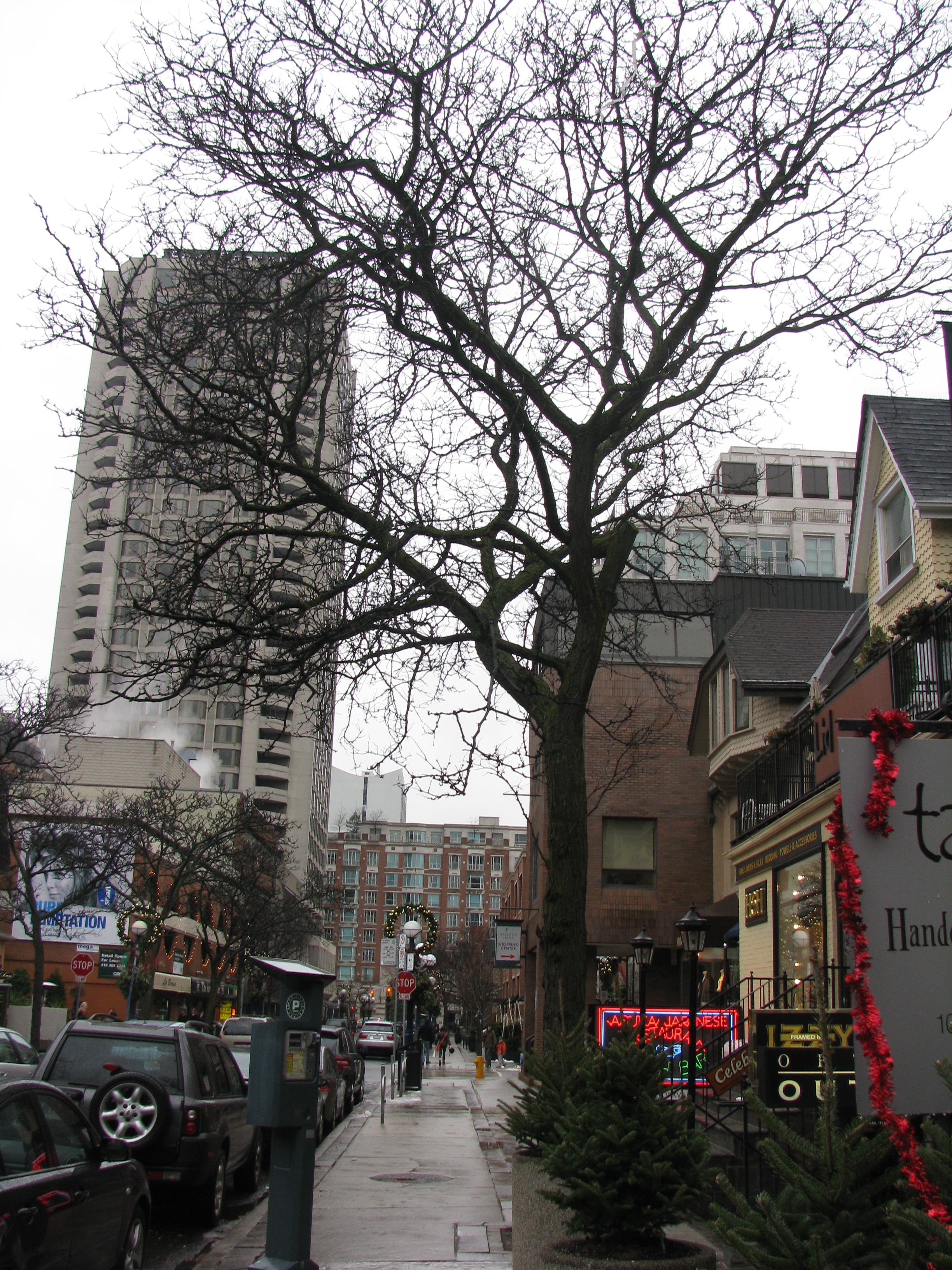
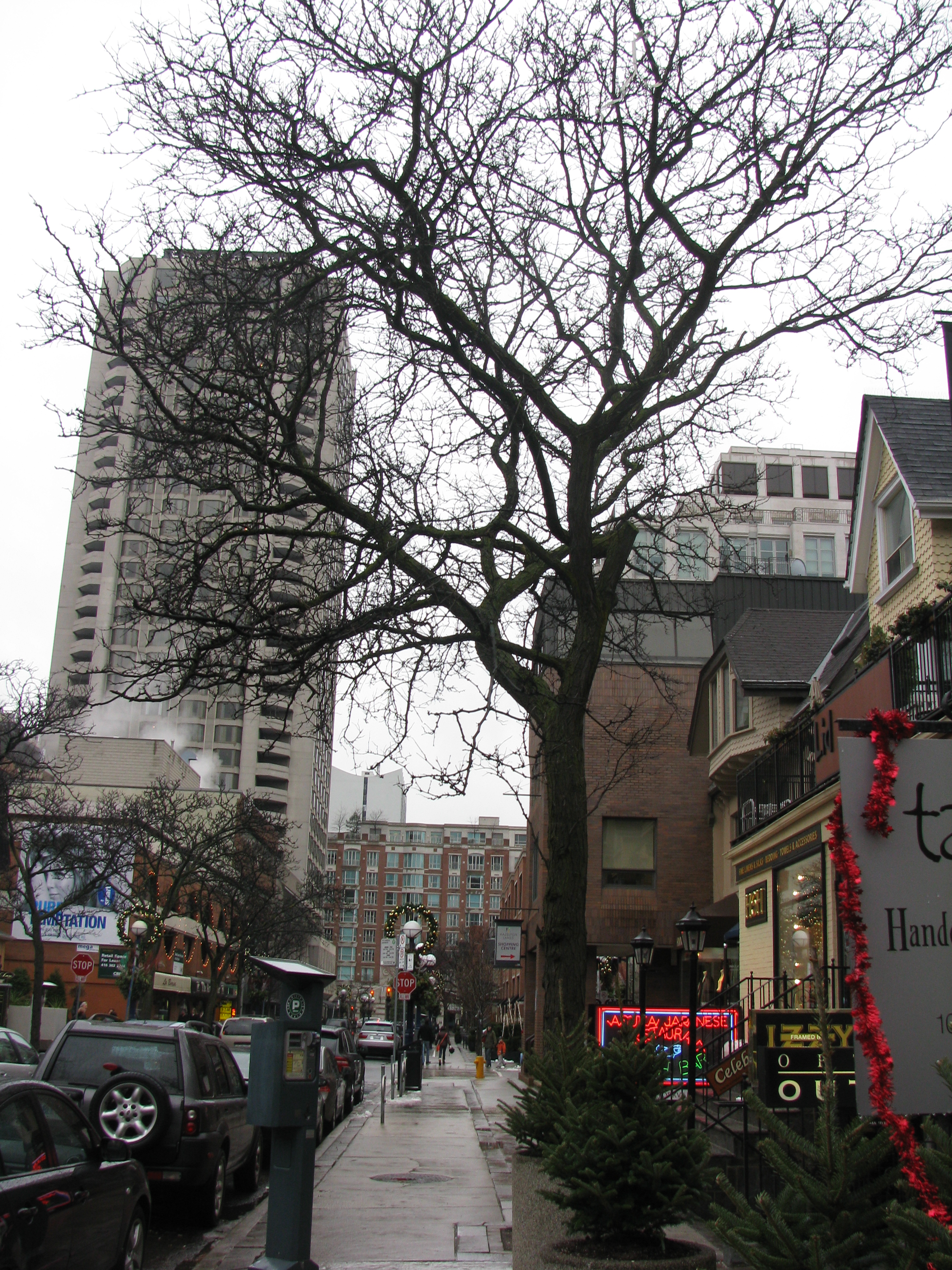
Over in Yorkville I noticed that none of the trees are being cut down. In fact they’re decked out with lights.  In fact… they’re big and beautiful and happy, thriving in their ‘unnatural’ urban setting.

Something’s not right here. Trees can live in an urban environment. They do live in urban environments. So why—really—were the trees on Bloor cut down? The guy said they hadn’t been planted deeply enough in the first place. Egad. Does anyone do any research? Any planning? There are books to read for pity’s sake…

I’m thinking an intervention may be necessary, that I should send a letter before a decision is made to spend more money planting new trees that will only have to be cut down. I could begin with something like this: Dear Him/Her, Whatever was done in Yorkville seemed to work; make a note. Additionally, you might ask family and friends to give you books on the subject of trees this holiday season. In fact, you might even have a gander at one or two of them; if the words don’t interest you, at least look at the pictures…

Reflecting the belief that urban life requires an ‘escape’, city parks have long been designed in imitation of pastoral surroundings. Henry F. Arnold challenges this tired romantic style that disregards the urban environment—and shows how trees can be used to enhance urban elements rather than hide them. He encourages landscape architects and city planners to utilize trees, not as decoration, but as living building materials to create and reinforce urban spaces.” (From: Trees in Urban Design, Second Edition, By Henry F. Arnold)

when it looks like nothing

I’m standing in front of an empty cage at the Conservancy of SouthWest Florida—a tiny gem of a place doing its tiny part to help preserve what’s left of nature in that part of the world. They also have a facility to rehabilitate wild animals that have been hurt, mostly in traffic accidents. Those that can’t be released live out their days in large outdoor pens or cages and serve as noble ambassadors on the importance of living in harmony with the natural world.

So along comes a grandmotherly woman, young boy in tow, rushing through, no time to consider how the animals got there, no time for conversation; she merely points, bird, bird, turtle, bird.

Next to me, in front of the empty cage, the boy pauses; the grandmother tugs to keep him moving.

“There’s nothing in there to see,” she says and the boy, reluctantly, allows himself to be tugged away.

And I think: this is how it happens, this is how we train children ‘to see’, to look only for the feature attraction, the shiny, the obvious, the Disney version of things. God forbid they should be allowed to think, to imagine for themselves. In fact, the empty cage contains sand, shadows, pebbles, a small tree, bits of wood… but it’s all been called nothing and the boy has learned something from that.

I hang around the empty cage for awhile, looking at the tree and the sand; evetually another child comes along. He asks his mother what the sign says.

“Unoccupied,” she answers. “There’s nothing in there, let’s go.”

The child looks at the cage, then up at me looking at the cage, then turns to his mum and says, “But something might come into it.”

Even she can’t argue with that.

Still, she takes his hand and they move on—in search, I guess, of the ever elusive ‘something’…

on a warm autumn day…

I saw a boy riding a bike, thirteen or fourteen, plugged into an iPod, snarly and unseeing and when I moved off the sidewalk so he could more easily pass, he looked at me in his unseeing way and said nothing. The poor creature had not even been taught, or so it seemed, to offer a simple nod of thanks—he had absolutely no skills beyond being able to listen and pedal at the same time.

I saw a tiny tot riding a motorized car while a harried mother moved about in a front yard full of large plastic toys. When the child left his car in the middle of the court the mother said: you can’t leave it there, Dakota, go and get it. But Dakota was already off in another direction and mother was already walking toward the abandoned car. As Dakota, and I, knew she would.

I saw a dog named Steve, the colour of a fox and the size of a rolled up newspaper on a slow news day.

And then I saw hail fall in the garden and thought how odd, until I popped one of the marble sized balls of ice into my mouth—which seemed a perfectly wonderful thing to do on a warm autumn day.

when words and nature meet, good things happen

Last night on the way to the grocery store, I looked up and saw thousands of starlings flying en masse—their shape changing with every swoop—every wing catching twilight at the same moment—flashing silver— then another turn and all wings are black. The entire flock moving together, gliding, sweeping left then right, expanding and contracting like a perfect shape shifting kalaeidescope.

I’d seen the birds fly in large groups before, but never this pre-sunset ritual, which I’ve now learned is common; supposedly a form of communication before calling it a day.

I stood there alone staring at the sky for maybe ten, fifteen minutes. I assumed the show had only just started, that soon a crowd would gather and we’d all shake our heads and sigh, agreeing that nature is magnificent and we’re inferior dolts that have so much to learn.

But only a  few people even slowed down long enough to look up, and one disappointed voice who did,  said, “It’s just birds,” and turned quickly away.

This is the season for the starlings dance; for robins getting drunk on juniper berries outside my window; for geese arguing about the tidiness of the vee; chickadees, doves, cardinals and finches, a bounce in their step now that the bullyish greckles have finally gone.

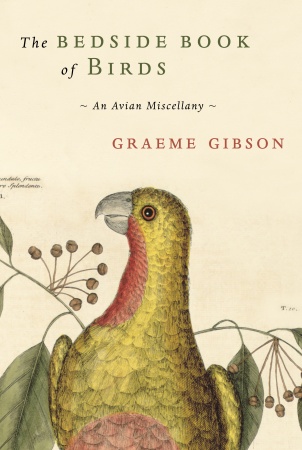
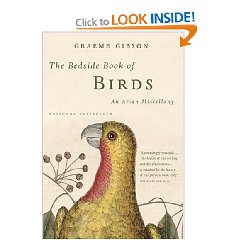
With all that avian magic on my mind I happened to come across this interview, which reminded me that I’d wanted to read The Bedside Book of Birds

And now I will. 


“Stevenson remembered the story of a monk who had been distracted from his copy-work by the song of a bird. He went into the garden to listen more closely, and when he returned, after what he thought were only a few minutes, he discovered that a century had gone by, that his fellow monks were dead and his ink had turned to dust. The song of the bird had given him a taste of Paradise, where an instant is as a hundred years of earthly time. Was the same true of time in hell, Stevenson asked himself.”  (From— The Bedside Book of Birds, by Graeme Gibson)