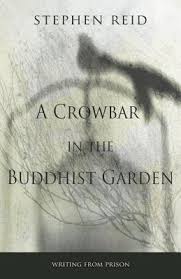
this is not a review: ‘a crowbar in the buddhist garden’, by stephen reid


I’m mystified at how, collectively, and for a very long time, society has had the idea that to lock someone up and treat them like garbage, will help them blossom. From what I understand, there’s little within the prison system designed to achieve that outcome. Nor do the stats support the theory.

Yet we continue this charade of ‘punishment’ which we prefer to call rehabilitation even though there are fewer and fewer funds to make it so.
I wonder at the why of it and can only come up with Because we’re idiots. And lazy and what’s tucked away out of our sight is someone else’s problem. The problem is that the people whose problem it is have too many problems to fix the real problem.

So we console ourselves with being better than other countries at this prison thing as if that’s the only marker and in some camps the answer now lies in MORE prisons—and ever bigger—where inmates can be treated even less as individuals with individual needs and emerge even more isolated—emotionally or otherwise—to try and live within a society that stands on its moralistic pedestals clucking its giant tongue.

The anthropological side of this absurdity fascinates me.

It’s a big subject and I certainly don’t know what to do about it. I’m not even qualified to rattle on about it. All I know comes from what little I’ve read, a few conversations and a stunning tour through Kingston Penitentiary a mere week after the last inmate left, an eye-opener as to some of what’s wrong with our prison system. [all photos taken on said tour]
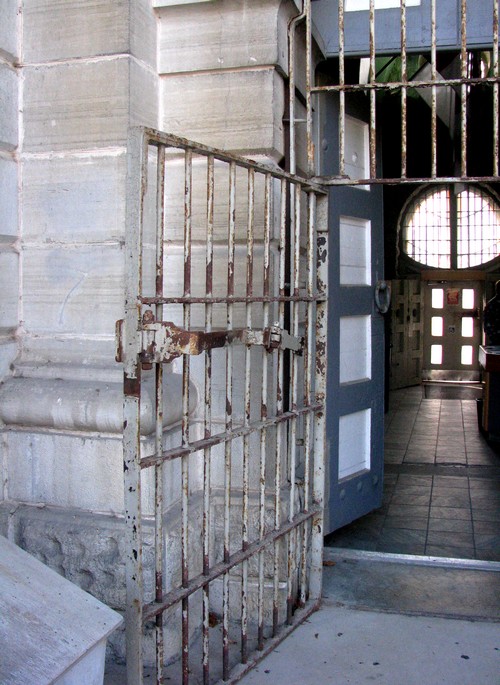
IMG_3819
In his book, A Crowbar in the Buddhist Garden, Stephen Reid talks about the lack of ‘prison literature’ while writing (from prison) one of the best of that genre I’ve read. Despite spending the better part of his sixty something years dealing with the effects of abuse, drugs, rehabilitation and incarceration, Reid is able to share his stories objectively and without sentiment. Also without gratuitous asides of the horrors of a system he knows too well. Reid doesn’t name any monsters or over-describe details or try to persuade you to feel this way or that; he’s wise enough to let us be all the more dumbfounded by the monster that emerges rather naturally.
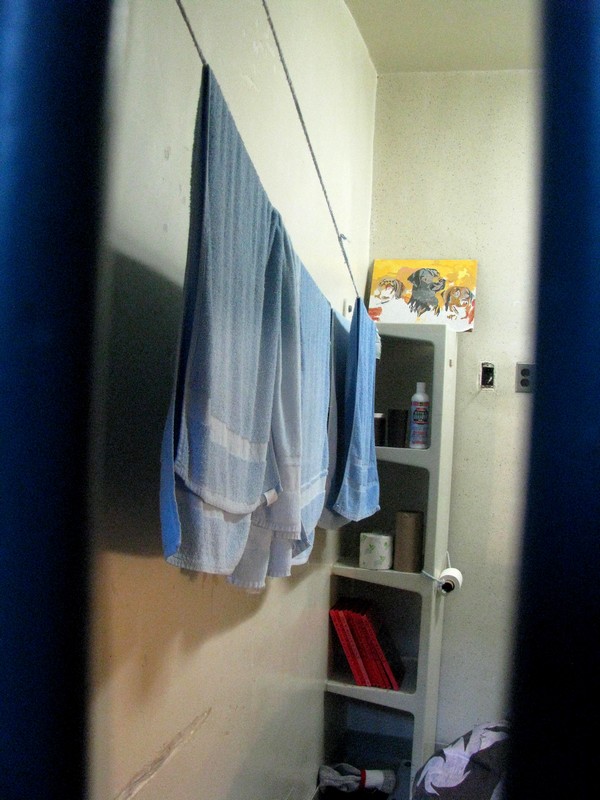
IMG_3869
Most surprising of all, he writes without a shred of anger or self-pity but with the wisdom of a seasoned prison sage when he says it would be a fine thing to be a ‘metaphysical butcher’ so that we could slice away the 1% of the personality that uses and offends, suggesting that the greater part of the most hardened criminal is decent and kind. Unfortunately, it doesn’t work that way, he says. “In criminal law, and much of life, we are our behaviour.”
IMG_3912
In the essay ‘The Last Score’ he details the circumstances that landed him most recently in jail after thirteen years of living on the ‘outside’, drug free.

In ‘A Man they Loved’ he is remorseful beyond measure. “I’m forty-nine years old, married to one of the most interesting and beautiful women on the planet, and parent to two incredible pieces of magic… The forfeiture is unbearable. I see a clear plastic laundry bag lying in one corner of my cell. If I could only get it over my head, wind it tight, airtight, at the neck….

“I am determined to go where I have to go, to take it as deep as it is deep, to do whatever it is I have to do to become whole, to never commit another offence, to never again get addicted. To become finally and forever, the man my many friends and family described…”
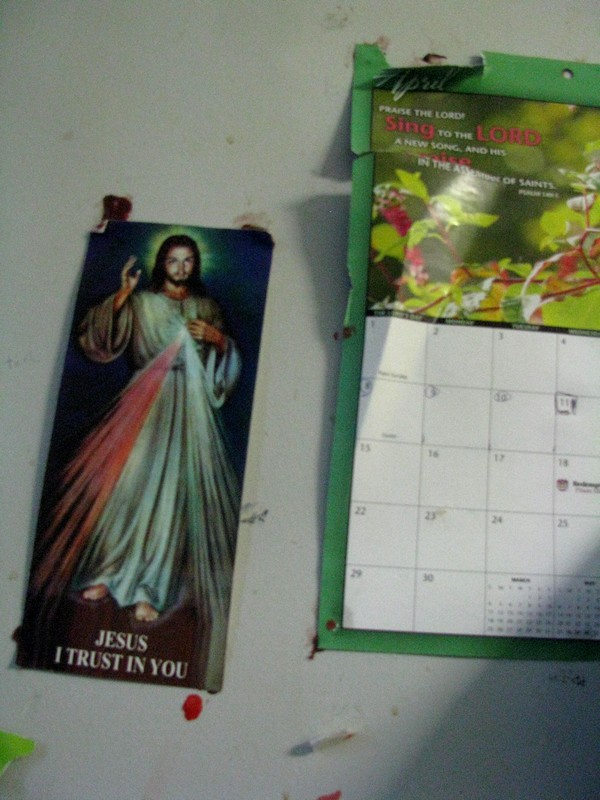
IMG_3864
‘The Last Jesus I Know Of’ is about the Intensive Therapy Violent Offender Program… “a gruelling horror show in which sixteen of the most dangerous offenders are culled from seven regional prisons and forced to endure a year of masochistic and humiliating psychodynamic therapy.” He does this because it will at least break the monotony.

“No one has to be Sigmund Freud to figure out these were men who grew so tired of being wounded, they went out and wounded something else.”

They write autobiography for therapy. And read aloud during sessions. And discover the humanity inside those broken shells.

“… I have learned… that for a lot of people in this room, their first bad choice was their parents.”
IMG_3860
“Christmas Eve [a guard] shows up with his crew for a surprise shakedown on the tier. They toss our cells, making a mess, then depart going, ‘Ho Ho Ho.’ The rest of the holiday season passes with Sally Ann Sunshine Bags, attempted suicides, and dark chocolate.”
IMG_3974
“Prisons are about addictions. Most prisoners are casualties of their own habits. They have all created victims—some in cruel and callous ways—but almost to a man they have first practised that cruelty on themselves. Prison provides the loneliness that fuels addiction. It is the slaughterhouse for addicts, and all are eventually delivered to its gates.”
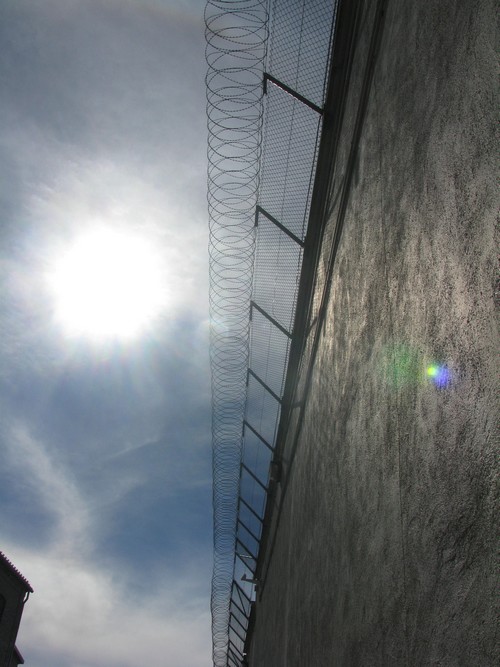
IMG_3919
“Perhaps the days of prison literature have passed… our culture doesn’t encourage those locked up as criminals to learn to engage with their experience on any intellectual level…. We are a society impatient with its misfits.”

He then offers a list of books worth reading.
IMG_3904
In ‘The Zen of the Chain’ he writes about being transferred from one prison to another. He breaks down the indignities, the realities, the heartbreak and fear like a 12 step program. By #11 you are holding your breath and by #12 you realize you’ve just read pure poetry.

 “…To survive you must find the zen of the chain. For instance, if you’re unfortunate enough to have a black box designation and you have to wear that uncomfortable contraption over your handcuffs all day, don’t dwell on the cramps and pain it causes, flow with it, become your black box. Don’t be a new wave crack baby criminal, don’t go sissy on yourself. Suck up them fumes, concentrate on your breathing, find your mantra. Diesel in, diesel out. Let that which doesn’t kill you make you stranger. Transform yourself and your busload of fellow maniacs into an edgy version of Ken Kesey and his band of merry pranksters. Be patient in all things, let the seasons come and go, and one day fortune will smile. The bus will rumble to a stop at some front gate and you will walk in, passing by enough piles of coiled razor wire to make a knife, fork, and spoon for every man, woman and child on the subcontinent of India. You will step into the induction area, they’ll take off the chains and do the strip fan. You’ll get dressed again but this time the bulls will direct you to the right. And just like that you’re walking down a corridor towards a mainline. You feel weightless. You have survived. Life is grand. Until next time.”
IMG_3866 - Copy

About native justice, healing circles and the sweat lodge [versus incarceration], he writes: “A hundred years ago [an offender] would have faced his victim and his village in a longhouse. Restitution would have been part of the determination. [The offender] would have been punished and the circle would have been damaged but it would not have been broken.”

“Prison is, simply put, the bottom rung of the welfare ladder.”

“…if a native prisoner recovers his culture, he recovers himself.”

IMG_3940
Whether he intended it or not, Reid’s opinion of what prison literature should be, describes his own work perfectly:images
“…writing from an experience, not about it.”

Should be required reading in high schools.

_________________________________________

Crowbar in the Buddhist Garden is available online at Blue Heron Bookssupport indies!!


this is not a review — nature’s little wonders: bees, by candace savage

“The life of a bee is like a magic well. The more you draw from it, the more there is to draw.” ~ Karl von Frisch

—A beautifully made book of satiny semi-gloss pages, colour photos, drawings, side-bars rife with fascinating facts, bee lore and poetry. Co-published (2008) by D&M Publishers (Greystone Books) and David Suzuki Foundation.  A joy to read. And important too. [Excellent gift idea. The bees will thank you. Which, in turn, is good for us human bee’ns.]

Here’s but a few things I learned from its delightful pages

Bees evolved from wasps.

They are herbivores, sting only in defence; raise young on protein rich pollen while wasps are carnivores, sting for food; eat other insects; also like people food [especially mine].

There are currently 16,000+ species of bees, ranging in size from that of a fruit fly to half the size of a human palm. (4,000 species in N. America)

A colony is about 300-400 bees of which most of those are worker bees.9781553655312

All worker bees are female; they live 60 days or so, except for those born late in season, which will spend a winter in the hive.

Only a few males are produced in late summer for one purpose: to mate and thereby produce fresh queens for the following year.

After the once-in-a-lifetime mating spree, the queen has enough sperm stored in her body to fertilize each egg she lays. Fertilized eggs become female (worker bees). Unfertilized become male (drones).

A Queen bee lays eggs (1,500 each summer day/ half a million in a lifespan of two years) while worker bees help raise successive broods of females.

The eggs are fed and raised by the female worker bees. Only a very few are reared in special areas of colony and fed the ultra-nutritious royal jelly, which allows them to grow into queens, i.e. egg layers.

Worker bees know that it’s time to raise a new queen (i.e. feed the royal jelly) when the current queen’s pheromones no longer predominate in the hive.

Drones die immediately after mating, or are killed. [I’ll spare you the gruesome details.]

Bee stingers don’t get stuck in bee flesh the way they do in human flesh. So they ‘can’ sting one another to death. [see above… but this is merely one method of getting rid of unwanted drones]

Honeybees can see colour.  [The book outlines how this was first shown by placing a bowl of sugar water on a square of blue paper. The bees, of course, were attracted to the sugar. Then the bowl was removed and the blue square moved to a different position among several grey squares. Didn’t matter. The bees still went to the blue square.]

The book cites the work of Karl von Frisch, A Nobel Prize winner for his research on the honeybee, and Martin Lindauer, a student of von Frisch, and a renowned bee expert in his own right. Of Lindauer, Savage writes:

“Through the glass walls of his observation hive, Lindauer could watch the workers as they scurried around performing their household tasks. Here, bees were cleaning out vacant cells in preparation for reuse, by removing old cocoons and re-coating the walls with wax. Over there, others were poking their heads into occupied cells, the ones with grubs in them, to check on the larvae and see if they needed to be fed. (According to Lindauer’s data, nurse bees inspect each larva, on average, 1,926 times during the five or six days before it makes its cocoon but feed it on only 143 of those visits.) Elsewhere in the hive, bees were busy building comb, capping comb, packing comb with pollen. Tucked away in a quiet corner, an individual might be flicking a droplet of nectar in and out on her tongue, waiting for the honeyed glob to thicken. At the same time, others were fanning their wings near the entrance, for cooling or ventilation, or standing guard in the doorway, with their forelegs raised and their antennae up, at attention.”

Lindauer noted that bees are hyper aware of various stimuli, changes in temperature, texture, taste, and instinctively know how to respond or communicate direction to others. When he inadvertently put a heat lamp too close to the hive he noticed the bees stopped foraging for pollen and collected water droplets instead to flick into the hive for a cooling effect.

Savage addresses the issue of colony collapse and other problems we’ve contributed to, while noting that “Bees [bring] sweetness out of chaos. Humans, on the other hand, [seem] to have an instinct for devastation. Could it be that these insects have something to teach us?”

And this, perhaps my most favourite morsel of all:

“Unlike human groups, which often seem less intelligent than the individuals who make them up, a swarm of bees is always smarter than the sum of its parts.”

American_foulbrood_honeycomb_drawing

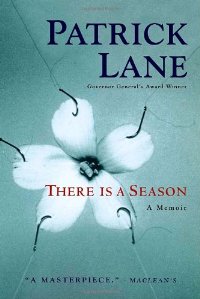
this is not a review: there is a season, by patrick lane

 
I can’t lie. Nor do I think I ought to. On reading the first chapter of Patrick Lane’s There is a Season I felt mostly annoyed. I didn’t think I’d make it to page fifty, which is my official limit…[page 100 is my un-official limit]. If I haven’t engaged in a book by then I close it and move along.

I can’t say what it was that bothered me, I just couldn’t get with the rhythm, I wasn’t paying attention.

When this happens, and despite the accompanying crankiness, something about the book occasionally compels me onward and prevents me from slamming it shut. This was not the case here. I walked away muttering about how I wasn’t in the mood for epiphanies in the form of raindrops. But the next day I picked it up again. It was a library copy so nothing would have been simpler than to take it back from whence it came—but those raindrops had gotten into my head and when I opened it up the second time to some random page, I read this:

“I don’t know why I confuse myself in the world when all I need to do is spend a few moments in this gentle space.”

I kept reading, pages and passages in no particular order.

“I measure friendship by those who are the friends of spiders and those who are not.”

“The drenched garden glows like the womb must to an unborn child.”

“What I call silence is not the absence of sound but the presence of the garden when it is not weighted down by traffic noise and talk.”

“My quest has always been to find what I could not leave.”

“A green frog does not sit on a red geranium unless he’s gone a little mad.”

“There are times I want to be in the second or third person… It’s simpler to be a fiction.”

“We break our path when fear tells us to live.”

** 

And then I started again, at the beginning.

—It’s springtime in the Okanagan and the author is a boy. We meet him as he stands “… among yellow glacier lilies and…windflowers…the western anemone, their petals frail disks of trembling clotted cream.”

This is the opening. What, exactly, about that is cranky-making?? I’ll tell you what: nothing. Whatever my initial reading mood was, I’m thrilled it passed.

It’s a book about a garden in flux and the man who is putting it [and his life] to rights; about the connection of man to nature. Of an ornamental tree, he says “Their leaves funnel the rain, and the water runs down one leaf, falls to the next and the next, miniature waterfalls in a stream until the last and outer leaf drops the water where the feeder roots drink.”

It’s a book of poetry in the form of prose. Or vice versa. It’s a meditation. You read it slowly, and maybe that’s what was wrong on my first attempt. My speed setting was off.

“That is beauty, to stop a moment and watch the endless play of light on water and stone and see how the living things of the garden come to drink or just to gaze as I do now at the surface of the pond.”

The book is also about sobriety although drinking is rarely mentioned. It’s Lane’s senses that are sober for the first time in forty-five years and so the reader is privy to the perspective of not only a great poet, but of someone who’s been issued a set of fresh eyes, ears, skin and taste buds.

“The drenched garden glows like the womb must to an unborn child.”

51aac9pD90L__SX200_There are many references to rain and mist and dew, pools of water, as if the booze has been replaced by more useful forms of liquid, ones that help him think—and remember—more clearly.

The book is divided between the present day Victoria garden and the past: childhood, parents, marriage, failures, joy, sadness and one especially incredible scene where he returns with his now elderly, unemotional and extremely reluctant mother to the old homestead; it’s near the end of the book and is one of the best passages I’ve read anywhere for its power to convey, essentially, a whole world, the now and the then, in a few sentences. Perfectly placed.

I’ve since returned the library copy.
And purchased one of my own.

this is not a review — back alleys and urban landscapes, by michael cho

I don’t remember how I first heard about Michael Cho’s beautiful book: back alleys and urban landscapes but the title made it a sure-fire gifty pick for an alley loving friend. The book is more collection of drawings than text—in fact there’s almost no text, which makes the experience of wandering through its pages not unlike ‘wandering’, generally. Flipping through—being careful not to leave jammy fingerprints [is it wrong to test run a gift book?]—I was reminded of my own favourite alleyway behind a Toronto duplex where I carved out a garden in the gravel between dilapidated wooden garages. With the addition of a wonky table and a barely working 61WPGikTBtL__SL500_AA300_BBQ, it became a hub for summer games, watermelon seed spitting contests and the first of many ‘ant hotels’ [ant hills that are left to prosper and grow] complete with No Vacancy sign.

When seen in a certain light, past the grit and the scruff, alleys are more inviting than intimidating… connections not barriers.

Micheal Cho knows this and his drawings beautifully reflect one of the very best aspects of city life.

“They’re family places, quiet and often hidden in plain sight… when you know a city, you know its back alleys. It’s like a house: the dining room is in the front to show guests, while the real living goes on in the kitchen…”  ~back alleys and urban landscapes, by Michael Cho (Drawn & Quarterly, 2012)

_______________________________________

—Purchase back alleys and urban landscapes online at Blue Heron Books.

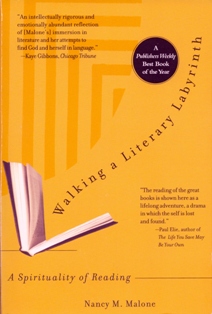
this is not a review: walking a literary labyrinth, by nancy m. malone


I couldn’t remember how I came to have this book on hold at the library and when it came up I nearly put it right back. I wasn’t in the mood for a ‘literary labyrinth’, which I took to be a list of books that I will feel compelled to read. But curiosity kicked in—I couldn’t help wondering what about it struck my fancy once upon a time. And guilt of course, that annoying and familiar tic that insists I read—properly—at least a few pages of everything I put on hold.

[Note: I have since remembered how it came to my attention.]

And so I took it home. And I began reading. And I finished it in one happy sitting. With food breaks of course.walkingaliterarylabyrinthlrg

In a nutshell: Nancy Malone is a nun who has left the nunnery and now lives in a funky little cottage on City Island in NYC where she swims and reads and reminisces about her reasons for making her life choices.

What it is: part theology, part literary chat, part philosophical bon mots, part superbly fascinating woman who isn’t shy about expressing her thoughts re the church’s tendency toward small mindedness in the ways of discouraging a variety of reading material and the subsequent thrust and parry of good conversation that results from same. Essentially, Malone couldn’t accept the limitations imposed on her, book-wise; she describes the simple pleasures we take for granted in reading widely as something of an epiphany, so malnourished was she.

…reading has changed how I see, or have not seen, others (isn’t this the point of Ralph Ellison’s Invisible Man?); it enlarges my vision. Alice Walker’s The Color Purple make me see the world through the eyes of a black woman. In Saul Bellow’s Mr. Sammler’s Planet, I live inside the head of a Jewish intellectual in Chicago. I become intimate with a reluctant Czech dissident in Milan Kundera’s The Unbearable Lightness of Being. I can hardly conceive how limited my perception would be without the books I have been privileged to read, how superficial my understanding of others, how undeveloped my sympathies.

The larger context being that, as a religious person, she can see the benefit of reading beyond ‘prescribed’ books, and how the church might also benefit from giving that idea some thought.

There is, in fact, a list of clever reading, which, while annoying because I can’t help but feel I must make note of several smart titles, thus adding to the sense that I’ve read nothing… she adds to with asides for each selection. And while her focus is the church [which she continues to respect for many reasons] and its influence and how it saddens her that ‘It’ just doesn’t get that “…learning has to do not only with facts but also with ideas”, the larger effect is that of books, generally, and their power to increase understanding within all aspects of society. Including, and perhaps most importantly, religious societies.

And I say “my spirit” on purpose, because I believe that language, in all its dimensions, articulates the human spirit. Language is grammatically complex because we are, our thoughts and feelings and relationships are, because life is. We don’t experience ourselves, or life, simply, declaratively,. We need subordinate clauses, compound-complex sentences to express the reality of who we are, to show what is more important or less important, just how one thought or feeling or situation is related to another.
And we need a rich palette of words, with their different, fine shades of meaning, from which to select just the right words. Surely these are among the blessings that good prose and poetry, without trying to say everything or saying too much, bestow on us… Thus, to the extent that our language, both literary and spoken is monochromatic, monorhythmic, grammatically unarticulated, sometimes monosyllabic—impoverished and flattened—so are our spirits.

(at)eleven with brenda schmidt: flight calls–an apprentice on the art of listening


I discovered Brenda Schmidt’s work through her blog with the curious title: Alone on a Boreal Stage and was immediately hooked by her nature photography, often presented with a poetic twist, a caption or some element of surprise. Over the years I’ve learned she also paints, covets all manner of culverts and cake and has published four poetry collections, two of which I’ve since had the pleasure of reading, both of which I return to often for bits of wonderfulness such as this, from Grid, and the poem, ‘Yes Bobolinks’ 

“Even the abandoned buildings, most windowless,/ without paint, some with porches leaning, reminded me/ a group of Bobolinks is a chain, and any chain that dark/ can pull you thorugh a mud hole and back again.”

and in Cantos from Wolverine Creek, I adore ‘Pigs’ for its non-romantic look at human and ‘other’ nature.

It’s like going to a spa.
Skins are dehaired in scalding soda solution
then sit and swell in cold mineral acid.

After that they take a dip
in hydrochloric, then sulfuric,
and follow that with a cold shower.

All that just to be transformed
for you, to sit there on your spoon,
to slide down your throat so easily.

She doesn’t pull punches—words and images are precise, evoking emotions we both revel in and are sometimes uncomfortable with, but only for as long as it takes to recognize them as true. My kind of thing. So when I heard she’d come out with a collection of essays I couldn’t wait to get my hands on a copy—a situation quickly remedied by a call to my trusty bookseller.

The very title of the collection intrigued me. Flight Calls—An Apprentice on the Art of Listening promises a birdish focus but I suspected there would be much more. A keen observer of Schmidt_thhow nature fits into the ‘elseness’ of life as we’ve shaped it, Schmidt packs these 113 pages with connections between the incongruous and presents them as merrily wrapped gifts, the contents of which seem to surprise even her. But then the essays are about discovery and how it’s only ever the tip of the iceberg that we find; whether it be the world around us, the people in it, the essence of anything is what we remember and what we convey, and if we can manage that much, it’s plenty.

In her Introduction Schmidt explains how the essays evolved from writing prompts in the form of epigraphs from her mentor, Gerald Hill. A personal letter to Hill from Schmidt runs as an undercurrent throughout, a few paragraphs of which follow each essay. It’s an intimate, strangely integral and beautiful part of the text in which the author’s voice shifts to a different kind of reflection as she shares a different part of herself with the reader. It feels like a whole other gift as our perceptions also shift and we listen in on this private revelation/confession/one-sided chat.

“I suppose there’s a word for this kind of letter. Here we are, five pages later, and nothing but forest. But there you have it. No matter how careful I am with my feet, each step makes noise. I make myself heard. Things slip away in the underbrush. Others freeze and I walk right by. I’ve spent half my life trying to make sense of this place, but I still feel lost. Unwelcome. Less than half a life to go and I still haven’t got the orchids straight…”

In one of my favourite essays, ‘Snap’, which is both about ptarmigans and learning to trust one’s instincts, she says of knowing the difference between procrastination and ‘percolation’: “Procrastination is a brackish lake in the flypath of my mind.”

I love a line I can pin over my desk, one that ‘snaps’ me back to a finer point of clarity, if only for a millisecond. Sometimes it’s enough to change everything.

Schmidt writes gorgeously about the natural world and how she feels as she moves through it, how she’s humbled, puzzled, concerned. But never does she sentimentalize. And so, while she includes poetic elements: “Memories are like cowbirds. An image flies into mind unbidden and leaves behind an egg. It hatches early and demands to be fed. It quickly grows into a monster, removing other nestlings, but the monster is yours. You can’t stop feeding it.” you stay balanced between the beauty and the sometimes not so perfect—being charged by a bear, storms, thunder, darkness, the look in the eyes of a dying insect. She writes from the perspective of a flawed human, from awe and curiousity, stepping always closer on the reader’s behalf, and when she writes that “A Turkey Vulture lifts its head from the belly of a skunk and watches us pass.” we don’t cringe because we’ve come to trust that she’s only telling us how she finds it, sees and hears it. It’s up to us what we receive.

—It’s been a delight and a pleasure not only to read her, but to have some fun with this Q&A.

Please note: as is tradition in the @Eleven series, the Q&A is followed by my idea of the perfect meal to complement this book.
Why?
Oh, no reason. I just like food and books. And people who like food and books.

And on that note, may I present… Brenda Schmidt.

The Eleven

1.   What literary character did you identify with as a child?

BS—Nancy Drew.

2.   What were you reading at age ten? At fifteen?

BS—I read anything and everything at that time. The Western Producer. Field & Stream. Outdoor Life. Reader’s Digest. The Hardy Boys. Harlequins. Zane Gray. Ludlum after Ludlum.  Hemingway.

3.  When did you begin writing and can you recall some aspect/premise of an early (never-before-seen-by-human-eyes-and-never-will-be-as-long-as-you-can-help-it) work? I’m wondering if nature has always been an inspiration or was there a time you wrote about the ballet or mused poetically about life as the owner of a newsstand in downtown Saskatoon…  You’re also a painter. One would think it’s a perfect complement to the writing, a respite from the words. Is that how it works for you?

BS—I imagine I began writing as soon as I learned to spell. Nature was it from the get-go I think. I liked playing outside, climbing trees and hanging out with other animals. I didn’t like dolls or kitchens or tea parties. I did write the odd story about love and war when I was a kid, likely influenced by the news and what I was reading. Drawing and painting used to happen right along with the writing. I’m at odds with my brushes these days.

4.  Can you share a favourite line, or passage from any source… and what it means to you?

BS—“Description is hard. Remember that all description is an opinion about the world. Find a place to stand.” – Anne Enright, from “Ten rules for writing fiction” http://www.guardian.co.uk/books/2010/feb/20/ten-rules-for-writing-fiction-part-one

I think it sums up what being a writer is all about. It sums up what I try to do.

5.  Do you find certain recurring themes  in your work? What are some of the things you tend to explore again and again?

BS—I don’t know. Questions of theme are harder to answer each time I encounter them. I read the back covers of some of my books with nothing but curiosity. I can speak to images a little better perhaps. I do know I tend to mull over particular recurring images, but the juxtapositions are always different and so is the thinking. Images are like buckets of sand. You can build anything. The bucket makes a difference. So does water, the beach, the amount of time you’ve been in the sun. It all suggests what needs to be built at that moment.

6.  Flight Calls is such a perfect title given that the essays are written as a response to the ‘call’ of epigraphs, writing prompts, from your mentor, Gerald Hill. In the Introduction, you say you were intrigued by an article about the power of epigraphs to influence the reading of a text and wondered how they “might affect the writing of a text”. You explain that while you had a sense of what you wanted to write about, i.e. ‘the art of listening’, you began the essays only after receiving all ten prompts. Was it what you expected? Were there surprises in the process of writing this collection? Is it difficult writing to an epigraph? Did some of them baffle you or merely lead you in unexpected directions?

BS—I didn’t know what to expect. I was excited by the idea and just concentrated on doing the work. I decided on the title of the book before I asked Gerry for the ten epigraphs. The epigraphs were a constraint. A foundation of sound. There was no escaping them. With the epigraphs in hand, I came up with ten titles and ten ideas for essays and went from there. Each day before I began work on an essay I’d read the epigraph aloud and that was that. I trusted it would resonate in some way. Everything that followed was a surprise. I just tried to relax and let myself go wherever the essay wanted. In his book Listening, the philosopher Jean-Luc Nancy says “to listen is to be straining toward a possible meaning.”  I love that. It speaks well to what I was attempting with these essays.  I never did relax. I was straining the whole time.

7 In the essay ‘Snap’ you say: “The writing hadn’t been going well, so I put on my parka and… headed out into the cold.” And later, in ‘Call Notes’: “I’d spent the day fighting with a single paragraph. It still wasn’t right. I needed to get out. The darkness often breaks me out of the pen, so to speak, when my writing seems to be going nowhere.”  Your need for the outdoors strikes me as more than just a writer taking a walk to clear their head, more like fuel. And so I wondered… what would happen to your writing if, as an experiment, you were asked to work in a hermetically sealed, windowless room with no outdoor privileges? [I know, I know, this is an awful image for someone like you. But that’s why I ask: what would be different? What would be impossible?]

BS—What a horrifying thought. I can’t imagine.

8.  It’s said that poetry grows out of attention to detail. One could say the same of all art forms, but, in your opinion, what determines how those details take shape, why these become an essay, and those a poem? And do the tools necessary to construct one or the other occupy different compartments of the mind? Or—how’s this—let’s talk cake:  if the poetic form is a petit four, the essay is_______________.

BS—Meringue.

9.  The letter to ‘Gerry’, one page of which appears at the end of each essay. Beautiful. You sound almost daunted as you begin the project and it makes a lovely juxtaposition to the journey, through which you ultimately discover that “Listening is a full-body experience…”. I’m curious though: had you received the epigraphs yet when you wrote the letter? I’m wondering at your mood and what you wanted to get across to him that you didn’t think the essays would.

BS—Thank you. Like the essays, the letter was written after I received the epigraphs. I initially thought I’d link the essays with linked prose poems as a way of going back in and rethinking and responding, of straining some more, but after staring at the epigraphs on my bulletin board it struck me that I never call him by the given, formal “Gerald.” I call him “Gerry,” personal and familiar. The structural potential hit me then. I thought I’d address him directly in an apprentice-to-mentor letter and see what happens.

10. You’re a pretty serious birder. With a cat. Any conflicts there? 

BS—Ha!

11. Choices: 

Fall or Spring?   Fall AND spring. Times of migration. Heavenly seasons.

Pen or Keyboard?   Keyboard nowadays.

Bob Dylan or Dylan Thomas?   Bob some days, Dylan others. I’m so inconsistent.

Pizza or Pasta?   Pizza. Homemade, topped with just a little olive oil and feta.

Ptarmigan or Owl?   Ptarmigan. They are the imagination embodied. I imagine an owl will be the last thing I hear before I croak.

Fruit or Veg?   Veg. Not a fan of citrus. Oranges are scary. Apples are weird.

Canoe or Kayak?  Kayaks excite me when I see them. I think I’d be too squirrely for a canoe. Canoeists seem so composed.  I can’t swim, so I have nothing to do with either in any real way.

Mittens or Gloves?  Mittens! My fingers hate to be separated.

Fiction or Non?  Trick question!

Desert Isle or Ice Hotel?  Ice please. Heat kills me.

Butterscotch or Strawberry?  Butterscotch. Strawberries kill me.

andre-kertesz_the_fork_1928_500px

The perfect meal to accompany this book, as chosen by me—

Carrot Cake

followed by

Cheesecake

followed by

Chocolate Cake

(the book has nothing to do with cake; I only know that after reading it I do not feel like eating chicken)

♦◊♦

Brenda picBrenda Schmidt is a writer, visual artist and naturalist based in Creighton, a mining town on the Canadian Shield in northern Saskatchewan.  She is the author of four books  of poetry, A Haunting Sun (Thistledown Press, 2001), More than Three Feet of Ice (Thistledown Press, 2005), Cantos from Wolverine Creek (Hagios Press, 2008), Grid (Hagios Press, 2012), and a book of essays Flight Calls: An Apprentice on the Art of Listening (Kalamalka Press, 2012).

Both Grid and Flight Calls are shortlisted for Saskatchewan Book Awards.

http://birdschmidt.blogspot.ca/

this is not a review: every man dies alone, by hans fallada


Hans Fallada, it seems, was a complicated chap. An alcoholic addicted to morphine [these were but a few of his issues], he didn’t live to see publication of Every Man Dies Alone , a book it took him twenty-four days to write.  A remarkable feat for this rendering of the German Resistance during WWII—even taking into account the feel of the thing, which comes off as more a compelling need to present little known information, to set records straight or offer a tribute via truth/exposure, than story well crafted. Makes me wonder why he chose the fiction route given how very closely  the story hinges on real events [actual notes and documents are displayed at the end]. Published in 1947, it was one of few books on the German Resistance and while it was translated throughout Europe and re-issued in 1994, it wasn’t until its first English translation in 2009 that it received serious attention and achieved best seller status.200px-Every_Man_Dies_Alone_-_cover

In a Nutshell: The Quangels are quiet, simple Germans. After the wife loses her brother in the war the couple set out to create an anti-nazi propaganda mission by writing and distributing postcards throughout Berlin that essentially suggest Herr Hitler is not all he’s cracked up to be and people need to wake up and smell the coffee. The cards, with various and simple messages—“Mother! The Führer has murdered my son. Mother! The Führer will murder your sons too; he will not stop till he has brought sorrow to every home in the world.”—are left in stairwells, restaurants, shops, on the street, buses, parks; the city is littered with these crudely penned warnings against Nazism and yet no one, not the police nor the Gestapo, knows who’s behind it. For a while at least. Then they find out and the Quangels are caught and executed.

I was fascinated by this aspect of events so rarely heard about. However, despite the book’s more than 500 pages, I never really felt as caught up by those events as I’d have liked. I wanted to enter this world much more than I was allowed, to see those cards being written, experience a view rarely depicted. It was a time of confusion and uncertainty; people like the Quangles, ordinary Germans, saw the benefits of Hitler’s regime in the form of jobs, etc., but couldn’t shake the sense that, despite what appeared to be improving, much wasn’t right, that people of every class, race and culture were being arrested for simple disagreement. Spies were everywhere and it soon became obvious that you couldn’t entirely trust anyone—not your neighbours, friends, not even your family. This is a side of the story little known outside of Germany, and even there, only recently has it begun to be discussed among younger generations.

The problem with this kind of re-telling of truth is that because we already know the outcome the fictional version must have some fresh angle—further developement of the story or characters, or even one interior journey that the reader feels privy to. As it is, Every Man Dies Alone  is written in an overly simplistic style with long passages of expository dialogue and zip character development, leaving the reader well outside the ‘world of the story’ and privy to little more than the author’s need to opine on the subject while purging his own emotions.

Better, maybe, in that case to have done it as a work of non-fiction. In any case, not the world’s best slice of literature, but if you can get over that, it’s absolutely a story worth reading.

And all that in twenty-four days… hats off, mate, I say.

this is not a review: indian horse by richard wagamese


I didn’t know exactly what to expect when I began reading Richard Wagamese’s Indian Horse . Everyone seems to be talking about it, I’d seen reviews, it’s a Canada Reads contender. I knew there was hockey. I’d heard the descriptions: ‘powerful’, ‘stunning’, ‘heartbreaking’. But I hadn’t heard the details.

Now I understand why.

The details are hard to talk about, hard to accept. Harder still to read but impossible to stop reading.

The in-a-nutshell version is this: An Ojibway man who is a mess due to a family history of residential schools, booze and unemployment, ends up in rehab after almost making it to the NHL.

If you think you’ve heard the story before, believe me, you haven’t. Not like this.

The book opens with images of life before the white man, before indigenous peoples were made to accept a pittance for the job of helping the government devastate their own land, before they beganindianhorse trading berries for bottles.

It soon moves ahead a few generations with the focus on Saul Indian Horse’s childhood and family: a nurturing grandmother; a father who’s fine when he’s working but work for Indians is rare; a mother who is already a wreck from her own years at residential school and is now forced to watch as her children are taken to the same place, one at gunpoint.

Saul himself ends up at the school—where, among other atrocities, children die standing up, bodies hang from rafters, wrists are slashed on bathroom floors and a young girl fills her pockets with stones and calmly walks into the creek to drown. Where another child, already dead inside, speaks matter-of-factly about the priest and the nuns coming to her in the night to share “god’s love”.

“They called it a school, but it was never that….There were no tests or examinations. The only test was our ability to survive.”

Despite the horrors there is not a trace of rancour in the writing, not one gratuitous scene to drive home a point. Quite the opposite in fact. Wagamese wields a strong but subtle hand on the subject, the power being in what’s left unsaid. One gets the terrible idea that what Saul knows, what any of us know, is merely the tip of the iceberg.

How Wagamese kept what must be his own deeply rooted feelings out of the story, focussing only on Saul, telling The Bigger Story through him… is a feat not many writers manage, much less manage so beautifully.

“When your innocence is stripped from you, when your people are denigrated, when the family you came from is denounced and your tribal ways and rituals are pronounced backward, primitive, savage, you come to see yourself as less than human. That is hell on earth, that sense of unworthiness.”

Escape for Saul comes in the form of hockey—and these are some of the most beautiful passages in the book. While I can watch a game and be soothed by the sound of skates on ice, puck meeting wood—even though I really know very little about what’s going on—I didn’t think I’d like reading about hockey and it was one of the reasons I initially hesitated picking up the book. Turns out reading about hockey the way Wagamese writes it is an utter joy, even for someone who doesn’t know a crease from a blue line. The passion and lyricism of those chapters could easily be applied to a description of any artist or athlete doing what they love.

Saul has the talent of a Gretzky or a Crosbie and he moves quickly up the ranks, becomes a local hero where ‘hockey brings unity to a fractured society’ and “Every reserve in the North had a team.” But the system has him move up even higher, to minor leagues, to big city games in the south where an Indian on skates is an event, a cause for racist headlines, jeering and jokes.

“During one game [the fans] broke into a ridiculous war chant whenever I stepped onto the ice…. When I scored, the ice was littered with plastic Indian dolls… A cartoon in one of the papers showed me in a hockey helmet festooned with eagle feathers, holding a war lance instead of a hockey stick.”

What once was his salvation proves to be just another thing that belongs to the white man. Hockey is metaphor for the “white man’s game”… the game of life. They expect him to play the role of savage Indian, and eventually, fueled by a lifetime of suppressed rage, and against his better instincts, he obliges them.

From there he spirals down until he’s at the New Dawn Rehab Centre where he discovers perhaps the most difficult layer of his past [a shocker I did not see coming…] and begins the long process of healing.

This is the part of the book that was hardest to take. We white folk in Canada pride ourselves on our multiculturalism, our supposedly easy acceptance of all races. But we don’t talk about the aboriginal population when we talk about race and racism. We don’t talk about the aboriginal population at all. Because, well, they live “up there somewhere” and very little that happens to them is reported in mainstream media, and even when it is, it’s a news blip not a serious problem. Contaminated water in Walkerton? A very big deal. Heads rolled. In Attawapiskat? Where’s that?

Ditto mould, insufficient housing, suicide.

But it’s not that we don’t care, it’s that we don’t know.

The Idle No More Movement has shown, at least to some degree, that there are large numbers of us, people of all description, that do care. And we crave information. Yes, we can ferret it out online, but perhaps the day has come where equal air time and ink in mainstream media is given to aboriginal issues.

The long and short of it is this: we know too little about the history of native communities. For this reason books like Indian Horse are important in that they convey a hard story that needs not only to be told to heal the teller—but heard, to help heal our world.

Indian Horse  is available for purchase on-line at Blue Heron Books. 

And Hunter Street Books.

Support indies!

this explains everything

So I’m in bed Sunday morning reading and loving the stories, the reminiscences of various Canadians in Everybody’s Favourites as they recall special books from their childhood. I make a list of titles to get—for me, for friends, nieces and nephews, ones to browse through at the library. I note that many of the books mentioned I haven’t read and I begin to wonder what kind of childhood did I have??

Then a title jumps out at me: Island of the Blue Dolphins.

I know this book.

I can see the cover, a darkish blue, the illustration of a girl on the grassy edge of a cliff by the sea, a cradle floating in the water. I remember that it’s a slim hardcover and suddenly I’m overwhelmed with a whim to see it, maybe even crack it open again. I go down to the basement, sort through my sadly unsorted kid collection.

I find it.

And I’m right about the cover; it’s exactly as I remember. Only it’s not Island of the Blue Dolphins. It’s a completely different book— Child of the Western Isles, by Rosalie Fry.

No dolphins.

Familiar as I am with the cover, I don’t remember ever reading it but it has drawings [by the author] and so I take it upstairs and snuggle back under the covers and after a page or two… I do remember… and I’m eight or nine or ten again and it’s summer and I’m not sitting on my front porch amongst pots of wax begonias but am right there on one of those wind-swept, wildflowery all-cliffs-and-rocks-and-sea islands off the coast of Scotland wherever Scotland is, and I’m tearing around with Fiona, who was born in the Western Isles, lucky bugger, but left as a child with her family to live in a city where a few years later she became unwell and the doctor ordered her back to the health-giving properties of life by the sea with her grandparents where she adventures about, rows boats, plays with oyster shells, befriends seals and finds a lonely cabin to live in before eventually uncovering the mystery of a long-lost baby brother.
Spoiler alert: there’s a happy ending.

How could I have forgotten this story? I used to want to be Fiona (that is, when I wasn’t wanting to be Nancy Drew). In fact, I think it may be Fiona, Child of the Western Isles, that’s responsible, at least in part, for my love and fascination of watery environs, of gulls and oysters and wind-swept hills. Not to mention lonely cabins and row-boats.

It may even be this story that led me to invent a baby brother one year. When my teacher asked if my parents would be coming to the parent/teacher night, I replied that no, they wouldn’t be going because my mother was in the hospital having a baby, a boy, I said. I’m not sure if I gave him a name. I only remember my mum and dad coming home from the event and telling me how surprised Mrs. Thingy was to see them…

This book, I notice, is one of the handful I own that is stamped with the name of my elementary school and that I possibly forgot-to-return, aka pilfered. So ancient is it that it has a strip of foolscap glued onto the back inside cover with the word Due handwritten at the top and a list of dates written below it in a variety of ink and handwriting styles. March 1st [no year] is the last date. I really can’t give it back [by that I mean I really don’t want to], but I’m thinking I’d almost like to write to the school and pay for the book. [But not the late fines!]

Then again, I wonder… is owning up a noble and good idea or am I just inviting the very-late-and-possibly-pilfered-book-patrol to show up at my door with a warrant?

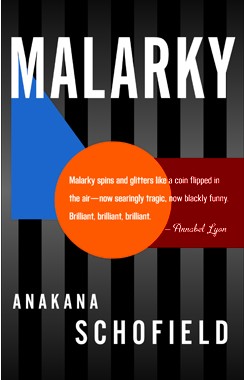
this is not a review: malarky, by anakana schofield

I’ve said it before and I’ll say it again: my favourite books are the ones in which nothing happens, except that whole worlds change.

Anakana Schofield’s Malarky  fits the bill perfectly.

The world in question belongs to a middle-aged widow as she speaks to a counsellor, this after having become ‘confused’ or possibly temporarily off her nut [though she strikes me as saner than most] following her husband’s death. Between what she tells the counsellor, who she refers to as Grief, and what she tells us and what is told us via third person narration, we learn that she, Philomena, aka Our Woman, some years previous, and quite by chance, meets the mistress of her cattle farming husband, known as Himself. Turns out said mistress [The Red Twit] feels compelled to share details of the dalliance that Our Woman would be happier not to know.

And it’s not as if her head isn’t already full up with images of her son and another lad having it off in the pasture, after which he joins the military and she, Our Woman, knows, just knows, he won’t be coming back in one piece. And there’s no consolation to be found in her husband. Even if he weren’t indulging himself with The Red Twit, she cannot discuss the simplest things with him, much less anything of an emotional nature. Certainly not anything beyond cows.

In fact, he blames her for the son being ‘soft’.

So she keeps much inside herself, does Our Woman. Or, I should say, she keeps much from the people in her life. With us, the reader, she’s very good at sharing.

“The thing people don’t realize about patchwork women like me is how given to exasperation we are. On the surface, we fuss over the cleanliness of a work surface, or kitchen counter top, we notice the scum around the bath, we may, the most desperate amongst us, brasso the door handles each week, but do not for a millisecond misbelieve that as we are doing this undulating task we are not awash with rage and salty sentiment the likes of which would sting the eyes of out of the most coarse rumped pig.”

Soon enough she meets a man who is driven by strange curiosities about the mechanics of reproduction from a woman’s point of view, and, although he is slightly younger than would have been ideal, his interest in practicalities, in the anthropology of sex rather than the emotions, suits her in many ways, not the least of which for its quality of distraction. She begins an affair with him, partly to even the score but mostly to understand her son.

“Jimmy’s absence taking all of it, more than I wanted gone. No sooner is something gone than we must know more of it. Why’s that? I often felt this same way when a cow leaves to the factory. I’ve no interest in the animal, but once missing, a hole forms for her. I look for her. I miss her in a whole new way.”

It should be said the book is not about sex.

Not in the slightest.

It’s about language. The way we speak, the way we hear, what we communicate and why and how and how we pick our moments to reveal the things we do. And to whom. And then we’re back to why.

Why do we marry, love, befriend, hate? Are these even choices? What do we accept, what do we hope to change? And then we’re back to the how.

“Everything about widowhood is exhausting because you’re trying to recall, unable to recall and then expected to explain why you cannot recall. It is not as simple as living. It is not as simple as being irritated. Being alive and married is like sanding a windowsill. Maybe it is dusty, it may get in your eyes or knick your fingers but you can look at it and see there’s a windowsill. You can look at your husband and feel no need to say anything to him.
“The curse of the widow is the non-stop chatter outside and around your head. Like a television talk show where you loathe the questions, but cannot turn it off.”

I adore the way Our Woman notices the details of life even as its biggest boulders are falling on her head, the way a character “…ponders how it all went wrong, while her biro did a word search.”

Schofield’s use of language, the playfulness of it, including local dialect and turns of phrase [the story is set in the countryside outside Dublin], as well as clever stylistic choices, all conspires to convey the message of how we communicate—and is pitch perfect. Gorgeous in fact. And even though I’ll admit the sometimes unusual sentence structure and occasional [intentional] missing punctuation annoyed me at first, I couldn’t stop reading. Much like meeting up with someone who rattles on and on and you think, god, how do I get out of this, but then, something in their eyes, some gesture, some honest inflection in their voice makes you hear, really hear, what they’re saying and it’s so real and they’re sharing it with you and you realize that’s no small thing and so you listen and before you know it you’re leaning forward across the table, yes, yes, go on, you’re saying… and when it’s time to leave you make a date to meet again soon and as you walk away in separate directions, you notice not much is different except a shift in the world… by just the tiniest degree.

Reading Malarky is like that.