this is not a review: swimming studies, by leanne shapton

 
Leanne Shapton knows how to make a book.

In fact, designing books is what she does.

So it’s no surprise that, like Important Artifacts and Personal Property… her latest, Swimming Studies, is a composite of lovely things. Only this one includes essays—mostly memories from her days as a competitive swimmer—complemented by photos and personal art. The essays, however, are almost incidental.shapton-swimming-studies

Almost.

But not really. The words are certainly important, essential even, but this is what I mean about how she makes a book: it’s not in any way entirely about the words. In fact, I’d say her best writing is inspired by the visual, also by the remembered: smells, sounds, textures, shapes. And much of this she represents in one visual form or another.

Swimming Studies [the cover is cleverly, beautifully done, textbook style] is divided into sections, short pages of text followed by… something. Always something new, unexpected. Very Shapton, this, I’m beginning to realize. ‘Size’, for example, is a series of black and white photos, swimsuits she’s owned with notes on where she purchased them, wore them, who she was with, some small memory: “…My first technical suit. I do a test run in my backyard pool before using at a swim meet in Wilton, Connecticut. It makes me feel more buoyant, but also as if I’ve been swallowed by a boa constrictor.”

In ‘Fourteen Odors’ she offers a series of numbered watercolour sploshes, each number corresponding to the memory of a scent; the wet brick of a parking lot, a teammate’s hair, chlorine mixed with BBQ chips on her finger. Of an exercise partner she notes: “…Tide, milk, terrier, and grape Hubba Bubba.” Of her own wrist, beneath a watch strap: “…Vaseline Intensive Care, iodine and banana.”

This is Shapton at her best—translating the mundane into something that resonates on a large scale, relatable because it’s so real anyone else might overlook it. In no way does she strike me as someone who lives in imaginary places.

If the book has a weakness, it’s a tendency to lean toward the sophomoric in a few essays where a stroll down memory lane feels more self-indulgent than relevant or revelatory. I’d like to say this might just be a taste thing, or an age thing, but I’m not so sure. There’s a difference between presenting your life ‘as is’ because you believe it’s fascinating in itself… or really thinking about what it all means and then presenting that in equally simple ways.

For instance, in the section ‘Other Swimmers’, a series of portraits with notes, she writers under one: “I am not crazy about Stacy since noticing that she copied onto her own shoes the piano keys I drew on the inside of my sneakers.” It’s not that I don’t get it. She’s bringing us into the minutiae of this world, I get it. I just don’t care. Because it’s the same minutiae of any teenaged world. It lacks that je ne sais what—that deeper point that makes the incident special.

It doesn’t help that the entire thing is written in present tense, which gives everything equal intensity and creates pacing that isn’t sustainable. It’s an odd decision, this, and doesn’t suit the subject; not everything about one’s swimming history, however interesting, is that urgent.

Having said that, there is much to adore here. Tiny perfect observations, the reverence for her subject, the movement of bodies, the dedication to sport, the lingering effects, the habit of it all. Essays such as the opening ‘Water’, seven lines that sum up a lifelong passion or, ‘Laundry’, where a recent cold water swim in a London pool triggers a variety of memories from being billeted in an Edmonton basement to the smell of a on-line purchase: “…A detergent-fragrant scarf bought on eBay arrives in the mail and I debate whether to write the seller and ask what brand she washed it in.”

Overall, not a lot to complain about. Throw in a couple of essays written in past tense, a dash of reflection rather than action, and you’d have the necessary balance missing in this otherwise delicious morsel of a read.

the long and worthwhile road…

—That leads to my bookseller’s door.

Please understand.

I don’t have to drive. I can call the store, phone in my order [and have, often], or place it online through the shop’s website. I can have it delivered to my doorstep—but I prefer the thirty minute drive to pick up the books in person, see how the shelves are stacked, see what’s in the windows, chat with staff about new favourites, gift ideas, book club picks, the best food in town, the latest author reading or event being held in Blue Heron’s studio space [where among this summer’s inaugural events was a Neil Flambe camp for kids with Kevin Sylvester], or just wander about neighbouring shops. It’s the kind of town where you feel encouraged to wander, discover things, where you end up getting back in your car with not only books but goat cheese, olives, pastries, fresh bread—the fixings for a perfect rest of the day.

The bookshop is merely the town’s heart. Stuart McLean named it among his ten favourites in the country.

Recently ordered, collected, or waiting for me, are Joe Brainard’s I Remember, Alice Zorn’s Ruins & Relics, Brenda Schmidt’s Grid, Jon Klassen’s This is Not My Hat, Alice Peterson’s All the Voices CryLorri Neilsen Glenn’s essays on poetry, Threading Light, the re-release of Sheree Fitch’s classic, Toes in My Nose, and the short story anthologies Riptides  and Bridges. 

All of which has arrived, or will, without a glitch. The phone will ring and I’ll pick a day when I need goat cheese and good bread and head out.

Lucky us for having all that.

And congratulations to Shelley Macbeth, the creative genius and owner of Blue Heron Books, who, this year, [so well deservedly] received the CBA Libris Award for Canadian Bookseller of the Year.

Congratulations.
And thanks.

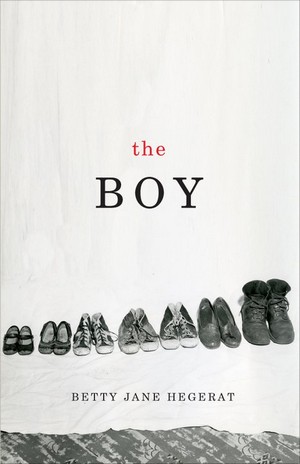
(at) eleven with betty jane hegerat: the boy

I was introduced to Betty Jane Hegerat’s work through a mutual friend, Susan Toy, who I met through a Humber writing program some years ago. A small group of us have kept in touch and Susan, who owns and runs Alberta Books, regularly fills us in on what’s new and brilliant, book-wise, in the western half of the country. Over the years I’ve come to value her judgment. Hegerat’s The Boy  was no exception to her exceptional taste.

The story, based on real events—the murder of a family in 1959 rural Alberta—is told in three interconnected parts: i) fiction (Louise’s story; she’s stepmother to Danny, a difficult and troublesome boy), ii) creative non-fiction (this is Daisy’s story, the real-life mother of five, whose stepson, Bobby Cook, ‘the boy’ of the title, was convicted of murdering his family and became the last person to have been hung in Alberta, though there remains much doubt about his guilt…), and iii) a memoir of the author’s journey through the research and writing of the book, during which time she develops a relationship with the fictional character, Louise, who makes regular appearances throughout, prompting Hegerat to storylines and directions she’s reluctant to pursue. The reader is privy to all these ‘conversations’.

It sounds complicated. It isn’t. At least not for the reader. As a piece of writing, it’s quite a feat; Hegerat’s use of structure alone is inspirational. (I challenge anyone to suggest a better way of telling this story.) The three perspectives (as well as comments by fictional Louise—this is such a mad and wonderful component!) eventually merge and, seen as a whole, we realize that it’s not just about the boy, but about everyone else, about the way we judge, the roles we play, the things we protect and why. The subject is disturbing, yes, not the least for its setting in the most ordinary of lives, but at the end of the day, the story is less about murder and more about compassion, small-mindedness, fear, what it is to be a woman, a mother, a friend, a neighbour. We all have an influence on each other’s lives and no matter our circumstances, we really aren’t that different— which, if you think about it, is both comforting and frightening.

The (At) Eleven series was begun as a way of chatting about books written by people whose paths have crossed mine in some small way or other. And because I feel that any discussion of words and stories goes best with a little something to eat—and because it’s hard to share a meal online—I make a suggestion at the end of the Q&A as to what meal the book has inspired. (In case anyone would like to do a little book club food pairing.)

“Eating is our earliest metaphor, preceding our consciousness of gender difference, race, nationality, and language. We eat before we talk.” ~Margaret Atwood from The Can Lit Food Book

And now, without further ado… I give you Betty Jane Hegerat.

~

1.  What literary character did you identify with as a child?

BJH—The orphans.  Although I had two loving parents and a perfectly fine childhood, I was drawn to what my librarian daughter refers to as the “plucky orphan genre” in children’s literature.  Anne, of course.  Elnora from Girl of the Limberlost, an old chestnut that’s not remembered by anyone but women my age and older.  Elnora had a mother but she was a cold one.  I adored Heidi, and longed to sleep on a straw mattress and breakfast on warm goat’s milk and hard black bread.  Amazing what we romanticize as children.

2.  Can you recall one of your earliest poems, stories (or hand-made book with finger-painted illustrations…)??

BJH—No hand-made books in the archives, but I do remember writing drippy poems, and being heavily influenced by whichever author I was reading.  Memorizing poetry was part of school in those days and I remember writing a Wordsworth-inspired poem about a meadow full of tiny violets—no daffodils on the Canadian prairies.  When I was in grade six I won a contest with a story about a teenaged boy who helped Grandpa stand up to the rest of the family and save the farm.  Maudlin, but apparently I had a way with words if not with realism. In high school I tried desperately to write in the style of Salinger.

3.  What were you reading at fifteen?

BJH—I read  voraciously when I was a teenager, and my tastes ranged wide.   To Kill a Mockingbird stayed with me forever.  So did Catcher in the Rye. 

My parents were blessedly unconcerned about my choices in reading, and never censored.  I read Lady Chatterly’s Lover when I was in my early teens and a steamy book called Harrison High was making the rounds when I was in high school.

I totally bought into Ayn Rand, but I was probably older than fifteen when I read The Fountainhead. It wasn’t until university that I discovered Canadian authors.

4.  Can you share a favourite passage from any book?

BJH—Too hard, this question!  If I did choose a passage, I know that within minutes I’d remember another and want to change it and that would go on for days.

5.  Do you find recurring themes in your work that surprise you?

BJH—I’m a social worker by profession, and I’ve struggled long and hard with issues of privacy and confidentiality and ownership of some of the stories I’ve felt compelled to write as fiction. Both of my novels were directly influenced by my social work experience.  Running Toward Home is the story of a lost child and I suspect written in homage to the children over whom I’ve grieved.  Delivery explores adoption.  It seemed I needed to write both of those stories, and then, to move on to picking at the bones of “ordinary”  families, looking for the secrets and lies, trying to answer the unanswerable question of why things run amok.

When I was writing The Boy, I realized that in the short fiction I was playing with at the same time — I never work on just one project, and short story was a good way to disengage from murder and mayhem now and again—forgiveness seemed to be a common thread.  Looking at those stories more recently, and contemplating finally getting back to work, I’ve also found that I’ve been exploring isolation in its many forms; everything from blissful solitude to anomie.

6.  I’m curious about the reading/writing balance. Are there certain times you avoid reading during the course of a project, or certain projects where you read only certain things? In the case of The Boy, I can imagine your research was an almost complete immersion for a period of time. During the years you were working on the book, were you able to read much at all that was unrelated to the Cook case?

BJH—I never stop reading.  The research I did on the Cook murders was relentlessly grim.  Late night has long been my best writing time, but I learned very soon after I began obsessing over the story, to push away from it long before bedtime.  An evening of reading was the best way to escape.

I always have a pile of books at hand, but because I was back and forth for a long time on whether to write this story as fiction or non-fiction, I was looking for other work that was written around true crime.  I picked up In Cold Blood again, Ann Marie McDonald’s As the Crow Flies,  Margaret Atwood’s  Alias Grace,  Meyer Levin’s Obsession.  One of the most disturbing books I read at the time, even more disturbing than the research I was doing, was Lionel Shriver’s novel We Need to Talk About Kevin.

7.  Louise is a truly ‘magical’ element in this story. Do you think you could have written the book without her? Did you ever worry she might stop showing up?

BJH—No, the book would never have been written without Louise’s irritating insistence that I tell her story.  The fiction began before the non-fiction.  I’m quite sure it was Louise’s story that triggered my memory of the Cook case.

Quite the opposite of worrying that Louise would disappear, I kept hoping she would so I could either write the book as non-fiction or walk away from it entirely.  I certainly didn’t want to write true crime, nor had I aspired to work in creative non-fiction.  When I finally acknowledged that Louise wasn’t going away, I gave myself permission—against all of the counsel I was getting from respected mentors—to create this hybrid of fiction, non-fiction, and memoir.

8.  There’s a powerful sense of foreboding in each of the storylines, not the least of which is how you, the author, feel throughout. You say, of an early draft, that you had only sketched out a little about the character Louise— where she was from and so on and had a general idea where you’d take things, but then you say… “Churning underneath that small cache of information… was a darkness I felt too cowardly to explore.” In fact, you were so uncomfortable you wanted to make Louise into a quick short story and be done with her. You refer to your apprehension as both an “obsession” and something that was “pushing you away”. Yet Louise wouldn’t leave you alone. (Thank goodness!) Here’s the thing: usually fear is a good sign in the writing process… where the meat of the story lives, but it sounds like this was something different. Was it? 

BJH—Yes, that is indeed the “thing” and I struggled with that as well, with knowing the value of “writing down the bones.”  I’ve always known that my own emotional reaction to the fiction I’m writing is a good sign, but in this case the fear was so strong that the writing of the book became an exploration of that fear as well as a piece of contemporary fiction running parallel to an infamous murder case.   I had a significant turning point when I realized that the only way out of the darkness into which I had plunged so obsessively was to get the fear on the page, acknowledge it, and find an ending that would put it to rest. As with most of my fiction, I was looking not for the happy ending, but for a moment of grace, a sense of redemption.

9.  What was the reaction to The Boy in the towns where the Cooks lived, the coffee shops of Stettler? Have opinions softened on Bobby Cook? And that deathbed confession by the uncle—has that simply gone down in history as myth? And what about reaction, generally, to the possible injustice served in this case; has your investigation, and the book, stirred up any hornet’s nests?

BJH—Opinions on the Cook case are as divided today as they were 50 years ago. Many people who read The Boy told me they were drawn afterward to read Jack Pecover’s book on the case, and if they did I suspect they may have come away doubting the verdict.  Jack’s book, The Work of Justice, The Trials of Robert Raymond Cook is a scathing account of the investigation and the trials.

My intent in writing The Boy was to go beyond the legal case, beyond the infamy of Robert Cook, to lift up this very ordinary small town family and examine the tragedy from that perspective.  If the book stirred up anything, it was more likely empathy for the family, including “Bobby”.

The myth of the deathbed confession by the uncle comes up over and again and I suspect it will live on as such myths do.

10. Finally, how did you feel as you left Louise in that final scene? And has she left you?

BJH—I have been invited to many book club to join in their discussion of The Boy, and one of the questions that comes up over and over again is whether I will return to Louise’s story in fiction, write a sequel to the novella that’s embedded in The Boy.  The answer is a resounding “No!”  I have a strong sense of resolution in the story Louise insisted I tell.  When the box of books I arrived, I pulled one out, leafed through it quickly and then closed the covers on Louise.  She’s gone silent, and I like to think she’s satisfied too.

11. CHOICES:

Scrambled or Fried?  Poached

Pen or Keyboard?  Keyboard always

Pasta or Pizza?  Pizza

Poem or Song?  Song

Forest or Field?  Field

Sweet or Savoury?  Savoury


Suggested Menu for The Boy:

Salmon Sandwiches
Strong Coffee (from a thermos and consumed in a car)

Flapper Pie

~

Betty Jane Hegerat is the author of two novels, a collection of short stories, and a book of creative non-fiction.  A social worker by profession, Betty Jane now teaches creative writing for Continuing Education at the University of Calgary and occasional workshops in other venues. She was the 2009 Writer in Residence at the Memorial Park Library.

Betty Jane writes from a longstanding fascination with relationships and families and the secrets and lies that bind ordinary lives together.

Delivery was shortlisted for the George Bugnet Prize for Fiction in the 2010 Alberta Literary Awards. One of the jurors said of  Delivery: “Domestic dysfunction never had it so good.  This novel lactates with life.”  The Boy was shortlisted for the 2012 City of Calgary Book Prize, the Wilfrid Eggleston Prize for non-fiction in the 2012 Alberta Awards and is a finalist in the High Plains Awards upcoming in Billings, Montana in October 2012.

She can be found at her website.

The Boy is published by Oolichan Books.

stories we (still) like

I didn’t spring from a literary family. Our shelves didn’t contain the classics or even the near classics—more like a strange collection of mistakes from The Book of the Month Club, discards from the library, or sometimes outright thefts books that somebody forgot to return. These were the days when withdrawals were noted in ink on slips of cardboard tucked into tiny pockets on the inside back cover. Easy for the odd book to fall through the cracks.

Our incomplete set of encyclopedia came from the various weekly promotions at Food City. Buy enough laundry detergent and you, too, could go home with The World Book of Knowledge [C through N], unmatched towels or flower-stamped dinner plates.

I remember a Reader’s Digest anthology, a fat wine-coloured Websters, an atlas with full-page colour pictures of gemstones, ocean life, constellations, that my dad and I would pore over at the kitchen table after dinner. After supper. We’d look at maps and I’d flip those huge pages, ask daft questions, revel in his answers, true or made up. We sometimes lingered for hours.

There were no kid books, no one read stories out loud. But I discovered the library early and dragged home stacks of things and don’t feel deprived in the slightest. The memory of choosing books, the way they smelled, the joy of surrounding myself with them in my room… I’m sure I missed out on something by not having them read to me, but fortunately I have no idea what that might be.

The only book I owned as a kid was a ‘Laidlaw Reader’ called Stories We Like. There were some Aesop fables and condensed Grimm’s among its contents, but mostly it was a collection of crazy little things about pillow eating geese, mud turtles, mornings on a farm, a talking brass kettle, what kittens dream about, a homesick monkey, flower fairies, and one delicious story about a boy sent to deliver three perfect cherries to the king but the cherries looked so good and it was so hot that he ate two of them en route and when the king read the accompanying note that mentioned three cherries, he said: Well, where the bloody hell are the rest?  Or words to that effect. The boy, bless his heart, admitted he ate them, prompting the king to say: You ate them? How the hell did you do that?  To which the boy replied, “Like this!” and popped the last one into his mouth.

God, I loved that story.

Still think of it every time I eat cherries.

I found the book the other day, among the many kid books I’ve collected as an adult. Lovely to open it again, immediately felt about eight. For the first time, I wondered about the authors—Louise Abney, Eleanor V. Sloan, Gerald Yoakam, M. Madilene Veverka, Margery Clark. Googling them only brought me to a lot of ‘Laidlaw Reader’ links that amounted to zip information. I suspect they were pseudonyms anyway. They have that ‘Ernest Hemingwaithe’ ring to them.

It’s beat up and written on inside and out, my name all over it, The Monkees etched into the cover, then I notice a stamp with the name of my elementary school. Uh oh. A bit late to take it back. Does anyone even read ‘Readers’ anymore? And who writes them? Are there still a team of Eleanor V. Sloans and Gerald Yoakams out there? It might actually be fun to show up at the Principal’s office, book in hand, apologize, admit to being a bit of a slow reader

But, nah, I’m pretty sure it was a discard.

That’s my story anyway, and I’m sticking to it…

Anyone else feel like confessing questionably attained books of youth?

(at)eleven with john wing — when the red light goes on, get off

(AT)Eleven is a series of Q&As with writers whose paths and mine have crossed in one way or another and whose books I want to discuss—ideally in person, over lunch (my favourite meal of the day)—but given how we’re all in different parts of the country and beyond, it’s a bit simpler to do a vicarious version. So here we are. If you’d like to take a moment to get something to eat, I’ll wait. And if, after the Q&A, you’re inspired to read the book, you might be interested in my suggestion of the perfect meal to go with the reading.

—bon appetit.

“Eating is our earliest metaphor, preceding our consciousness of gender difference, race, nationality, and language. We eat before we talk.”
~Margaret Atwood from The Can Lit Food Book

~
I’ve never met John Wing—we were introduced online by a mutual friend—but he’s a familiar face; I’ve been watching him on the Comedy Chanel for years. He’s a regular at Montreal’s Just for Laughs, and various other festivals and clubs throughout the country and the U.S. where he has long made his home. (It’s amazing how many of the best comedians working in the States hail from our side of the 49th.)  I was delighted when he agreed to do this Q&A, partly because he’s the only person I know who’s been on the Tonight Show (something like eight times), but mostly because I thoroughly enjoyed his book.
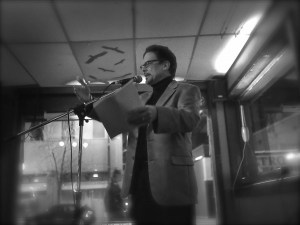
Beginning with the title—When the Red Light Goes On, Get Off—there’s a very engaging kind of instructional entre nous vibe in Wing’s writing; hey, he seems to be saying, if you think comedy is all laughs, think again: here’s the real deal, here’s what the road is like, the people, the venues, the hotels, the food, the hours and years devoted to a single joke. And while we’re at it, here’s how to write a joke—“Take them somewhere, until they’re sure of where it is, and then go somewhere else at the last second. The juxtaposition of the incongruous…”  He makes it sound simple but then talks about rhythm, sound, word choice, pacing, why the ashtray in a sex joke must be cold… He tells stories, dozens of tiny, perfect anecdotes, how 25 years ago he hired a couple of guys to help him “shpritz” jokes for his act; they worked for three hours (at $50/hour) and at the end of it he had one excellent joke, which he shares, and which he still uses and so “got his money’s worth”.

Here is what I didn’t know before reading this: a good comedian is a good writer. They have to be. I can see that now. Like a lot of people maybe, I assumed it was all about the performance, but that’s zip unless the words are there first… tight and perfect and rehearsed and balanced and revised and updated and and and. One difference Wing notes between writing standup and writing anything else, is that “The audience has the final say, and it’s by their sound that you make the corrections.”

Wing is a good writer. And this is a good book… should be required reading for anyone thinking of going into the business, as well as anyone curious about the ‘other side’ of the business, as well as anyone who enjoys a well told story. As much as we learn about the business, Wing also candidly shares personal moments. He talks about the addiction to attention, the solitude, drug use, the need for a good memory, his penchant for photographing cemeteries, meeting Eric Idle, rivalries, strange but solid friendships and the ‘private club’ that is comedy—a hard place to make friends ‘on the outside’.

Wing has also published a number of poetry collections… a form he says is not dissimilar in process to writing standup. That in itself sounds like a whole other conversation…

Overall, I was left feeling I’d grown up a little. My naive idea of comedy considerably changed, I found myself more drawn to the form than ever. I’m watching the acts on the Comedy Chanel in a different way, laughing, yeah, but with a deeper, new-found respect. Awe, even. This is one tough business and you wonder why anyone sticks with it. A question that could be asked of many professions that require mere brilliance, passion and dedication.

Let’s just be glad they do.

And now, may I present…  comedian, writer and poet, John Wing.

~

1. What literary character did you identify with as a child?

JW:  Probably Tom Sawyer, which was the first novel I read. The idea of coming to one’s own funeral was as delicious then as it is now. And there is such haunting beauty in the note he was going to leave. ‘We ain’t dead. We’re just off being pirates.’

2. Can you recall an early piece of writing?

JW:  I wrote a speech in grade eight about the Canada-Russia hockey series of 1972. I started writing poetry about that time, too. Lyric poetry, unimaginably bad. I tried to use large words, many that I had to imagine the spelling. I remember my version of ‘epitome’ was ‘epittamy’, which is, to this day, how I think it should be spelled. I tried to write a novel with my sister when I was around that age, too. I wrote the even-numbered chapters. Unfortunately it didn’t work out, as she hated and rewrote all of my chapters and I had no real idea what hers were about. I also wrote a funny newscast about that time. My brother and I performed it at a family gathering to huge laughs. The first jokes I ever attempted were in there. I recall one: “Studies show that the best way to avoid a hangover is to keep drinking. There is one side effect, however. In two months, you’ll be dead.”

3. Do you find recurring themes in your work that surprise you?

JW:  Of course themes are recurrent, sometimes to an embarrassing degree. I try to branch out occasionally, but it is very difficult. I don’t know that I have themes that surprise me. They all come from a deep well somewhere. I am more surprised to find new stories in the well at times, since one always wonders when one book is finished if there will ever be another. The why of things is always my fascination. The truth of what you think is true. A poet friend of mine once mentioned he was trying to get a Canada Council grant. I asked what he would do with it if he got it and he said, “Oh, you know, go up to Baffin island for six months and write poems about my father.” I suppose I have written more than four or five poems that reference Moby Dick. Probably just wishful thinking.

4. A few questions on process. Given the amount of travelling you do, it must be a trick to find time to write or create an ideal work environment—or does the how and where and when depend on the ‘what’, i.e. poetry vs. performance material vs. memoir? Did I read that you’re also working on a novel?

JW:  It’s not a trick at all. I write voluminous amounts on airplanes, which are almost perfect places to write. My routine is not a set thing, despite the warnings of all my literary heroes that it should be. My ideal work environment is a deadline. I need goals, concrete goals. I wrote thirty pages of ‘When The Red Light…’ in about ten months, and then was told by the publisher that he needed a full draft in three weeks. I wrote the whole thing in twelve nights, midnight to six, on a cruise ship. I finished the draft so quickly that I had time to do a polish, thanks be to God. Regarding the various types of writing, I tend to stick with one for a while, then switch to another. Where I am generally has very little to do with what I’m writing. The deadline creates the energy. Comedy and poetry are very similar types of writing, so that’s an easy switch. Prose is the hardest for me. I have started many novels and rarely reached a second chapter. However, hope springs eternal. If only someone would put a gun to my head. My favourite writing is the rewrite. I have three editors for my poetry books, and one gets the first draft, critiques it, then I rewrite it, send it to the second for another sandblasting, then another rewrite and the final editor and the final rewrites. Those are the best sessions. Making things better than they were.

5. In ‘When the Red Light Goes On, Get Off’, you mention that you’re good at being alone; I’m interested in the idea of solitude as it relates to art and wonder: is ‘being good at’ the same as being ’happy’ alone? And if we were to take work out of the equation, would the need for a certain amount of solitude still exist? It’s a kind of chicken/egg question, i.e. do the kids who are good at being alone become artists or do artistic kids learn to like being alone?

JW:  Yes, being good at being alone is the same as being happy alone. I don’t know why I’m happier alone, but undeniably, I am. This job requires one to live in one’s head a lot, and being alone helps with that. I don’t know if I would like it so much if I were in another profession. I don’t know if my liking it was bred in me and came in handy when I chose comedy or if I adapted when I had to. As a boy I was fantastically homesick, to such a degree that I was razzed about it by my siblings. I was hosting a documentary film last year and we worked full days, 8:00 a.m. to around six. Four of us: me, the director, the cameraman, and the sound man. We would get back to the hotel after a long day and the director, who was the friendliest of fellows, would say, “Okay, boys, dinner in forty-five minutes!” And I would just groan inwardly. Not that I didn’t like all three of them. I did. But God in heaven, I just spent all freaking day with you guys! I have to have dinner with you as well? I have for thirty years been used to going back to my room alone having the rest of my night free. I need the recharge. Or to put it another way: Once I was doing a panel on addiction among comedians, and I said to the host, “I’m not good at interacting.” “You interact with the audience,” he replied. “Yes,” I said, looking out at the crowd. “I love to perform for you, but I don’t want to meet any of you personally.” Cold, I suppose, but it was true. Do I need lots of alone time as an artist? Absolutely.

6. Speaking of art, I was struck by your description of comedy as a skill not an art, how you remind us that art is open for interpretation, yet a joke can’t be ambiguous… you don’t want fifty different reactions, or people leaving the show debating what everything meant. You want laughter, a visceral, immediate response. In that way it’s more like a science. This is what’s so great about the book, this quality of opening the readers’ eyes to the industry in a way that allows for an appreciation of the work as something beyond being able to tell a good joke, which I’m pretty sure is how most people see comedy. (I’m wondering if even newbie comics think it’s as simple as that.) In a nutshell, what would you say is the most important quality any successful comedian has… is there a common denominator?

JW:  This is difficult. You need three things to be successful. Writing ability, performance ability, and business ability. The amazing thing is you can do very well on a smidge of the first two if you have a lot of the third. The business ability has always been my weakness. The common denominator I have always seen is enormous insecurity. You need something you failed to get from your parents or siblings or peers when you were very young and impressionable. A prodigious memory helps, also. And persistence, which is the real problem now. Almost all comedians are going to just suck in the beginning. It takes two to five years to really develop an act. And there are going to be a lot of painful nights in that development. And you have to believe in yourself, and what you’re doing.

7. Any thoughts on why the majority of comedians are male?

JW:  Well, the road might be harder on women than it is on men, partly because every week you’re working with someone who’s hitting on you. It is an utterly nomadic life, where extended periods of time at home make you really itchy and hard to be around. Also, if your partner doesn’t do stand-up comedy, you can’t really share much of it with him or her. Do women enjoy being alone as much as men do? I don’t know. I married a stand-up comedian. She pretty much stopped when we had children. Women have other pulls on their psyches. I hope none of that sounded idiotically sexist. It has nothing to do with women being funny or not. They are amazingly funny. The club owners are almost all male, and they prefer booking males. Sad but true. Women have a harder time getting booked, because it’s either an all-woman show, or there’s only one. Not as many spots. So it’s a hard life, and a harder living for women.

8. I enjoyed the road stories; you tell them well and I can see how it plays a big part in the lifestyle—the road being almost a character. Does it ever feel like a friend/enemy at times? There are also some nice bits about the culinary (or lack of) side of things and a lovely riff about which hotels/motels have the best amenities, location, bedspreads… I was stunned to learn that the best rooms are next to the elevators. That surprises me. Is it true?? Just curious.

JW:  The reason the best rooms are next to the elevators is because they’re the shortest walk with a lot of baggage. and the further down the hall you go, the smaller the room is. You’re also close to the soda machine when you’re near the elevators. Yes the road is a friend, a companion. Have I been here before? Where did I go? Was it good? Let’s go there again. I’m going to Niagara Falls, London, and Toronto next month, and have favourite places in all three. And one of those favourite places will be the hotel room.

9. Of your poetry you say that you started doing it as a way to appeal to women. Did it work? And, more seriously, what about poetry speaks to you? Who are your influences; who do you read? And, finally, of all the genres you write in, which feels most comfortable? Which allows you the most freedom, if freedom is even the right word…?

JW:  Did it work? I suppose it did, to one degree or another. One wished to be seen as soulful, or the word we used at the time– deep. In college, all my dorm mates thought I was gay, which was a wonderful way to recognize the idiots. Poetry was something my father loved deeply, and I wanted to impress him, too. In learning about it and reading it out of spite for his criticisms of my poor reading habits, I grew to love it. Housman and Kipling were early influences, also e.e. cummings. The first book of poems I ever bought was The Collected Hart Crane. I thought it was a nice copy, and I thought his name was interesting. His poetry was a new world. I also bought Leonard Cohen’s Selected Poems around that time. Both were large influences. Then I began to get poetry books as gifts from relatives. My aunt bought me Earle Birney’s Near False Creek Mouth, and my grandfather bought me Don Coles’ Sometimes All Over. My grandfather was friends with Don’s father, Jack. And Don had been a school friend of my father. Don became the greatest influence over my writing, and one of my great friends now. He is my first reader, and second editor of my manuscripts. His poetry is among the best I have ever read, and I have learned much from him. In college, my first writing professor was John Ditsky, who had a huge influence upon me. We corresponded for twenty years and he was my first reader and his critiques were brief but telling. His letters usually said one of two things. ‘Liked the poems’ was what I craved, and ‘Not up to your usual standard’ was what I feared. Sadly, we stopped writing each other for a time, and had just started again when he died suddenly. I owe him a great debt.

I read and collect reams of poetry. British, American, Canadian, and some Irish. Philip Larkin, D.J. Enright, Thomas Hardy, John Clare, Dylan Thomas,T.S. Eliot, Robert Burns (technically not a Brit—a favourite of my father) among other U.K. poets. Many Americans, Gary Snyder, Allen Ginsberg, Gregory Corso, Theodore Roethke, Carolyn Kizer, John Ciardi, Walt Whitman, Cummings, Crane, Ezra Pound, Lawrence Ferlinghetti, and James Tate, a Boston poet who is so original you can’t put him in any category. My Canadian brethren include Susan Holbrook, Julie Bruck, Erin Moure, Phil Hall, Al Purdy, John Newlove, Raymond Souster, Marty Gervais, and Joe Rosenblatt. On road trips, I always take two or three to keep me company, almost always a Don Coles or a Phil Hall. I feel most comfortable writing poetry or jokes, which are very similar disciplines. The hardest thing to write is a funny song, where the jokes have to rhyme AND scan. The only thing I find harder is to perform a new song. The first performance is so scary. What if they hate it? And every song has a weak line or a weak couplet, and every single time you sing that part you think, “Goddamnit, I should fix this piece of crap line.”

10. The memoir ends with your first appearance on The Tonight Show. There’s a whole lot more to your story since then. Will there be another book?

JW:  I doubt it at the moment. It’s not on my radar. In the future, who knows?

11. CHOICES:

Chocolate or Vanilla?
Vanilla. No doubt. Vanilla

Prairie or Mountains?
Difficult, as I live within sight of mountains and grew up in a flat place. Though I like mountains, my heart is prairie.

Pizza or Pasta?
I like pizza pretty much one way, and I love the variations of pasta, so I will pick pasta.

B. Dylan or D. Thomas?
I’ll take the poet.

Chopsticks or Fork?
Man is this easy. Fork, fork, a thousand times fork.

Large Room or Small?
I have spent the majority of my life in small rooms, so I would hope it’s my preference.


Editor’s Note:  food and drink inspired by When the Red Light Goes On, Get Off

—one perfect grilled cheese sandwich, *sponge cake, strong coffee, Pepsi and beer

*read the book and the reason will be clear; still laughing about this one

~

John Wing was born in Sarnia Ontario during the Diefenbaker administration.
He has published seven books of poetry, all with Mosaic Press, and one memoir
with Black Moss Press. He has been a standup comedian for over 30 years,
logging more than 250 television appearances. His new book of poems,
Almost Somewhere Else, will be published in the fall. You can find John’s club dates on his Facebook page, and his books on Amazon.

this is not a review: elle, by douglas glover

 
“What do you with a girl who has journeyed to the Land of the Dead (Canada), has consorted with savages, left her soul on an island inhabited by demons, given birth to a fish, disappeared into a labyrinth of dreams and turned into a bear? At best, if I return to the place I once called home, I will be a spectacle. Now I have no home nor self nor soul.” (from Elle, by Douglas Glover, Goose Lane, 2003)

When, on p.167, I reached this passage in Douglas Glover’s novel, Elle, I thought: oh, I’m so glad someone’s put things into context because for a moment I feared I might be losing my mind…  not that that would have stopped me reading. The book was, despite my confusion at times, unputdownable for its quirky take on history and its sensuous imagery mixed with perfectly pitched satirical elements.

Its shape takes the form of an anti-quest, best explained in Elle’s words:

“… You go on a journey, but instead of returning you find yourself frozen on the periphery, the place between places, in a state of being neither one nor the other. Instead of a conquering hero, you become a clown or fuel for the pyre or the subject of folk tales.”

In a nutshell:

A wealthy and young nymphomaniac slightly bored tart living in 16th century France, who has disappointed her father (seems he disapproves of rampant lustfulness), sends her to Canada on one of Jacques Cartier’s ships. On board, she’s soon at it with a handsome but seasick tennis player—mostly to distract herself from a raging toothache (a tooth later removed by tying one end of a string to it and the other to a dog named Leon, who is then encouraged to jump overboard, taking the tooth with him).

Perceived as being more trouble than she’s worth, Elle is abandoned en route on a tiny island at the mouth of the St. Lawrence, along with her nurse and her lover. Soon after, they both die and she’s left alone to cope with the elements, hunger, and eventually a kind of weird dreamlike madness where she maybe/maybe not turns into a bear and maybe/maybe not gives birth to a fish. (One of the most beautiful scenes follows this ‘birth’ with Elle’s initial horror being replaced by love and the realization that the ‘creature’ will not live long; she then begins to tell it everything she knows…)

Eventually she befriends the indigenous people and ultimately comes to understand something of them, all of which leads to her transformation from acerbic child obsessed with trivialities to deeply thoughtful woman respectful of life and connected with the earth. It’s in this new, improved state that she returns to France to face a kind of culture shock of the soul.

What I loved:

Elle’s voice. She may be afraid, confused, possibly going doolally at times, but her delivery is consistent and crystal clear—casual almost—whether she’s reducing the most horrendous or inane events to brilliant satire, or being philosophical on the deepest level.

(Also loved the cover photo of a statue in Pere Lachaise Cemetery, in Paris; cover design by Chris Tompkins)

Favourite Character:

Richard, the tennis playing lover who does little more than build a tennis court (and rebuild it each time the tide goes out). He has almost no dialogue but is clearly, and cleverly, drawn by his actions; every scene with him in it made me laugh.

What I Questioned:

Possibly a few too many dreams. The story can be confusing at times—though this confusion parallels Elle’s experience, is essential, and works beautifully. However the dreams, and certainly the number of dreams, began to  detract from the surreal-ness of her experience by virtue of their mundane-ness (I mean, we all have dreams).

Three Impressions Overall:

Memorable characters. Beautifully strange journey. Smart, subtle, and delicious humour.

~

From the Re-Run Series: originally posted March, 2010.

_____________________________________________

—Purchase Elle online at Blue Heron Books.

(at)eleven with karen shenfeld — my father’s hands spoke in yiddish


“Eating is our earliest metaphor, preceding our conciousness of gender difference, race, nationality, and language. We eat before we talk.”
~Margaret Atwood from The Can Lit Food Book

I met Karen Shenfeld a couple of years ago through a series of events set in motion by a short post on Matilda about her lovely 2007 film— Il Giardino: The Gardens of Little Italy. To my surprise, she saw the post when she happened to be writer in residence at Open Book Toronto in December, 2009, from which vantage point we conducted a back and forth until we decided to meet for lunch in her College Street ‘hood. That it was winter didn’t matter—no gardens in bloom but one of her neighbours invited us into her house to see the most charming and amazing xmas display.

Ever since, I’ve had the feeling that where Karen Shenfeld goes, serendipity and the best kind of magic follows.

I was delighted when she agreed to a Q&A for my new (at)eleven feature on Matilda. Still evolving to some degree in my wee brain, but essentially meant to focus on writers and books, with a culinary slant. Because, in my world, good books inspire thoughts of food, and vice versa.

~

1.  I’m always curious about process. Where do you work best, do you have a writing routine, an ideal environment? And the all important question: what about blocks? Do you write through them, or do you feel they’re a necessary piece of the whole, a sign maybe that it’s time to step back for a bit and play?

KS:  I’m heliotropic. In the morning, I work at my kitchen table to catch the light of the eastern sky. In the early afternoon, I move to my west-facing study, which I confess looks like the study of a Victorian poetess: high ceiling, plaster mouldings, wood-burning fireplace, oak bookcase, Persian rug.

I tend to write from around 10 in the morning until 4 in the afternoon, only stopping briefly to snack. And I often work on several projects at once: the writing of a poem, a magazine article, or a grant proposal; the editing of a documentary, etc.

Ah, blocks… Yuck! I’m a harsh taskmaster. I chain myself to my chair and force myself to work through blocks. I try not to quit working until I have something–at least a line or two. Even a word!

2. Here’s an even bigger question: how do you deal with the distraction of the Internet, Twitter, FaceBook, etc.?

KS:  I get distracted!

3. What were you reading when you were fifteen?

KS:  On the Road by Jack Kerouac. The Electric Kool-Aid Acid Test by Tom Wolfe. Under the Volcano by Malcolm Lowry. I and Thou by Martin Buber. Shakespeare’s sonnets. The metaphysical poetry of John Donne and Andrew Marvell.

4. Are there certain themes that often appear in your work and surprise you?

KS:  I’m surprised by how often Jewish themes crop up in my works, because I don’t think of myself as particularly observant. (though, for complex reasons, which I can’t quite explain, even to myself, I do attend services at a tiny historic Toronto shul, a little ‘shteibele,’ many Saturday mornings, and I often light Sabbath candles on Friday night—a ritual, which, as I note in an early poem, my mother, a devout atheist, conscientiously  refused to do). I think Jewish themes crop up because, as a poet, I’m drawn to create works that somehow transcend the everyday.

5. My first taste of My Father’s Hands Spoke in Yiddish was when the book opened to p. 41, ‘Sweetheart of Second Avenue’; I was immediately struck by the ‘sound’ of the language, the joy and playfulness of the structure and rhythms, the way you combine English and Yiddish (in several pieces), mixing the two in a way I’m guessing comes natural to your childhood memory of growing up with these two ‘sounds’, these two cultures, yes?

KS:  You’re absolutely right. On two counts. I did hear lots of Yiddish when I grew up. My father spoke solely in Yiddish to my paternal grandmother. And my parents also spoke in Yiddish to each other when they didn’t want my brother and I to understand what they were saying. (No wonder we kids picked up so many great words and expressions!) You’re also right in surmising that I grew up in two distinct cultures simultaneously: a distinctly Jewish culture and a 1950s/60s Canadian culture.

6. Your poem on reciting Archibald Lampman is one of my favourites. That reversible skirt! And the innocence expressed in that back and forth motion, ‘reversing’ from the power of reality to the power of poetry. Can you talk a little about early influences, or The Moment it occurred to you that poetry would be an important part of your life?

KS:  I can honestly say I wanted to be a poet for as long as I can remember, but I’m not really sure why! I think the idea of it appealed to my heightened sense of romance. I also remember reading, at school, the poems of Pauline Johnson and, as the poem you mentioned reveals, Archibald Lampman. Those poems seemed to contain the power of a spell. I was tempted to try to create something that possessed that incandescent charge.

I started to scribble down a few poems when I was around 10 or 11. Later, during my undergraduate years, I studied the art and craft of poetry with Irving Layton at York University. (I’m still influenced by Layton’s sense of aesthetics, and return often to his signature poems for pleasure and inspiration.) But, I don’t think I really began to write poetry in earnest, or truly realized that poetry was going to be an important part of my life, a defining part of my identity, until I’d finished school. After fourth year university, I went on a long trip to Europe and North Africa. It was then, within the confines of cheap hotel rooms, that I began to spend substantial time calling upon the muse and wrestling with words.

7. One of the things that surprised me most was how physical the reading felt. Very much a journey, not only across time but actual space, and the way those ‘spaces’ featured, not as backdrop, but prominent characters—Bathurst Manor, northern Ontario, Auschwitz-Birkenau, a classroom, a skating rink, the shade of a tree—diverse mini universes in their own right, yet connected to a distinct and singular path. Was this intentional, this visiting of ‘place’, or something that became apparent to you along the way, as being essential to the greater, internal, journey?

KS:  Carin, you’ve made me super happy, because the visiting of ‘place’, the revelation of the genius loci of Bathurst Manor, was indeed one of my conscious intents in writing My Father’s Hands Spoke in Yiddish. What drew me to this? Perhaps because, as I said, I’m a traveller. Throughout my twenties and early thirties, I was fortunate enough to spend years back-packing through Europe, Africa, India, and South America. I hitchhiked across the Sahara desert through Algeria. I rode the top of trucks transporting coffee and tea across Zaire. I trekked in Nepal and floated idly on a houseboat on Dal Lake in Kashmir. In my mid-thirties, however, I decided I wanted to have a child and travelling became more difficult. (My husband, mathematician Stephen Watson, and I didn’t mind taking our son, Oren, out of school for long periods of time. But we did mind that, as he grew older, he began to get very lonely for his friends on long trips away.) So, I guess what I’m saying in this perhaps roundabout way is that travelling initially inspired the writing of my poetry, and now, the writing of poetry itself has become a means for me to travel.

I probably should also tell you that I love reading poetry that’s about ‘place’. I love, for example, the poems of Seamus Heaney, Dannie Abse, and Douglas Dunn. And, yes, travelling, for me, both literally and metaphorically through poetry, is an exploration of the self.

8. Golems! I sense mystery, reverence (also a hint of fear?) mixed with humour—I’m intrigued. Can you share something of what this figure represents in the context of ‘the neighbourhood’?

KS:  I’m so glad you’ve asked me about the golem! Because the golem poems are truly at the heart of my book. (In fact, I originally wanted to call the book The Golem of Bathurst Manor, but my publisher, Antonio D’Alfonso, did not think that enough people would be familiar with the Jewish folkloric figure.) I was striving to use the golem in the book as a leitmotif to connect the luminescent Eastern European Jewish Old World, which was essentially destroyed in World War II, to the Jewish New World in suburban North America. I was also, through the use of humour, striving to reference the Jewish people’s eternal, very unhumorous struggle against anti-Semitism.

By the way, a Toronto indie band, by the name of KlezFactor, has coincidentally put out a CD of klezmer-infused jazz music called The Golem of Bathurst Manor. I listened to KlezFactor’s music on the band’s Myspace site and I think it’s great! The music is available for sale from CD Baby and iTunes.

9. ‘Elm Tree’ is, for me, one of the most powerful pieces in the collection. It feels like a vantage point from which the past is seen through wisdom, experience, love, and everything suddenly has a deeper meaning; a final inhalation before the slow exhale of the denouement. I would love to know the background to this poem.

KS:  Thanks so much for your sensitive reading of this and other poems! Bathurst Manor, the suburban neighbourhood in which I was raised, was built on previously cleared farmland. So that particular elm tree truly was, as the poem states, the ONLY tall tree standing for blocks and blocks from my house. It actually stood right across the street from me in the backyard of an ever so slightly older girlfriend named Linda Schatzker (with whom I have recently reconnected). I grew up of course long before the time of central air conditioning. So, on hot summer days, all the kids on the block would go into Linda’s backyard to play in the shade of the tree. I was absolutely shocked and saddened when the tree died, along with millions of elm trees in Europe and North America, from the terrible Dutch elm disease.

10. Why poetry?

KS:  I love the compression of poetry. The distillation. The transformation. The transcendence. The unconscious connections. The physicality. The intellectuality. The abstraction. The sound. The fury. The music. The rhythm.

11. Choices:

Coffee or Tea?  Cappuccino!

Bob Dylan or Dylan Thomas?
Carin! Do I have to choose between these two? I love them both! And I was just in Wales!

Desert or Ocean? Ocean.

Sweet or Savoury? Savoury.

Pen or Keyboard?
Both. I begin composing most poems on paper using a fine-point rolling pen. I used to write on narrow-ruled graph paper, but, a little while ago, a friend and colleague, the wonderful documentary filmmaker, Dany Chiasson, gave me as a present a Moleskin notebook. And, now, I really like writing the first drafts of poems in it. Once I’ve written the first draft, I revise the poem on the computer.

Primary or pastel? Mediterranean pastels.

Editor’s Note, aka Culinary Slant food and drink inspired by My Father’s Hands Spoke in Yiddish:

a perfectly made espresso and a grilled cheese on matzo.

(To which KS added Campbell’s Tomato or Mushroom Soup—an after school staple in her mother’s kitchen!)

~

Karen Shenfeld has published three books of poetry with Guernica Editions: The Law of Return, 1999 (which won the Canadian Jewish Book Award for poetry in 2001), The Fertile Crescent, 2005 and, My Father’s Hands Spoke in Yiddish (November, 2010). Her work has appeared in journals and magazines across North America, and in South Africa and Bangladesh. Her poetry has been featured on CBC Radio, and on the U.K.’s 39 Dover Street.

Her personal documentary, Il Giardino, The Gardens of Little Italy, was screened at the 2007 Planet in Focus Environmental Film & Video Festival. She is currently at work on two new documentary films and on writing her fourth book.
~

My Father’s Hands Spoke in Yiddish, can be ordered on-line at Blue Heron Books. Support Indies!

From the Re-run Series: originally posted May, 2011.

this is not a review — aka: ‘stuff’ as story arc, plot AND character development

 
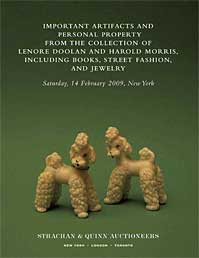
Leanne Shapton’s Important Artifacts and Personal Property from the Collection of Lenore Doolan and Harold Morris, including Books, Street Fashion, and Jeweleryis such fun I’m not sure I can do it even a smidge of justice here.

Presented as an exquisite auction catalogue, the book is 129 pages of photographs and ‘Lot’ descriptions of items belonging to the fictious Lenore Doolan and Harold Morris from the time they meet until their breakup some years later. Sheila Heti ‘plays’ Lenore to Paul Sahre’s Harold and the photographs of them are so real (goofing in photo booths, cooking, hanging out with friends) disbelief is well and truly suspended; they are Lenore and Harold. Sheila who?

The catalogue, in essence, catalogues the couple’s meeting and courtship through postcards sent, unique gifts, books with inscriptions, souvenirs and so on, through their relationship and ultimate breakup.

Despite there being no ‘story’—not one bit of narrative or dialogue—there is a definite rhythm and tension to the ‘stuff’ as it’s presented and we come to know these people intimately through their shoes, musical tastes, playbills, party invitations, dishes, clothing, sunglasses, handmade cards, tea towels, recipes, various doo dads and quirks.

LOT 1174 / A half a wishbone / The winning side of a turkey wishbone. Kept by Morris in his bedside table. Length 3 1/2 in. / $5-10

LOT 1197 / A small headlamp / A halogen headlamp, affixed with an elasticized cloth band. $12–15 / Used by Doolan for reading in bed.

A black and white photograph of the item (and often Doolan and/or Morris) accompanies each Lot description.

Towards the end of the catalogue the items slowly reveal a change in the relationship. A broken coffee mug, notes of apology, a white noise machine, restaurant receipt showing the main courses cancelled. Among the last items are pressed flowers and four-leaf clovers kept by each, separately.

Very cleverly done.

Apparently Shapton, a former Torontonian now living in NYC where, at the time of the book’s publication (2009) she was the art director of the New York Times op-ed page, got the idea after attending an auction of Truman Capote’s belongings (at which she purchased his overcoat).

I can only imagine the planning and execution of the book must have been both daunting and a complete blast.

Note: After writing the above, I then googled around for links and, to my horror, stumbled upon this. Good god. The whole magical point of the book is that there is NO action; the ‘stuff’ is what brings the people to life. I somehow can’t see Brad Pitt taking a backseat to a salt shaker.

And that may very well be unfortunate.

~

Important Artifacts is available for purchase online at Blue Heron Books.

Indie love.  ♥


From the Re-Run Series: originally posted in June, 2010.

beginings and endings and beginings again

For weeks now I’ve been dipping in and out of Beth Powning’s book—Seeds of Another Summer, a gorgeous thing of full page photos and essays, and I think the first book she published (1995), some twenty-five years after having moved to the wilds of New Brunswick.

I can’t seem to help myself—no sooner do I say ah, yes, that was nice, and set the book aside thinking I’m done with it, than I find myself opening it again (and it’s a library copy that must go back which is terrible and makes me think I need to place a call to my bookseller to find me a good used copy so I can continue dipping at leisure).

What I can’t get enough of, I realize, is the feeling of having a very pleasant walk with someone who loves nature and knows enough about it to know she has a lot to learn—and having this person point out the million things you don’t see along the way because you’re too caught up in looking at the whole.

Powning is great to walk with. She notices spider webs at dawn. And the hieroglyphics of bird tracks in fresh snow. The shadows trees cast. But she’s honest about the journey from city to country and how she didn’t see these things at first.

From the section on ‘Gardens’, she writes about the veggies just starting to grow in June when “…it’s so easy to nick the shallow-rooted weeds from their tenuous holds…. For a while, the garden grows just as I imagined it would, just the way I sketched it on paper, last February….Quickly, though, it passes this quiet stage and moves on to a startling urgency of growth….Thistles with roots like parsnips erupt through the straw in the cabbage bed. Mint creeps slyly amongst the broccoli. My fingers fly like a typist’s around the corn stalks, scrabbling away weeds which spring up nightly.…[By] late July, early August; the garden pressures me with its heedless and chaotic production. Keeping up with it is like trying to prepare dinner with guests in the kitchen, children underfoot, the phone ringing, and unexpected visitors pulling into the driveway and honking their horn.”

And I love her honesty and think: oh how very nice to know I’m not the only one who starts each year’s garden believing that this time I’ll keep things manageable—no bolted lettuce, no overripe cucumbers with seeds the size of foreign currency or woody zucchini because I forgot to pick it. 

Blackberry Patch

 Ha! Powning says to that, and suddenly I feel okay about the fact that my blackberries are overrun with Black-Eyed Susans and instead of beating myself up over it, I decide to take a picture and send it to a gardening friend in England, one of those people who you assume would never allow anything as slovenly as bolted lettuce in her garden…

—or maybe it will delight and reassure her.

Powning makes me want to celebrate my lovely crop of errant flowers.

In the section called ‘Boundaries’ she talks about the idea of home at the edge of wilderness and the misconception that nature is somehow separate from civilization and how that view changed as she began to understand and ‘know’ the fields around her, and stopped imposing on her expectations and assumptions of what it was.

     “Boundaries: between the geese and me, between the crickets and me. Yet the longer I listen, the more I hear.”

The photographs are of things we’ve all seen a thousand times: hillsides of freshly mown hay, a single buttercup, a spider’s burrow (okay, a few things we’ve never seen), but completely stunning in that way that can sometimes leave you in awe at the magnificence of ‘ordinary’. There’s also a sense of integration, of us and them, how the presence of one affects the other. A brilliant shot of footprints through a dewy morning field says it well.

It all seems so obvious when seen through her lens.

There is a section on ‘Trees’, another on ‘Wild Plants’ and, finally, ‘Home’. The last picture in the book is barn roofs at dawn. How perfect.

      “…Then, like a well-lived life, comes the quiet. I pull up the plants that have finished their cycle. Into the wheelbarrow I toss bolted lettuce, bush beans whose leaves are brown and crunch, and exhausted zucchini.
     “…There is a different kind of peace in the garden, now. It is not the serenity born of potency, and affirmation, but the quiet of fulfilment, and endings.
     “…At the end of the season, my garden plan is all but forgotten, and my illusion of stewardship long gone. Instead, like another harvest, there is another year’s memory of the voyage I have taken, swept, like a leaf, away from my own small visions and into the vast, potent current of regeneration.
     “…Autumn is like a long, deep breath drawn after some endeavour of great intensity.
     “Nasturtium leaves rot, quietly, into the soft mould between the raspberry canes.
     “In the end is the beginning.
     “In the garden is the whole universe.”

—from ‘Gardens’, in Seeds of Another Summer.

~

From the Re-Run Series: originally posted in September, 2010.

this is not a review: my life as a dame, by christina mccall

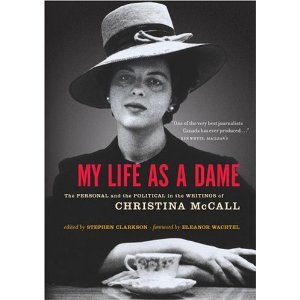
I’ve been time-travelling recently, spending happy hours in the late fifties, sixties, seventies and early eighties, with Christina McCall, one of the ‘lady journalists’, or dames, from that extraordinary era, and author of the collected essays in My Life as a Dame.

It was after the war. Technology was king (definitely not queen); women’s equality was still a quaint if irksome notion. Chaps were growing their hair and women taking off their gloves and corsets. Jane Jacobs had just arrived in Canada and wondered what was our problem with ‘identity’—“When you come here from outside, as I did, you know immediately what ‘Canadian’ means and that it is this very Canadian quality that has so far kept your cities liveable. Your saving grace is common sense…”.

Trudeau was a mania and George Ignatieff (yes, Michael’s dad) was the Man Who Should Have Become Governor General, if only the rules of the whole game hadn’t changed and then nothing was ever the same again. Yonge Street was just starting to get grubby, the Four Seasons was a still a motel on Jarvis and CanLit was a few talented writers with pluck.

It was a world of Bloody Caesars at mid-morning meetings, swingers, bad hair and the birth of bilingualism in Ottawa. “With their end-of-June paycheques, civil servants got an institutional green pamphlet telling them in effect to learn French or resign themselves to dead-end jobs.”

McCall wrote for magazines such as Macleans, Saturday Night, Chatelaine (during the Doris Anderson years), among others. Her subjects were people and politics; her slant was that of justice, a dissection of class, an attempt to understand various aspects of society, including her own distinctly privileged middle class one. In fact it was her own class and those ‘above’ it that were often her favourite targets. She observed the banalities of privileged lives but not in merely a cursory way—her essays inspired neither outrage nor indifference, but a changed perspective, or at the very least, thoughtfulness where once a vacuum had been.

She was especially passionate about women’s rights and defended them well (while wearing hat and gloves, naturally) and at every opportunity. One of my favourite pieces in the collection, ‘Some Awkward Truths the Royal Commission Missed’, refers to the document published in 1970 to study the status of women. She charged many things about it that were disgraceful in its execution and, even worse, the presentation of the final document: a long, dry, statistical non-account of things.

“I sat in on those hearings….and I found it one of the most engrossing, moving and involving experiences I’ve ever had. The women who appeared before the commissioners weren’t silly suffragettes in defensive hats or mannish harridans seeking unearned privileges. They were professors, farm women, nursery school teachers, Aboriginals, deserted wives, nuns, disaffected suburbanites—all real women with real problems of poverty, alienation, loneliness, and prejudice. Surely, something of their quality as human beings should have been imparted in the report, some part of their individual stories should have been told so that all those who couldn’t attend and hear for themselves would have been affected, as were the audiences at those hearings. At one session in Ottawa, for instance, when an Aboriginal woman from the Caughnawaga reserve was eloquently describing the hardship of her life, another woman in the audience, the very model of a Rockcliffe matron in an expensive dress and careful hairdo, sat with tears rolling down her face. Something of the eloquence and the tears should have been in the report.”

However, my MOST favourite essay comes last in the book: ‘What Won’t Appear in My Next Paradise’, written in 1970, in which she outlines what she hopes the world, especially as it relates to women, will have achieved by 2020. It begins:

“…For I belong that nameless generation of the 1950’s, that uncommitted company of the cool who were born in the years just before the Second World War: educated in the expectation of equality, confronted by the realities of domesticity and the double standard, too young to have been gulled into believing in the feminine mystique (as was the generation of the 1940s, for whom happiness was supposedly a man, four children on three levels, Birks sterling, real pearls and a grand slam at the Victoria College Alumnae annual bridge tournament) but too old and—oh! shameful admission—too liberal to be affected by the Sisters, Unite-Against-the-Capitalist-Imperialist-Phallic-Society! militancy of the new women’s liberation movements.

“If you add to the uncertainties of my whole generation my own specific experience—too many dues paid to feminism in the form of five years spent on a women’s magazine writing such mind-blowers as ‘Why Can’t We Treat Married Women Like People?’ and ‘Working Wives are Here to Stay!’—you realize that it would be paradise enough for me if by A.D. 2020 people had simply stopped talking about women as though we were a national problem… “

She then outlines five simple (and I mean s-i-m-p-l-e) but brilliant points—markers—that if achieved, would indicate a somewhat more enlightened world.

It’s both stunning and interesting to note that, in the almost half century since she wrote the piece, not one of those points has been realized by the so-called ultra modern, progressive, and so very very savvy society we think we’ve become.

~
From the Re-Run Series: originally posted in June, 2010.