(at)eleven with teri vlassopoulos — bats or swallows

“Eating is our earliest metaphor, preceding our conciousness of gender difference, race, nationality, and language. We eat before we talk.” ~Margaret Atwood from The Can Lit Food Book

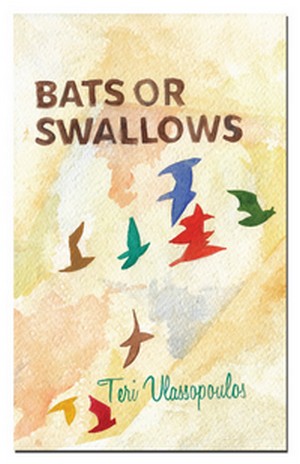
The idea behind the ‘(at)eleven’ Q&A series was to allow me to highlight books I like, written by people I know (because I am so lucky to know some lovely people who write), without having to worry about bias. Having said that, I don’t really know Teri Vlassopoulos, that is, we’ve never met in person although we’ve ‘known’ each other since taking the on-line Humber School for Writers mentorship program circa 2006, at which time a sort of group emerged.  Amazingly, the group (we keep threatening to name ourselves) is more or less intact and continues to inform, critique, support, and celebrate one another’s achievements—of which there have been a delightfully surprising number—not the least of which was the recent short-listing of Bats or Swallows for both the ReLit Award and the Danuta Gleed Award.

The other reason was to connect food to books. (I do believe there is a connection.)

A funny thing about The Group is how many of us are foodies. (Although, given that food is one of the world’s great tools of procrastination, I suppose it’s a natural love interest for writers.) In any case it ties in well with the small but important side theme, i.e. what food an indvidual book inspires.

My answer to the all-important question: what does Bats or Swallows make me want to eat?… follows the Q&A.

~

1.  Okay. My favourite question first: what literary character did you identify with as a child?

TV:  The first character that springs to mind is Leigh Botts from Dear Mr. Henshaw, even if our lives were vastly different. I almost feel embarrassed for identifying with a character that was, in many ways, sad when my childhood was not, but I guess as an only child there was a loneliness to him that I understood. And I liked writing fan letters too. Let’s also say Ramona Quimby and her cat-eared Q’s. (Beverly Cleary: she knew what she was doing.)

2. What were you reading at fifteen?

TV:  Girl by Blake Nelson, which I discovered when Sassy magazine published a few excerpts. Andrea Marr is a teenager in Portland who stumbles onto the local rock scene, wears a fish-printed dress, gets obsessed with rock star boys and has confusing and intense friendships. It was a bible of sorts.
3. What about themes… are there often recurring themes in your work that surprise you?

TV:  The surprise comes in retrospect when I read what I’ve written and realize that I’ve been working through an issue that I didn’t necessarily admit to myself was something I needed to work through.

4. Describe your work space, what’s on your desk?

TV:  Our apartment is tiny and I don’t have a proper desk, so I do the bulk of my writing on the kitchen table. I’m sure one day I’ll get sick of this arrangement, but in themeantime I prefer it. What’s on my desk depends on the day. Right now there’s a vase with a Christmas branch, my husband’s camera, a glass of water and a lone mechanical pencil. Soon: dinner.

5. What are your biggest distractions while writing: internet, chocolate cravings, a sudden need to learn another language, rain…? How do you deal with them?

TV:  THE INTERNET, UGH! I deal with it by telling myself that my writing time is precious and that I shouldn’t squander it. It sometimes works.

6. What’s the best advice you received (writing related or not) that you’d like to pass on?

TV:  I read Writing Down the Bones by Natalie Goldberg years ago and her comparison of writing to running was life-changing. “Like running,” she says, “the more you do it, the better you get at it.” It reframed the way I thought of the act of writing: an exercise that requires stamina and practice. This advice still reverberates with me, especially when I haven’t written for awhile and realize that I’ve gotten rusty.

7. The stories in Bats or Swallows explore relationships with family, friends, partners, for the most part from the perspective of young women. ‘My Son the Magician’ stands out for its POV of a mature single mother with an adult son. You nail the voice perfectly, BTW, but I’m curious – how did this one come to you?

TV:  Thank you! It was one of the last stories I wrote for the book and I was getting sick of young woman narrators, to be honest. I do a lot of thinking about my writing during my commute to and from work. The first sentence of that story came to me while I was waiting for the metro – I’m not sure why (I guess I was thinking about male strippers?), and once I had the hook, the rest of the story kind of poured forth.

8. There’s a sense of movement throughout the book. People physically moving from one place to another, from one person to another, distance, travel, road trips, moving on. Were you aware of this as you wrote or was it one of those things that become apparent only afterwards?

TV:  I write about things I want to read about, and travel—not necessarily big travel, but small voyages, physical and mental—is one of those things, so I was conscious about it at the time.

9. If you had to spend a long weekend with one of your characters, who would it be and what would you do?

TV:  Zoe from ‘Swimming Lessons’. We’d walk around Montreal and I’d show her my favourite places and try to introduce her to better friends. I’ve actually chosen to spend more than a long weekend with her because she’s now one of the main characters in the novel I’m working on.

10. Why short fiction?

TV:  Because I like reading short fiction; because it gives me flexibility to experiment with voice and style; because writing short fiction is conducive to a full-time job schedule; because I didn’t really think about it when I first started writing, it was just what I did.

11. Choices:

Breakfast or Lunch?  Breakfast! My love of breakfast is well documented (http://www.bibliographic.net/2011/02/26/scrapbook-4-in-praise-of-breakfast/).

Pen or Keyboard?  Keyboard.

Theatre or Film?  Film.

Dylan (Bob) or Dylan (Thomas)?  Bob.

Pasta or Pizza?  Pasta, homemade.

Bicycle or Canoe?  I have an irrational phobia of bikes and I can count the number of times I’ve canoed on my hands. I like walking.

Twitter or FB?  Twitter, as proven by @terki.

Coffee or Tea?  Coffee, although only on weekends because it makes me kind of crazy and this is not conducive to my day job.

Mountain or Ocean?  Ocean.

Party or Solitude?  Solitude.

Pie or Cake? — and *both* isn’t a choice ;)  CAKE! (With an extra slice for you for asking me such great questions. Thanks for the interview, Carin!)

Okay, Bats or Swallows. I’ve read you. Now what to eat??

My pick: gourmet burger made of  the best pasture-raised, sunshine-in-its-face-all-its-livelong-life, happy beef.
And a side of fries— travellin’ food.

~
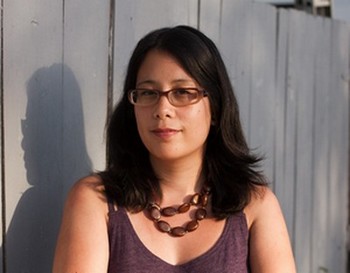
Teri Vlassopoulos is a Montreal-based writer who’s first collection of short stories, Bats or Swallows (Invisible Publishing), was shortlisted for the Danuta Gleed Literary Award for best first collection of short fiction and the ReLit Award. She is currently working on a novel. Find her on-line at http://bibliographic.net
~
From the Re-Run Series: originally posted January, 2012.

this is not a review: join the revolution, comrade, by charles foran

Charles Foran’s ‘Can’t Think for the Racket’ is a stunningly lovely essay on the moment a writer finds the courage to use their own voice. The moment when you realize that the truth of what you want to say comes not from your head or how clever-clever you are or what you’ve learned, but from an ability to notice the precise colour of juniper berries after a rain, or tap into some deep awareness of every experience you’ve ever had and translate that into what a bar of dark chocolate tastes like on a warm day in September.

Or whatever.

The berries and chocolate are mine. Food is my portal. Foran’s was music.

He wanted to play guitar but it didn’t go well; a musician friend tried to help by saying that to really get music “…no thinking was allowed. Whatever you do, don’t think. Whatever you decide to play, don’t ponder why you did it. For sure, whatever you are feeling—ah, feelings, again—don’t fuss or fret or worry about figuring it out. Don’t figure anything out. Just play.”

Despite himself, words were more this thing and eventually he found himself wandering about listening to the rhythm of language, trying to force what he heard onto the page.

While the friend’s advice stayed with him he didn’t really understand the message until he was living in Ireland, working as bartender, trying to capture the lingo, the music of the Dublin dialect, repeating descriptions he’d heard of wankers and omadoons and writing about their devotion to U2 and Thin Lizzy in a manuscript where the narrator is a Canadian working in a Dublin bar among characters— “wankers and omadoons who thrashed to U2 and Thin Lizzy…”

One day while he’s busily writing this dross, a piece of music, for whatever reason, offers up a moment long enough to replace the square peg in a round hole effort of trying to get all that ‘external’ stuff, all that thinking, down.

“One afternoon I put down my pen at the opening notes of a reel played on solo flute. The musician had the breathy style I associated with prog-rocker Jethro Tull. From the start, the music was fluid. I turned up the volume and watched through the window as a weather formation, stately as a regatta, floated out into the Atlantic ocean to the melody, wisps of angels’ breath scurrying along the margin between earth and sky. A second reel merged from the first. Now the flutist was adding ornamentation–triplets and trills and grace notes. Certain notes were stretched and held. Others were blunted or bitten. All manner of non-thoughts flashed through my mind while I listened and watched. everything seemed in motion, in flight; everything seemed at once exact and permanent, fleeting and evanescent. Like the weather. Like a young Canadian in a school house in Galway.”

And there it is. The moment beyond which a writer can never again not ‘know’ when their work is hitting a false note. We may try to fool ourselves into thinking it’s okay, that no one will notice, that the darlings are so effing cute they’ll make up for any weak areas—but no matter what tricks we try to play on ourselves—after The Moment there’s no going back. We will know when our work sucks and when it sings. (We may not know how to fix it, of course, but that’s another thing entirely.)

The piece ends with a quote from Northrope Frye that Foran had clipped and kept since his university days, proving his connection to rhythm and language from the start, but words that only now, decades later, sink in: “If the music of  a sentence is right, the sense will take care of itself.” 

Seems it’s all about listening. Not thinking.
But then, so much is. When you think about it.

excerpts from the essay ‘Can’t Think for the Racket’,  from the collection Join the Revolution, Comrade, Biblioasis, 2008

~

From the Re-Run Series: orginally posted in February, 2011.

no labels

Over at Fitch Happens, Sheree Fitch has written an interesting post on the question of what is children’s poetry? and why it’s even a question—in the end determining that “children’s poetry is poetry”… to which I say hallelujah, thank you and yes. I couldn’t agree more and would only add that society’s analysis of art, generally, combined with the impulse to categorize, complicate and impose labels on everything, serves no purpose that I can see except to make me tip over with the weight of it all.

Moving slightly beyond poetry—and if it must be defined—then, okay, what is a children’s book, story, poem, song…?

I suppose it’s something created with the child-nature in mind, however that doesn’t mean its appeal needs to be limited to children. I collect picture books because they’re gorgeous works of art on many levels and I love reading them for their whimsy, humour and joy as well as their philosophy and depth; they remind me of aspects of life, who we are, what’s important, in a way that nothing else does.

I’d like to think that children, also, are benefiting from reading outside the ages suggested on the backs of books—both higher and lower ages—and that teenagers are including both middle grade and adult books among their choices, and vice versa in all directions.

When we read as children, or are read to, we take away one thing, but if we dare to (are allowed to/allow ourselves to) come back to the same book as an older child, a teenager, an adult, we get something entirely different (or—also very nice—are reminded of the original insight). As with any art form, we take from it what we need at that moment.  When we read to our children, that’s one thing, but my hope is that we don’t read children’s books only because we have children, but because we were children, and because there’s bits of us from that enchanted time we’d be wise to try to hold onto.

Labels are useful for publishing houses, bookstores and libraries but we mustn’t let that limit our choices, for ourselves or our kids (or the gifts we give each other; I love giving picture books to adults).

Consider those merry chaps, those pre-label Grimm Brothers, who wrote at a time when stories weren’t specifically for children and whose stories can absolutely be consumed by all ages and then consider what’s been done to the original “faerie tale”— Disney is a good example of “kiddifying” work. In commercial hands stories quickly become shlock, so much candyfloss.

Maybe THAT’S what we’re talking about when we talk of “kid stuff”.

But that stuff isn’t the real goods—because real words are ageless. And because everyone knows once you’ve discovered the real thing you’ve discovered it for always.

~

From the Re-Run Series: orginally posted November, 2011.

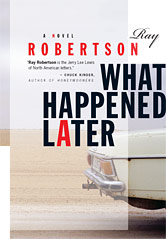
this is not a review: what happened later, by ray robertson

 
My favourite books are always those where not much happens except entire universes quietly change. Both the characters’ and mine.

Ray Robertson’s What Happened Later is such a book. I read it twice last year. Each reading brought me deeper into the language with layers yet to be discovered.

It’s all about the sentences.

Written in two story lines—the first, a fictionalized account of Jack Kerouac’s last road trip, a kind of going home, to find his ancestral roots in Quebec. The second, a fictionalized account of a boy named Ray Robertson who’s trying to get away from home—1970’s small town, Ontario—and find a copy of On the Road.

In alternate chapters and distinct voices, the stories weave back and forth through time—and not much happens. Except life. On every page, in very sentence—every word is full of what feels like absolutely raw truth—not fact necessarily (it’s fiction, right?), but truth. 

The chapters play beautifully off each other—from the innocence and simplicity of Ray’s life and his introduction to Jim Morrison:

“Before Jack Kerouac could change my life, Jim Morrison had to save it. Every Almighty needs an ambassador down below to do his dirty work. Mine wore tight brown leather pants and shouted out his rock and roll couplets like it somehow actually mattered.” 

—to Kerouac’s bennies for breakfast, falling down drunk with booze and resentment, guilt; his brilliance in offering up what every story needs:

“… a flesh and blood body on the other side of the book telling the story and not just a bunch of nouns and verbs and adjectives held together under house arrest by a bully bunch of rules of composition some mastermind mammon cooked up to keep everybody talking and thinking and living the exact same way. Because ask yourself this, Mac: Were we born and do we suffer and do we die just so we can all sound the same? What a spit in God’s eye, that.” 

The book begins close to the end of Jack’s life and close to the beginning of Ray’s, but ultimately, we’re left mid-stream in both, knowing how each will end. Along the way we see Kerouac in a new light as he mourns the loss of a Georgia pine, holds a kitten up to see the moon, asking aloud how science could explain that; we discover tenderness, vulnerability, and a man whose greatest desire was “…to be Cervantes alone by moonlight.”

I can’t think of a better shape or tone for this book. There’s an almost physical sense of movement with each chapter—from the jaded ‘star’ who’s had anything but a normal life, desperate to get away from society’s narrow-minded idea/treatment of ‘fame’—

“Remember how last week you were a spontaneous prose poet, a singular bard of bop, a lyrical visionary declaiming a previously unknown hipster-rich American underbelly? Yeah, well, now you’re a sloppy, undisciplined, self-indulgent media creation prone to sentimentality, immorality, and obvious sensationalism. Next, please.”

—to Ray, living in this tiny, loving world of grandparents, leather sleeved sports jackets; where he so sweetly sings the national anthem to his father in the bathroom; a place where his greatest career challenge is climbing the ladder of the Sears sales team; a world of wry observations—when he accidentally kisses his own shoulder while making out with his first girlfriend, he reflects “…but that’s okay too…”. This mini philosopher, obsessed with finding the answers to life through Kerouac—all such delicious irony.

Despite my love of the fiery, gorgeous, richly written Kerouac chapters—at the close of each, I found myself turning the page, eager and curious to read more of young Ray, and immerse myself in the very different but just as honest tempo of his life. In many ways it’s Ray’s story, but not completely, because to tell either of the two on their own would render both less.

—This is my part of the movie, let’s hear yours.  Jack Kerouac, Tristessa  (Epigraph, What Happened Later, by Ray Robertson, 2008, Thomas Allen)

~

From the Re-Run Series:  originally appeared in February, 2010.

(at)eleven with steven mayoff — fatted calf blues

“Eating is our earliest metaphor, preceding our conciousness of gender difference, race, nationality, and language. We eat before we talk.” ~Margaret Atwood from The Can Lit Food Book

From the start, food has featured large in my friendship with Steven Mayoff. We met at the inaugural Seawords workshop series on PEI, in 2009. A brilliant experience and a magical place where words and the business of words were the daily focus from early morning til night.

But it’s the food I remember most.

Oysters right off the boat, lobster, patios with beautiful watery views, roadside chip vans selling fresh-from-the-red-dirt spuds, mussels ten thousand ways, a tiny mom and pop diner on a Charlottetown side street that made the kind of perfect toast I haven’t eaten since I was a kid, and the giant bowl of cioppino Steve and I shared at one exceptional place he kept suggesting I try: The Dunes (officially now one of the top ten places I’ve ever eaten; and I’ve eaten a lot).

Food continues to find its way into most of our e-conversations, if only as a closing comment—and due to Steve’s powers of description, I can sometimes almost smell what his foodie-extraordinaire wife, Thelma, is fixing for dinner (especially hard on the days I’m having sauerkraut).

Despite the title, Fatted Calf Blues is not about food. But in my world, all good books inspire culinary thoughts at some level.

The meal inspired by Fatted Calf Blues can be found at the end of the Q&A.

~

1.  What literary character did you identify with as a kid?

SM:  As a kid the only literary characters I knew came from TV and movies, such as The Wizard of Oz or Winnie the Pooh. I actually walked around with a posse of imaginary cartoon friends (Huckleberry Hound, Yogi Bear, etc.) like we were some kind of street gang. They were my confidants.

I didn’t do very much reading, although I do remember picture books about mythology and dinosaurs. And I remember being fascinated by book spines on our shelf and strange titles like Tropic Of Cancer and Nine Hours To Rama and unpronounceable author names like Kazantzakis. There was also a book about the Holocaust that had gruesome photos of shrunken heads and lampshades made of human skin. That certainly caught my attention.

The first books I remember actually reading were The Apprenticeship of Duddy Kravitz and Catcher In the Rye in high school. Of those two, I’d say I identified more with Holden Caulfield: the loner, the outsider, someone with a rich interior life. Duddy was more of a go-getter, which is not how I saw myself, although the influence of Richler’s book is still with me. Salinger influenced me more with his short stories.

2.  Can you recall your earliest poem, story or finger-paint-illustrated trilogy?

SM: I remember making a finger painting when I was probably around 5 or 6 years old and having my sister, who was around 19, ask me what it was called. I’m pretty sure I said something like “Snakes of Love.” I knew it was a grown-up thing to say and my sister was both amused and shocked.

I drew a lot as a kid, mostly super heroes and later on rock bands. I didn’t start writing poems until my last year of high school. I had three published in the school literary journal. One was a description of a pair of construction boots “looking at the world through unlaced eye-holes” or something like that. Another was some kind of meditation on the contradictions of labels while trying to figure out my identity. I can’t remember the third. I was also into writing song lyrics as a natural outlet for being a frustrated musician. I didn’t attempt a short story until my late twenties.

3.  Are there recurring themes in your writing that surprise you?

SM: I’m surprised when any kind of recurring theme arises, because I don’t think that way. I’m not even sure what the recurring themes are. Alienation, I guess. Ummm…good hygiene? Seriously, I do notice things in retrospect that, more often than not, don’t surprise me. But I am a great believer in what Wayson Choy said: “I know I am a writer because until I’m writing I don’t know what I know,”

4.  Do you work to a routine, a schedule, a daily word count?

SM: The only real routine I work to is the urgency in my head that I have to get something done. How that happens is anyone’s guess. There’s no particular schedule I follow, except that I try to write every day, usually in the afternoon or evening. The idea of a daily word count makes me want to blow my brains out. I know the professional thing is to see writing as a job, but I’ve always resisted that. I worked at various jobs for most of my adult life, so I’m happy not to have one now. In one way I kind of envy writers who say they wake up and bang out so many pages or words first thing in the morning. Waking up is a long process for me.

5.  What is a favourite passage from any book?

SM: “Listen: Billy Pilgrim has come unstuck in time.” from Slaughterhouse Five. It’s a simple sentence (I suppose I should say “deceptively simple”) that leaves a lot to the imagination. It could be describing the most liberating experience or the most horrifying nightmare. Surprising how often those two things go hand in hand.

I’d have to say that sentence (as well as the book and Vonnegut in general) really influenced my writing. The whole idea of coming unstuck in time is a kind of madness where one discovers that linear time as we understand it doesn’t exist and everything – past, present and future – is happening all at once. That’s what fiction and the writing process is for me: a kind of madness where truth reveals itself, but not in any coherent way, until I begin writing and trying to make some kind of sense of it. I learn things about my characters and the situations they are in (and also about myself and what is important to me) as I slowly organize the events and give shape to the story.

6.  What was the best advice you ever received as a writer?

SM: When I was in high school I asked an English teacher what I needed to do to become a writer. He looked down at me soberly (he was a giant of a man with very blue eyes) and said: “You have to suffer.” That scared the crap out of me and maybe even deterred me a little, because I didn’t know what “suffering” entailed. I thought of that when I published my first book, Fatted Calf Blues, (I even thanked that teacher in the acknowledgements). In retrospect, I like to think he was really telling me to go live my life so that I’d have some experience to enrich my writing. I appreciate the fact that maybe he was just treating me like an adult and giving me the real information, thinking it would either scare me off or inspire me. And it did both.

7.  The opening story, The Most Important Man, sets the tone of ‘displacement’ that runs through the collection, personal discomfort, shown through discomfort with the physical space the characters occupy. This leads me back to the theme question: was this intentional, something you were exploring, the idea of ‘not fitting’… or did you recognize the thread only after the stories were written?

SM: To be honest, I didn’t realize there was a thread until you just mentioned it. While promoting FCB I was asked what the connecting idea of the stories was and I usually tried to bluff my way through and say all the characters were searching for some notion of home. “Displacement” is probably a better answer. Anyway, these things only become evident after the fact. I never or rarely think about them beforehand. But again, in retrospect, the themes of displacement and looking for a home are very personal for me, so it only seems natural that they would creep into my writing. I’m obviously attracted to those kinds of stories, so I have no doubt an unconscious part of my creative process preplans some sort of exploration of those themes.

8.   A couple of the pieces are written in either the voice or POV of a woman; what were the challenges with that, if any?

SM: I can’t think of any real challenges. I invest myself in my characters and try to be a kind of witness to their lives. I never think to myself something like: “what would a woman do here?” because I’m looking for the humanity in the character, although I do believe there are specific differences in the attitudes of men and women. Men might have more difficulty expressing themselves and women might be more open about their feelings, but people as a whole don’t voluntarily give out too much information without some prodding. So discovering any character’s voice or POV entails me searching for the right buttons to push.

9.  If the title story were made into a film, who would you like to see play Mavis Jean? (Any other casting ideas?)

SM: That’s a very timely question as I have just returned from the Screenwriters’ Bootcamp that happens every year in Charlottetown and is sponsored by the Island Media Arts Cooperative (it’s only open to Atlantic Canadian writers). I was in an adaptation workshop with renowned story editor, Ken Chubb (he was involved with the Canadian horror film Ginger Snaps and the CBC mini-series Dragon Boys). I’m trying to adapt the story Fatted Calf Blues into a screenplay and it has been a long process. After this workshop, I now find myself back at square one, although I have a better idea of how to go about it.

Mavis Jean: Hilary Swank, Tara Spencer-Nairn (also, Nancy Roberts, although she is older, would be interesting)

Milo: Michael Cera, Elijah Wood

Two-Gun Billy: Chris Cooper, Nicholas Campbell

Vesta:  I used to think Jackie Burroughs was pefect, but she’s passed away, so my alternative would be Toronto actor, Barbara Gordon. Or even Sissy Spacek.

10. Why short fiction?

SM: It has the expansiveness of prose, but matched with the precision of poetry. It is a kind of postcard portrait that allows you to glimpse life beyond its edges. Every short story should be a kind of map you might find in a mall that says: You Are Here.

11. Choices:

Coffee or tea?  Coffee. I do like a nice caffeine buzz.

Lyrics or prose?  Lyrics. My fantasy job is to be a lyricist in a rock band like Keith Reid in Procol Harum or Pete Sinfield in King Crimson. (I bet you will have to Google these). The next novel I want to write will have a lyricist as its narrator and a series of song lyrics to complement the unfolding story.

Ocean or river?  River. I live right by one and I think a river has more metaphorical mojo.

Pen or keyboard?  Keyboard. I find it more playful. I like tapping things. Also, it placates the frustrated musician in me. I’m the Elton John of hunt-&-peck.

Kundera or Beckett?  Kundera. His quote: “The present moment is unlike the memory of it.  Remembering is not the negative of forgetting.  Remembering is a form of forgetting.” from his book of connected essays, Testaments Betrayed, helped me get a handle on my novel manuscript, Blessing and Song (which I’m currently shopping around).

Scrambled or Poached?  Poached. On toast. I have it rarely, so it’s a treat.

Editor’s Note: Food and Drink inspired by Fatted Calf Blues

Beer Steamed Mussels (aka moules) and frites with an icy cold selection from

The Gahan House Brewery

~

Steven Mayoff was born and raised in Montreal and now makes his home on
PEI. His fiction and poetry have appeared in magazines across Canada and the
US, as well as in Ireland, Algeria and France. His story collection, Fatted
Calf Blues, won a 2010 PEI Book Award, was shortlisted for a 2010 ReLit
Award and was a Finalist for the (Maritime) 2011 CBC
Cross-Country Bookshelf.

His web site is www.stevenmayoff.ca

From the Re-Run Series: originally posted in April, 2011.

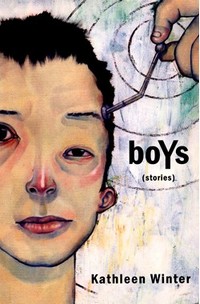
this is not a review: burt’s shawarma, by kathleen winter

Rhonda has been angry and unhappy for a long time. It doesn’t help that she lives on the outskirts of a town whose claim to fame is being the nation’s teenage suicide capital “…just past the point where the Pinegate Pizza won’t deliver”. Nor does it help being married to Dan, a farmer with a soul as romantic as a milking machine. God bless him though, he’s one of those guys who thinks that duty and maintaining a roof over one’s head is enough. In his own out-to-lunch way, he tries. He’s probably in as much pain as his wife but it matters to him less or it matters in a different way. He takes solace, not in conversation, not in reaching out to her, but in immersing himself ever deeper in the work of livestock, insulation, leaks in the barn. Nothing personal… these are merely the things that matter.

Part of her knows he won’t change yet another part continues to believe he’s capable—if he tried—of finding a way in. She’s waiting for the moment where he’ll sit down next to her in his cowshit covered clothes and say to her:

“…Why don’t I get a shower and make you a cup of tea? Hoffman’s elm is like us, isn’t it? I’m sorry you’ve been lonely inside. Let me touch you? Not with my paws—with the word rain, the colour green, with eating bread and sitting here till a yellow bird comes and eats the crumbs.”

She’s starved for him to merely try. 

When Dan suspects (correctly) that Rhonda is having it off with Burt, the local ‘exotic’ who runs a Lebanese cafe, and who thinks Rhonda is perfect, he buys her tulips for Valentine’s Day. This is huge in their dry and loveless union and enough to keep it going for another painful stretch, despite her apathy.

“…she no longer cares that her vinyl toilet seat has torn pieces that stick up and prickle her butt.”

While she realizes the thing with Burt can’t last, she takes some comfort in the knowledge he can be replaced. By which logic, so can Dan, albeit with a bit more difficulty and anyway, what would be the point?

“You can tell about the state of anyone’s marriage from their medicine cabinet,” she tells her sister Bett. Her own has empty calamine lotion bottles piled in with rubbing alcohol for ears pierced fifteen years ago, ancient antibiotics, blunt useless tweezers and a stack of wrapped soaps with cobwebs on them from the Holiday Inn in 1989, which was the last time she and Dan took a trip together, and that was to bring home a trailer for getting show cattle to the fall fair. She doesn’t care about the fence Dan promised to make for her garden twenty years ago. She doesn’t care that Dan had an affair when the kids were little, or that there has never been chemistry between Dan and herself. She doesn’t even care that the magic with Burt is dying out. Bett calls him an interim phase and that’s fine by Rhonda. What matters is that her anger, her poisonous anger, has drained away, thanks to Burt. She watched her mother carry the same anger, panicked when she realized she had it too, knew one day she was mad as hell at her whole life and it looked like there was nothing she could do about it. Burt stopped the time bomb with his hideout, with its cool walls and blue shadows where she didn’t have to do things from morning till night in which she had no interest. She will feel relief deep down, be able to breathe deep down, whenever she thinks of Burt even after this is over, which it almost certainly is already, with no illusion of anything permanent. No one has mentioned Rhonda helping Burt run his cafe, but not in the same way that no has ever mentioned her helping Dan run his farm.”

— excerpts from ‘Burt’s Shawarma’, from the collection BoYs, by Kathleen Winter

Three Impressions Overall: delicious ironies, entire worlds sympathetically drawn in mere pages, and the kind of truth that makes you squirm as it pulls you forward, then leaves you pretty much where you thought you’d be left for pretty much the reasons you thought you’d be left there. Only thing that’s changed is that now you’re aware of the ‘why’. It may not feel like enough but of course, truth is always more than enough. (And may I say I love the cover of this gorgeous collection.)Note: this post first appeared in May/2011 as part of Year of the Short Story (YOSS) celebrations.

Now part of the Re-Run Series.

______________________________________________

—Purchase boYs online at Blue Heron Books.

hypothetically speaking…

IF… and I’m not saying I have, I’m just saying if I had just finished reading a book that had been heralded as the next great literary thing, or words to that effect [the point being it was raved about excessively]… If such a book existed and I had just finished reading it and I found it, let’s say lacking to a great degree in literary greatness to the point where almost none was discernible [unless literary greatness translates into a few not entirely bad sentences and a few good ones]… if I’d just finished that book—in which the title character is essentially pointless, only occasionally and dismissively referred to, and who then dies and is referred to again down the road as a means of cueing the reader to recall the narrator’s bond with them and so trigger an emotional response [which doesn’t happen, BTW, because exactly zippity-do-dah in terms of a relationship has been developed between the two and frankly nobody cares that one of them is dead…]

…If I’d just read this book, in which, it should also be mentioned, that while written in first person, the narrator knows things inside people’s heads and other places she has not been—which annoys me more than this keyboard has letters to describe, given how hard I work and curse and revise to avoid just such sacrilege—and while we’re at it, the narrator’s dialogue is not consistent with her age, not to mention dull, not to mention one minute she’s an innocent and the next, though still the same age, she’s expounding on life in a way that suggests having spent the past century sitting cross-legged on a mountain-top in saffron robes…

…IF I had read such a book, a book that had been touted as a remarkable debut, in which not one shred of poetry exists, where even the imaginative is obvious [and just in case you still don’t get something, don’t worry, it’ll be spelled out in crayon somewhere down the road]; where countless unrelated events span decades haphazardly and pointlessly, leaving a nest of loose threads rather than any semblance of whole cloth; a book that reads like a bad movie in which darlings rule [we can only assume they amused the author too much to have them properly shot], where relationships are flat, and where—because apparently nobody stopped her—the author uses both ‘immediately’ and ‘suddenly’ in the same sentence…

had I read such a book—I would have slammed it shut and asked that age-old question: wtf?

For the record… it’s not the author I blame. It’s a good draft. But where was the editor? And how does a reputable house publish this, in this… this very good draft condition?

But here’s the real sixty-four thousand dollar question: how in all that’s decent does it not only get good reviews, but buzz in high places…?

I mean, if there was such a book. And I had just read it.

diana athill, let’s have lunch…

 
Because lunch is what you want to do with someone who looks out at you from the cover in such a saucy Oh do I have a few stories up my sleeve sort of way. And in that necklace.

And when that lunch turns out to be just you and the book and maybe a salad at a corner table in a cafe, it’s really okay because Diana Athill’s Somewhere Towards the End reads like a chat, the tone is casual as she shares her philosophy of life (which includes a lovely riff on tree ferns). And while you munch on your croutons she goes easily from one thing to the other: memories of painter friends, writer friends, thoughts on loyalty, faith, death, genes — both good ones and not so good—  sex, London, night school, religion, gardening, driving, love, reading, writing and books — never focussing overly on opinions or even offering any of this from the perspective of age, but merely from the perspective of someone who’s paid attention.

At the end of your salad you close the book, look at that face, that DaVinci-style grin, and all you can hope is that you might grow up to be even one tenth as interesting and wear big jewellery with that kind of panache.

“There would be an agreeable sort of itchy feeling, a first sentence would appear from nowhere, and blip, out would come a story. One of them won the Observer’s  short story competition, an intoxicating thrill in that it showed I had been putting down words in the right way, but it didn’t  make any more stories come after a tenth had fizzled out after two pages. That was followed by a lull of almost a year. Then, looking for something in a rarely opened drawer, I happened on those two pages, and read them. Perhaps, I thought, something could be made of them after all, so the next day I put paper in my typewriter and this time it wasn’t blip, it was whoosh! — and Instead of a Letter, my first book, began. Those stories had been no more than hints of what was accumulating in the unconscious part of my mind, and the purpose of that accumulation, which I hadn’t known I needed, was healing.” ~ from Somewhere Towards the End, by Diana Athill

this is not a review: the forgotten waltz by anne enright

Oh, Anne Enright. I do love your words so. The way they lie there on the page, end to end, magically forming sentences. I’m sure it’s all quite effortless of course, this brilliant way you have of conveying things. I have no doubt it’s as simple as wandering about your life, observing, thinking, mulling, fashioning bon mots almost accidentally as you shine your shoes or select grapes from the fruit monger’s stalls, and then having them fall out of your head, the words I mean, clunk clunk, onto the pages at just the right time in just the right order. Oh look! you might exclaim, That’s exactly what I meant to say, exactly what I was thinking, I don’t need to change a comma… someone peel me a grape…

The Forgotten Waltz, Enright’s most recent novel, begins simply, with a glance over a shoulder and a child. It’s classic girl meets boy. Gina meets Sean. Both are married. Both of them not especially unhappy or happy, not especially well matched or mismatched.  And then there’s the child—his, Evie, who is not quite right—a tendency towards seizures or something never clearly defined—a situation that parallels Evie’s eventual role in Gina’s life, and vice versa. There is little emotion expressed yet it’s all about emotion, driven by a thirst for it and then regret in its inevitable passing and morphing into something resembling real life. The way things do.

What gives the book a delicious tilt is the vantage point Enright chooses to tell the story, i.e. from Gina’s current status happily (happily?) living with Sean. The thrust of the story is her recollection of the affair, its building blocks and motivations, the changes that occur, things given up and left behind in the pursuit of what feels like love and in fact may well be. The eager or reluctant, sometimes regrettable, tradeoffs and surprises en route, hidden costs and, most importantly, the thing no one ever thinks of: the landscape at the end of the day— the stuff that comes with as well as that which is forgotten once the music stops and the lights come on.

… In which case, Evie’s room is like something after the tide went out: dirty feathers, scraps of paper, endless bits of cheap, non-specific plastic, and some that are quite expensive:

Do you know how much those fucking things cost? says Sean, going through the compacted filth of the Hoover bag, looking for a game from her Nintendo.

My stuff, on the other hand, does not matter. A Chanel compact, skittering across the floor, my phone pushed off the arm of the sofa, the battery forever after temperamental.

Gawd, says Evie.

She does not say ’sorry’, that would be too personal.

Evie was always a bit of a barreller, a lurcher; her elbows are very close to her unconscious. At one stage they were going to have her checked for dyspraxia, by which they just meant ‘clumsiness’, but I guarantee you I have seen her move with great finesse. In this house, she is only clumsy around things that belong to me.

She eats nothing she is asked to eat, and everything that is forbidden. But she eats. Which I consider a minor miracle. She filches, she sneaks and crams. She waits—a bit like myself indeed—until her father is not there. The place we meet most often is at the fridge door.

Two months ago, when Sean was at the gym and Evie was complaining I had finished all the mayonnaise, I tossed my bag on the kitchen table and said, ‘Why don’t you go and buy your own fucking food?’

Not pretty, but true.

Evie looked at me, as though noticing me for the first time. Later that day, she said something to me—something that wasn’t just a whine, like, ‘Why don’t you have Sky TV?’

She said, I can’t believe you have so many shoes.

And I had to leave the room to stuff my knuckles in my mouth, and pretend to bite into them, behind the door.

—from The Forgotten Waltz, by Anne Enright (McClelland & Stewart)

the harvest hokey pokey

There’s a sense of urgency at this time of year. Something primal, a scrap of DNA left over from hunter-gatherer days that makes us forget there are grocery stores [and, bonus, they’re open all winter!]. We see produce, feel a chill in the air, think: uh oh, frost, starvation, scurvy, ice storms, must stock up, and before we know it we’re surrounded by heads of cauliflower and cabbage, bunches of beets and carrots, more green beans than seems right, zucchini and peppers, potatoes, eggplant, onions, broccoli, did I say carrots?, celery—celery root for god’s sake. And it has to be hauled home all at once because next week might be the week the farmers are no longer at the market or all they’re selling is those crocheted toilet paper roll dresses.

It starts small. You put up the odd jar of relish, quince jelly, pear and apple butter, you feel organized in that way you feel in the garden in spring—when the weeds are just starting to show, when plucking one here and there is enough to keep things tidy and every year you think: heck, this isn’t so bad, I must be getting better at being organized  [uh huh]and then suddenly there’s so much fresh food in the house it’s impossible to imagine eating it all and one day it seems entirely normal—what? what’s the problem?—to be making vats of borscht in your pyjamas at six on Sunday mornings, all day spaghetti sauces, cranberry, rum and raisin conserves before lights out; jars of pickles and marmalades taking precedence over everything, over reading. The pop of lids is both a joy to behold and annoying and your back throbs and the vinegar makes your eyes water but the good news is that should you fancy a bit of cheddar one December evening, you will be able to eat it with a green tomato and apple chutney. Not to mention a rosemary infused carrot if the mood takes you.

And that, dear friends, is what it’s all about.

So happy harvest trails and best of the season!

GREEN TOMATO AND APPLE CHUTNEY
(makes about 6 – 7 8oz (250 mL) jars

(from Well Preserved, by Mary Anne Dragan)

1 lemon
5 C finely chopped green tomatoes (1.2L)
2 C finely chopped apples (457 mL)
1 C finely chopped onions (240 mL)
2 cloves garlic, peeled and minced
1 C currants (240 mL)
1 C brown sugar (240 mL)
1 C cider vinegar (240 mL)
1 TBSP mustard seeds (15 mL)
1 1/2 tsp dried chili flakes (7.5 mL)
1 tsp salt (5 mL)
1 tsp ginger (5 mL)

Prepare the preserving jars.

Slice the lemon very thinly, discarding the ends and seeds. Chop very finely.

Combine all the ingredients in your preserving pot. Simmer over medium heat for 25-30 minutes, or until thickened. Stir often to prevent sticking, especially during the last 10 minutes of cooking time.

Remove from the heat. Spoon the chutney into hot, sterilized jars, leaving 1/2 inch (1.2 cm) head space. Wipe the rims clean. Seal according to manufacturer’s directions. Process the jars in a boiling water bath for 10 minutes.

(A traditional English condiment, this chutney is excellent in a sandwich with any type of meat or cheese. It is a great accompaniment to beef dishes such as meat loaf, scrambled eggs or macaroni and cheese.) ~ from Well Preserved, by Mary Anne Dragan