the first time

It really doesn’t matter how good or not the first time is—it’s usually memorable and that’s enough. My first was James Michener. Well, not technically the first. There were plenty before him if you want to go back to Dr. Seuss. Then Lucy Maud and those Grimm Brothers, Heidi and Black Beauty, E.B. White, and Nancy Drew—who I used to think actually wrote the books; I was somehow oblivious to Carolyn Keene’s name prominently placed on all the covers. I’d love to know who I thought she was.

There were others, obscure names and stories I’ve long forgotten, picked up at the library or found among the slim pickings on my family’s shelves. But it was James that was the real first, the one I found myself opening and not being able to shut until it was done. The first time I went all the way in one fell swoop.

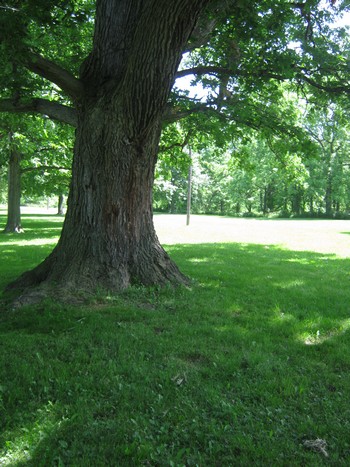
It happened under a tree.

It was summer. I was twelve. I had a bike. This was in the days before people got driven anywhere; when your parents could have cared less where you were as long as your room was clean, the dishes done, laundry hung, house vacuumed, garbage taken out and you were back in time for supper [‘cuz that table ain’t gonna set itself].

It was also in the days before the invention of plastic. At least in the shape of water bottles. People, everyone really, used to go places, everyplace, without water. It’s a miracle we all survived when you think about it now.

In any case, there I was on my bike in summer and it was hot. Very very hot. I rode across the canal into the country where the orchards lived and swiped a few peaches. And then I took those peaches to a small park—no, it wasn’t a park, more like a place for cars to pull over and check what the hell is making that rattling sound in the trunk. It was a small grassy space; there were trees, shade. Peaches. And James between the covers.

The book was The Fires of Spring. I remember the beginning best, how a little boy and his grandfather lived in a poorhouse, happy but poor, you know the type. The old man, beloved by all, died, leaving the little boy on his own. So he joined the circus, the way you do when your poor, beloved grandfather dies, and saw unspeakably exciting and horrifying things and possibly fell in love or lust or confusion. It gets foggy at this point. In fact, I remember very little and what I do recall may or may not even exist in the book. 

Who cares. The story isn’t the point. The feeling is the point and no one and nothing, including the actual plot, can erase the feeling of laying on that small slice of cool grass on that hot day, illicit peach juice dribbling down my chin onto James’ pages as I turned them one after the other after the next… all afternoon.

It was the book that showed me, in ways I can’t recall, the power and the magic of words. It wasn’t necessarily the best I’d ever read, I just remember it that way.

Recently, when Peter and I spend a weekend in Niagara, we find ourselves near the grassy place. I ask him to pull over, tell him about James…I spare him the details.

He finds my nostalgia quaint, smiles, stays in the car while I walk around. Which tree was it? This one, that one? I study branch formation, proximity to the road, until it occurs to me that where matters as little as the storyline. What matters is I”m suddenly breathing deeply, smiling, shoulders drop and I’m twelve, in yellow denim cutoffs—because I’m the only kid I know who doesn’t own blue jeans—lying tummy down on grass, surrounded by peach pits and so engrossed in a book a whole day goes by without me noticing. Best of all, I am not even slightly aware of how I will remember this day, for possibly ever.
this is not a review: no guff vegetable gardening by donna balzer and steven biggs

Seems I’ve outgrown many of my old gardening books. Not because I’ve learned so very much [mostly what I’ve learned is how much I don’t know] but because my style has changed. Used to be I liked a cacophony of colour from March to November, which meant endless planning and revising, wandering the crowded aisles of garden centres in a confused fog, pushing about a giant trolly, only to find all that consideration of height and spread and bloom time amounted to zip when somehow all the tall yellow stuff ended up together—not to mention the expense of annuals to fill in gaps and baskets and pots everywhere.

Worse, at the end of a day of ‘garden management’, I’d kick back on the patio with a glass of wine, look at the lovely vista in front of me and say: oh crap, the phlox is three inches too close to the Echinacea… and they’re both pink!!

And then one day, I’m not sure when or how, I changed.

Now my pots are filled with food: peppers and eggplant and basil, and what I like best is green with splashes of colour wherever colour chooses to appear. I like surprises better than control. There are few annuals and all the perennials are either native or very hearty. No wimps allowed.

And nothing is ever in the wrong place. Sometimes I move stuff, sometimes I don’t.

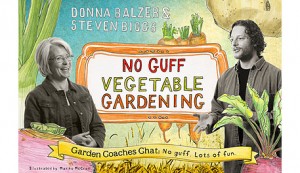
So goodbye fancy formal books that describe how to do Vita Sackville West’s white garden, or Hugh Johnson’s idea of simplicity—something along the lines of casual Versailles—and hello No Guff Vegetable Gardening, by Donna Balzer and Steven Biggs.

That is where I’m at today. Food and simplicity.

And that, thank god, is where Balzer and Biggs are at.

Not only do they get the joy of gardening and, specifically, the pleasures of growing food, they’re able to share that enthusiasm—along with the wisdom of their experience—in a way that doesn’t feel like it’s coming from a book.

Written from slightly varying points of view—their differing opinions centre around gadgets, fertilizer, cauliflower coddling…[and getting both sides is part of the fun]—but overall there is agreement on the basics of organic and do-able gardens. The pages are a mix of beautiful photos, colourful illustrations by Mariko McCrae, charts, lists, refreshingly straightforward advice from starting a garden to succession crops to harvesting tips to composting—essentially everything any home veggie gardener needs to know or be reminded of, and then some.

With that much info coming at you it’s easy to slide into a cluttered look but they’ve avoided that with good page layouts—multi-coloured fonts and backgrounds and a balance of graphics and pics—making for easy to read bite sized chatty chunks… and [so clever] both the cover and the pages are a smooth glossy finish as if made to be delved into straight from the garden with mucky in-the-middle-of-a-situation-that-needs-an-answer-NOW  hands.

Which is exactly how I approached the book the other day when I noticed my zucchini are all flower and no veggies and found out why in a small blurb on p.146 under the title: ‘Gender Roles Affect Squash Harvest’… wherein it was very simply explained [I’m paraphrasing here] that the bees haven’t done their job and hand-pollinating is in order. Male flowers have a long stem; females, a short stubby one. Get a tiny paintbrush and go to it. Directions are supplied of course, as is an aside by Biggs saying he’s never hand-pollinated and feasts on the blossoms instead. Which is what I chose to do. And may I say they’re delicious. (Dip blooms in egg wash, then bread crumbs, and sauté lightly in butter with a drop of olive oil so they don’t burn. If you want to stuff the blooms, do that before dipping. This is so good that I’m not even sad about no zucchini this year. I go out every day and pick the flowers instead.)

For me this book is a little like having that neighbour at your beck and call [the one who grows the best tomatoes and beans], dispensing not only answers but pearls of garden wisdom, anecdotes, recipes, back and forth exchanges and incidentals. You just want to hang around and hear more, ask questions.

Having said that, should you ever find yourself in the mood for the intricate details of herbal knots, Latin binomials or how to maintain French lavender topiaries in the shape of the Eiffel Tower—there are better books on the subject. What I like about the No Guff concept is its smart idle chat feel; you don’t read it so much as open it and find a conversation [or debate] that welcomes you right in, practically pours you a drink and never says a word about conflicting colours.

This one’s going straight onto the gifts-to-give list.

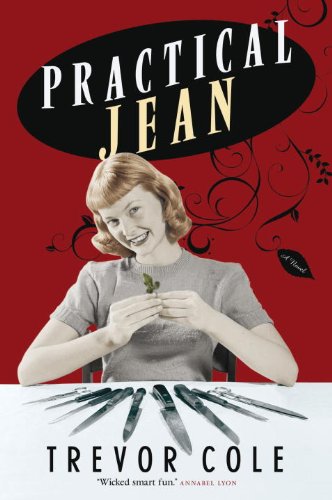
this is not a review: practical jean by trevor cole

Among the definitions of insanity are…
i) doing the same thing over and over and expecting different results, ii) deviating from social norms or iii) becoming a danger to one’s self and others (although it’s generally agreed that being a deviant or a danger does not always stem from being insane).

It may also be agreed that Jean Vale Horemarsh, the protagonist in Trevor Cole’s Practical Jean—given her quest to kill her four closest friends—falls bang into the second category.

Please don’t misunderstand; she’s doing it out of love. She’s doing it because she doesn’t want them to suffer old age and disease the way her mother did; she wants them to go out in a moment of bliss. Which brings us to the second part of her quest: determining what would constitute a unique moment of bliss for each of the women, then making that moment happen. Then knocking them off.

I love what this book makes you think about: what is friendship? what is kindness? what is nuts? (I also love the cover.)

Trevor Cole has done two remarkable things: he’s written from the perspective of a woman in a way that if you didn’t know, you would insist a woman had written the book. Inner monologues, dialogue, neuroses, petty grievances, vanity—sounds bad, I know, but it’s satire and satire is best done from a negative place—all gorgeously identifiable from a feminine point of view—albeit, admittedly, a little ‘trop’ in the name of art…

Or maybe not.

Which brings me to an interesting, possibly worthwhile, point of digression: can men ‘write women’ effectively, and vice versa? I think: yes, they can. Not all, but those who do it well (Richard B. Wright’s Clara Callan comes to mind), can be enlightening if only for the insight ‘the other’ receives in the reading. In fact, if handled with a deft and sensitive hand, the result is a little like looking into a mirror, being slightly startled and immediately wanting to blame the lighting, but then realizing that, yes, that is indeed us, with our dark circles and bad haircut.

One of my favourite scenes is Jean’s recollection of sitting on the porch eating Peek Freans Digestives (“…even though they were cookies it seemed like they were almost good for you…”) with her friend Cheryl. They’re both teenagers, newly aware of sex but in agreement about wanting nothing to do with it. Life is still wonderfully simple (as Cole illustrates with a lovely example of the ‘facetious’ he does so well) but there’s an ominous sense of adulthood creeping round the corner…

“…Cheryl was acting as if she wasn’t hungry… [she] was just fiddling with the cookie on her plate and crumbling little bits off the edge, and Jean had to ask:
Cheryl, is something wrong?
She said nothing, didn’t even look up, so Jean knew something was wrong and thought maybe Cheryl was mad at her. For what she couldn’t imagine, unless it was forgetting to say something nice about the turquoise barrette in Cheryl’s hair. That seemed like such a petty thing to be mad about, but Jean thought that was probably it. Cheryl could be a little sensitive sometimes; it was one of the few things about Cheryl that wasn’t so great.
I forgot to say, began Jean, that’s a really nice
Before she could finish Cheryl covered her face with her hands and started sobbing. Sitting across from her Jean was thinking Oh, for Heaven’s sake. It’s just a barrette! But she leaned over and put her hand on her friend’s shoulder and said, Cheryl, I’m really sorry. It’s such a pretty—
Cheryl lifted her glistening face from her hands and bawled out, I’m pregnant!
Jean yanked her hand away as if it had been bitten. Even as she did it she wasn’t proud of herself…”

This simple moment carries a lot of weight, not only as a turning point in their lives, but as a through line in the book. Jean immediately drops Cheryl as a friend; soon after, Cheryl and her family disappear. Decades later, Jean’s guilt resurfaces and she’s desperate to find Cheryl, to atone for her lack of compassion.

By killing her of course.

The other remarkable thing in this book so focused on death is that Cole manages, without cliché, to maintain a very high, very subtle, level of humour via spot-on takes of various relationships, letting us in on the power of memories, the dynamics created by conflicting emotions, things said and unsaid—all of the sad mad truth of everyday lives. And all of it perfectly placed against an insane backdrop of benevolent murder.

Somehow the suspension of disbelief is complete.

Dark, delicious and very discussable; best read with a few good (but not too good) friends and a little good (very good) dark chocolate.

This post first appeared in July, 2011.

a few canadian words worth repeating

I don’t do book reviews. At best I occasionally air thoughts on something I’ve read… and then not always the whole book, but one story, one essay, an aspect that strikes me. A sentence maybe. Recently I’ve begun a Q&A series, which I enjoy because I can pretend the chat is happening over food and drink. I even note the appropriate food and drink for the book. (Online is such nerdish tiny-personal-universe fun, eh?) Most of what I read, however, goes publicly unbabbled—for reasons due mainly to timing and whim.

Having said that, I like what John Mutford is doing over at The Book Mine Set, especially his annual Canadian Book Challenge, so have gathered and submitted a collection of CanLit babbled about on Matilda over the past year.

The art of reviewing I respectfully, and happily, leave to others.

~

My Father’s Hands Spoke in Yiddish, by Karen Shenfeld (poetry)

BoYs,  by Kathleen Winter (short stories)

Join the Revolution, Comrade,  by Charles Foran (personal essays)

Close to Spiderman, by Ivan E. Coyote (short stories)

The Cat’s Pajamas, by Wallace Edwards (children’s picture book but really so much more…)

Comfort Me with Apples by Joe Fiorito (extremely delicious essays on food)

Stunt, by Claudia Dey (a novel, which I nearly didn’t finish, then loved madly for reasons I am only too happy to explain)

Player One, by Douglas Coupland (Massey Lectures in the form of a novel, sort of…)

Room, by Emma Donoghue (a novel, read in a garret)

Seeds of Another Summer, by Beth Powning, (essays on nature and gardening and life)

CanLit Food Book, edited by Margaret Atwood (beautifully odd assortment of food-related bits by Canadian authors, including recipes, essays, excerpts, drawings, random thoughts, directions for making toast…)

whale, that’s my story and i’m sticking to it

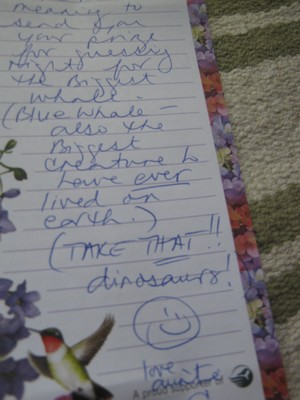
Dear Young Niece,

First, may I apologize for bad puns.

Second—I’ve decided not to send you the book, Whales of Canada, which was going to be your latest pocalog prize for successfully naming the largest whale, which, frankly, is hardly a giant feat given the willingness of google to do this kind of work for us. And by us I mean you. (And everyone else in the world. Including me.)

And I say not sendwhen what I really mean is not send yet… because I do want you to have the book. Eventually. By which I mean in the not too, too distant future. I know you like whales and my hope is that reading about them will appeal to you more than wanting to wave at them from over-crowded tourist boats, that you might choose to curl up, enjoy the book’s photos and recite fun and fascinating whale facts to your family over dinner or while they’re trying to watch Dancing with the Stars.

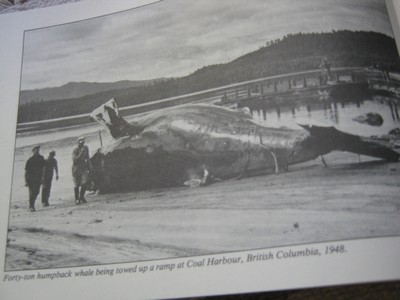
I’d actually got so far as writing you a note introducing the book; I’d even addressed the envelope into which I was about to slip it when I glanced at the index of twenty kinds of whales, each chapter title being a mini cetacean lesson in itself. (During which time I learned the word ‘cetacean’… and that it includes dolphins and porpoises.) I scanned pages of photos, a cross section of a whale’s head showing how it feeds and a chart showing how a blue whale is twice the size of a Brontosaurus. I flipped through tidily written chapters on diet and range and history and habit that debunk myths and offer up some general commentary on the state of whales and what’s to become of them if we don’t smarten up:

“Perhaps the best thing we could do would be to stay out of their way—with our oil tankers, effluent outpourings, radioactive spills and nuclear tests.”

And as I perused and flipped and scanned, it occurred to me that I couldn’t remember when or where I’d bought the book, or even if I’d ever sat down and read it properly myself.

The point is I suddenly loved it far too much to give away.

I know. It’s hard to hear. But stuff like this happens.

I’m hoping you’ll take some comfort in the fact that you had no idea the book was meant to be your prize. My change of heart, therefore, shouldn’t be too earth shatteringly depressing for you. Not to mention that I’ll be on the hunt for something to replace the book with (because you’re still owed a prize, google search notwithstanding). And given what amounts to more than a soupcon of guilt arising from a twisted sense of selfishness on my part, it should be something good.

But, I hope, for your sake, not too good…

oceans of love,
auntie c.

all is not lost — i learned a new word

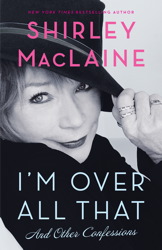
This weekend I learned that to engage in small talk is to ‘smalk’. I learned it not by smalking but by reading about it in Shirley MacLaine’s most recent memoir: I’m Over all That.

I know, I know.

But it was advertised on the library Home page and I was weak and in a mad moment I put a hold on it and when that hold came up, yes, I could have not picked up the book but I was weak again, and hungry—it was just before lunch—and I wasn’t thinking straight. True enough, no one held a gun to my head and forced me to read it on a lounge chair in the sun on Saturday afternoon while nibbling on 85% fair trade and swilling peppermint tea. I chose to. And I’m not apologizing. Just a little embarrassed is all. I mean there are so many, dare I say ‘better’, books to read and many of them are in my house in a stack beside my bed.

And yet I choose to read this. In god’s name why?

I’ll tell me why.

It’s because every now and then a little ‘this’ is good for the soul. That’s why detective novels were invented, no?

Anyhoo. Aside from perhaps a bit too much about Hollywood and the fact that she’s been in one sort of relationship or other with most of the men on this planet (and possibly a few others), and aside from her opinion that there are essentially two kinds of people: i) her, and ii) those who have not time-travelled to ancient Egypt… Despite all that she does make some interesting points.

For example, on the subject of increased security at airports (which has caused her to give up travelling) and fear-mongering, generally, she writes:

“I don’t believe that terrorism is the real reason we have become saluting robots. I believe we have neglected to see that terrorism is just a convenient excuse for those in power to gently instruct us to go quietly into that good night of being compliant and unrevolutionary citizens who willingly become subjugated to authority…. Fear is the most powerful weapon of mass destruction.”

She admits America is sorely lacking in world news programming and that Americans, generally, are not global thinkers except to consider how an international event might relate to them. God bless her for that at least.

“When I hear the controversy about sending more troops to Afghanistan, nobody but Christiane Amnapour mentions the value and power of the poppy fields and the opium trade. Who wouldn’t want to control the country where as much as 90 percent of the world’s heroin production is located? Why don’t our newscasters get past the point of imposing democracy on another tribal culture and get to the real point of why we’re there? Follow the money, as the old saying goes.

“Let’s have some deep and probing investigate reporting on why so many people are addicted to drugs.f If we did that I think we’d be into an investigation of the contemporary human spirit, of depression, of pointlessness, of spiritual poverty, and finally the addiction to serving whatever God we’ve been taught to believe in, whether it’s the Christian one, the Islamic one, or any other. We know that more killing has occurred in the name of “God” than anything else. Did the devil make us do it? Let’s investigate who we really are in relation to our beliefs, because if we don’t we are going to be forever manipulated by the real ruling elite in this world–the international banking community. In effect, “they” understand the real polarities governing our lives are not Good versus Evil, but rather Materialism versus Spirit.”

Not a bad little rant.

But I wouldn’t say this book is her best effort. I read her years ago and remember being slightly more impressed (possibly due to youth). Mostly though, I continue to respect her curiousity and the places it takes her, but not always the way she presents her thoughts as gospel. In any case, I’m Over All That is really just an unconnected collection of casual commentary on many and various subjects—from the alchemy of time (which ancient cultures apparently understood and which we are out of sync with), to the importance of living with a dog, the predictions for 2012, hair colour, funerals, rudeness, exercise, world leaders she has known and loved, politics, live theatre vs film, driving at night—you get the idea. I read somewhere that it came about as a result of lunch with her agent, friend, publisher?? Someone. A lunch during which she’d been idly rattling on about all the things she was ‘over’ until friend, agent, publisher allegedly said: make a book!

The way you do.

Overall impression: goes well with lazy afternoon chocolate. Not mind blowing, but a pleasant enough read if you’re in the mood for a rambly one-sided conversation with one of the more interesting people at the party.

Definitely better than smalk.

this is not a review: the cat’s pajama’s, by wallace edwards

While it’s true that The Cat’s Pajamas,  by Wallace Edwards, is another of the gorgeous picture book genre I adore—and while it’s also true that it’s been designed to amuse and enthral children, which it will certainly do, it must be said that even better than all that, it’s a tremendously fun parlour game for adults.

At least in my world.

I bought the book as a gift for a tiny person I know but haven’t given it away yet, in fact I’ll have to buy the kid another copy. This one’s mine. (I’ve since discovered it’s a follow-up to Edwards’ Monkey Business, which will be next on my list…)

As you may have worked out, The Cat’s Pajamas is heavy on idioms. Each page, a beautifully illustrated bit of quirkdom depicting one of the twenty-six idioms that make up the book—such as a panda seated at a table, playing a fiddle with a string of spaghetti (above text which reads: In order to have dinner music, Andy was forced to use his noodle.)

It doesn’t matter that the very young won’t get the nuanced brilliance of the compositions or the humour or the double entendres—they’ll be more than entertained with the absurdity of the pictures. (Did I mention that each illustration contains a hidden cat?)

Older kids though, and certain adult types (ahem)… will find that trying to guess the idiom being depicted is a whole other level of merriment.

Okay, picture this:

—A camel stands beside two small suitcases in what appears to be a desert; a single palm tree behind her, a train track in front. She’s draped in several colourful blankets, a feather headdress and beads. Each foot is placed deeply and firmly, it seems, inside either a strawberry or chocolate ice cream cone.
Text: “The Oasis Express was running late, so Camilla had to cool her heels.”

Or this—

An anteater in pearls, long tongue fully extended and in her hands, stands beside a goat in a striped dressing gown who points to a collection of quite hideous art.
Text: “The sight of Sir William’s new painting made Anita hold her tongue.”

Get it?

I actually played this with friends the other night. Granted, it could be that I hang around with fairly nerdish types, birds of a feather and all that, but it was just the thing between the soup and the nuts. And the bonus is that if you, like me, have an increasingly short memory, the game can be played any number of times with exactly the same level of challenge.

Oh, and don’t forget, you can also read it to the kidlets.

If you must.

~

this is not a review: close to spider man, by ivan e. coyote

 
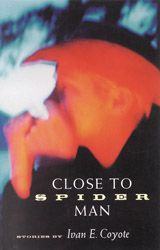
Somewhere in Ivan E. Coyote’s collection Close to Spider Man ( 2000, Arsenal Pulp) Coyote describes the Yukon sun shining bright but ‘heatlessly’ and then wonders if that’s even a word. Not that it matters because the way it’s presented, it becomes one and it sticks and the next day when I’m skiing on a bone chilling morning in the sunshine of a blue blue sky, I think how very heartlessly  it shines. And I know that every time I encounter that particular kind of day I’ll remember Coyote’s reference and even though it was to a northern sun, specifically, the way it was presented it, it applies, generally, to all suns.

Coyote does this a lot. And not just with large objects in the solar system, but with teensy details right here on terra firma where stories cover pretty general ground—childhood, family, neighbourhood, school, first love, friends, being misunderstood. And while these subjects resonate universally, they’re actually specific to a girl growing up in a small northern community, with the mind, body, spirit, soul, of not merely a girl, but also a boy.

None of which, in the reading, ever feels strange. The beauty of Coyote’s writing is its straight-from-the-hip truth, which over and over again takes the specific and makes it general so that the reader forgets there are differences. At least long enough to see the similarities.

One beautiful scene has Coyote giving the eulogy for a beloved grandparent. When the attending priest mistakes ‘her’ for a guy and suggests s/he join the priesthood, Coyote is tempted to straighten him out with a one-liner but opts instead to respect the dead grandmother’s high opinion of the church and thank him for the compliment.

The circumstances may be unique and the situations unusual, but at the heart of everything, Coyote manages to remind us, we’re all dealing with the same basic stuff: kindness, respect, compassion, decency.

Or their opposites.

In No Bikini  Coyote accidentally passes for a little boy at swimming class by wearing only a bikini bottom—and for purely practical reasons keeps up the charade because… “It was easier not to be afraid of things, like diving boards and cannonballs and backstrokes, when nobody expected you to be afraid.”

In Three Left Turns  Coyote is six years old when a little girl, thinking Coyote is a boy, wants to kiss. Coyote wants to kiss the girl back but feels it’s wrong unless Coyote admits that she’s not a boy. It doesn’t end well—all the more heartbreaking when you think a six year old is already aware of society’s narrow (and punishing) rules on who to love.

Coyote, whose work includes five story collections and a recent novel, self describes as a kitchen table story-teller. I love the quality of “ordinary” in that. That even though the stories… about gender roles, how they develop, how judgments are passed, and the pressures we put on one another, knowingly or not, seem directed at an element of society that is seen as ‘different’, we soon recognize ourselves in the difference.

The hope is that maybe from there we can begin to see the similarities.


this is not a review: comfort me with apples, by joe fiorito


Love.

Go ahead. I dare you. Just try to read Joe Fiorito’s Comfort Me With Apples and see if you don’t end up in love. Because it’s not possible. Chap or chapette, you’ll be in love with him. I guarantee it. (Okay, I don’t guarantee it, but there’s a strong possibility…)

It’s not a new book, just newly discovered—also not exactly a cook book, nor exactly anything else; the man simply writes about food. And in such a way that I haven’t stopped cooking or eating since discovering it.

Yes, alright, another exaggeration. But it’s true that I can no longer cook or eat the same way. I mean, when in a simple essay on oranges he tells you—

“…You can put orange peel into beef stew along with your bouquet garni. You can squeeze a little juice in your fresh tomato soup; add a little orange zest while you’re at it. Or try this…peel two oranges, finely slice the peel, blanche it in boiling water for two minutes, and drain. Sautee a finely chopped onion in four tablespoons of olive oil. Add the drained peel to the oil, along with a cup-and-a-half of pitted black olives. Remove from the heat. Cook a pound of spaghetti in a pot of salted boiling water until it’s al dente. Dress the spaghetti with the olive oil mixture, add four more tablespoons of oil, and be grateful the Moors invaded Italy.”

—how can you not immediately want to put on your coat and walk to the nearest orange purveyor, purchase a dozen, make stew and soup and boil up some spaghetti, and when that just happens to change your outlook on life and entire DNA for the better…well, how can you not fall in love?

In another essay he reveals how a nun’s peculiar answer to his childhood question: What does my soul look like? led him to hate all cereal except oatmeal (and only then in the form of cookies). And then he gives you the instructions to make a batch. No recipes in this book and few precise measurements—mostly he just tells you how to do things the way he would if you were in the kitchen with him, chatting and sipping wine. And somehow things work out beautifully, the way they always do in happy kitchens.

I’ve been waiting for the perfect Sunday morning to make the popovers he describes in ‘Breakfast in Bed’—

“…Wake early one Sunday and smell the person sleeping next to you. Do it. Lean over. The side of the neck will do, just below the ear. Take a deep breath. The knowledge of this scent is lodged in the deepest part of your brain.

“…Now go to the kitchen. Throw two eggs into a bowl…”

And the perfect Friday night to re-enact his piece titled ‘A Plate of Spaghetti’, which begins:

“Today you’re going to eat, drink, sing, read—and act—Italian. I want you to start by going to the film store to rent Fellini’s ‘Nights of Cabiria’…” And ends with: “Whisper the last words of Puccini’s ‘Nessun Dorma’ as you fall asleep…all’alba vincero—at dawn I will win. And you will. You’ll have leftovers. Spaghetti arrabbiata is wonderful for breakfast.”

He writes about sushi and Halloween apples, the importance of the right knife, the woman who hummed while she ate and how he married her, how to make the best potato salad, chicken soup, pork chops (I’ve tried the chops, they’re truly amazing); he compares chili dogs to alligator shoes, discusses food myths and food in movies, considers his last meal, his worst meal, and the piece that confirmed my adoration for this man’s work, ‘Museum Food’—which is too long to transcribe but, trust me, it’s a gorgeous piece of writing and a gorgeous testament to food.

Impossible to read this book and not come away with a deeper appreciation for the connection between what we eat and how we live, between food and people, music, sights, art, books, sound, neighbourhoods, joy, sadness, seasons. (And we all know the connections are there; I can’t rub a piece of thyme between my fingers and not be transported to my mother’s kitchen where a roast is the oven on a Saturday afternoon in winter, juices heavily infused with thyme from her garden, picked fresh from under the snow.)

All of which leaves me deeply in love—okay, maybe just deeply grateful for the reminder that food isn’t so much about eating, but about everything around the eating, everything that precedes it.

And everything that follows.

_______________________________________

Purchase Comfort Me with Apples online at Blue Heron Books.

this is not a review: stunt, by claudia dey

I don’t have a lot of guilt about giving up on a book that hasn’t got me riveted by, say, page 100. But that still doesn’t make it easy. Before crying Uncle I tend first to do a kind of dithery dance: close the covers, open them a few hours later, close them, consider another book, open its covers, then go back to the original, skim a few chapters.

And so on for a day or two.

By which time I could have read the bloody thing.

Much easier of course is a book so outright awful (or just really not my cup of tea at that moment) that it inspires me to slam it shut and move on without the hint of a dither. It happens but it’s rare.

Even rarer is a book I consider giving up on but don’t, and then end up not only glad I didn’t pull the plug, but thrilled that I didn’t. Claudia Dey’s Stunt is such a book.

It’s narrated by a young girl searching for her runaway father. The setting is Toronto: the islands, Parkdale, ravines. Much of her journey is internal, much bopping back and forth in time, and peopled with characters so quirky I sometimes couldn’t distinguish between what she’s living and what she imagines. Which is the whole lovely point of course.

Having said that, it felt long in places. Too much of a good thing is still too much and by page 100 I was saying: enough; it’s all beautiful poetic writing that circles and circles but I keep losing track of the story; is there a story??  But when I tried to stop, I couldn’t. That hypnotic circling poetry kept prancing round my head and so I continued and by the time I finished I wanted to start all over again. And I will.

Not for the story—but for the language.

And for the place Dey’s word magic ultimately takes both us and the narrator—back to ourselves with sharpened senses—the way senses can only be sharpened after a particularly breathtaking ride.

Language always wins.

“I wake to you standing above me, grinning. You should have bird feathers between your teeth. A thermos of coffee and a bag of worms in your hands. Apples in your suit pockets making you the many-breasted Artemis, goddess of the beasts. Boots grinding the carpeted floor, you are flinging sparks. Secret. And suddenly we are on your bicycle and we are, with your fist in the air, heading southeast to fish and to make fire!,our house and the life that we stage within it shrinking behind us to a dot on a map—instantly, the Old World. How far will we go? The Scarborough Bluffs? The Orient? And will we ever go back? Or should I start to memorize my mother’s face now? My sister’s? Every night I ask myself this question, and every night we return home, smelling like fire.”  —From Stunt, by Claudia Dey, Coach House Books, 2008
~