questions

“Questions, doubt, ambiguity, and dissent
have somehow become very unmasculine.
Authoritarian maniacs are
premiers, czars, and presidents.
Each one is more righteous than the next.
Each town they bomb
each human they kill
is done for ‘humanitarian’ purposes.

“People don’t own the water in their own village
and they certainly don’t own the diamonds and gold.
Millions are forced to make dinner out of garbage and dust
while Russian businessmen and movie stars
are buying 500-million-euro villas on Cote Sud.

“Bees have stopped making honey.
People are drilling in all the wrong places.
The U.S., Russia, Canada, Denmark, and Norway all claim the Arctic
but none of them seem to care that the polar bears are drowning.

“They are fingerprinting, photographing our licenses and teeth.
Big Brother is now in our phones, our pods, our PCs.
Not one of us feels even a little safer.
New Age mental health providers turn
out to be former war torturers with beards.
And the pope in a dress showing off his
ermine trim and cuffs
is telling everyone that
people kissing people they love is the greatest evil.
A woman running for U.S. vice president
believes in creationism
but not global warming.

“Why is everyone so much more afraid of sex
than SCUD missiles?
And who decided God wasn’t into pleasure?
And if the hetero nuclear family is so great
how come everyone is fleeing it
or paying their life savings just
to sit in a room with a stranger and cry about it?

“The Iraq war cost nearly $3 trillion.
I can’t even count that high
but I know
that money could have
would have
ended poverty in general
which would have cancelled terrorism.
How come we have money to kill
but no money to feed or heal?
How come we have money to destroy
but no money for art and schools?”

—from I Am An Emotional Creature, by Eve Ensler

this is not a review: player one, by douglas coupland

The Massey Lectures begin broadcasting today.

I’m curious to see how they come across, given that this year they take the form, not of essays, but of Douglas Coupland’s novel, Player One, in five parts.

The book is, essentially, about disconnection in a wired world.

I heard Coupland read briefly a few weeks ago in a fairly intimate setting (an event hosted by one of my favourite booksellers) and to be honest, I think the ‘lectures’ may be more than a little hard to follow… if only because it’s difficult to get into any kind of listening groove. One minute you’re hearing the narrative of a novel, you’re hearing dialogue, expecting plot and character development, action and reaction—but what happens instead is that the dialogue has suddenly morphed into a mini essay.

And not in a way that works to any kind of advantate in the context of the book. In fact, it’s almost like the book is merely a vehicle for the author’s personal thoughts, theories and musings—which are vast and clever and endlessly discussable—but they are clearly his, not the characters’. That’s the other thing—every character has the same basic view of life. Hard enough to tell them apart as I read the book at my own pace—I can’t imagine listening to the lecture series and being able to keep track of who is who. There are few distinctions.

Not that it matters much. It’s the philosophy, the big questions posed, the commentary on humanity’s impending doom that’s the point.

All of which is good stuff. Especially in Coupland’s hands. But why write a book of clever theories posing as a ‘novel’?  Why not go non-fiction? Or, here’s an idea: a book of five essays.

I thought maybe I was missing the symbolism, that the sameness of characters, their flatness and non-reaction to the world ending outside their window, was to suggest that increasing ‘disconnection in a wired world’. But really, if that’s it, it still doesn’t work as a novel. It’s a book of possibilities and deep reflection, but unfortunately mired in a storyline that exists only enough to intrude, and with one-dimensional characters who constantly say things like this:

“Karen, tell me, what is the you of you? Where do you begin and end? This you thing—is it an invisible silk woven from your memories? Is it a spirit? Is it electric? What exactly is it? Does it know that there exists a light within us all—a light brighter than the sun, a light inside the mind? Does the real Karen know that, when we sleep at night, when we walk across a field and see a tree full of sleeping birds, when we tell small lies to our friends, when we make love, we are performing acts of surgery on our souls? All this damage and healing and shock that happens inside of us, the result of which is unfathomable. But imagine if you could see the light, the souls inside everybody you see—at Loblaws, on the dog-walking path, at the library —all those souls, bright lights, blinding you, perhaps. But they are there.

Great writing. And I like what he’s stirring up, but as dialogue throughout it does not a great novel make. The characters simply haven’t earned that level of wisdom. 

Having said that, can the record please show that it’s not overly philosophic, theorizing characters I object to. On the contrary. If done well a strong philosophic bent is a beautiful thing—in a context that delivers, rather than fights with itself. 

And god knows I’m not criticizing the brilliance of Mr. Coupland’s mind, a writer whose work I respect and enjoy very much. Just questioning why he felt it necessary to take material that would so perfectly suit five brilliant Couplandesque essays—that might have actually had us thinking in new ways—and isn’t that what the Lectures are all about?—and clutter it instead with undeveloped characters and a rather ineffectual storyline. Was it just to be different? Because (thankfully) he’s already different. He doesn’t have to try.

Then again, maybe it’s just me. Maybe I read it at the wrong time, in the wrong circumstances. Maybe I should have had less tea or more wine. Or vice versa. And maybe no one else will find the packaging of Player One’s  weak story a distraction from what could be a powerful and important message.  

~

my next cat will be called charles wallace

You mean you can read our minds?”

“Charles Wallace looked troubled. ‘I don’t think it’s that. It’s being able to understand a sort of language, like sometimes if I concentrate very hard I can understand the wind talking with the trees. You tell me, you see, sort of inad—inadvertently. That’s a good word, isn’t it? I got Mother to look it up in the dictionary for me this morning. I really must learn to read, except I’m afraid it will make it awfully hard for me in school next year if I already know things. I think it will be better if people go on thinking I’m not very bright. They won’t hate me quite so much.'”

—from A Wrinkle in Time, by Madeleine L’Engle

~

diary of a room (with a view, a pen, and a book)

—Writing from a garret in London, Ontario. 

8a.m.— Gorgeous golden day. Huge trees outside the window. Blue boxes line the street. Yesterday when I arrived, I shoved two arm-less arm chairs together to make a sort of chaise lounge in the 3rd floor bay window alcove, then wrote like mad. It’s quiet here, the only sound an occasional car, glass and tin cans being dumped, and there’s very good food in the restaurant downstairs (I recommend the mixed greens with dried cranberry and pistachio, and goat cheese/yoghurt dressing), a porch also for contemplating, which I did some of after lunch. Mostly on the colour grey. Surprising results.

Today I’m devoting time to reading Emma Donoghue’s  Room, which I brought with me not knowing that Ms. Donoghue lives in London, Ontario. Possibly in a garret?? It doesn’t say on the  jacket.  Anyway, I found that a strangely lovely coincidence.

So because I’m out of my usual routine, and am using a keyboard that is driving me slightly bonkers, I decided that instead of trying to write one coherent post I’ll write several small incoherent ones throughout the day—a sort of real time account of reading progress and life in the garret generally.

Have only just begun the book and, although the rhythm takes a minute to get used to, I’m thoroughly enjoying the narration by a five year old as he introduces us to his world and to his mother.

“I still don’t tell her about the web. It’s weird to have something that’s mine-not-Ma’s. Everything else is both of ours. I guess my body is mine and the ideas that happen in my head. But my cells are made out of her cells so I’m kind of hers. Also when I tell her what I’m thinking and she tells me what she’s thinking, our each ideas jump into our other’s head, like colouring blue crayon on top of yellow that makes green.” (—from p.10 of Room)

While this perhaps should leave me doubting that a five year old can put things into terms that involve cells, it doesn’t— it just leaves me looking forward to finding out how he can.

“Bunnies are TV, carrots are real…” (p.17, Room)

9:15 a.m.— A man walking three dogs on three leads passes a woman walking two children on two leads. Honest to god.

11 a.m.— On the street opposite my window a black cat and an orange cat have been playing together for hours. They cross the road together, jump on stone walls together, stand around the sidewalk, then run off and disappear for a while, together, then reappear, at first just the black and then seconds later, the orange. Seems there’s never one without the other. It’s a very nice little vibe watching them. When do you see anyone, kids even, so consistently, without argument, for this long, enjoy each other’s company? Must take a walk later, have a closer look, maybe say hello.

1:30 p.m.— Smoothed out some wrinkles in the final chapters of the WIP. Celebrated with perfectly cooked Arctic char in mustard and cider reduction, and arugula salad. Am enjoying this garret life.

2:30p.m.— For Jack, the boy narrator of Room, having a grasp of what cells are is the least of his accomplishments (see 8a.m. entry). He’s a little genius who, literally, lives in a world ofhis own making and with the help of his twenty-six year old mother, who’s spent the past seven years living in the trumped-up and sound-proofed garden shed of her abductor, Old Nick. Because of her, Jack has a better grasp of reality, however unreal, than most people. She has, it seems, taken enormous strength from the need to protect and nurture and teach him, in turn, to be strong. Together they’ve invented dozens of games using ordinary objects or just their senses and words. They have rituals and traditions and rhythms to their days. He trusts her completely and is shocked and frightened when he learns that she’s hidden some chocolate to keep as a surprise for his birthday. If there are “hidey places”, he thinks, then there are places for vampires and bogey men. In such a confined space that would be a very bad thing indeed. Secrets are equally not tolerated.
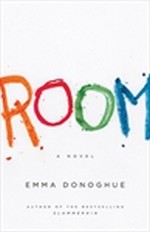
Because he was born in the room (a stain on the carpet marks the spot), and has seen nothing else (other than TV, which he believes is a two-dimensional ‘unreal’ place) this tiny universe makes perfect sense to him. His mother, on the other hand, is becoming increasingly unhappy, concerned that Old Nick will eventually leave them to die, and begins to tell Jack about the ‘real’ world, about her parents and her life as a child. At this point I’m not sure if she’s doing it as a gift to him, some new exciting thought to fill his mind, or a way of consoling her own grieving self.  

“Stories are a different kind of true.” (p.71, Room)

5:45p.m. A few weeks ago there was some flap about how writing in the present tense was a cheap trick employed by three of the six Man Booker finalists, of which Room is one. It struck me as an absurd discussion at the time, even moreso now that I’m reading Room. The reason—for Philip Pullman’s and Philip Hensher’s information—that Room is written in the present tense is because if it were written any other way it wouldn’t have the same brilliantly creepy effect of drawing us into that place in real time, which is a place we don’t want to go but can’t stop peering into. Perhaps I’m in the minority but I enjoy first person, present. Like anything, it has to be done well, and unlike some possibly ‘easier’ POVs, it’s very hard to do well. I’m guessing Donoghue chose it for a few reasons: 1) the story itself demanded that form, 2) the feeling of being there in ‘real time’ works exceedingly well in unsettling the reader, and 3) there is something almost subliminal about present tense, a kind of tacit reminder that what you are reading did not happen then… but is happening still. And for this book, that’s exactly what you need to feel. For many reasons.

6:15p.m.  The orange cat is across the street; I run over expecting to find the black one nearby, maybe capture their extraordinary relationship on film. But the orange is on his own (orange tabbys are always boys). Where’s your friend? I say, and he rubs against my leg, looks up at me and purrs What friend? 

So much for my brilliant cat loyalty theory.

10:30p.m. At about the exact middle of Room the thing I expected to happen at the end happens, and I’m left stunned and thinking: how the bleep will the author sustain the next 150 pages?? Well, sir, she does in the most surprising and amazing way, turning our perceptions about ‘freedom’ upside down and having us look at ourselves in the process. And I don’t care if you hold your breath, gnash your teeth or utter vile words, I will not divulge even one more tiny piece of the story, except to say I loved it so very very much—one of those books that begs to be read again, not necessarily to understand better—because the story is simple and clear—but to benefit from its truth. 

~
this is how it happens…

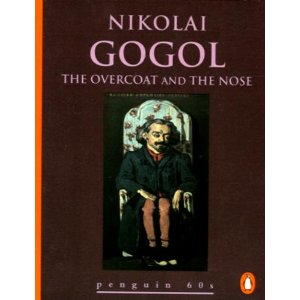
I’m in love with Nikolai Gogol. I say this based on one story in a recently purchased four by five inch book, published by Penguin in 1995—a Penguin 60s—part of Penguin’s 60th anniversary celebrations. The book contains two stories: ‘The Overcoat’ and ‘The Nose’. It was ‘The Overcoat’ I read Sunday morning. And it was then that I fell in love.

Here is a chap with a mighty sense of humour. And that’s always irresistible. Plus control and subtlety and things that really aren’t at all what they seem. The story centres around Akaky Akakievich, a titular councillor—essentially a lowly civil servant in early 19th century Russia—(a whole beautiful long riff is done on how he got his unfortunate name, which culminates in…”The child was christened and during the ceremony he burst into tears and made such a face it was plain that he knew there and then that he was fated to be a titular councillor.”)

In a nutshell, the piece is about a man who needs a new overcoat to survive the winter; he doesn’t ask for much in life and gets even less. But in his way, he’s happy. Though he lives an extremely simple life (the list of his possessions include two buttons that have fallen off some clothing) and has been a devoted employee to his ‘company’ for many years, he has to scrimp and practically starve to save money for the coat and then when he has it, it’s stolen. And no one cares. When he dies he returns as a ghost to steal the overcoats of others.

But of course that’s not what it’s about at all. It’s actually a brilliant political statement that (sadly) still resonates today…

Here is my favourite sentence—

“Even at that time of day when the light has completely faded from the grey St. Petersburg sky and the whole clerical brotherhood has eaten its fill, according to salary and palate; when everyone has rested from departmental pen-pushing and running around; when his own and everyone else’s absolutely indispensable labours have been forgotten–as well as all those other things that restless man sets himself to do of his own free will–sometimes even more than is really necessary; when the civil servant dashes off to enjoy his remaining hours of freedom as much as he can (one showing a more daring spirit by careering off to the theatre; another sauntering down the street to spend his time looking at cheap little hats in the shop windows; another going off to a party to waste his time flattering a pretty girl, the shining light of some small circle of civil servants; while another–and this happens more often than not–goes off to visit a friend from the office living on the third or second floor, in two small rooms with a hall and kitchen, and with some pretensions to fashion in the form of a lamp or some little trifle which has cost a great many sacrifices, refusals to invitations to dinner or country outings; in short, at that time of day when all the civil servants have dispersed to their friends’  little flats for a game of whist, sipping tea from glasses and nibbling little biscuits, drawing on their long pipes, and giving an account while dealing out the cards of the latest scandal which has wafted down from high society–a Russian can never resist stories; or when there is nothing new to talk about, bringing out once again the old anecdote about the Commandant who was told that the tail of the horse in Falconet’s statue of Peter the Great had been cut off; briefly, when everyone was doing his best to amuse himself, Akaky Akakievich did not abandon himself to any such pleasures.”  (—from ‘The Overcoat’ by Nikolai Gogol)

And this in 1842.

And you wonder why I’m in love?

~

the book that started it all

 
My family was not what you would call literary, or even an especially bookish lot. Oh, there were books in the house—some came free with special offers at the grocery store—that’s how we got our partial set of encyclopedia (it ended at EAR–FIS); others were from the Book of the Month Club, which I think my father signed up for to get the free ones then god only knows how many peculiar titles were delivered at full price for god only knows how long before he could figure out how to make it all stop. There were also a few stolen books, mostly from schools my sister went to though I think a few came home with me from the library, permanently. All of it unintentional—I swear.

And it’s not that my parents didn’t read. They did, in their own way. Apparently more when they were younger than when I knew them. My father, who could build anything, and loved the outdoors, once said his favourite book was Robinson Crusoe; my mother was the sewing, cooking, growing vegetables, hanging laundry outside kind of mother who read what she called ‘love stories’—books with pretty blonde heroines on the cover, petting horses in meadows while dark-haired men stood in the background looking confused and handsome.

In any case, ours was a pitiful collection to say the least, and you can probably guess there was no encouragement toward reading, yet I gravitated to it anyway and from a very young age read whatever I could find, the way one might read every dog-eared volume on a dusty plywood shelf while stranded in a cabin for a rainy week a million miles from anywhere. In other words, grateful for anything. Best part in cases like that: sometimes you find a gem or two in the debris.

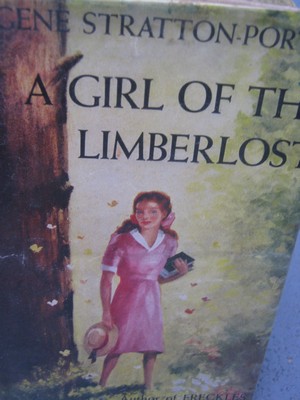
My own possibly pilfered, possibly purchased copy.

One of the highlights on our shelves was A Girl of the Limberlost, by Gene Stratton-Porter, which is stamped with the name of a local school but has a price of $2.50 marked inside in pencil. So it may have been one of the few acquired legitimately.

I read it at about ten, eleven, twelve years old, I’m not sure, but I remember connecting immediately with Elnora Comstock who wore hand-me-down clothes and lived in the woods communing with nature when she wasn’t arguing with her mother. I didn’t live in the woods but I wanted to. I can still practically smell the spice cakes her mother packed in the bucket that carried Elnora’s lunch to school. And I remember how those cakes were one of the few but important signs of her mother’s otherwise unexpressed love. I’ll have to read it again to be sure but I don’t believe Stratton-Porter sentimentalized the mother’s role in any way, which to me was refreshing. A change from all those love stories cluttering up the house, the Cherry Ames, Student Nurse, and books where everybody was so bloody happy and the only problem was something outside the family—a ghost in the vestibule, a murder in the vicarage, etc.  Yeah, right.

It was, I suppose, my first character driven story, one that suggested interior journeys were possible in literature, that it wasn’t all about ‘the other’, meeting someone who changed your life after a series of predictable problems, or climbing the mountain, or solving the murder.

All this reflection, BTW, came as a result of stumbling across a short video at The Guardian. Before that, I hadn’t given ‘the first book’ much thought, nor its many and varied influences on me (too introspective to rattle on about). Maybe the sort of thing that requires a certain age and perspective in order to see it clearly. Anyway, it’s all got me thinking that it’s probably quite often, maybe even always, a book, rather than a person or even an environment, that nudges us around a corner of our early reading. That maybe the love of words is a nature rather than nurture affair, in our DNA, and it’s just a matter of time before we find that book that connects with an inherent understanding or curiosity about the world—and reflects it back to us. True, if we’re surrounded by people who bring us sacks of lovely things to read we may find it sooner, but even if we’ve got nothing but a dusty shelf in a cabin, I’m convinced we will find it.

And then off we go. Never to be the same again. And more ourselves than ever.

Funny how stuff begets stuff.

So, latest dinner party question: what was the first book that made you think differently about books?

~

the best case this tea drinker has heard for coffee

“When I was a sophomore in college, I drank coffee nearly every evening with my friends Peter and Alex. Even though the coffee was canned; even though the milk was stolen from the dining hall and refrigerated on the windowsill of my friend’s dormitory room, where  it was diluted by snow and adulterated by soot; even though Alex’s scuzzy one-burner hot plate looked as if it might electrocute us at any moment; and even though we washed our batterie de cuisine in the bathroom sink and let it air-dry on a pile of paper towels next to the toilet—even though Dunster F-13 was, in short, not exactly Escoffier’s kitchen, we considered our nightly coffee ritual the very acme and pitch of elegance. And I think that in many ways we were right…

“…It was the last time in my life that coffee slowed the hours rather than speeding them up. Those long, lazy nights—snow falling outside on Cowperthwaite Street, the three of us huddled inside a warm, bright room, talking of literature and politics until the rest of Dunster House was asleep—were an essential part of my college curriculum. After all, wasn’t education a matter of infusing one’s life with flavorful essences, pressing out the impurities, and leaving only a little sludge at the bottom?”

—from At Large and at Small: Familiar Essays, by Anne Fadiman

~

this is not a review: confessions of an advertising man, by david ogilvy

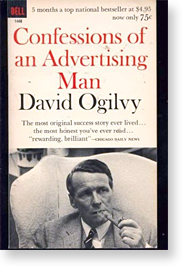
In my ongoing search for the meaning of life, the universe and the great white light, I recently stumbled across Confessions of an Advertising Man by David Ogilvy. Published in 1963 (by Dell), the cover on my copy shows the man himself sitting in a large wingback chair decked out in a three-piece tweed, cradling a lit pipe. You can see the smoke curling away from his lips. He looks every bit the successful, ultra confident, middle aged man who is either on his way to or returning from a double martini lunch where, among others of his ilk, clients or colleagues, he no doubt elegantly chortled his way through a sirloin steak, baked potato and oh-so-many-bon-mots lunch. For what is an advertising man if not a chap full of gin and bon mots?

And it was a chap’s world in them days. Girls (there were no women at the time) were for fetchin’ coffee and lookin’ cute, whether it be while fetchin’ coffee or in ads or—as evidenced by the Laura Petries, Samantha Stevens and possibly Betty Drapers of the world—while preparing perfect hors d’oeuvre to soak up yet more booze consumed by (male) clients and/or colleagues in perfect living rooms with Pledge polished veneers, before serving perfect meals of yet more red meat.

The book outlines Ogilvy & Mather’s beginnings, with, essentially, Ogilvy coming over from the U.K., starting an agency and taking Madison Avenue by storm in his own quietly dignified way. In a style that comes off relaxed and conversational, like he’s smoking that pipe while dictating to some gal in a cashmere twin-set, he offers advice on how to get and keep clients, use illustration, write copy, build campaigns, when to get rid of clients you’ve lost faith in (“I also resign accounts when I lose confidence in the product. It is flagrantly dishonest for an advertising agent to urge consumers to buy a product which he would not allow his own wife to buy.”)—sexism aside, can you imagine how far we’ve regressed if this ethic actually ever existed??

He goes on with anecdotes and suggestions for everything from how to succeed in the business (step by step instructions) to having a restful vacation:

“…Take your wife, but leave the children with a neighbour. Small fry are a pain in the neck on a vacation…. Take a sleeping pill every night for the first three nights.”

I’m fascinated by advertising and happen to believe it can change the world. Already has, but not in the right way. Imagine the difference if, in the past few decades, the amount of money spent on convincing people they should eat at McDonald’s had been spent instead on convincing them that real, honest to god food is sexy and delicious and can make you sexy and delicious.

But then we’d have risked creating a world of happier, healthier people who didn’t need ten thousand products, books and videos to help them become happy and healthy.

And then what?

The world would end as we know it.

Which is the whole point.

But I digress.

A nice element of the book are photos and samples of some of O&M’s more famous ads, such as for Rolls-Royce—the headline of which reads:

“At 60 miles an hour the loudest noise in this new Rolls-Royce comes from the electric clock.”

Followed by 719 words of copy.

Different times.

I guess what remains the same is our hookability, that whatever is presented to us in a certain way, we literally ‘buy’.

An interesting footnote tells us that Dorothy Sayers, Charles Lamb, Byron, Bernard Shaw, Hemingway, Marquand, Sherwood Anderson and Faulkner also wrote ‘advertisements’ at one point—“none of them with any degree of success”. 

While this is ultimately a good outcome, I think it would have been fascinating to see how differently the world might have been shaped if only Byron had opened an ad agency.

~
Note: this post first appeared in August, 2010.

________________________________________________

Confessions of an Advertising Man online at Blue Heron Books.

not just for kids


Confession: I like picture books.

I still remember the delicious weight of them as I’d lug a stack out of the school library, the anticipation of getting them home, the pleasure of sitting surrounded by them, on my bed, on the floor; every one of them smelled the same—of what? other people’s PJs? warm bed covers? snacks? Nothing smells like picture books from the library—the result, perhaps, of a particular intimacy with many—and those pages, soft from turning, being turned, and turned back again…

I remember laughter at some point. Not mine, someone else’s; comments and laughter at the stack of big square books clutched to my chest as I made my way home in falling down socks and MaryJanes (sigh; book snobbery begins early). Seems other kids had moved on to the abridged Heidi or whatever. At least publicly. Privately, I realize now, they would have still been read to at night. But no one read to anyone at my house; it was every man for himself, which I didn’t find odd in the slightest. Never crossed my mind in fact until Peter and I, a few years ago, were talking about a book I’d bought for a nephew and he said how he’d loved that one being read to him.

Read to you?

By then, of course, I understood that children were read to, I’d read to a few myself, it just hadn’t clicked that someone might have read to me…

Maybe that’s why I didn’t have any sense of categorizing books as childish, or being for babies. I read what I liked. No one chose for me.

Having said that, I did eventually move on to Heidi and beyond, but I didn’t outgrow my love of big square books, to which I returned as an adult and which I now appreciate for what they actually are: bite sized literary gems of art and poetry, illustrations worthy of a gallery—prose, poetry, humour and life lessons, worthy (no, better than worthy) of sharing shelf space with the likes of any zennish tomes written by the ubiquitous ‘life coach’.

I have a small collection, which would be larger if I didn’t keep giving copies away to small people—although I’ve noticed many of the kids in my life are getting to that Heidi age and may not return to the pleasure of PBs for another few decades.

All of this to say, my most recent (truly) gemmish discovery is The Sound of Colors, by Jimmy Liao, a Taiwanese writer and artist who embraces the small in life and makes it expandable enough for all ages.

The story is about a nameless girl in a nameless place who is going blind and finds her way, through the dark tunnels of a subway system (what a strangely perfect vehicle), back to colour and light and life. And then back underground. The degree of actual darkness or light around her not much mattering, she realizes—it’s what she ‘sees’/hears/feels/carries within her as memory and sensation that makes all the difference.

The ‘paintings’ are beautiful—packed subway cars in primary colours, box cars painted with Matisse dancers, bright geometrics, giant green mazes (that “if you look hard enough, there’s always a way out“), elephants in apple printed capes, whales for sleeping on, a caged crescent moon—all this and more juxtaposed with the real world of grocers and traffic and mobs of people.

Then there’s the text:

“Trains rumble and clank and rush past me.
Which is the right one?
It’s easy to get lost underground.
I wonder where I am and where I’m going
and if I’m getting closer to what I’m searching for.
A little boy asks me how to get home.
“I’m looking, too,” I tell him.
Home is the place where everything I’ve lost
is waiting patiently for me to find my way back.”

And that’s just a tiny slice of the middle.

I’m not sure the kids I know are the right age for this book at the moment—they’re in that awkward stage of being both too old and too young at the same time.

Fortunately, I do know a few adults who’ll love it.

~