good news for the creative genius who doesn’t need to eat

“How, specifically, does motivation affect creativity—both the generation and the editing of ideas? It matters where the drive comes from. All driven writers focus on their work. But people driven by intrinsic motivations such as curiosity and enjoyment have a relationship to the product of their work different from those moved by extrinsic motivations including praise, money, and a constantly varying world of punishments. Someone who is fascinated by language attends to details and to the overall texture of a writing project more than she will if she is writing simply to satisfy the public. While strong intrinsic motivation increases creativity, surprisingly, adding extrinsic motivations—even positive ones—can actually decrease creativity. If that is true, paying a writer may paradoxically make him writes less well. Reward may encourage the writer to stop work as soon as he or she has completed the minimal amount necessary for the reward, resulting in what the economist Herbert Simon calls satisficing. Extrinsic motivation may also have a negative effect on creativity by distracting the subject’s attention from the task to thoughts of reward or punishment.” —from The Midnight Disease: The Drive to Write, Writer’s Block, and the Creative Brain, by Alice W. Flaherty (Houghton Mifflin, 2004)

~

flying mammals on my mind

“Does his first venture into prose herald a change of direction in his life? Is he about to renounce poetry? He is not sure. But if he is going to write prose then he may have to go the whole hog and become a Jamesian. Henry James shows one how to rise above mere nationality. In fact, it is not always clear where a piece by James is set, in London, or Paris or New York, so supremely above the mechanics of daily life is James. People in James do not have to pay the rent; they certainly do not have to hold down jobs; all they are required to do is to have super-subtle conversations whose effect is to bring about tiny shifts of power, shifts so minute as to be invisible to all but the practised eye. When enough such shifts have taken place, the balance of power between the personages of the story is (Voila!) revealed to have suddenly and irreversibly changed. And that is that: the story has fulfilled its charge and can be brought to an end.

“He sets himself exercises in the style of James. But the Jamesian manner proves less easy to master than he had thought. Getting the characters he dreams up to have super-subtle conversations is like trying to make mammals fly. For a moment or two, flapping their arms, they support themselves in thin air. Then they plunge.”

 —From Youth, by J.M. Coetzee

~

jj cale vs the beatles vs the bellows

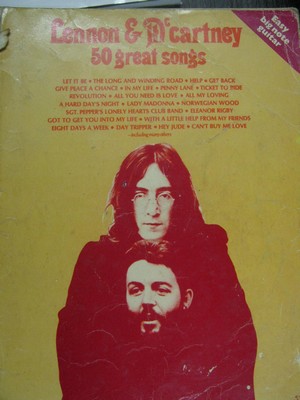
Recently found this old music book from when I took guitar lessons in the back room of a vacuum cleaner repair shop at Avenue Road and Lawrence ten thousand years ago.

My instructor, who was into JJ Cale, said Bah to the Beatles! This was scribbled on the inside  cover.

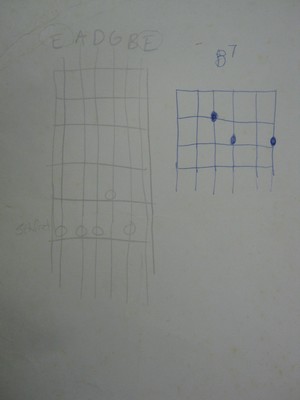
After a series of I can’t remember how many lessons, the only thing I could play was a version of ‘With a Little Help from my Friends’, with hints of ‘Magnolia’, ‘After Midnight’, and ‘Cocaine’.

I don’t blame my instructor.
I’m an accordionist at heart.

~

the book that started it all

 
My family was not what you would call literary, or even an especially bookish lot. Oh, there were books in the house—some came free with special offers at the grocery store—that’s how we got our partial set of encyclopedia (it ended at EAR–FIS); others were from the Book of the Month Club, which I think my father signed up for to get the free ones then god only knows how many peculiar titles were delivered at full price for god only knows how long before he could figure out how to make it all stop. There were also a few stolen books, mostly from schools my sister went to though I think a few came home with me from the library, permanently. All of it unintentional—I swear.

And it’s not that my parents didn’t read. They did, in their own way. Apparently more when they were younger than when I knew them. My father, who could build anything, and loved the outdoors, once said his favourite book was Robinson Crusoe; my mother was the sewing, cooking, growing vegetables, hanging laundry outside kind of mother who read what she called ‘love stories’—books with pretty blonde heroines on the cover, petting horses in meadows while dark-haired men stood in the background looking confused and handsome.

In any case, ours was a pitiful collection to say the least, and you can probably guess there was no encouragement toward reading, yet I gravitated to it anyway and from a very young age read whatever I could find, the way one might read every dog-eared volume on a dusty plywood shelf while stranded in a cabin for a rainy week a million miles from anywhere. In other words, grateful for anything. Best part in cases like that: sometimes you find a gem or two in the debris.

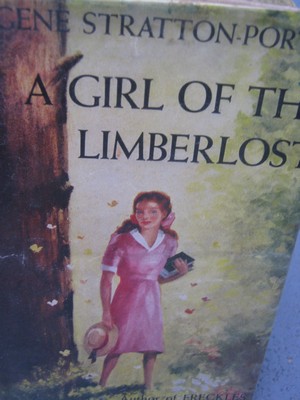
My own possibly pilfered, possibly purchased copy.

One of the highlights on our shelves was A Girl of the Limberlost, by Gene Stratton-Porter, which is stamped with the name of a local school but has a price of $2.50 marked inside in pencil. So it may have been one of the few acquired legitimately.

I read it at about ten, eleven, twelve years old, I’m not sure, but I remember connecting immediately with Elnora Comstock who wore hand-me-down clothes and lived in the woods communing with nature when she wasn’t arguing with her mother. I didn’t live in the woods but I wanted to. I can still practically smell the spice cakes her mother packed in the bucket that carried Elnora’s lunch to school. And I remember how those cakes were one of the few but important signs of her mother’s otherwise unexpressed love. I’ll have to read it again to be sure but I don’t believe Stratton-Porter sentimentalized the mother’s role in any way, which to me was refreshing. A change from all those love stories cluttering up the house, the Cherry Ames, Student Nurse, and books where everybody was so bloody happy and the only problem was something outside the family—a ghost in the vestibule, a murder in the vicarage, etc.  Yeah, right.

It was, I suppose, my first character driven story, one that suggested interior journeys were possible in literature, that it wasn’t all about ‘the other’, meeting someone who changed your life after a series of predictable problems, or climbing the mountain, or solving the murder.

All this reflection, BTW, came as a result of stumbling across a short video at The Guardian. Before that, I hadn’t given ‘the first book’ much thought, nor its many and varied influences on me (too introspective to rattle on about). Maybe the sort of thing that requires a certain age and perspective in order to see it clearly. Anyway, it’s all got me thinking that it’s probably quite often, maybe even always, a book, rather than a person or even an environment, that nudges us around a corner of our early reading. That maybe the love of words is a nature rather than nurture affair, in our DNA, and it’s just a matter of time before we find that book that connects with an inherent understanding or curiosity about the world—and reflects it back to us. True, if we’re surrounded by people who bring us sacks of lovely things to read we may find it sooner, but even if we’ve got nothing but a dusty shelf in a cabin, I’m convinced we will find it.

And then off we go. Never to be the same again. And more ourselves than ever.

Funny how stuff begets stuff.

So, latest dinner party question: what was the first book that made you think differently about books?

~

planting solitude

“How one hates to think of oneself as alone. How one avoids it. It seems to imply rejection or unpopularity. An early wallflower panic still clings to the word… we seem so frightened today of being alone that we never let it happen… if family, friends, and movies should fail, there is still the radio or television to fill up the void.

“…Even day-dreaming was more creative than this; it demanded something of oneself and it fed the inner life. Now, instead of planting our solitude with our own dream blossoms, we choke the space with continuous music, chatter, and companionship to which we do not even listen. It is simply there to fill the vacuum. When the noise stops there is no inner music to take its place We must re-learn to be alone.

“…how inexplicable [the need for solitude] seems. Anything else will be accepted as a better excuse. If one sets aside time for a business appointment, a trip to the hairdresser, a social engagement, or a shopping expedition, that time is accepted as inviolable. But if one says: I cannot come because that is my hour to be alone, one is considered rude, egotistical or strange. What a commentary on our civilization, when being alone is considered suspect; when one has to apologize for it, make excuses, hide the fact that one practices it—like a secret vice.”

(from: Gift from the Sea, by Anne Morrow Lindbergh)

fruit goes with poetry

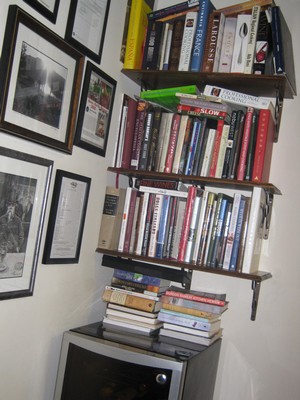
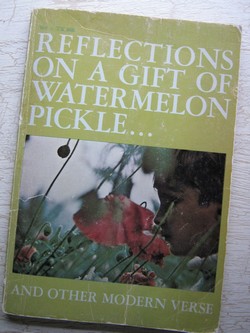
Still finding funny old titles as I slooowwlly clean up my shelves. No idea where I got half of them, like this one—Reflections on a Gift of Watermelon Pickle (Scholastic, 1966). On the inside cover is written, not in my handwriting: English 311, Mrs. Hart. This is always a bonus; I like having an idea what a book’s been up to, imagining who might have read it and why and whether or not it made a difference.

But then every book makes some, even-if-only-so-small-it-seems-insignificant, difference, does it not?

~


How to Eat a Poem

Don’t be polite.
Bite in.
Pick it up with your fingers and lick the juice that may run down your chin.
It is ready and ripe now, whenever you are.

You do not need a knife or fork or spoon or plate or napkin or tablecloth.

For there is no core
or stem
or rind
or pit
or seed
or skin
to throw away.

—Eve Merriam


things read in the shade

I probably spent just a little too much time reading on the weekend under this umbrella (no, I take that back; actually, I didn’t spend nearly enough time).

I’ve been thinning out my bookshelves recently, and coming up with some odd and interesting titles in the process—things I’ve either not read or can’t remember reading. (Which makes me think of the old Born Loser comic strip where the husband is increasingly frustrated by his middle-aged forgetfulness, can’t find his glasses, etc., and his pragmatic wife, who says:

“Think of the positives—soon you’ll be able to hide your own Easter eggs.”)

But the point is…

Oh yes. The books.

One of the more unusual titles I’ve unearthed is Just Add Water and Stir, a collection of essays by Pierre Berton, most of which appeared in the 50’s in what was then The Toronto Daily Star. The book is described by the publisher (McClelland & Stewart) as… “Being a random collection of satirical essays, rude remarks,used anecdotes, thumbnail sketches, ancient wheezes, old nostalgias, wry comments, limp doggerel, intemperate recipes, vagrant opinions, and crude drawings

What often strikes me about writing from this era is the intelligent humour, that black and white Gable and Lombard rat-a-tat pace that’s clever without the need for cynicism or the homogenous drum rolls in which much of today’s humour is packaged. People then, it seems, weren’t afraid to be subtle.

I’m also struck by the whole Hey-Honey-Get-Me-a-Coffee-Willya mentality and the (shudder) girdles-riding-up image that conjures.

For example, there’s a section titled “Seven Men and a Girl”. Not a ‘woman’— a girl. Not boys, men. Seven of them. Some of whom include Glenn Gould, Charles Templeton, Russ Baker (“last of the world’s great bush pilots”), Robert Service, Milton Berle. Then there’s the girl—the sole representative of half the population—a prostitute named Jacqueline.

These happen to be among the few serious sketches about lifestyle, achievement and personality, based on interviews Berton conducted. The one about Jacqueline is meant to dispel the theory that all call girls are unhappy. Unlike so many others, Jacqueline, evidently, “has it made”, mostly because—

“…she’s met a man who has given her his name and expects nothing from her but her love. One may well ask why, under this odd arrangement, he too is happy. And again the answer must be that happiness is not an absolute. Jacqueline’s husband spent ten years in prison. Now he has a steady job and a wife who looks after him. For him, this is enough.

Berton writes that when Jacqueline was asked about quitting “her profession”, she said she’d quit tomorrow if her husband told her to.

“But he hasn’t told her, though perhaps some day he may. And I don’t think Jacqueline really wants to quit, anyway.”

In addition to the ‘serious’ stuff, there are parodies and take-offs of society, of education, the press, bureaucracy, smoking, marketing. Smart satirical re-tellings of fables and fairy tales and recipes. Opinions on Dick and Jane, racial origins, thought control.

More than anything, it’s a fascinating romp through a not really that long ago—yet in another lifetime—era.

~

At the other end of the spectrum, I read a poetry collection recently purchased for my nieceThink Again, by JonArno Lawson, (Kids Can Press, 2010). Beautifully illustrated by Julie Morstad, with simple pen and ink line drawings that just so perfectly capture the essence of emerging adolesence—all beauty and innocense mixed with tension and confusion mixed with childlike joy and what’s left of that fleeting childlike wisdom that they are perfect just as they are.

The poems, written as quatrains, may be a little too angsty or introspective on their own, but complemented by the drawings, the book reflects something pure about the young teenage mind that, as grownups, we’d do well to be reminded of now and then.

What I Want

I’ve objected and complained/But it hasn’t done any good—/I don’t want to be explained/I want to be understood.  (from Think Again)