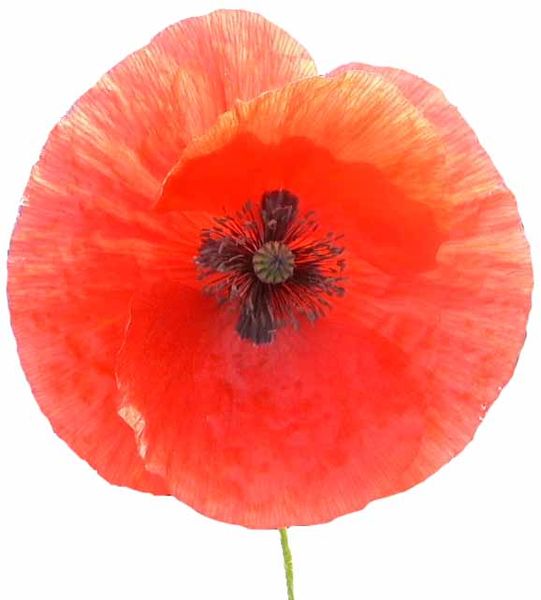
Each morning I visit the nursing home where my mother now lives. I help her dress and give her breakfast. I always leave by 10 a.m. But this morning, Remembrance Day, when we walk to the common room for a bit of exercise, the chairs, each with a photocopy of ‘O Canada’ on its seat, are lined up in rows facing a podium. There’s a large screen at the front and poppies everywhere.
I consider staying the extra hour or so but Phyllis isn’t interested in ceremonies. Me neither. I prefer observing my own two minutes of silence, alone and in my own way. We find a sunny spot at the back of the room, and I read Barbara Kingsolver’s piece about water in the National Geographic while Phyllis sleeps in the chair beside me.
It’s nine thirty. I’ll take her back to her room at quarter to ten.
But at twenty to ten they start arriving.
Soon there’s a row of four men and one woman seated beside the podium, facing the rows of chairs. “Residents who served” I overhear someone say. One, in a wheelchair, sleeps with his head back and mouth wide open. The woman sits quietly confused with her ankles crossed, and a happy man with a British dialect tells everyone who passes “you’re wonderful”, and to the man with dementia beside him who’s beginning to nod off and fall sideways, the happy man says Are you alright, Tom?
Someone straightens Tom out and asks what it was he did during the war but Tom just looks straight ahead. The happy guy says: What we all did… sink or swim.
More residents are wheeled in. A few come with aluminum walkers or a nurse. None come unassisted. The room is filling up with bodies and sounds. Phlemgy coughs, orphaned words, mumbles. The woman who yells all day I want to go home, somebody help me, what am I going to do? arrives, pushed in her wheelchair by a nurse and placed at the front of the room. Where am I? Where are you taking me? she yells. She has terrible teeth and long thin hair. I’ve never seen her family; she may be one of the many abandoned to the system, completely dependent on the mood of staff and Ministry guidelines, at the mercy of Long Term Care politics and rubbery cream of wheat.
‘One Tin Soldier’ plays in the background. By The Original Caste. I remember being young and hearing it for the first time and not really understanding what it was about. Listening to it now, surrounded by so many drooling tin soldiers of yore, it takes on even deeper meaning and I realize I’m staying for the ceremony.
I stay for these men and women who did, and others who continue to do, in a mad world because it’s, sadly, still the only way any of us knows to say thank you. I stay because we’re all a product of our past and because we’re all connected whether we like it or not.
I stay for my dad whose only comments about the war had to do with unexpected kindnesses from all sides. He didn’t speak of heroics.
The German man down the hall from Phyllis is brought in to sit with former enemies, which makes me wonder at the word ‘enemy’. Circumstantial at best. They all sit quietly confused together now, eating the same gruel, wondering perhaps what it was all about anyway.
Oh, yes. A madman. There’s always a madman.
Tom keeps falling over so his son moves him off to the side where he can keep him upright. He’s brought his dad’s beret and medals and pins them on a slightly stained beige pullover. The son takes pictures of Tom, asks Tom to salute. Tom just stares straight ahead.
It would be easy to leave. Wake Phyllis and go. I don’t want to hear ‘In Flanders Fields’ and cry with strangers. But I stay because it’s such an honour to sit in among the muddle of their confusion, their dignity and continued bravery in this forgotten place of forgotten people where the beauty of old age is seen as ugliness, as something to pity.
During the ceremony I watch a daughter put a pink sweatered arm around her mother, pull her close and kiss her face. Another daughter is her mother, thirty or forty years earlier, so striking is the resemblance. A man in a motorized wheelchair wipes his eyes with a facecloth, says it bugs him that he can’t stand up to pay his respects. The happy man occasionally blurts out: Too much talking, too much talking and he’s right of course; there’s always too much talking. I notice his breathing is difficult, like my dad’s the year he died.
I notice the woman who yells all day is quiet.
And when eleven o’clock comes the whole room is suddenly hushed except for the sleeping veteran who snores loudly beside the podium and the happy man who says Hallelujah. But the muttering and coughing and shuffling stop. It’s like these people, who aren’t sure of much, can still sense what’s important. Maybe that’s what makes us human.
As the ‘The Last Post’ is played, and while I blow my nose, Phyllis wakes, looks at the rows of silent backs in front of us and says: Wow, it must be a good movie.
The ‘residents who served’ are recognized and the anthem is sung and then later a video clip is shown, based on a true story about a guy in a Shoppers Drug Mart who was outraged that the store observed two minutes of silence, causing him to wait—two minutes—to pay for his purchases.
The happy man is again saying Too much talking, too much talking, and when the video and the ceremony end, and we’re thanked for being there and all is done, the happy man, breathing hard in his veterans’ seat, says: Peace at last, peace at last.
On our way out, I stop and ask Tom’s son if I might shake his dad’s hand. He beams, says Sure! and explains to Tom what I want. Tom in his beret and strip of medals pinned to his sloppy sweater, stares back, silent. His son helps him extend a hand. It feels soft and weak, the kind of hand that hasn’t worked in years except maybe to scratch an ear, adjust a bib at lunch. I hope that on some level he might still understand what a handshake is. And even if he doesn’t, I do.
I try to find something in his eyes to connect with but they stare in a kind of trance; I wonder what they’ve seen and whether I’d have the stomach for knowing.
Thank you, sir, I say, and Tom’s son tells him: Say you’re welcome, dad!
And ever so quietly, Tom does.



 Matilda Magtree
