seen heard and noted on a late september ramble

A woman dashing, that is, walking swiftly and with purpose, from front door to car, but not without glancing up at a strolling passerby. That would be me. And then glancing away without so much a s Hale Fellow Well Met!  I’m all set to say good morning but it’s clear she has no time for such nonsense.

A chap, in his thirties, looking smart in a purple tie, approaches his smart silver car, starts the engine then returns to his house, leaving the car in idle, spewing unpleasantness into his smart neighbourhood while he’s back inside his smart house possibly positioning his tie so as not to get anything on it as he slurps the dregs of his coffee, very possibly made with the very smartest of coffee makers.
I consider how early the poor soul will have to rise in order to warm his vehicular interior once the morning temperatures fall below 15 celsius.

Something about the pillows on the porch chairs, the shade of green, the fact that bird silhouettes are stenciled on them in a sort of pale burlap colour, the way they look recently leaned against, makes me warm to the strangers living inside this house.

The very day after someone asks: why is it you never see two people walking a dog?—and at the exact moment I’m pondering this almost-koan—I see coming toward me two people walking a lovely rust-coloured pooch of indeterminate breeding.

I notice a bottle of Listerine in a neighbour’s blue box. This feels an oddly personal thing to know about them.

A bottle and can man in a red and black lumberjacket pulls a trolley along the street. I know it’s bottles and cans, it’s recycling day and I can hear them clatter. I respect this form of earning a few bob. In fact, I’d like to see those plastic bottle return depots they have in Calgary. Keeps the streets cleaner, folk make a little dough and there’s less for the landfill. What don’t I know about this seemingly good idea? Why aren’t they in every city and town?

I’m pleased and proud to see Giant Tiger yard waste bags, also President’s Choice, Canadian Tire and ‘Life’ brand in my neighbourhood. I think maybe we’re actually, collectively, getting how every tiny choice matters, support local! choose wisely where you spend your dollars or you will soon be surrounded by big box stores!  Maybe the 100 monkey thing is kicking in at last. Hooray! Then I turn a corner and just like that it’s all Costco and Home Depot, Loews. A different crowd entirely, and it occurs to me that you can probably judge someone’s politics by their yard waste bag as easily as a sign on the lawn.

Yet another man in red and black lumberjacket, this time a bathrobe. He sneezes as he walks to his garbage bag already on the street, opens it, adds something, then catches my eye as he turns and we say good morning, good morning. He looks like Peter Gzowski.

the long and worthwhile road…

—That leads to my bookseller’s door.

Please understand.

I don’t have to drive. I can call the store, phone in my order [and have, often], or place it online through the shop’s website. I can have it delivered to my doorstep—but I prefer the thirty minute drive to pick up the books in person, see how the shelves are stacked, see what’s in the windows, chat with staff about new favourites, gift ideas, book club picks, the best food in town, the latest author reading or event being held in Blue Heron’s studio space [where among this summer’s inaugural events was a Neil Flambe camp for kids with Kevin Sylvester], or just wander about neighbouring shops. It’s the kind of town where you feel encouraged to wander, discover things, where you end up getting back in your car with not only books but goat cheese, olives, pastries, fresh bread—the fixings for a perfect rest of the day.

The bookshop is merely the town’s heart. Stuart McLean named it among his ten favourites in the country.

Recently ordered, collected, or waiting for me, are Joe Brainard’s I Remember, Alice Zorn’s Ruins & Relics, Brenda Schmidt’s Grid, Jon Klassen’s This is Not My Hat, Alice Peterson’s All the Voices CryLorri Neilsen Glenn’s essays on poetry, Threading Light, the re-release of Sheree Fitch’s classic, Toes in My Nose, and the short story anthologies Riptides  and Bridges. 

All of which has arrived, or will, without a glitch. The phone will ring and I’ll pick a day when I need goat cheese and good bread and head out.

Lucky us for having all that.

And congratulations to Shelley Macbeth, the creative genius and owner of Blue Heron Books, who, this year, [so well deservedly] received the CBA Libris Award for Canadian Bookseller of the Year.

Congratulations.
And thanks.

take a letter…

Dear Girls in Pretty Dresses in the Purple Car in the Parking Spot on St. Patrick Street:

—Which as we know is right around the corner from the Art Gallery of Ontario, which is where I’m heading to see Picasso and which is why I covet your spot and am beyond thrilled when, as I’m circling the block, I see you and a friend get into your car. Oh joy!  I think as I slow down, pull over behind you and wait a few moments for you to pull out.

But, dear girls, you don’t pull out, do you?

No.

What you do is put the top down on your purple car which turns out to be a convertible so that now I have a clear view of the back of your pony-tailed heads as you sit… SIT!! there.

Minutes and minutes go by. And you continue to sit.

Doing what????

[deep breath]

Dear girls, I’m writing for two reasons. One, to tell you that it’s just about this time that I find myself saying some very bad words in your direction. Out loud. But you can’t hear. Unlike you, I don’t drive a shiny new purple convertible, but a well-loved tan Toyota with an Obus form in the driver’s seat and a bit of rust around the wheel wells. On top of that, my windows are closed. But rest assured the words are said.

Because, dear girls, what kind of idiot sits in a parked car when someone is clearly waiting behind you for that spot. I mean, for god’s sake, if you’re leaving, leave!

After a few more minutes it occurs to me that there might be some problem that prevents you from leaving so I get out of my car and approach yours and see that the problem is that you and your friend are having lunch. Pad Thai by the looks of it.

Hello, I say.

Hello, you say.

I don’t mean to rush you, but after you eat, will you be leaving?

We?

(At this point I detect an accent, can’t quite place it… central Europe somewhere.)

Yes, I say, you, your car.

You say yes, after you eat, you will be leaving.

I can’t believe I ask, but I do. How long do you think that might be?

You consider this quite seriously and say, ten minutes?  like it’s a question.

I say, great, I’ll wait. (Does this give you some idea of how precious a parking spot is in this neck of the woods?)

I try to read but I keep looking up. I feel the need to stay alert in case you start the engine and someone else sidles up, expecting to move in. I have to stay vigilant.

I can tell by the way your heads are moving that you aren’t rushing. You’re chatting and having a splendid time and why shouldn’t you in your dresses and hair and youth and noodles and European accents? You’ve paid for the space, why not have a picnic?

I say more bad words about out of towners and Central Europe. [Which is ironic given that I, myself, live out of town and my parents are from Central Europe.]

Almost exactly ten minutes later you open your door, walk over to my car and in your accent, which I now recognize as something like German or Swiss, you tell me you have an unused ticket for Picasso if I’d like it. I say I’ve already got a ticket, but thank you. I don’t mention it but the ticket you have isn’t valid anyway, as it was only good for entry between one and two p.m. We discuss the exhibit and your Pad Thai and I say I hope you didn’t eat quickly on my account and you say no, you didn’t. I’m oddly relieved. You tell me you’re off to somewhere-somewhere next; I have no idea what you’ve said and don’t ask for clarification… the point being you require sustenance, which, you explain, is why you had to eat before setting out. You laugh as though any fool would agree one must never go to somewhere-somewhere on an empty stomach. And of course I laugh too.

We bid one another a fond farewell. Really quite fond.

And then you are off at last in your purple convertible and pony-tails to somewhere-somewhere. I hope, dear girls, it’s all that you hoped it would be.

I just wanted you to know how the story ended.

men


The first one has a dog. A shih tzu, I think. Small and fluffy, friendly. A soft tongue and short attention span (the dog, I mean). He’s just coming out of the park and I know him so I stop and say hello, how’s the new puppy, has he changed your life? As it turns out, he has. They no longer need an alarm clock, the man says, not that they really want to get up at exactly 6:15 every morning now that they’re retired. He smiles when he says it though and then we say goodbye—me to the man, me to the dog. The man says goodbye for them both and as I round the corner I hear him talking to the dog in a sing-song voice that in no way matches his grey hair, weathered face, his sweat pants and tee-shirt: Let’s go home and see mommy…

The next is much younger. Shirtless and shooting hoops in his driveway. A dog, fox coloured and Lassie shaped, sits politely off to the side, presumably keeping score.

I’m not looking for men, they’re just about tonight as I wander through the neighbourhood and beyond. Maybe it’s the hour—6 p.m.—dinner being cooked, or just eaten. The wimmin inside playing with power tools or sewing on buttons.

The guy in a white floppy hat and suspenders putting out his recycling lives alone I decide. He’s lived in this same house, a small brick bungalow, for forty years; he was the first owner. He and his wife chose rose-pink broadloom from the builder’s catalogue to cover the hardwood; they panelled the basement, put in a fake fireplace and a dartboard. He has a little workbench in the corner and his wife crocheted doilies for the arms of every stick of living room furniture. Cabbage rose chintz. Went smashing with the rug. She died ten, maybe twelve, years ago. In her sleep. He’s still grateful for that. Not that she’s gone, but how she went. The kids moved out in the 80’s and come back most weekends to see how he’s doing; they bring food and stay for supper, wash dishes and tidy the place up a bit. All the clatter and voices makes him feel like almost no time has passed and he might even think it stood still if it weren’t for garbage day coming around the way it does, reminding him yet another whole week is gone.

A man in his 70’s sits on the porch with a woman in her 40’s. I’m guessing, his daughter. Something about the way he leans back and she, slightly forward, towards him, as if falling into familiar postures in each other’s company.

A younger man rakes grass clippings, having moved a soccer net and ball.

Another mows his lawn carefully, precisely, perfectly even rows on a perfect angle. I want to stop and ask what he does for a living. He’s either an engineer or an acrobat.

The construction workers are still jackhammering and chatting, and the guy around the corner shakes open a yard waste bag while the one across the road waters hanging baskets of red impatiens.

♣♣♣

You might also like:

Solitude en Masse

Three Girls

it’s not them, it’s us

Several years ago I was picking my mum up from the hairdresser and as I waited in the parking lot of a small plaza, a huge green pick-up truck pulled in beside me. The window was open and the guy driving was heavily bearded, ruddy-faced, plaid-shirted, the kind of guy you just know spends a lot of time outdoors; you could almost smell the pine boughs and bait—I guessed fisherman, hunter, lumberjack. Maybe all three. When he opened the door I expected a giant to emerge but what happened was he lowered a tiny step-stool attached to a rope, then turned and slid himself off the seat and onto the running board and, with a cane for balance, hopped down to the step stool and onto the pavement. Then he tossed the stool back into the truck, shut the door and made his way into the plaza.

He was maybe three feet something tall.

A few minutes later he was back, walking just ahead of my mum and her fresh perm. He reversed the stool routine and got into his truck as my mum sat down beside me.

Poor man, she said. It must be terrible to be handicapped.

Had I just glanced at him I might have agreed, but I’d had time to watch, time to think what it means to be handicapped, because this man certainly wasn’t. He was a short man functioning very well in a world designed for people who fall into certain categories, certain heights.

I wondered how well I’d do in a world designed for his height. A whole world where everything, everything, was way too low. My back aches just thinking of it.

The word handicapped just doesn’t seem right somehow, the way we use it, except to suggest that anyone could be handicapped in a situation not ideally suited; we, who thrive in this world, would be handicapped in a world not constructed for us—not by our limitations, but by the limitations imposed on us by awkward ‘constructions’.

It seems that in our narrow view of what’s ‘normal’ we’ve built a rather limited world, one for sighted, right-handed, hearing people of a certain size. I suppose it’s a ‘majority rules’ kind of thing, which really isn’t a good answer but if that’s the best we’ve got then you’d think at least we could get our perceptions straight and see things for what they are—that very normal people who happen to be blind or smaller than the ‘majority’ are seriously inconvenienced as a result of those ‘majority’ rules.

They are not handicapped.

If anything, our thinking is.

I’ve been meaning to write about this guy ever since I saw him. He came to mind again when, the other morning, I heard about Oscar Pistorius qualifying for the Summer Olympics.

“My disability is that I can’t use my legs. My handicap is your negative perception of that disability and thus of me.” – Rick Hansen, Man in Motion, 1987

define treasure

A few weeks ago I got an email from Allyson Latta, asking if I’d be interested in participating in her Seven Treasures series, which, she explained would amount to simply listing a few items that, for whatever reason, I couldn’t part with.

I was delighted with the idea of course, honoured to be asked.

At first what came to mind were the obvious things when one hears the word treasures—i.e. pirate loot and pots of gold.

But given that I live in a world of stones collected from the beach, feathers that appear magically at my feet, and a few pieces of art… there’s not a lot of lootish takings to list. And anyway, things that can be bought are never the real treasures, the value attached being purely arbitrary, an abstract created by some vague entity. Not to say that a treasure can’t have monetary value, but I think that quality is incidental, secondary at best.

So next my thoughts went to treasures so valuable they don’t need mentioning—the people and animal ones.

But they don’t need mentioning. (Have I mentioned that?)

Which brought me to the most interesting list of all: treasures I didn’t know were important to me until someone asked.

I was surprised by what surfaced. (The bowl I ate popcorn from as a kid? Are you kidding me? This is what I’m attached to??) But no, of course not the bowl, but what the bowl represents, what I think about every time I see it in my own cupboard and remember its position on the second shelf above the flour and sugar tins, in my mother’s. I remember where I ate that badly burned popcorn, made in a beat-up aluminium pot (used only by me for, um, badly burned popcorn)… what I watched on TV, the pages I turned with buttery fingers; I remember the coolness of the basement, the sound of my dad’s lawnmower through the window, my mother sewing in another room. I can’t remember the bowl being used for much else. Maybe it was, but it felt like mine. How privileged I feel now to have been given this ‘space’ of my own—space the size of a bowl—yet large enough to hold the sound of my mother’s sewing machine.  No one, including me, could have guessed what a gift it was.

It’s always this stuff that matter most, things that connect us to ourselves in ways we hardly know, and that might otherwise be lost.

So this is what the lovely Allyson has so beautifully and thoughtfully presented on her blog.

My seven were first up.

And I see that Rebecca Rosenblum’s seven have just been posted. (Oh that spider plant! Of course. How could she ever get rid of it? It’s like a tiny striped pet!)

Lovely idea, this. And such fun. Both the writing and the reading. And a great question to ask yourself or family and friends. I sent an email to a few friends recently and was amazed with what they wrote back.

Happy excavating!

dear lady

Dear lady in the check-out line at Sobeys who the whole time the cashier rang in your stuff you were on the phone… So how ARE you? Uh huh, uh huh…. and in this way you managed to ignore her, the cashier I mean, even as she gave you the amount and set up the ATM machine and thanked you and printed out your receipt and handed it to you… all during that you never once made eye contact… And how is Brittany? Uh huh… oh wow… uh huh…

Yes, it’s true, I was watching you. And listening. Forgive me. I assumed you wouldn’t mind given how your personal space (and everyone else’s) doesn’t seem overly important to you. Forgive me also for any sarcasm you may detect in this note, of which there is plenty, especially if Brittany, et al, are in the throes of dysentry or scurvy and you are their ward nurse, checking in (though even that could probably have waited until you were in the parking lot).

Mostly, dear lady, I’m writing to say how much you missed. The cashier was a lovely person and when, after you left, it was my turn, and I said to her, in an exaggerated way: So, how are YOU?…  she got it and laughed (please don’t think we were mocking you although we were) and then as she rang in my yellow tulips and my spinach we talked about Spring and she said she was thinking of planting her first garden ever in Canada this year, flowers mostly, and I suggested including a few tomatoes and some lettuce and she said she would do that even if her husband thought she was mental. And I said good. Because the world needs more gardens.

That is what the world needs, dear lady. Gardens. And conversations with people who are standing right in front of you.

solitude en masse

 
At the beach where I go to walk among the gulls and mutter about darlings that won’t take a hint, where I write sometimes in my car or at a picnic table if the weather allows it, or simply breathe and gather pictures, I am rarely alone.

There are the gulls of course.

Now and then joggers.

And yesterday a woman in a headscarf eating a MacDonald’s burger in her car as she read something I couldn’t see.

Maybe because the day was sunny, or maybe because of the recent holidays and all that family and turkey and Auntie So-and-So’s Marshmallow’d sweet potatoes that render even the strongest among us a little queasy but is a tradition so must be taken with a mmmmm, that sure is good, Auntie So-and-So as you try to disguise the stuff under a pyramid of wing bones—maybe because of that, there is also a man in his car next to mine, eating a whole pizza from the box on the passenger seat.

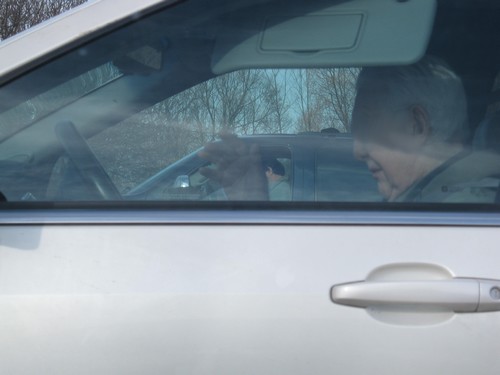
Another man, this one elderly, stares out the window of his medium sized silver sedan, one hand held in the air over his head. I consider dementia, an open-eyed cat nap with sleep paralysis, loneliness turned eccentric, but then, as he remains focused on the lake, his fingers begin to move ever so slightly, more and more until with a dramatic swoosh his whole hand is swaying back and forth, then stops—and his fingers again…fluttering, graceful. I realize he’s listening to music and I wonder if it’s on radio or CD or just in his head. I turn the ignition, flip the dial until I land on CBC 2. A symphony. I glance back at the man who is still conducting, eyes open, now closed—his movements, the pauses, the dips, the quick tilt of his hand as the violins come in, match what’s being played. It’s a long piece and gives me time to consider why he’s there. I decide it’s a solemn day, an anniversary—of what though, his wife’s birthday, their wedding, her death, the death of their first child perhaps (was that child a disappointment or a joy?); is this the date he was taken prisoner of war sixty something years ago or is it a year to the day that his wife announced she was leaving him for the guy that runs the Saturday night films at the Senior Centre?

Who knows, maybe he’s celebrating.

Later, a couple arrive in a small red truck. The man is driving. The woman’s head is down, facing her lap. When he turns off the ignition she looks up but her eyes are vacant, she could be anywhere. She stays in the truck while he gets out, lights a cigarette and walks toward a few gulls perched on a railing. He stands facing the water and I’m pretty sure I see his shoulders drop at least a few inches as he exhales.

my day, in food and words

It begins with a haircut.

Not at the cheap place where you can just walk in without an appointment, where I ususally go—essentially a unisex barber—but to my old, more expensive, hairdresser who I used to see when my hair was long and didn’t need cutting every twenty-five minutes. It still feels like I’m having an affair, this new place; I’ve never accepted that I really left the old place. Just taking a break. I go back a couple times a year for a decent cut, a template for the uni-barber to follow. A little unconventional but it seems to be working for all three of us.

It’s a day of errands and appointments. There is the usual traffic. A bus pulls in front of me at a dangerous angle; I consider making my feelings known but the sun is shining and it’s easy to be nice, so I keep my hand on the wheel.

A woman, sixties, stout in a pink house-coat with permed hair the colour of cardboard, smokes on her balcony, and later, in a different part of town, there is a man, also in his sixties, trying to get on a unicycle. I round the corner and never know if he succeeds.

The appointments and errands go on and soon it’s late afternoon and I haven’t eaten and I know I won’t get any work done even if I return to my desk so I decide to take myself out for a bite, treat myself to that place inside the art gallery, but it’s closed. The gallery itself, however, is open and though my stomach is growling the exhibit draws me in: William Brymner, his own work and that of his students, Prudence Howard, Morrice, A.Y. Jackson, et al.

The Quebec paintings are always easy to spot—all church steeples and snow. Even the houses have churchy elements, even the log cabins alone in their forests of birch— especially the cabins.

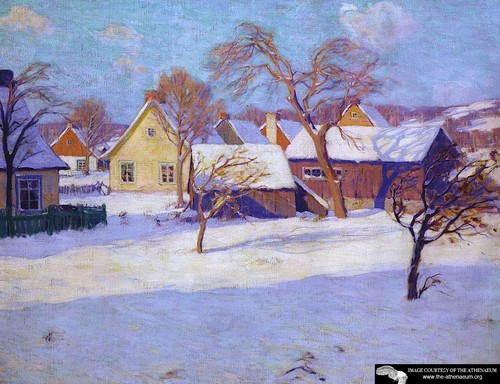
In Clarence Gagnon’s ‘Winter, Village of Baie-Sainte Paul’, a wind blows on a sunny afternoon. Lunch has been eaten, slabs of cold tortiere and glasses of cider. The dishes are done. The men have gone back outside, the children too. It might even be a school day. Inside the slope-roofed houses women breathe on the glass as they look out onto frozen gardens, broken fences and knee high drifts of snow.

I like the idea of painting en plein air and vow to do some soon.  Pourquoi ne pas en hiver?  Well, maybe just a quick sketch…

I still haven’t eaten so I stop at a deli on my way home, the one I used to take my mum to on errand days when she’d come with me for the ride, staying mostly in the car, especially if I parked in a sunny spot. She was like a salamander then. I’d stock up on her favourites: blocks of smoked bacon to slice or grind with garlic and eat with fresh rye bread, brandy filled chocolates, sauerkraut and a bag of pfeffernusse—a spicy cake-like cookie. I’d always buy one square of ice-chocolate from a box near the cash register—creamy milk chocolate that feels cool when you eat it. She wakes up when I open the door and all groggy wonders where we are; I hand her the chocolate and like a child, she brightens immediately, fumbles with the gold and turquoise foil, pops the whole thing into her mouth. I hear her dentures clatter and soon she begins to sing crazy old songs about chickens and underwear, songs I’ve been listening to all my life. I tell her I got the smoked bacon, and she hoots, says let’s go home and eat!

That was then.

The last few months of her life, after the stroke, she was in a nursing home and for a while she still ate the bacon and the rye bread, the chocolates and cookies. Surprisingly, it wasn’t this stuff that killed her, in fact it’s what kept her going, all that was left. When nothing else mattered, the bacon was still a small joy, some connection to better times—she always talked of home when she ate it, the mountains, her mother; it even made her sing occasionally, even in that hideous room.

The chocolates and cookies went first, and when one day she said no to the bacon and bread, I knew the last corner had been turned.

All this comes back to me as I stand in the delicatessen, choosing meat for a sandwich, my stomach still growling.

I buy the meat. And a bag of pfeffernusse, a block of smoked bacon, which I’ll put through a meat grinder with garlic, salt and pepper. I buy sauerkraut and brandy filled chocolates. I want to buy more but I leave it at these things, some of which I don’t even like, it just feels good to place them in front of me on the counter. And then even better to carry them outside into the sunshine.

I open the car door, set the bag down on the passenger side. Only the square of chocolate is missing.

I start the engine. It’s time to go home.