the real world
sounds of summer
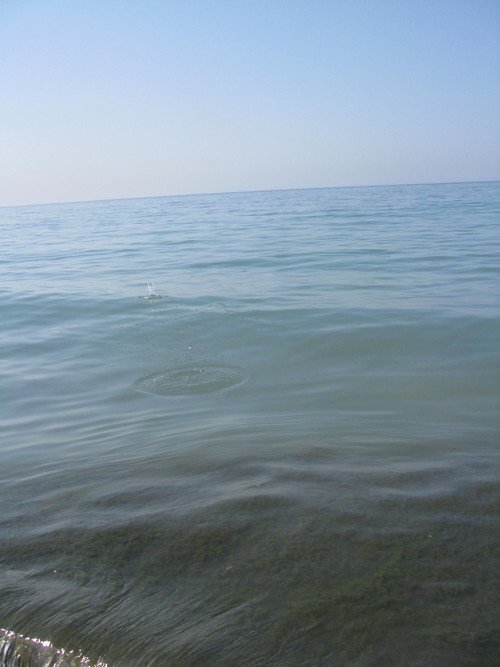
Gulls. Always gulls.
Then something else, a party of black birds, a celebration.
Ten thousand voices in the reeds.

The sound of roses.

—Wilting in the heat, the kerplunk of falling petals almost lost against the din of all that invisible black bird revelry.

Seaweed drying.
It sounds like this: schwimfftmtzwuft
You have to lean over to hear it.
The splash of a dog named Winston belly-flopping into the drink.

The slosh of my feet and the surf blocks voices of walkers, strollers, the breath of joggers, a herd of cyclists and a grown man working out on the monkey bars.

But a woman comes through loud and clear, warns of dog poop ahead.
“Somebody let their dog just poop, poop, poop…”

The skip of a stone.

Scrunch of pebbles.
Me cursing the mentality that appreciates beauty enough to come here, then spits in its face.

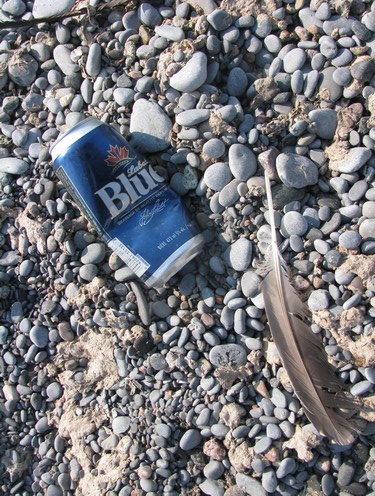
But no one warns of litter ahead…

Inhale.

Exhale.
this morning i danced
This morning I danced to Ladysmith Black Mambazo in front of a winter scene by Lynne Campbell, black-legged sheep in falling snow. I didn’t think much about winter or sheep, or Africa for that matter although I wondered if the music was inspired by the land. I would assume so, drums and heartbeat. And then I thought of a pueblo in New Mexico full of tourist buses and the woman I met as I walked across a parking lot who lived there and for some reason stopped to tell me that when the buses and the people were gone you could feel the energy of the red earth through your feet.
I’m often thinking about land in one form or another and so as I danced it wasn’t unusual that I began to think about the wild, unkempt garden outside my window with its bushy native shrubs, serviceberries just ripening, rows of lettuce and cucumbers, the robins and rabbits I share this with, and then I thought beyond it to my town—not especially picturesque or special, just mine—and the lake that I love despite its pollution… the gulls, the peace, the way the lake knows how to be itself and do what it’s supposed to do despite what we do to it because we don’t know how to be—and how all of it links me to childhood, to the flinty smell of factory on my dad’s clothes as he comes through the back door—my mum, with a picnic hamper of potato salad, homemade bread, radishes, a thermos of Koolaid, another of coffee; us heading to the beach for supper and a swim.
I dance to Ladysmith Black Mambazo thinking how what’s happening in Ottawa this week, this month, is a crying shame. That this act of devastation to the land and the water, to the rights of everything alive, is being trampled without explanation or apology. That these changes to the environment and the eco-system are not merely wrong and unfair and unkind to the planet, to ourselves and the creatures we’re meant to protect—which in turn we can thank for our survival; see how far you get without bees—but what the madness in Ottawa changes is how generations will think, how they’ll live, whether they ever eat radishes on a beach, what they’ll have to think about, care about. What they’ll have left to care about…
That woman in the pueblo recognized the inevitability of economics, she knew that ridiculous as it is, we’ve created a society where there are concessions that need to be made. But What Ottawa is doing—turning its back on the environment—is more than a concession, it’s unconscionable.
And yet it’s happening right now, a Parliament all eager willingness to bulldoze and deceive. Something wicked this way comes…
My new favourite mantra comes from @Belgraves: “What our country needs is for Canadians to act like the people they think they are.”
It’s not possible to sit back and do nothing.
So I dance, try to feel the earth beneath my feet.
And then I wonder: what can I do? How do I sing the rhythms of this land?

silence is not an option
may and i
I should have known I couldn’t let May slip by without a note of reverence. We have history, May and I. It’s the month when I seem to both lose the most and find the most; the month that makes me pay attention.
It’s the month my dad died twelve years ago, the month my mum had a stroke in 2010; the month she died a year later. It’s the month I was married and the month—in a completely different year—that I was close to snuffing it too. It’s also the month I didn’t.
The details of finding and losing are never as important as the lessons.
And there’s little point in going on about either.
Cryptic, yes.
And personal, in way that’s worth celebrating with others.
That’s May.
~
I went walking this morning, although I didn’t feel like walking. I’ve buggered up my neck. Don’t ask how. It doesn’t matter. It’s a long story. It’s the usual story. It’s no surprise. It’s my own fault. It happened a few weeks ago. In May.
Anyway. Everything hurts. Walking, sitting, swimming, driving, writing, thinking, looking around.
Like I said, the details are unimportant.
Halfway to the beach I remember I’ve forgotten my camera, which almost makes me turn around and go home and stay there. Wallow a bit, the way you feel you have a right to when everything hurts.
But the car keeps moving toward the lake and I don’t have the strength to argue.
So to the lake we go.
And once there, I walk.
First, past the hot pink wild roses that smell just like gift soap, then past gulls sunbathing on the pier, past the guy, young, maybe his first summer job, with ear protectors and a weed whacker in the garden donated by the Rotary Club. I think how much more he might get out of the experience if he could hear the waves and the birds, the laughter of an older couple in matching helmets as they cycle by. I have a set of clippers I’d be happy to lend him.
The sand is warm, the lake calm and glassy. Sky blue. Clouds fat.
A woman approaches in lycra. I lift my head for eye contact, prepare to say hello, but she marches by, all purpose and form. I have the feeling a pedometre might be involved. She’s walking for health, for fitness. No time for niceties. Best not to get in the way. Best not to judge. We all walk for our own reasons.
I’m carrying my sandals, sloshing through the water, hoping I don’t have any open wounds; a couple of seagulls paddle along just ahead of me, stopping when I stop. I like this connection, all three of us aware of each other. Then a story I heard on the news this morning comes to mind, about that guy who sent body parts in the mail, the things he did to kittens, and I wonder what happens to some people that they don’t feel connected to things, and I wonder how much of that can be fixed… and whether we’re a society who even knows how to fix broken people.
I watch a mother and a young boy, maybe four years old, approach the lake. She is so scared for him, clutches at him as he makes for the shore. But he’s scared too. He walks slowly, tentative. Both of them stand at the edge not knowing to pick up a stone and skip it. Eventually, they leave, make for the swing sets up on the grass, but even there I can see her face, anxious, telling him to be careful. He moves around stiffly, checking to see if she’s watching; he wants to please her. He’ll be careful.
After that it’s just me.
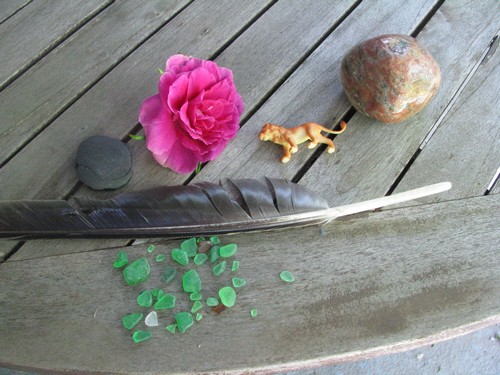
I collect beach glass, more than I’ve ever collected in one day. Mostly green but a couple of browns and a nice sized clear. Most are tiny, but it doesn’t matter. That my eye finds them is what counts. I’m grateful whenever I can see what’s right in front of me.
I fill a grocery bag with litter.
I find a plastic lion and almost leave it but then it makes me think of Bert Lahr and I smile, pop it into my pocket with the glass. I hope its owner wasn’t too distraught when s/he got home and found the lion missing. Maybe s/he’ll come back to search for it and find something else, something much lovelier, in the process. Maybe I’ll take it back, leave it in the crook of a tree. Or on the swings. Maybe the frightened boy will be the next to find it.
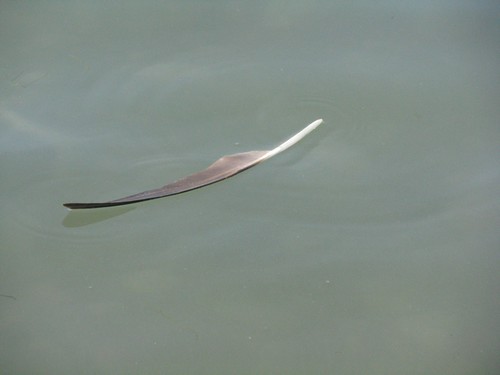
I’m sorry I don’t have a camera to take a picture of a low-flying gull over clear stoney water and tufts of seaweed.
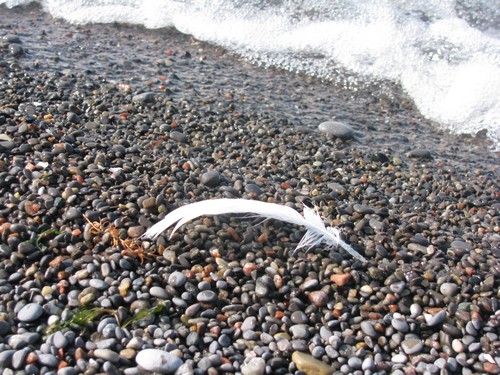
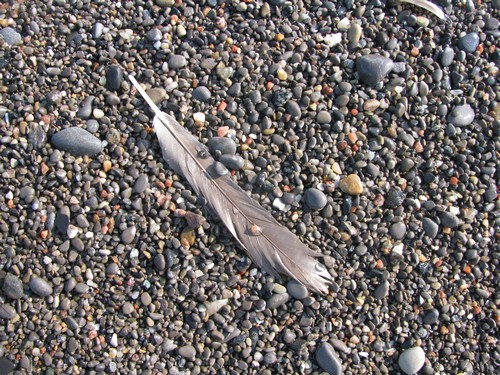
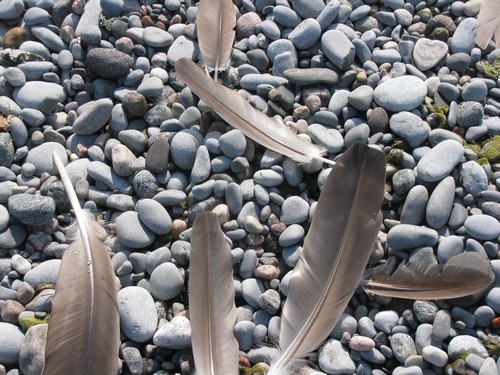
Or four feathers that look more like ancient pens discarded on the sand.
By the time I get to the large flat rock where I once saw a young girl meditating, seemingly oblivious to anyone who passed, I’ve stopped thinking about pictures, about capturing things, and I remind myself it’s good sometimes to let things go, that there are other ways, many ways, of remembering.
Things lost.
beginings and endings and beginings again
For weeks now I’ve been dipping in and out of Beth Powning’s book—Seeds of Another Summer, a gorgeous thing of full page photos and essays, and I think the first book she published (1995), some twenty-five years after having moved to the wilds of New Brunswick.
I can’t seem to help
myself—no sooner do I say ah, yes, that was nice, and set the book aside thinking I’m done with it, than I find myself opening it again (and it’s a library copy that must go back which is terrible and makes me think I need to place a call to my bookseller to find me a good used copy so I can continue dipping at leisure).
What I can’t get enough of, I realize, is the feeling of having a very pleasant walk with someone who loves nature and knows enough about it to know she has a lot to learn—and having this person point out the million things you don’t see along the way because you’re too caught up in looking at the whole.
Powning is great to walk with. She notices spider webs at dawn. And the hieroglyphics of bird tracks in fresh snow. The shadows trees cast. But she’s honest about the journey from city to country and how she didn’t see these things at first.
From the section on ‘Gardens’, she writes about the veggies just starting to grow in June when “…it’s so easy to nick the shallow-rooted weeds from their tenuous holds…. For a while, the garden grows just as I imagined it would, just the way I sketched it on paper, last February….Quickly, though, it passes this quiet stage and moves on to a startling urgency of growth….Thistles with roots like parsnips erupt through the straw in the cabbage bed. Mint creeps slyly amongst the broccoli. My fingers fly like a typist’s around the corn stalks, scrabbling away weeds which spring up nightly.…[By] late July, early August; the garden pressures me with its heedless and chaotic production. Keeping up with it is like trying to prepare dinner with guests in the kitchen, children underfoot, the phone ringing, and unexpected visitors pulling into the driveway and honking their horn.”
And I love her honesty and think: oh how very nice to know I’m not the only one who starts each year’s garden believing that this time I’ll keep things manageable—no bolted lettuce, no overripe cucumbers with seeds the size of foreign currency or woody zucchini because I forgot to pick it.

Ha! Powning says to that, and suddenly I feel okay about the fact that my blackberries are overrun with Black-Eyed Susans and instead of beating myself up over it, I decide to take a picture and send it to a gardening friend in England, one of those people who you assume would never allow anything as slovenly as bolted lettuce in her garden…
—or maybe it will delight and reassure her.
Powning makes me want to celebrate my lovely crop of errant flowers.
In the section called ‘Boundaries’ she talks about the idea of home at the edge of wilderness and the misconception that nature is somehow separate from civilization and how that view changed as she began to understand and ‘know’ the fields around her, and stopped imposing on her expectations and assumptions of what it was.
“Boundaries: between the geese and me, between the crickets and me. Yet the longer I listen, the more I hear.”
The photographs are of things we’ve all seen a thousand times: hillsides of freshly mown hay, a single buttercup, a spider’s burrow (okay, a few things we’ve never seen), but completely stunning in that way that can sometimes leave you in awe at the magnificence of ‘ordinary’. There’s also a sense of integration, of us and them, how the presence of one affects the other. A brilliant shot of footprints through a dewy morning field says it well.
It all seems so obvious when seen through her lens.
There is a section on ‘Trees’, another on ‘Wild Plants’ and, finally, ‘Home’. The last picture in the book is barn roofs at dawn. How perfect.
“…Then, like a well-lived life, comes the quiet. I pull up the plants that have finished their cycle. Into the wheelbarrow I toss bolted lettuce, bush beans whose leaves are brown and crunch, and exhausted zucchini.
“…There is a different kind of peace in the garden, now. It is not the serenity born of potency, and affirmation, but the quiet of fulfilment, and endings.
“…At the end of the season, my garden plan is all but forgotten, and my illusion of stewardship long gone. Instead, like another harvest, there is another year’s memory of the voyage I have taken, swept, like a leaf, away from my own small visions and into the vast, potent current of regeneration.
“…Autumn is like a long, deep breath drawn after some endeavour of great intensity.
“Nasturtium leaves rot, quietly, into the soft mould between the raspberry canes.
“In the end is the beginning.
“In the garden is the whole universe.”
—from ‘Gardens’, in Seeds of Another Summer.
~
From the Re-Run Series: originally posted in September, 2010.
how to spend a day in peterborough
If the day is Saturday…
…start with the market.
Buy potaotes from the Potato Guy who has a dozen different varieties at least and can tell you the history and origins of every single one. He will also tell you which ones make the best potato salad, the best for mashed, scalloped, boiled, baked, fried, potato-pancaked, you name it, he will tell you. He is the Potato Guy.
Buy mushrooms from the [you know what’s coming…] Mushroom Guy. Only in this case it’s the Mushroom Gal. But she’s not there in person in winter [though her ‘shrooms are]; in winter she’s in her lab figuring out how to cultivate morels. I think she’s doing a PhD in mushroomology. Seriously. The Shiitake are always spectacular. And the Portobello are fresh and don’t need their insides scraped out before you eat/grill/sautee them the way they do when you get the ones from Outer Mongolia at the grocery store.
Buy chocolate from two lads who call themselves ChocoSol and whose [better than fair trade] endeavours are worth supporting. Not to mention the chocolate. Which is worth eating. Expensive, but that’s because it’s ethical and real. And that is the price of ethical and real food. The recipe is simple: buy smarter, eat less.
Buy clean, fresh greenhouse greens from the guy right near the entrance at a tiny table where you never know what he’ll have from week to week, but you know it will be excellent.
Buy apples from the St. Catharines guy, also apple cider; and for god’s sake, don’t forget the pulled pork pastry from The Pastry Peddler or a jar of freshly jarred honey—or cheese, or perogies, farm fresh eggs, homemade pies and cookies, sausages and a few samosas.
Buy flowers to feed the soul.
Remember to thank the buskers for their delightful ambience.
And be absolutley stunned that you spent all your money but applaud yourself for spending it so wisely and in a way that will directly help others, rather than helping already-doing-just-fine-thanks grocery store gazillionaires who bully farmers.
Make a mental note to get cat food on the way home.
Visit a 94 year-old uncle who has a fractured femur but that doesn’t stop him lighting up at the bag of mudpie chocolate cookies you bring him from the market. [p.s. bring him reading material also; Harlan Coban is a good choice.]
Have lunch at Elements. Have the wild boar pate. Have the mussel and fish stew. Have the vino verde. Smile. Sit back. Breathe. Be thankful.

Pop into Titles Bookstore. Buy a copy of something local.
Decide against visiting the many second hand bookshops on George Street [you can’t do it all] and walk west, along the river instead. If you see litter, pick it up. If you fancy a sit down, well then, for pete’s sake, sit down. [Make a note to try the patio at the Holiday Inn once the weather heats up; lovely view.]

Walk all the way to the art gallery, one of the best you’ll see anywhere, where you might find an exhibit by the students at PCVS, a local, downtown high school under threat of closure—and then wonder at the madness of the powers that be.
Choose as your favourite, an installation comprised of one large pink velveteen sofa with dark and ornately carved trim, above which are four standard paint-by-number style formal landscape paintings in gilt frames, each of which has been over-painted in Norville Morriseau style interpretations of ‘landscape’.
Second favourite installation: a text written on the wall, denouncing art. Heart-breaking in one way, given that the artist feels there’s no point in art because no one really gets it and it changes nothing. Oh dear. I want to find this person and say: it doesn’t matter. Do it anyway.
Walk back along the river to your car and make a mental note to wear better shoes next time.
Stop to take pictures of a dilapidated building that was once a place to eat and drink and be merry.

Go home. Eat, drink and be merry.
[But not before picking up some cat food, otherwise there will be hell to pay.]

◊♦◊
More Travel:
Prince Edward Island
Miami
Montreal
Niagara Region
Chile
Stratford
Vancouver
spring fever
There’s nothing to explain why I’d make public this merry bit of drivel composed while drinking lapacho bark tea on the patio one morning, other than the kind of confused thinking brought about by elevated temperatures. Although, really, I’m fine, thank you.
But it’s spring and things can sometimes get silly.
So here’s my contribution…
I call it ‘Springing Forward and Back’, because, really, what else could it be called other than, perhaps, ‘Ode to Those [and you know who you are] Who are Each Year Surprised When Wildlife Returns to Their Prized Lawns and Gardens and Whose Noses Wrinkle at the Sight of Droppings Near the Hydrangeas as They Wonder Aloud Whatever to do About the Rabbits and Squirrels and Ducks Who Refuse to Stay Tucked Away in the Wilderness Where They Belong but Stubbornly Hang About Instead in Respectable Neighbourhoods That Were Fashionably Carved out of the Wilderness and are now NOT Wilderness and Who are Not Impressed with People Like Me Who Welcome Said Wildlife to our Un-Manicured and Un-Lawned Garden Because I Figure There is Enough at the Buffet for All of Us’.
But that seemed on the long side.
So, ‘Springing Forward and Back’ it is—
The garden has become a couples retreat
cardinals first, become regular guests
then the rabbit starts bring a date
(it looks serious)
now Ethel and Norman arrive
swim in the snow melt of tarp covered pool
(it looks serious)
preening wings, paddling feet
swim in the snow melt of tarp-covered pool
“over here!” rabbit calls to his date
preening wings, paddling feet
and the cardinals dine on black seed
“over here!” rabbit calls to his date
withered greens, water, feed, put to good purpose
and the cardinals dine on black seed
if not allowed to eat here they’d kill the prize orchids
withered greens, water, feed, put to good purpose
god forbid they bathe nude in the fountains!
if not allowed to eat here they’d kill the prize orchids
a retreat from the lawns, manicured, clipped
god forbid they bathe nude in the fountains!
yes, bring them, we say, your friends and your lovers
retreat from the lawns, manicured, clipped
spread your wings, fluff your fur and relax
The garden has become a couples retreat
cardinals first, become regular guests
then the rabbit starts bringing a date
(it looks serious)