this is not a review: elle, by douglas glover

 
“What do you with a girl who has journeyed to the Land of the Dead (Canada), has consorted with savages, left her soul on an island inhabited by demons, given birth to a fish, disappeared into a labyrinth of dreams and turned into a bear? At best, if I return to the place I once called home, I will be a spectacle. Now I have no home nor self nor soul.” (from Elle, by Douglas Glover, Goose Lane, 2003)

When, on p.167, I reached this passage in Douglas Glover’s novel, Elle, I thought: oh, I’m so glad someone’s put things into context because for a moment I feared I might be losing my mind…  not that that would have stopped me reading. The book was, despite my confusion at times, unputdownable for its quirky take on history and its sensuous imagery mixed with perfectly pitched satirical elements.

Its shape takes the form of an anti-quest, best explained in Elle’s words:

“… You go on a journey, but instead of returning you find yourself frozen on the periphery, the place between places, in a state of being neither one nor the other. Instead of a conquering hero, you become a clown or fuel for the pyre or the subject of folk tales.”

In a nutshell:

A wealthy and young nymphomaniac slightly bored tart living in 16th century France, who has disappointed her father (seems he disapproves of rampant lustfulness), sends her to Canada on one of Jacques Cartier’s ships. On board, she’s soon at it with a handsome but seasick tennis player—mostly to distract herself from a raging toothache (a tooth later removed by tying one end of a string to it and the other to a dog named Leon, who is then encouraged to jump overboard, taking the tooth with him).

Perceived as being more trouble than she’s worth, Elle is abandoned en route on a tiny island at the mouth of the St. Lawrence, along with her nurse and her lover. Soon after, they both die and she’s left alone to cope with the elements, hunger, and eventually a kind of weird dreamlike madness where she maybe/maybe not turns into a bear and maybe/maybe not gives birth to a fish. (One of the most beautiful scenes follows this ‘birth’ with Elle’s initial horror being replaced by love and the realization that the ‘creature’ will not live long; she then begins to tell it everything she knows…)

Eventually she befriends the indigenous people and ultimately comes to understand something of them, all of which leads to her transformation from acerbic child obsessed with trivialities to deeply thoughtful woman respectful of life and connected with the earth. It’s in this new, improved state that she returns to France to face a kind of culture shock of the soul.

What I loved:

Elle’s voice. She may be afraid, confused, possibly going doolally at times, but her delivery is consistent and crystal clear—casual almost—whether she’s reducing the most horrendous or inane events to brilliant satire, or being philosophical on the deepest level.

(Also loved the cover photo of a statue in Pere Lachaise Cemetery, in Paris; cover design by Chris Tompkins)

Favourite Character:

Richard, the tennis playing lover who does little more than build a tennis court (and rebuild it each time the tide goes out). He has almost no dialogue but is clearly, and cleverly, drawn by his actions; every scene with him in it made me laugh.

What I Questioned:

Possibly a few too many dreams. The story can be confusing at times—though this confusion parallels Elle’s experience, is essential, and works beautifully. However the dreams, and certainly the number of dreams, began to  detract from the surreal-ness of her experience by virtue of their mundane-ness (I mean, we all have dreams).

Three Impressions Overall:

Memorable characters. Beautifully strange journey. Smart, subtle, and delicious humour.

~

From the Re-Run Series: originally posted March, 2010.

_____________________________________________

—Purchase Elle online at Blue Heron Books.
this is not a review — aka: ‘stuff’ as story arc, plot AND character development

 
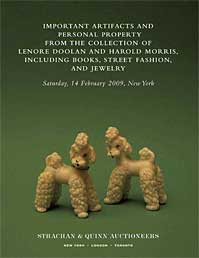
Leanne Shapton’s Important Artifacts and Personal Property from the Collection of Lenore Doolan and Harold Morris, including Books, Street Fashion, and Jeweleryis such fun I’m not sure I can do it even a smidge of justice here.

Presented as an exquisite auction catalogue, the book is 129 pages of photographs and ‘Lot’ descriptions of items belonging to the fictious Lenore Doolan and Harold Morris from the time they meet until their breakup some years later. Sheila Heti ‘plays’ Lenore to Paul Sahre’s Harold and the photographs of them are so real (goofing in photo booths, cooking, hanging out with friends) disbelief is well and truly suspended; they are Lenore and Harold. Sheila who?

The catalogue, in essence, catalogues the couple’s meeting and courtship through postcards sent, unique gifts, books with inscriptions, souvenirs and so on, through their relationship and ultimate breakup.

Despite there being no ‘story’—not one bit of narrative or dialogue—there is a definite rhythm and tension to the ‘stuff’ as it’s presented and we come to know these people intimately through their shoes, musical tastes, playbills, party invitations, dishes, clothing, sunglasses, handmade cards, tea towels, recipes, various doo dads and quirks.

LOT 1174 / A half a wishbone / The winning side of a turkey wishbone. Kept by Morris in his bedside table. Length 3 1/2 in. / $5-10

LOT 1197 / A small headlamp / A halogen headlamp, affixed with an elasticized cloth band. $12–15 / Used by Doolan for reading in bed.

A black and white photograph of the item (and often Doolan and/or Morris) accompanies each Lot description.

Towards the end of the catalogue the items slowly reveal a change in the relationship. A broken coffee mug, notes of apology, a white noise machine, restaurant receipt showing the main courses cancelled. Among the last items are pressed flowers and four-leaf clovers kept by each, separately.

Very cleverly done.

Apparently Shapton, a former Torontonian now living in NYC where, at the time of the book’s publication (2009) she was the art director of the New York Times op-ed page, got the idea after attending an auction of Truman Capote’s belongings (at which she purchased his overcoat).

I can only imagine the planning and execution of the book must have been both daunting and a complete blast.

Note: After writing the above, I then googled around for links and, to my horror, stumbled upon this. Good god. The whole magical point of the book is that there is NO action; the ‘stuff’ is what brings the people to life. I somehow can’t see Brad Pitt taking a backseat to a salt shaker.

And that may very well be unfortunate.

~

Important Artifacts is available for purchase online at Blue Heron Books.

Indie love.  ♥


From the Re-Run Series: originally posted in June, 2010.

beginings and endings and beginings again

For weeks now I’ve been dipping in and out of Beth Powning’s book—Seeds of Another Summer, a gorgeous thing of full page photos and essays, and I think the first book she published (1995), some twenty-five years after having moved to the wilds of New Brunswick.

I can’t seem to help myself—no sooner do I say ah, yes, that was nice, and set the book aside thinking I’m done with it, than I find myself opening it again (and it’s a library copy that must go back which is terrible and makes me think I need to place a call to my bookseller to find me a good used copy so I can continue dipping at leisure).

What I can’t get enough of, I realize, is the feeling of having a very pleasant walk with someone who loves nature and knows enough about it to know she has a lot to learn—and having this person point out the million things you don’t see along the way because you’re too caught up in looking at the whole.

Powning is great to walk with. She notices spider webs at dawn. And the hieroglyphics of bird tracks in fresh snow. The shadows trees cast. But she’s honest about the journey from city to country and how she didn’t see these things at first.

From the section on ‘Gardens’, she writes about the veggies just starting to grow in June when “…it’s so easy to nick the shallow-rooted weeds from their tenuous holds…. For a while, the garden grows just as I imagined it would, just the way I sketched it on paper, last February….Quickly, though, it passes this quiet stage and moves on to a startling urgency of growth….Thistles with roots like parsnips erupt through the straw in the cabbage bed. Mint creeps slyly amongst the broccoli. My fingers fly like a typist’s around the corn stalks, scrabbling away weeds which spring up nightly.…[By] late July, early August; the garden pressures me with its heedless and chaotic production. Keeping up with it is like trying to prepare dinner with guests in the kitchen, children underfoot, the phone ringing, and unexpected visitors pulling into the driveway and honking their horn.”

And I love her honesty and think: oh how very nice to know I’m not the only one who starts each year’s garden believing that this time I’ll keep things manageable—no bolted lettuce, no overripe cucumbers with seeds the size of foreign currency or woody zucchini because I forgot to pick it. 

Blackberry Patch

 Ha! Powning says to that, and suddenly I feel okay about the fact that my blackberries are overrun with Black-Eyed Susans and instead of beating myself up over it, I decide to take a picture and send it to a gardening friend in England, one of those people who you assume would never allow anything as slovenly as bolted lettuce in her garden…

—or maybe it will delight and reassure her.

Powning makes me want to celebrate my lovely crop of errant flowers.

In the section called ‘Boundaries’ she talks about the idea of home at the edge of wilderness and the misconception that nature is somehow separate from civilization and how that view changed as she began to understand and ‘know’ the fields around her, and stopped imposing on her expectations and assumptions of what it was.

     “Boundaries: between the geese and me, between the crickets and me. Yet the longer I listen, the more I hear.”

The photographs are of things we’ve all seen a thousand times: hillsides of freshly mown hay, a single buttercup, a spider’s burrow (okay, a few things we’ve never seen), but completely stunning in that way that can sometimes leave you in awe at the magnificence of ‘ordinary’. There’s also a sense of integration, of us and them, how the presence of one affects the other. A brilliant shot of footprints through a dewy morning field says it well.

It all seems so obvious when seen through her lens.

There is a section on ‘Trees’, another on ‘Wild Plants’ and, finally, ‘Home’. The last picture in the book is barn roofs at dawn. How perfect.

      “…Then, like a well-lived life, comes the quiet. I pull up the plants that have finished their cycle. Into the wheelbarrow I toss bolted lettuce, bush beans whose leaves are brown and crunch, and exhausted zucchini.
     “…There is a different kind of peace in the garden, now. It is not the serenity born of potency, and affirmation, but the quiet of fulfilment, and endings.
     “…At the end of the season, my garden plan is all but forgotten, and my illusion of stewardship long gone. Instead, like another harvest, there is another year’s memory of the voyage I have taken, swept, like a leaf, away from my own small visions and into the vast, potent current of regeneration.
     “…Autumn is like a long, deep breath drawn after some endeavour of great intensity.
     “Nasturtium leaves rot, quietly, into the soft mould between the raspberry canes.
     “In the end is the beginning.
     “In the garden is the whole universe.”

—from ‘Gardens’, in Seeds of Another Summer.

~

From the Re-Run Series: originally posted in September, 2010.

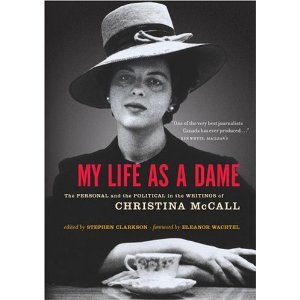
this is not a review: my life as a dame, by christina mccall

I’ve been time-travelling recently, spending happy hours in the late fifties, sixties, seventies and early eighties, with Christina McCall, one of the ‘lady journalists’, or dames, from that extraordinary era, and author of the collected essays in My Life as a Dame.

It was after the war. Technology was king (definitely not queen); women’s equality was still a quaint if irksome notion. Chaps were growing their hair and women taking off their gloves and corsets. Jane Jacobs had just arrived in Canada and wondered what was our problem with ‘identity’—“When you come here from outside, as I did, you know immediately what ‘Canadian’ means and that it is this very Canadian quality that has so far kept your cities liveable. Your saving grace is common sense…”.

Trudeau was a mania and George Ignatieff (yes, Michael’s dad) was the Man Who Should Have Become Governor General, if only the rules of the whole game hadn’t changed and then nothing was ever the same again. Yonge Street was just starting to get grubby, the Four Seasons was a still a motel on Jarvis and CanLit was a few talented writers with pluck.

It was a world of Bloody Caesars at mid-morning meetings, swingers, bad hair and the birth of bilingualism in Ottawa. “With their end-of-June paycheques, civil servants got an institutional green pamphlet telling them in effect to learn French or resign themselves to dead-end jobs.”

McCall wrote for magazines such as Macleans, Saturday Night, Chatelaine (during the Doris Anderson years), among others. Her subjects were people and politics; her slant was that of justice, a dissection of class, an attempt to understand various aspects of society, including her own distinctly privileged middle class one. In fact it was her own class and those ‘above’ it that were often her favourite targets. She observed the banalities of privileged lives but not in merely a cursory way—her essays inspired neither outrage nor indifference, but a changed perspective, or at the very least, thoughtfulness where once a vacuum had been.

She was especially passionate about women’s rights and defended them well (while wearing hat and gloves, naturally) and at every opportunity. One of my favourite pieces in the collection, ‘Some Awkward Truths the Royal Commission Missed’, refers to the document published in 1970 to study the status of women. She charged many things about it that were disgraceful in its execution and, even worse, the presentation of the final document: a long, dry, statistical non-account of things.

“I sat in on those hearings….and I found it one of the most engrossing, moving and involving experiences I’ve ever had. The women who appeared before the commissioners weren’t silly suffragettes in defensive hats or mannish harridans seeking unearned privileges. They were professors, farm women, nursery school teachers, Aboriginals, deserted wives, nuns, disaffected suburbanites—all real women with real problems of poverty, alienation, loneliness, and prejudice. Surely, something of their quality as human beings should have been imparted in the report, some part of their individual stories should have been told so that all those who couldn’t attend and hear for themselves would have been affected, as were the audiences at those hearings. At one session in Ottawa, for instance, when an Aboriginal woman from the Caughnawaga reserve was eloquently describing the hardship of her life, another woman in the audience, the very model of a Rockcliffe matron in an expensive dress and careful hairdo, sat with tears rolling down her face. Something of the eloquence and the tears should have been in the report.”

However, my MOST favourite essay comes last in the book: ‘What Won’t Appear in My Next Paradise’, written in 1970, in which she outlines what she hopes the world, especially as it relates to women, will have achieved by 2020. It begins:

“…For I belong that nameless generation of the 1950’s, that uncommitted company of the cool who were born in the years just before the Second World War: educated in the expectation of equality, confronted by the realities of domesticity and the double standard, too young to have been gulled into believing in the feminine mystique (as was the generation of the 1940s, for whom happiness was supposedly a man, four children on three levels, Birks sterling, real pearls and a grand slam at the Victoria College Alumnae annual bridge tournament) but too old and—oh! shameful admission—too liberal to be affected by the Sisters, Unite-Against-the-Capitalist-Imperialist-Phallic-Society! militancy of the new women’s liberation movements.

“If you add to the uncertainties of my whole generation my own specific experience—too many dues paid to feminism in the form of five years spent on a women’s magazine writing such mind-blowers as ‘Why Can’t We Treat Married Women Like People?’ and ‘Working Wives are Here to Stay!’—you realize that it would be paradise enough for me if by A.D. 2020 people had simply stopped talking about women as though we were a national problem… “

She then outlines five simple (and I mean s-i-m-p-l-e) but brilliant points—markers—that if achieved, would indicate a somewhat more enlightened world.

It’s both stunning and interesting to note that, in the almost half century since she wrote the piece, not one of those points has been realized by the so-called ultra modern, progressive, and so very very savvy society we think we’ve become.

~
From the Re-Run Series: originally posted in June, 2010.

this is not a review: join the revolution, comrade, by charles foran

Charles Foran’s ‘Can’t Think for the Racket’ is a stunningly lovely essay on the moment a writer finds the courage to use their own voice. The moment when you realize that the truth of what you want to say comes not from your head or how clever-clever you are or what you’ve learned, but from an ability to notice the precise colour of juniper berries after a rain, or tap into some deep awareness of every experience you’ve ever had and translate that into what a bar of dark chocolate tastes like on a warm day in September.

Or whatever.

The berries and chocolate are mine. Food is my portal. Foran’s was music.

He wanted to play guitar but it didn’t go well; a musician friend tried to help by saying that to really get music “…no thinking was allowed. Whatever you do, don’t think. Whatever you decide to play, don’t ponder why you did it. For sure, whatever you are feeling—ah, feelings, again—don’t fuss or fret or worry about figuring it out. Don’t figure anything out. Just play.”

Despite himself, words were more this thing and eventually he found himself wandering about listening to the rhythm of language, trying to force what he heard onto the page.

While the friend’s advice stayed with him he didn’t really understand the message until he was living in Ireland, working as bartender, trying to capture the lingo, the music of the Dublin dialect, repeating descriptions he’d heard of wankers and omadoons and writing about their devotion to U2 and Thin Lizzy in a manuscript where the narrator is a Canadian working in a Dublin bar among characters— “wankers and omadoons who thrashed to U2 and Thin Lizzy…”

One day while he’s busily writing this dross, a piece of music, for whatever reason, offers up a moment long enough to replace the square peg in a round hole effort of trying to get all that ‘external’ stuff, all that thinking, down.

“One afternoon I put down my pen at the opening notes of a reel played on solo flute. The musician had the breathy style I associated with prog-rocker Jethro Tull. From the start, the music was fluid. I turned up the volume and watched through the window as a weather formation, stately as a regatta, floated out into the Atlantic ocean to the melody, wisps of angels’ breath scurrying along the margin between earth and sky. A second reel merged from the first. Now the flutist was adding ornamentation–triplets and trills and grace notes. Certain notes were stretched and held. Others were blunted or bitten. All manner of non-thoughts flashed through my mind while I listened and watched. everything seemed in motion, in flight; everything seemed at once exact and permanent, fleeting and evanescent. Like the weather. Like a young Canadian in a school house in Galway.”

And there it is. The moment beyond which a writer can never again not ‘know’ when their work is hitting a false note. We may try to fool ourselves into thinking it’s okay, that no one will notice, that the darlings are so effing cute they’ll make up for any weak areas—but no matter what tricks we try to play on ourselves—after The Moment there’s no going back. We will know when our work sucks and when it sings. (We may not know how to fix it, of course, but that’s another thing entirely.)

The piece ends with a quote from Northrope Frye that Foran had clipped and kept since his university days, proving his connection to rhythm and language from the start, but words that only now, decades later, sink in: “If the music of  a sentence is right, the sense will take care of itself.” 

Seems it’s all about listening. Not thinking.
But then, so much is. When you think about it.

excerpts from the essay ‘Can’t Think for the Racket’,  from the collection Join the Revolution, Comrade, Biblioasis, 2008

~

From the Re-Run Series: orginally posted in February, 2011.

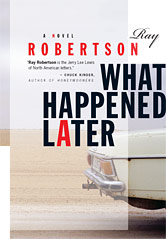
this is not a review: what happened later, by ray robertson

 
My favourite books are always those where not much happens except entire universes quietly change. Both the characters’ and mine.

Ray Robertson’s What Happened Later is such a book. I read it twice last year. Each reading brought me deeper into the language with layers yet to be discovered.

It’s all about the sentences.

Written in two story lines—the first, a fictionalized account of Jack Kerouac’s last road trip, a kind of going home, to find his ancestral roots in Quebec. The second, a fictionalized account of a boy named Ray Robertson who’s trying to get away from home—1970’s small town, Ontario—and find a copy of On the Road.

In alternate chapters and distinct voices, the stories weave back and forth through time—and not much happens. Except life. On every page, in very sentence—every word is full of what feels like absolutely raw truth—not fact necessarily (it’s fiction, right?), but truth. 

The chapters play beautifully off each other—from the innocence and simplicity of Ray’s life and his introduction to Jim Morrison:

“Before Jack Kerouac could change my life, Jim Morrison had to save it. Every Almighty needs an ambassador down below to do his dirty work. Mine wore tight brown leather pants and shouted out his rock and roll couplets like it somehow actually mattered.” 

—to Kerouac’s bennies for breakfast, falling down drunk with booze and resentment, guilt; his brilliance in offering up what every story needs:

“… a flesh and blood body on the other side of the book telling the story and not just a bunch of nouns and verbs and adjectives held together under house arrest by a bully bunch of rules of composition some mastermind mammon cooked up to keep everybody talking and thinking and living the exact same way. Because ask yourself this, Mac: Were we born and do we suffer and do we die just so we can all sound the same? What a spit in God’s eye, that.” 

The book begins close to the end of Jack’s life and close to the beginning of Ray’s, but ultimately, we’re left mid-stream in both, knowing how each will end. Along the way we see Kerouac in a new light as he mourns the loss of a Georgia pine, holds a kitten up to see the moon, asking aloud how science could explain that; we discover tenderness, vulnerability, and a man whose greatest desire was “…to be Cervantes alone by moonlight.”

I can’t think of a better shape or tone for this book. There’s an almost physical sense of movement with each chapter—from the jaded ‘star’ who’s had anything but a normal life, desperate to get away from society’s narrow-minded idea/treatment of ‘fame’—

“Remember how last week you were a spontaneous prose poet, a singular bard of bop, a lyrical visionary declaiming a previously unknown hipster-rich American underbelly? Yeah, well, now you’re a sloppy, undisciplined, self-indulgent media creation prone to sentimentality, immorality, and obvious sensationalism. Next, please.”

—to Ray, living in this tiny, loving world of grandparents, leather sleeved sports jackets; where he so sweetly sings the national anthem to his father in the bathroom; a place where his greatest career challenge is climbing the ladder of the Sears sales team; a world of wry observations—when he accidentally kisses his own shoulder while making out with his first girlfriend, he reflects “…but that’s okay too…”. This mini philosopher, obsessed with finding the answers to life through Kerouac—all such delicious irony.

Despite my love of the fiery, gorgeous, richly written Kerouac chapters—at the close of each, I found myself turning the page, eager and curious to read more of young Ray, and immerse myself in the very different but just as honest tempo of his life. In many ways it’s Ray’s story, but not completely, because to tell either of the two on their own would render both less.

—This is my part of the movie, let’s hear yours.  Jack Kerouac, Tristessa  (Epigraph, What Happened Later, by Ray Robertson, 2008, Thomas Allen)

~

From the Re-Run Series:  originally appeared in February, 2010.

this is not a review: burt’s shawarma, by kathleen winter

Rhonda has been angry and unhappy for a long time. It doesn’t help that she lives on the outskirts of a town whose claim to fame is being the nation’s teenage suicide capital “…just past the point where the Pinegate Pizza won’t deliver”. Nor does it help being married to Dan, a farmer with a soul as romantic as a milking machine. God bless him though, he’s one of those guys who thinks that duty and maintaining a roof over one’s head is enough. In his own out-to-lunch way, he tries. He’s probably in as much pain as his wife but it matters to him less or it matters in a different way. He takes solace, not in conversation, not in reaching out to her, but in immersing himself ever deeper in the work of livestock, insulation, leaks in the barn. Nothing personal… these are merely the things that matter.

Part of her knows he won’t change yet another part continues to believe he’s capable—if he tried—of finding a way in. She’s waiting for the moment where he’ll sit down next to her in his cowshit covered clothes and say to her:

“…Why don’t I get a shower and make you a cup of tea? Hoffman’s elm is like us, isn’t it? I’m sorry you’ve been lonely inside. Let me touch you? Not with my paws—with the word rain, the colour green, with eating bread and sitting here till a yellow bird comes and eats the crumbs.”

She’s starved for him to merely try. 

When Dan suspects (correctly) that Rhonda is having it off with Burt, the local ‘exotic’ who runs a Lebanese cafe, and who thinks Rhonda is perfect, he buys her tulips for Valentine’s Day. This is huge in their dry and loveless union and enough to keep it going for another painful stretch, despite her apathy.

“…she no longer cares that her vinyl toilet seat has torn pieces that stick up and prickle her butt.”

While she realizes the thing with Burt can’t last, she takes some comfort in the knowledge he can be replaced. By which logic, so can Dan, albeit with a bit more difficulty and anyway, what would be the point?

“You can tell about the state of anyone’s marriage from their medicine cabinet,” she tells her sister Bett. Her own has empty calamine lotion bottles piled in with rubbing alcohol for ears pierced fifteen years ago, ancient antibiotics, blunt useless tweezers and a stack of wrapped soaps with cobwebs on them from the Holiday Inn in 1989, which was the last time she and Dan took a trip together, and that was to bring home a trailer for getting show cattle to the fall fair. She doesn’t care about the fence Dan promised to make for her garden twenty years ago. She doesn’t care that Dan had an affair when the kids were little, or that there has never been chemistry between Dan and herself. She doesn’t even care that the magic with Burt is dying out. Bett calls him an interim phase and that’s fine by Rhonda. What matters is that her anger, her poisonous anger, has drained away, thanks to Burt. She watched her mother carry the same anger, panicked when she realized she had it too, knew one day she was mad as hell at her whole life and it looked like there was nothing she could do about it. Burt stopped the time bomb with his hideout, with its cool walls and blue shadows where she didn’t have to do things from morning till night in which she had no interest. She will feel relief deep down, be able to breathe deep down, whenever she thinks of Burt even after this is over, which it almost certainly is already, with no illusion of anything permanent. No one has mentioned Rhonda helping Burt run his cafe, but not in the same way that no has ever mentioned her helping Dan run his farm.”

— excerpts from ‘Burt’s Shawarma’, from the collection BoYs, by Kathleen Winter

Three Impressions Overall: delicious ironies, entire worlds sympathetically drawn in mere pages, and the kind of truth that makes you squirm as it pulls you forward, then leaves you pretty much where you thought you’d be left for pretty much the reasons you thought you’d be left there. Only thing that’s changed is that now you’re aware of the ‘why’. It may not feel like enough but of course, truth is always more than enough. (And may I say I love the cover of this gorgeous collection.)Note: this post first appeared in May/2011 as part of Year of the Short Story (YOSS) celebrations.

Now part of the Re-Run Series.

______________________________________________

—Purchase boYs online at Blue Heron Books.

hypothetically speaking…

IF… and I’m not saying I have, I’m just saying if I had just finished reading a book that had been heralded as the next great literary thing, or words to that effect [the point being it was raved about excessively]… If such a book existed and I had just finished reading it and I found it, let’s say lacking to a great degree in literary greatness to the point where almost none was discernible [unless literary greatness translates into a few not entirely bad sentences and a few good ones]… if I’d just finished that book—in which the title character is essentially pointless, only occasionally and dismissively referred to, and who then dies and is referred to again down the road as a means of cueing the reader to recall the narrator’s bond with them and so trigger an emotional response [which doesn’t happen, BTW, because exactly zippity-do-dah in terms of a relationship has been developed between the two and frankly nobody cares that one of them is dead…]

…If I’d just read this book, in which, it should also be mentioned, that while written in first person, the narrator knows things inside people’s heads and other places she has not been—which annoys me more than this keyboard has letters to describe, given how hard I work and curse and revise to avoid just such sacrilege—and while we’re at it, the narrator’s dialogue is not consistent with her age, not to mention dull, not to mention one minute she’s an innocent and the next, though still the same age, she’s expounding on life in a way that suggests having spent the past century sitting cross-legged on a mountain-top in saffron robes…

…IF I had read such a book, a book that had been touted as a remarkable debut, in which not one shred of poetry exists, where even the imaginative is obvious [and just in case you still don’t get something, don’t worry, it’ll be spelled out in crayon somewhere down the road]; where countless unrelated events span decades haphazardly and pointlessly, leaving a nest of loose threads rather than any semblance of whole cloth; a book that reads like a bad movie in which darlings rule [we can only assume they amused the author too much to have them properly shot], where relationships are flat, and where—because apparently nobody stopped her—the author uses both ‘immediately’ and ‘suddenly’ in the same sentence…

had I read such a book—I would have slammed it shut and asked that age-old question: wtf?

For the record… it’s not the author I blame. It’s a good draft. But where was the editor? And how does a reputable house publish this, in this… this very good draft condition?

But here’s the real sixty-four thousand dollar question: how in all that’s decent does it not only get good reviews, but buzz in high places…?

I mean, if there was such a book. And I had just read it.

diana athill, let’s have lunch…

 
Because lunch is what you want to do with someone who looks out at you from the cover in such a saucy Oh do I have a few stories up my sleeve sort of way. And in that necklace.

And when that lunch turns out to be just you and the book and maybe a salad at a corner table in a cafe, it’s really okay because Diana Athill’s Somewhere Towards the End reads like a chat, the tone is casual as she shares her philosophy of life (which includes a lovely riff on tree ferns). And while you munch on your croutons she goes easily from one thing to the other: memories of painter friends, writer friends, thoughts on loyalty, faith, death, genes — both good ones and not so good—  sex, London, night school, religion, gardening, driving, love, reading, writing and books — never focussing overly on opinions or even offering any of this from the perspective of age, but merely from the perspective of someone who’s paid attention.

At the end of your salad you close the book, look at that face, that DaVinci-style grin, and all you can hope is that you might grow up to be even one tenth as interesting and wear big jewellery with that kind of panache.

“There would be an agreeable sort of itchy feeling, a first sentence would appear from nowhere, and blip, out would come a story. One of them won the Observer’s  short story competition, an intoxicating thrill in that it showed I had been putting down words in the right way, but it didn’t  make any more stories come after a tenth had fizzled out after two pages. That was followed by a lull of almost a year. Then, looking for something in a rarely opened drawer, I happened on those two pages, and read them. Perhaps, I thought, something could be made of them after all, so the next day I put paper in my typewriter and this time it wasn’t blip, it was whoosh! — and Instead of a Letter, my first book, began. Those stories had been no more than hints of what was accumulating in the unconscious part of my mind, and the purpose of that accumulation, which I hadn’t known I needed, was healing.” ~ from Somewhere Towards the End, by Diana Athill

this is not a review: the forgotten waltz by anne enright

Oh, Anne Enright. I do love your words so. The way they lie there on the page, end to end, magically forming sentences. I’m sure it’s all quite effortless of course, this brilliant way you have of conveying things. I have no doubt it’s as simple as wandering about your life, observing, thinking, mulling, fashioning bon mots almost accidentally as you shine your shoes or select grapes from the fruit monger’s stalls, and then having them fall out of your head, the words I mean, clunk clunk, onto the pages at just the right time in just the right order. Oh look! you might exclaim, That’s exactly what I meant to say, exactly what I was thinking, I don’t need to change a comma… someone peel me a grape…

The Forgotten Waltz, Enright’s most recent novel, begins simply, with a glance over a shoulder and a child. It’s classic girl meets boy. Gina meets Sean. Both are married. Both of them not especially unhappy or happy, not especially well matched or mismatched.  And then there’s the child—his, Evie, who is not quite right—a tendency towards seizures or something never clearly defined—a situation that parallels Evie’s eventual role in Gina’s life, and vice versa. There is little emotion expressed yet it’s all about emotion, driven by a thirst for it and then regret in its inevitable passing and morphing into something resembling real life. The way things do.

What gives the book a delicious tilt is the vantage point Enright chooses to tell the story, i.e. from Gina’s current status happily (happily?) living with Sean. The thrust of the story is her recollection of the affair, its building blocks and motivations, the changes that occur, things given up and left behind in the pursuit of what feels like love and in fact may well be. The eager or reluctant, sometimes regrettable, tradeoffs and surprises en route, hidden costs and, most importantly, the thing no one ever thinks of: the landscape at the end of the day— the stuff that comes with as well as that which is forgotten once the music stops and the lights come on.

… In which case, Evie’s room is like something after the tide went out: dirty feathers, scraps of paper, endless bits of cheap, non-specific plastic, and some that are quite expensive:

Do you know how much those fucking things cost? says Sean, going through the compacted filth of the Hoover bag, looking for a game from her Nintendo.

My stuff, on the other hand, does not matter. A Chanel compact, skittering across the floor, my phone pushed off the arm of the sofa, the battery forever after temperamental.

Gawd, says Evie.

She does not say ’sorry’, that would be too personal.

Evie was always a bit of a barreller, a lurcher; her elbows are very close to her unconscious. At one stage they were going to have her checked for dyspraxia, by which they just meant ‘clumsiness’, but I guarantee you I have seen her move with great finesse. In this house, she is only clumsy around things that belong to me.

She eats nothing she is asked to eat, and everything that is forbidden. But she eats. Which I consider a minor miracle. She filches, she sneaks and crams. She waits—a bit like myself indeed—until her father is not there. The place we meet most often is at the fridge door.

Two months ago, when Sean was at the gym and Evie was complaining I had finished all the mayonnaise, I tossed my bag on the kitchen table and said, ‘Why don’t you go and buy your own fucking food?’

Not pretty, but true.

Evie looked at me, as though noticing me for the first time. Later that day, she said something to me—something that wasn’t just a whine, like, ‘Why don’t you have Sky TV?’

She said, I can’t believe you have so many shoes.

And I had to leave the room to stuff my knuckles in my mouth, and pretend to bite into them, behind the door.

—from The Forgotten Waltz, by Anne Enright (McClelland & Stewart)