all is not lost — i learned a new word
This weekend I learned that to engage in small talk is to ‘smalk’. I learned it not by smalking but by reading about it in Shirley MacLaine’s most recent memoir: I’m Over all That.
But it was advertised on the library Home page and I was weak and in a mad moment I put a hold on it and when that hold came up, yes, I could have not picked up the book but I was weak again, and hungry—it was just before lunch—and I wasn’t thinking straight. True enough, no one held a gun to my head and forced me to read it on a lounge chair in the sun on Saturday afternoon while nibbling on 85% fair trade and swilling peppermint tea. I chose to. And I’m not apologizing. Just a little embarrassed is all. I mean there are so many, dare I say ‘better’, books to read and many of them are in my house in a stack beside my bed.
And yet I choose to read this. In god’s name why?
I’ll tell me why.
It’s because every now and then a little ‘this’ is good for the soul. That’s why detective novels were invented, no?
Anyhoo. Aside from perhaps a bit too much about Hollywood and the fact that she’s been in one sort of relationship or other with most of the men on this planet (and possibly a few others), and aside from her opinion that there are essentially two kinds of people: i) her, and ii) those who have not time-travelled to ancient Egypt… Despite all that she does make some interesting points.
For example, on the subject of increased security at airports (which has caused her to give up travelling) and fear-mongering, generally, she writes:
“I don’t believe that terrorism is the real reason we have become saluting robots. I believe we have neglected to see that terrorism is just a convenient excuse for those in power to gently instruct us to go quietly into that good night of being compliant and unrevolutionary citizens who willingly become subjugated to authority…. Fear is the most powerful weapon of mass destruction.”
She admits America is sorely lacking in world news programming and that Americans, generally, are not global thinkers except to consider how an international event might relate to them. God bless her for that at least.
“When I hear the controversy about sending more troops to Afghanistan, nobody but Christiane Amnapour mentions the value and power of the poppy fields and the opium trade. Who wouldn’t want to control the country where as much as 90 percent of the world’s heroin production is located? Why don’t our newscasters get past the point of imposing democracy on another tribal culture and get to the real point of why we’re there? Follow the money, as the old saying goes.
“Let’s have some deep and probing investigate reporting on why so many people are addicted to drugs.f If we did that I think we’d be into an investigation of the contemporary human spirit, of depression, of pointlessness, of spiritual poverty, and finally the addiction to serving whatever God we’ve been taught to believe in, whether it’s the Christian one, the Islamic one, or any other. We know that more killing has occurred in the name of “God” than anything else. Did the devil make us do it? Let’s investigate who we really are in relation to our beliefs, because if we don’t we are going to be forever manipulated by the real ruling elite in this world–the international banking community. In effect, “they” understand the real polarities governing our lives are not Good versus Evil, but rather Materialism versus Spirit.”
Not a bad little rant.
But I wouldn’t say this book is her best effort. I read her years ago and remember being slightly more impressed (possibly due to youth). Mostly though, I continue to respect her curiousity and the places it takes her, but not always the way she presents her thoughts as gospel. In any case, I’m Over All That is really just an unconnected collection of casual commentary on many and various subjects—from the alchemy of time (which ancient cultures apparently understood and which we are out of sync with), to the importance of living with a dog, the predictions for 2012, hair colour, funerals, rudeness, exercise, world leaders she has known and loved, politics, live theatre vs film, driving at night—you get the idea. I read somewhere that it came about as a result of lunch with her agent, friend, publisher?? Someone. A lunch during which she’d been idly rattling on about all the things she was ‘over’ until friend, agent, publisher allegedly said: make a book!
The way you do.
Overall impression: goes well with lazy afternoon chocolate. Not mind blowing, but a pleasant enough read if you’re in the mood for a rambly one-sided conversation with one of the more interesting people at the party.
Definitely better than smalk.
the art of dirt
“I have contemplated a well-hoed ridge of potatoes on that bush farm with as much delight as in years long past I had experienced in examining a fine painting.”—Susanna Moodie, Roughing it in the Bush, 1852
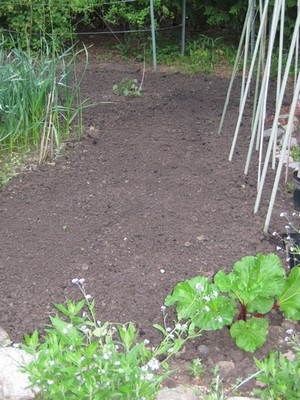
Ready for planting!
spreading (out) the joy
today’s colour(s)
garden hoe, oh garden hoe, wherefore art thou…?
just doing it (my way)
There are a couple of people in my neighbourhood who don special outfits to go walking or running or cycling—bodysuits, skinny tops, colour-coordinated shoes and shorts and shades. I’m torn between thinking they’re making a bit of exercise way too complicated, and envying their whole dashing I-take-every-damn-thing-I-do-seriously “look”.
I”m aware, of course, that there’s a multi-trillion dollar industry behind The Look—possibly men, possibly unfit—wielding extraordinary powers, convincing folk they need accoutrements to be fit. Even so, it doesn’t stop me occasionally thinking maybe I should get some spandex of my own, a tank top with wicking, one of those all-weather jackets that comes to a saucy little point at the back. A pedometre, a headband. I’d wear a water-bottle-belt (say that three times), read running magazines, get reflecting tape, strap a radio to my arm and groove to the beat as I thundered dashingly about town.
If people still groove to beats, that is…
It’s a colourful fantasy. Short-lived though. Fact is, I’d laugh if I wore spandex—it would crack me right up to see myself in The Correct Walking Outfit. This is for Other People. Not me. Despite illusions of being part of the active-wear set, the whole culture is counterintuitive to my DNA. Always was. As a kid I tried out for things, field hockey, for instance; I was so proud of my shin pads, walked around with them strung over my shoulder even when there wasn’t practice, hoping people would notice that I was an athlete. First time on the field though, when some big girl shoved me—which I didn’t know was part of the game—I found it so alarming I handed my pads in right then and there. My parents signed me up for tennis lessons one summer but I preferred cherry popsicles and comics in the shade of a nearby tree. The instructor didn’t care, he’d been paid whether I played or not. I was the last kid picked for the baseball team and I kind of liked it that way. More time for hopscotch and skipping and walking in ditches after it rained.
I’m not made for organized activity. I’m made for writing postcards and taking them to the mailbox in my regular shoes, which are often sandals. And riding my bike to the grocery store and the library. I walk downtown and to the creek and along the beach, and I watch things—the way tall grass moves in the wind, geese land on water, a kid with a silver tinsel wig runs to catch up with friends. I hike and I cross-country and snowshoe in winter. I jump on a trampoline to work out plot points. I swim as a meditation. I work in the garden because it needs it, and so do I, and do yoga daily to bring myself back to the centre of my own life. I wash floors and windows and sort out closets because order helps me think. Sometimes before lunch, I dance.
So, yes, I think I’m finally old enough to admit that, despite the not-to-be-denied allure of the dashing active-wear crowd… that’s one club I’m never going to join.
salt, etc.
I don’t know where to begin exactly. Aren’t endings supposed to come with their own beginnings? Doors and windows closing and opening…that kind of thing…
When my mum (we called her Phyllis although her name was Elizabeth) died on Friday, a door slammed shut. Well… it closed anyway, firmly and forever. And then I got up and closed all the windows. And despite what I’ve been doing since: arrangements, calls, notes, wandering, staring, I’ve been doing it in this unfamiliar and increasingly airless room. The metaphor feels right and comfortable; no need for oxygen when you’re holding your breath.
But today, not quite a week later, I notice the sun is shining. It shows up the dust that’s accumulated from the ongoing basement reno, which, ironically, we began so that we’d have a place for Phyllis after her stroke. When I told her we wanted her to live with us she smiled, was grateful but said she hoped she’d die first, that she didn’t want to be a bother, that we might not get along. I worried about that too but I thought there might be enough that was good to make it work—and anyway, she’d be useful, she knew things I kept forgetting: how to prune the blackberries, make pumpkin compote, remove burned on stains from pots, cure sore throats and earaches with herbs from the garden—the original nature girl, raised on a farm, she used to milk cows, make butter, spin wool, grow flax, weave her own linen with it for god’s sake. She carried sacks of grain on her head to have them milled into flour. She had no idea any of this was interesting. I had to pry the stories out of her.
I open a window. There’s a breeze. Kite weather.
Not only is there dust everywhere, the house is in disarray, debris all over the kitchen table, a puddle of stationery that would take two seconds to stack, sling an elastic band around, but it’s more time than I care to give. And I’d have to walk to the kitchen drawer for the elastic.
The very idea exhausts me.
So I leave them spread out and messy instead, along with a box of Sifto from the nursing home where the eggs were always bland she said. What am I supposed to do with a box of Sifto? I prefer sea salt. Should I throw it out? I don’t know. I don’t know… I’ll think about it later. And anyway it’s not hurting anything standing there next to a pair of green gloves from my coat pocket (it’s May, I don’t need gloves; where do they go?) and a new dust mop cover—pale blue, soft like a baby’s washcloth; I may use it soon. Or not. There’s a crossword, a tea stained mug, a basket of seeds, a few pens, a notebook, the Saturday comics with a Pardon My Planet that shows an old woman in her casket and beside her a man—husband? son?—telling the priest he’d like a few minutes alone with her while her mouth is shut. I’m not sure if I should find this funny or not but I leave it there next to the salt and the gloves and a stone from the beach that meant something once, I don’t remember what, and a bill from one of her caregivers and a letter I’d been writing to a friend before all this happened. Should I still send it? The old news is relevant though overshadowed by recent events…
I have no idea how to tidy this mess. The best I can do is ignore it, walk past it a dozen times a day, watch new things appear: sunglasses, lip balm, sixteen dollars and sixty two cents.
It’s the salt that finally gets to me.
I open a 1963 Pocket Book edition of Hints from Heloise—Phyllis thought Heloise was a genius for solving modern day problems such as getting gum out of shag rugs but the only use she offers for salt is to reduce suds from a dishwasher or washing machine. I do a google search. There are, apparently, 44 other things to do with salt. #18 for instance: “Remove old stains from teacups by rubbing with salt and a bit of water.”
I take a long breath, pour some Sifto into a badly stained mug, add a drop of warm water and presto it’s like new.
this is not a review: the cat’s pajama’s, by wallace edwards
While it’s true that The Cat’s Pajamas, by Wallace Edwards, is another of the gorgeous picture book genre I adore—and while it’s also true that it’s been designed to amuse and enthral children, which it will certainly do, it must be said that even better than all that, it’s a tremendously fun parlour game for adults.
At least in my world.
I bought the book as a gift for a tiny person I know but haven’t given it away yet, in fact I’ll have to buy the kid another copy. This one’s mine.
(I’ve since discovered it’s a follow-up to Edwards’ Monkey Business, which will be next on my list…)
As you may have worked out, The Cat’s Pajamas is heavy on idioms. Each page, a beautifully illustrated bit of quirkdom depicting one of the twenty-six idioms that make up the book—such as a panda seated at a table, playing a fiddle with a string of spaghetti (above text which reads: In order to have dinner music, Andy was forced to use his noodle.)
It doesn’t matter that the very young won’t get the nuanced brilliance of the compositions or the humour or the double entendres—they’ll be more than entertained with the absurdity of the pictures. (Did I mention that each illustration contains a hidden cat?)
Older kids though, and certain adult types (ahem)… will find that trying to guess the idiom being depicted is a whole other level of merriment.
—A camel stands beside two small suitcases in what appears to be a desert; a single palm tree behind her, a train track in front. She’s draped in several colourful blankets, a feather headdress and beads. Each foot is placed deeply and firmly, it seems, inside either a strawberry or chocolate ice cream cone.
Text: “The Oasis Express was running late, so Camilla had to cool her heels.”
Or this—
An anteater in pearls, long tongue fully extended and in her hands, stands beside a goat in a striped dressing gown who points to a collection of quite hideous art.
Text: “The sight of Sir William’s new painting made Anita hold her tongue.”
Get it?
I actually played this with friends the other night. Granted, it could be that I hang around with fairly nerdish types, birds of a feather and all that, but it was just the thing between the soup and the nuts. And the bonus is that if you, like me, have an increasingly short memory, the game can be played any number of times with exactly the same level of challenge.
Oh, and don’t forget, you can also read it to the kidlets.
If you must.
~