for miep and judy


A small tribute to two women who were born a month apart, who each lived more than a hundred years, and died a month apart.

Miep, the person who aided Anne Frank and her family, and who died on January 11, a month short of her 101st birthday.

And Judy, my one hundred year old friend in Naples, Florida, who spent a big chunk of her life as a journalist—managing the trick of being both a lady and a ‘dame’ at a time when most women were trying to manage the trick of being  June Cleaver.

After a heart attack in her nineties, Judy moved herself into a seniors’ residence and when, eventually, she found it too hard to walk, she accepted a wheelchair with a smile and a shrug, saying that if you lived long enough, chances were you’d eventually lose it “from either the neck up or the neck down.”

“I got lucky,” she said, like not walking was a gift.

She kept her eyesight and every one of her marbles right to the end and never lost her love of reading or telling a good story.

She didn’t have much to give, but always found something to send you home with: a stuffed toy she’d won at bingo, tic tacs, a lemon drop.

Eventually, she moved to a nursing home and practically ran her floor, keeping tabs on people, making sure others, younger but less able than she, got what they needed—the glass of water, the magazine, a hand to the loo—when they needed it. No doubt the staff thought she was a pain in the ass at times, but one they’d want around if it was their mother in the room next door.

Judy loved a dinner invitation and never said no to a couple fingers of bourbon.

She believed that people were essentially decent, that life, despite its madness, was good—and in Judy’s orbit, it was, and people were.

She died in her sleep last month, the day after her 101st birthday.

                *

“I want to get on; I can’t imagine that I would have to lead the same sort of life as Mummy and Mrs. Van Daan and all the women who do their work and are then forgotten. I must have something besides a husband and children, something that I can devote myself to!  I want to go on living even after my death! And therefore I am grateful to God for giving me this gift, this possibility of developing myself and of writing, of expressing all that is in me.”
(From—The Diary of a Young Girl, by Anne Frank)

things to do (and not do) with ice

At lunchtime I passed a group of children in fat snowsuits who were noisily, happily, sliding on patches of ice in a schoolyard until someone (a schoolyard lunchtime ice monitor?) came out and shouted:

“Stop sliding on the ice! Sliding is NOT ALLOWED.”

As I walked by, I wondered how old you had to be in order to slide on ice without someone yelling at you. I kicked a block of ice down the street as I went, which eventually attracted some strange looks. And then I wondered: how young do have to be in order to kick a block of ice down the street without people looking at you strangely…

(For those with an excess of ice, try this.)

c’est us, n’est pas?

 
Heremenegilde Chiasson’s marvellous book,
Beatitudes, begins like this:

“those who raise their heads in astonishment at the raucous cry of birds,

those who await the end of twilight,

those who ceaselessly leaf through catalogues and order nothing from life,”

—and continues, in  incomplete single sentences of a few, or few hundred, words, leading us on and on to an (incomplete) image of ourselves: funny, sad, beautiful, unsettling, always true.

“those who are euphoric about the mystery of snow crystals, delicately carrying home their unique fragility on woollen mittens,”

“those who scribble graffiti on their bodies with lead pencils, engraving their story in the secret depths of their skin, scratching themselves until they bleed, making a lie of pen and paper,”

“those who pull off their gloves with their teeth,”

118 pages of ‘those’…

Who would have thought the universe was big enough, that there were so many nuances…needs…differences…samenesses…things that unite us, tell us who we think we are, who we don’t want to become, who we may already be.

This book is a celebration of what it is to be human, a meditation, and a mirror.

new books

Am writing from somewhere under a stack of books received over the holidays and enjoying a moment’s pause with each as I (no rush) make my way to the top where I’ll choose a place to begin reading for real.

The stack:

The Collected Stories of Joseph Roth (translated by Michael Hofman); I’ve been slightly nuts about Joseph Roth since reading What I Saw so was extremely excited about cracking this open. In fact when I happened to wake up at one something a.m. (last night) I decided to turn on the light and read the first three stories.

What I Saw, by Joseph Roth. My introduction to him came via a library copy. Now I have my very own, thanks to P. 

The Bedside Book of Birds, by Graeme Gibson. I’d forgotten that this was on my list of Books to Get and for some reason the starlings’ twilight dance last month brought it back to mind so I trotted right out and bought myself a copy. Have only flipped through the pages and read a few entries so far but even doing that is a joy—the book is a work of art: the drawings, prints and photographs, the combination of poetry, fiction, facts and folklore, the feel of the paper…. I look forward to spending much much time with it.

The Golden Mean, by Annabel Lyon. (Ever since Oxygen I’ve been eager to read anything Annabel Lyon writes.)

Here is the opening sentence:

“The rain falls in black cords, lashing my animals, my men, and my wife Pythias, who last night lay with her legs spread while I took notes on the mouth of her sex, who weeps silent tears of exhaustion now, on this tenth day of our journey.”

“Canada and Other Matters of Opinion”, a collection of essays by Rex Murphy.

The Spare Room, by Helen Garner.

David, by Ray Robertson.

The Little Prince, by Antoine de Saint-Exupery

Help me, Jacques Cousteau, by Gil Adamson

Beatitudes, by Hermenegilde Chiasson (translated by Jo-Anne Elder)

Dowsing: A Journey Beyond our Five Senses, by Hamish Miller

A Certain je ne Sai Quoi: Words we Pinched from Other Languages, by Chloe Rhodes

Nonsense Botany and Nonsense Alphabets, by Edward Lear

Cat Naps: The Key to Contentment (a tiny square book of quotes and pictures of napping cats, intended to remind us not to take ourselves too seriously…)

Excerpts:  Nature does not hurry, yet everything is accomplished. (Lao Tzu)

Yawn and the world yawns with you. Snore and you sleep alone. (Anonymous)

Alligator Pie, by Dennis Lee. From me to me. Because it was high time.

message in a bottle — received

Oh, this is fun…

It seems Karen Shenfeld, Writer in Residence over at Open Book Toronto this month, has been conducting a blogosphere experiment in which I’m one of the lab rats. (And I’m completely flattered and delighted with my role!)

Here’s the background: Last week sometime I wrote a post about Karen’s film, Il Giardino. A few days later it came to her attention and she left a comment saying how surprised she was.

She was surprised??

I was gob smacked that so quickly (or even at all) she’d see the post, much less respond. Well, I wrote back, we had a virtual chuckle over the wonders of the wild, wacky world of blogs and that was—I thought—that.

Then, a few days ago (though I just opened my emails today), I received a Google Alert taking me to Open Book Toronto where I discovered that Karen (a poet as well as a filmmaker) was the Open Book writer in residence for December and had written a post about the Il Giardino ‘encounter’.

And she’d done it as a kind of experiment.

In her words:

“Sending something off into cyberspace is, I have realized, a little like putting a message in a bottle and casting it into the sea. We know that the odds are that the cork will leak and the bottle will fill with water and sink down to the sandy depths, forever lost. But we hope secretly that, against all odds, it will float and drift to a far, far shore, where it will be picked up by a passing stranger who will find our message and be forever transformed.

“When I wrote to Matilda, I didn’t let her know that I, myself, was writing a blog this month, and that I had decided to blog about her blog. Should I tell her, or just wait to see if she scoops the bottle from the water and discovers it by herself?”

Well, I’ve scooped the bottle! (And, for the record, it would have been sooner had I opened my emails.) I feel like bells should be going off, confetti flying, people appearing from the closet with champagne, a trophy maybe, a small tiara…

As Karen says, I think we all hope that our messages, whatever they are, are being received and heard—what’s communication if not a way of connecting with others by (bravely) sharing something of who we are, some tiny unique thing we have to offer…  

Aside from its (mind-bending) ability to practically embrace the whole earth in a single moment, cyberspace also has a kind of zen influence, allowing us to stand back and ‘see’ just how amorphous communication has become, maybe always was, how really we’re all so connected in these indirect, invisible, ways.

Unsettling as all that connection may seem at times,  it’s nice to remember that a lot of good—and very entertaining!—things can come of it…

(So, to continue the experiment, I’m sending the bottle back out—while keeping my eye on the OBT author blog  to see if it makes land…)

not just another bookstore

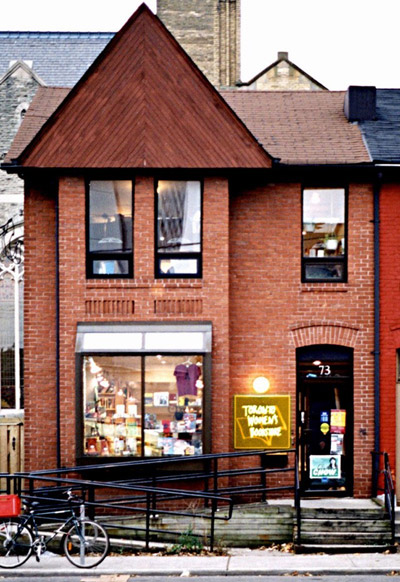
The Toronto Women’s Bookstore is in danger of closing.  If that happens, the whole city loses. Not just women, not just the people who buy books or attend workshops and readings or are served by the TWB outreach programs. We all lose. In Toronto, outside Toronto, across the country. Because every institution, every facility and service, wherever it happens to be, creates a ripple effect—positive or negative—on both the immediate community and society in general. 

If the TWB closes we don’t just lose another book store, we lose one of society’s positive ripples and risk making (yet more) room for the less valuable, the innocuous, the downright toxic…

It’s up to us which way things go.

If, one by one, we let these tiny positive influences on our society disappear in favour of giant homogenized nothings that cajole us by slick marketing to fill our lives with indigestible dreck that only dulls our minds with the addiction of wanting more, we’ll have—if not what we need—certainly what we deserve.

And their pockets will be full.  Because that, of course, is their bottom—their only—line. 

The choices we make, where we choose to spend our money is what determines what stays and what goes. It’s we that build our neighbourhoods, cities and societies.

This isn’t just about a bookstore, it’s about creating the kind of world we want to live in and the power of individuals to influence that world. The TWB is simply the latest canary in the coal mine.

HOW TO HELP.

yo rocko

I was walking in the park the other day when a big yellow dog ran over, all gallumpy and jumping; a woman followed, shouting Rocko stop that!  I told her not to worry, that I was used to dogs, I didn’t mind enthusiasm. She looked relieved.

I said there’s so much concern these days about animals—squirrels eating the bird seed, raccoons checking the bins, cats weeing on the turnips—dear oh dear oh dear where will it all end??  

“Frankly,” I continued, “it’s people I find scariest; it’s us that have the most annoying habits overall. Don’t you think?”  

She backed away a little, smiled in a way that suggested no, she didn’t think. She looked around for the dog, then apropos of nothing, informed me that Rocko was a Labradoodle.

“A cross between a lab and a poodle,” she said, as if  this bit of info was so valuable I might want to tuck it away for safekeeping.

I returned the smile and said aren’t we all to some extent Labradoodles… some weird experiment just trying to do our gallumping best?

The woman seemed confused.

But I’m pretty sure Rocko got it.

if it’s not one thing…

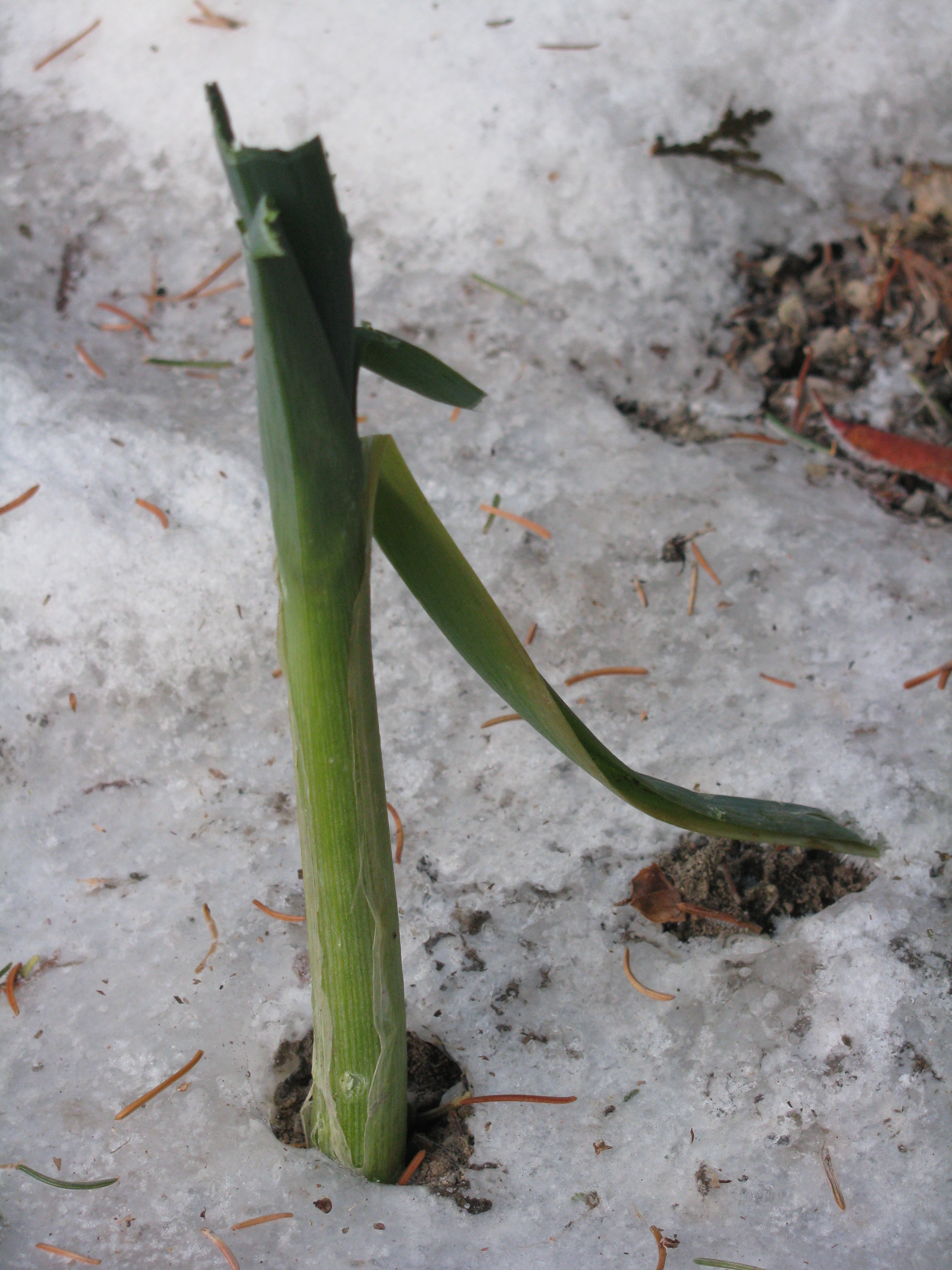
The good news is the leeks I didn’t dig up before the freeze have turned out to be just what our resident garden rabbit was looking for.

Strolling about the estate yesterday morning I was thrilled to find almost all of them ‘topped’. As soon as the ground warms up a bit (today??) I’ll dig out the roots and make soup as promised.

So there I was feeling all warm and happy about how nature has this brilliant way of not calling anything a mistake—

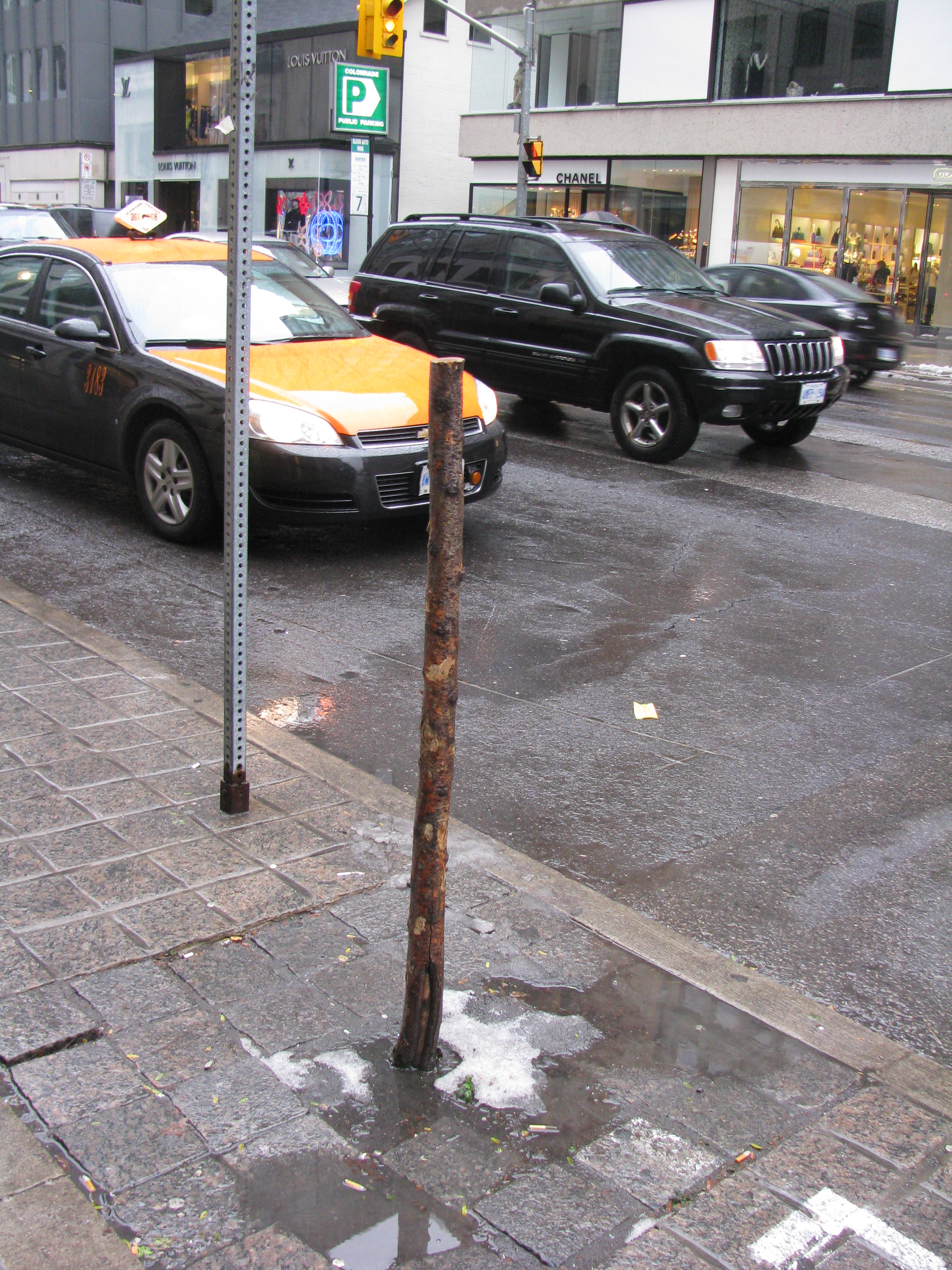
—and then I went into Toronto and found that ALL the trees, on both sides of  Bloor between (at least Avenue Road and Bay) were being cut down.

They were just young trees with trunks maybe four, five inches in diameter.

I asked one of the guys doing the cutting: Why? and was told that it’s not natural for trees to grow in an urban setting and they were going to die and it was cheaper to replace them than keep them healthy. 

Yeah, well, whoever made that brainwave decision will presumabley also die one day. I wonder if it’s occurred to him/her  that it may well be cheaper to replace him/her than keep him/her healthy…

But that’s not really the answer, is it?

Furthermore, I wondered: every tree between Avenue Road and Bay was in imminent danger of death?? 

Odd.

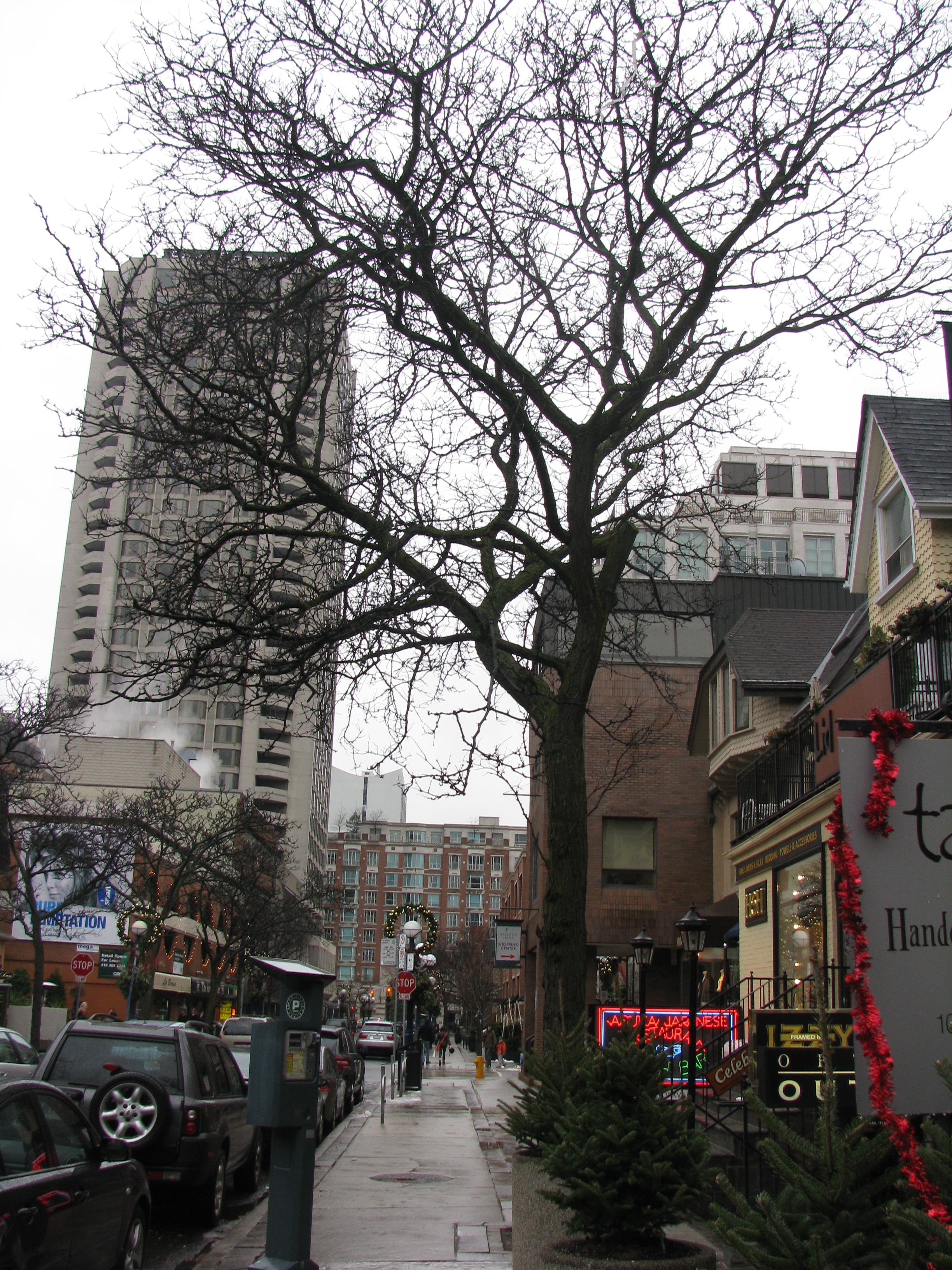
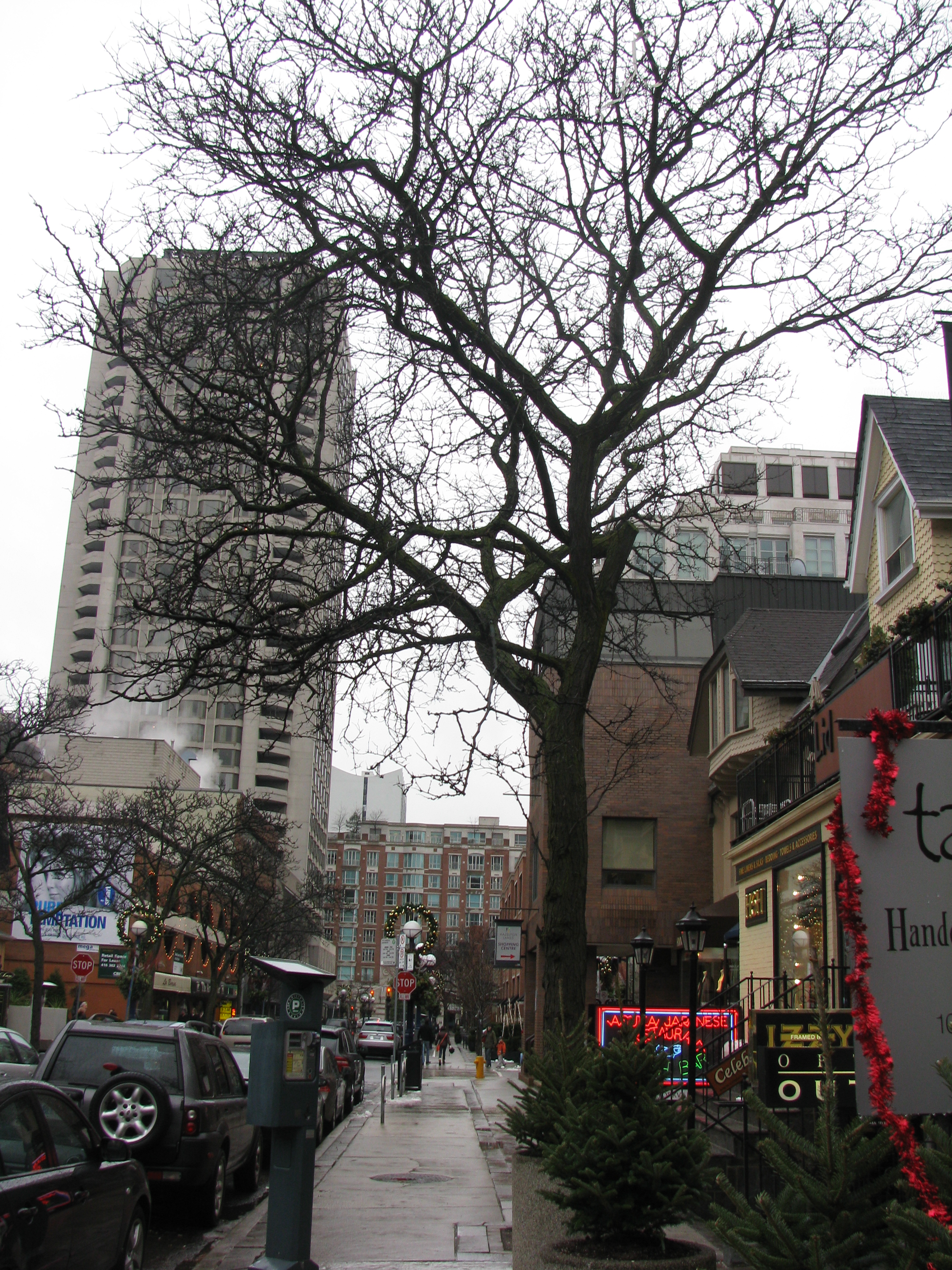
Over in Yorkville I noticed that none of the trees are being cut down. In fact they’re decked out with lights.  In fact… they’re big and beautiful and happy, thriving in their ‘unnatural’ urban setting.

Something’s not right here. Trees can live in an urban environment. They do live in urban environments. So why—really—were the trees on Bloor cut down? The guy said they hadn’t been planted deeply enough in the first place. Egad. Does anyone do any research? Any planning? There are books to read for pity’s sake…

I’m thinking an intervention may be necessary, that I should send a letter before a decision is made to spend more money planting new trees that will only have to be cut down. I could begin with something like this: Dear Him/Her, Whatever was done in Yorkville seemed to work; make a note. Additionally, you might ask family and friends to give you books on the subject of trees this holiday season. In fact, you might even have a gander at one or two of them; if the words don’t interest you, at least look at the pictures…

Reflecting the belief that urban life requires an ‘escape’, city parks have long been designed in imitation of pastoral surroundings. Henry F. Arnold challenges this tired romantic style that disregards the urban environment—and shows how trees can be used to enhance urban elements rather than hide them. He encourages landscape architects and city planners to utilize trees, not as decoration, but as living building materials to create and reinforce urban spaces.” (From: Trees in Urban Design, Second Edition, By Henry F. Arnold)