good intentions and sweet reality

I know, I know… mea culpa. The leeks didn’t get dug up before the snow fell and turned to ice, freezing them in situ (why am I speaking Latin?).

This morning as I walked past I swore I heard their cold, muffled cries: you little shit, you promised you’d get us out of here before this happened!! We were SUPPOSED to be be soup! 

Okay, maybe I didn’t hear anything. But you should have seen their angry little faces…

I took a deep breath, kept walking, and assuaged my guilt with a pot of tea made from a few leaves of sweet (unaccusing) woodruff I found poking through the ice.

any excuse for il giardino…

Snow’s falling today. Just yesterday I was still wearing sandals. Tomorrow I’ll pick the rest of the celery, dig out the leeks. By the end of the week things could well be frozen and white.

Used to be that was it; I’d hardly go past the patio from December to March, except to feed the birds, maybe make a snow angel. But then, a couple of years ago, I saw Karen Shenfeld’s film about the men and women of Toronto’s Little Italy and their amazing gardens.

There’s the guy who rigged up a clothesline of empty pop cans so he can sit on his patio in his undershirt and enjoy the view of his vegetables growing, occasionally yanking a string that rattles the cans and keeps the birds away all afternoon. Another who uses a handmade hoe and shovel, tools his father brought to Canada more than forty years ago.

The film is filled with music and food and front yards that are planted with tomatoes and zucchini and eggplant; they’re not beautiful in the mown and blown, pesticided, clipped and landscaped way, thank god, but in all the right ways.

These people don’t  ‘have gardens’, they have relationships with their gardens—healthy, head over heels, madly in love with life relationships.

My favourite was the guy who didn’t let even winter stop him spending time in his beloved “il giardino”—every day he’d go out and chip away at a little of the ice that covered it. (He’s the reason I’m not that sad it’s time to dig out the last of the leeks, store the patio umbrella and put on my socks—I’ve got a pile of cedar branches to tie into kindling bundles—one bundle a day, starting in January…)

when it looks like nothing

I’m standing in front of an empty cage at the Conservancy of SouthWest Florida—a tiny gem of a place doing its tiny part to help preserve what’s left of nature in that part of the world. They also have a facility to rehabilitate wild animals that have been hurt, mostly in traffic accidents. Those that can’t be released live out their days in large outdoor pens or cages and serve as noble ambassadors on the importance of living in harmony with the natural world.

So along comes a grandmotherly woman, young boy in tow, rushing through, no time to consider how the animals got there, no time for conversation; she merely points, bird, bird, turtle, bird.

Next to me, in front of the empty cage, the boy pauses; the grandmother tugs to keep him moving.

“There’s nothing in there to see,” she says and the boy, reluctantly, allows himself to be tugged away.

And I think: this is how it happens, this is how we train children ‘to see’, to look only for the feature attraction, the shiny, the obvious, the Disney version of things. God forbid they should be allowed to think, to imagine for themselves. In fact, the empty cage contains sand, shadows, pebbles, a small tree, bits of wood… but it’s all been called nothing and the boy has learned something from that.

I hang around the empty cage for awhile, looking at the tree and the sand; evetually another child comes along. He asks his mother what the sign says.

“Unoccupied,” she answers. “There’s nothing in there, let’s go.”

The child looks at the cage, then up at me looking at the cage, then turns to his mum and says, “But something might come into it.”

Even she can’t argue with that.

Still, she takes his hand and they move on—in search, I guess, of the ever elusive ‘something’…

on a warm autumn day…

I saw a boy riding a bike, thirteen or fourteen, plugged into an iPod, snarly and unseeing and when I moved off the sidewalk so he could more easily pass, he looked at me in his unseeing way and said nothing. The poor creature had not even been taught, or so it seemed, to offer a simple nod of thanks—he had absolutely no skills beyond being able to listen and pedal at the same time.

I saw a tiny tot riding a motorized car while a harried mother moved about in a front yard full of large plastic toys. When the child left his car in the middle of the court the mother said: you can’t leave it there, Dakota, go and get it. But Dakota was already off in another direction and mother was already walking toward the abandoned car. As Dakota, and I, knew she would.

I saw a dog named Steve, the colour of a fox and the size of a rolled up newspaper on a slow news day.

And then I saw hail fall in the garden and thought how odd, until I popped one of the marble sized balls of ice into my mouth—which seemed a perfectly wonderful thing to do on a warm autumn day.

power point creativity

Made the mistake today of attending a symposium about building creative communities. Promising keynote speaker, nice room, good food, three hundred and fifty people in attendance, from mayors to gallery owners, curators, writers, artists, librarians, economists, designers, musicians. Everyone keen and ready to listen and learn.

Unfortunately it was anything but creative because the creative types were forced to sit quietly while un-creative “presenters” flashed pie charts on power points and told us our part of the world, our town, was “doing just fine, creatively…see??”

Even the keynote speaker—someone we were told would ‘blow us away’ with his insights—took us instead on a long and uneventful journey through his childhood (and part of his father’s) to his omnipotent present. He then listed all the books he’d written, which, he pointed out, were for sale in the lobby.

More pie charts followed until I began muttering to myself. Finally decided to give it up and sneaked out before lunch. (They’re probably at this moment gnawing on rubber chicken, reflecting between bites—”See how creatively the chicken is rubberized…?”) 

On the way out I wondered about the idea of doing good work versus talking about doing good work, how only the latter is really encouraged because of all that dough to be made in the talking, the teaching, the writing of how-to books, running workshops (there are workshops now to teach you how to run workshops). We live in a culture that keeps society perpetually convinced its individuals are not yet equipped to take action, to think, to even know who they are, much less take the initiative and just do one bold and brilliant thing.

As I opened the doors of the convention centre, sucked in some sunshine and made my way to my car, I remembered something I’d once heard—how some professor was asked to speak a group of students on the subject of How to Become a Writer

He walked onto the stage of the auditorium and took the microphone.

“How many of you are serious, really serious, about becoming writers?” he asked.

Every hand shot up.

“Well, in that case,” he said. “What are you doing here? My advice to you is this: go home and write.”

And then he left the stage.

when words and nature meet, good things happen

Last night on the way to the grocery store, I looked up and saw thousands of starlings flying en masse—their shape changing with every swoop—every wing catching twilight at the same moment—flashing silver— then another turn and all wings are black. The entire flock moving together, gliding, sweeping left then right, expanding and contracting like a perfect shape shifting kalaeidescope.

I’d seen the birds fly in large groups before, but never this pre-sunset ritual, which I’ve now learned is common; supposedly a form of communication before calling it a day.

I stood there alone staring at the sky for maybe ten, fifteen minutes. I assumed the show had only just started, that soon a crowd would gather and we’d all shake our heads and sigh, agreeing that nature is magnificent and we’re inferior dolts that have so much to learn.

But only a  few people even slowed down long enough to look up, and one disappointed voice who did,  said, “It’s just birds,” and turned quickly away.

This is the season for the starlings dance; for robins getting drunk on juniper berries outside my window; for geese arguing about the tidiness of the vee; chickadees, doves, cardinals and finches, a bounce in their step now that the bullyish greckles have finally gone.

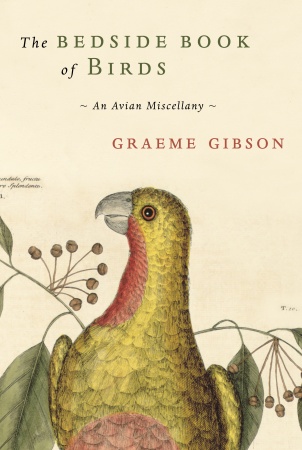
With all that avian magic on my mind I happened to come across this interview, which reminded me that I’d wanted to read The Bedside Book of Birds

And now I will. 


“Stevenson remembered the story of a monk who had been distracted from his copy-work by the song of a bird. He went into the garden to listen more closely, and when he returned, after what he thought were only a few minutes, he discovered that a century had gone by, that his fellow monks were dead and his ink had turned to dust. The song of the bird had given him a taste of Paradise, where an instant is as a hundred years of earthly time. Was the same true of time in hell, Stevenson asked himself.”  (From— The Bedside Book of Birds, by Graeme Gibson)

going for a walk

“Confronted with the truly microscopic, all pathos is hopeless, completely meaningless. The diminutive of the parts is more impressive than the monumentality of the whole. I no longer have any use for the sweeping gestures of heroes on the global stage. I’m going for a walk.”

(Joseph Roth, from What I Saw )