

I’ve written about trees before. Trees I’ve loved. And my love of trees.
Trees that replace old (tree) friends.
And I’ve occasionally ‘not reviewed’ books about trees… a couple of my favourites are mentioned here. Also here.
Of course I adore the Tree of the Week feature in The Toronto Star and the way trees are these subtle but enormous parts of our lives that we hardly even think about until someone asks.
So I’m asking.
What’s your tree history?
For instance, was there a beloved tree in your childhood? Was it a pear tree and did you read Nancy Drew and eat potato salad in it? Did your father knock down the apricot tree at the end of your driveway because he stepped on the gas instead of the brake, after which your mother no longer made apricot jam because she never found apricots that were as good as her own? Did you read James Michener in a quiet leafy park while eating stolen peaches from a nearby orchard? Do you have any tree stories at all that don’t involve fruit?
Feel free to share even the tiniest wee memory.
Also… I would love to know what I’m missing in the way of literature where trees feature prominently, including kid lit, poetry, and essays.
♣
Actually, it begins with a precocious eleven year old girl arriving in a small country town via horse and buggy, driven by a soft spoken older uncle type who is charmed by her precociousness. (Yes, she is poor and has lively big bright eyes and braids. No they are not red, but black. More about that later.)
But the story of how Rebecca of Sunnybrook Farm came to be in my house in the first place begins with bingo.
The Briny Books Book Bingo Challenge, to be precise. A new thing created by the wonderfully bookish mind behind the blog Pickle Me This (and in partnership with the simply wonderful Blue Heron Books).
I love stuff like this.
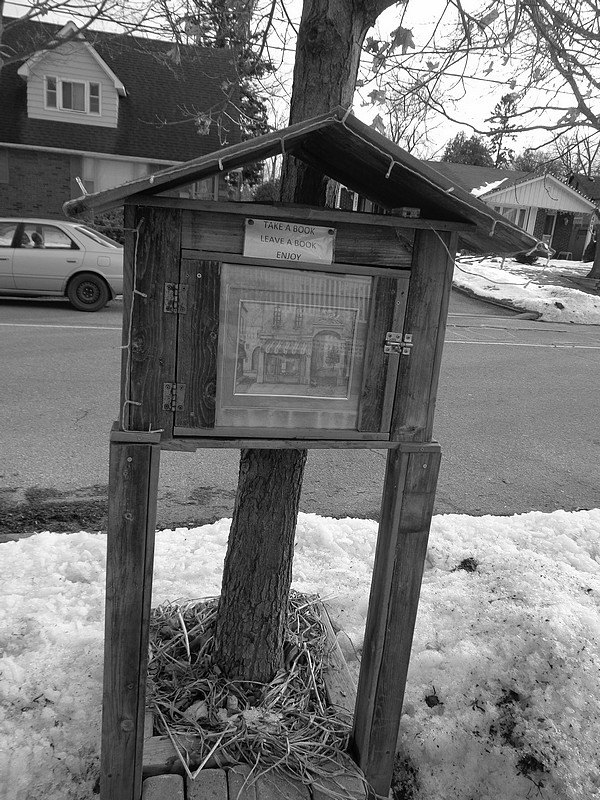 So I started with the first square (you don’t have to go in order though… it’s bingo for god’s sake!), which happens to be “A Book From a Little Free Library” and wouldn’t you know it but that very day I happen to pass a little free library I’d never noticed before.
This is how the universe works.
Unfortunately it was crammed with stuff that held zip interest for me but I was committed to THIS Little Free Library and from THIS ONE I decided I must take a book and read it. Because if I was going to get all choosy then I’m controlling things and that is NOT how I want to play my bingo. But Robert Ludlum? Um, no. And tekky books, macrobiotic diets… egad, what was the universe trying to tell me? And then… squished to one side, there was Rebecca. She was the best of what was on offer but I was still not very happy about things and I seriously considered leaving her there and trying another little library. But it was too late. I WILL NOT CONTROL MY BINGO had already become my mantra and so I took Rebecca, who I knew nothing about except wasn’t she supposed to be some overly cheerful chick like Polyanna?, home. (note to self: read Polyanna)
Well.
Turns out that not only is Rebecca of Sunnybrook Farm delightful and the  story perfectly fine and not intolerably sweet and, in fact, very funny even, but it led me to a whole THING insofar as its connection to Anne of Green Gables. The parallels and samenesses cannot be missed. I mean it’s REALLY very similar, not only in storyline but snippets of dialogue are word for word the same, characters (including Anne being a red-haired version of black-haired Rebecca), also voice, tone, descriptions, settings, relationships. I had no idea of the Rebecca story before this and as I read my jaw kept dropping further and further.
Kate Douglas Wiggin’s Rebecca came first (1905), and Lucy Maud Montgomery’s Anne in 1908, which is heart-breaking and makes you wonder: what was Montgomery doing, essentially copying Wiggin’s story??
I researched various reviews and discussions on the subject and while there is no doubt the books are bizarrely similar, there seems to be no broadly accepted WHY. At least no one’s daring to come right out and use the P word.
To make matters worse, Anne, of course, went on to become an international superstar and icon and entire industry. Whereas Becky was pretty much a non-starter outside the U.S. and over time even fizzled away there.
Hardly seems fair, right?
One theory has it that the Rebecca story is more overtly patriotic and American, while the Anne story focuses mostly on the oh-so-quaint village of Avonlea on Prince Edward Island, and while Canada is named and there’s no doubt where the story is set, the overall emphasis is more on landscape than ‘nation’… thus making the argument that the Anne story was more widely and internationally relatable at the time of publication.
All of which doesn’t explain what Lucy Maud was thinking. My personal theory is that she made her book so BLATANTLY the same as Wiggin’s as an homage, as her Canadian version of a story she loved. Because surely she could not have supposed it would be taken as a completely original tale.
Pure conjecture. I haven’t read anything to this effect so it remains a mystery. But if my theory is correct, it would have been a classy move to acknowledge Wiggin’s book right up front, even putting it in the dedication. Or at least have gone on record afterward and explained her reasons for ‘using’ so much of it.
That said, I’m thrilled with my first bingo pick. Who could have guessed it would lead to the discovery of what amounts to a possible literary scandal brushed under the literary rug.
Next up… hmmm.
Not sure.
Because I don’t have to go in order…
… it’s BINGO.
Might just see what comes my way.
Will keep you posted.

♦
A few years ago on this site I told the story of watching a short man emerge from a large truck and how my mother, seeing the same thing, saw a handicapped man and how I just did NOT see the handicap. On the contrary, I saw resourcefulness in a world that was not built for his height. (And that if it were built to his height, well then, we’d be the ‘handicapped’ ones.)
I remember also a time when my sister, who had ALS, was confined to a wheelchair and the looks of outright peeved annoyance as I rolled her about some store or other, taking up, I guess, more room in the aisles than ‘normal’ people. I was shocked by these looks and later wondered if the people giving them were possibly the same people who, in a different situation, one that wasn’t inconveniencing them, looked at my sister with pity and prided themselves on their ‘compassion’, which probably more often than not translated into gratefulness for not being her.
My sister was also asked to please not attend the wedding of a close family friend (formerly close) because her wheelchair and generally emaciated and twisted appearance and inability to talk in anything more than grunts and slurs, was not the vibe the general wedding decor/party/event was going for.
Judgement.
All this, and more, comes to mind after reading Falling for Myself, by Dorothy Ellen Palmer, a memoir that addresses ableism and judgement and what Stella Young termed Inspiration Porn, (a reference to the way the disabled are treated differently, referred to as ‘inspiring’, and used to make the so-called ‘normal’ people feel better about themselves for a) not being disabled, and b) being ‘kind’ to those who are.
“In inspiration porn, the disabled person is reduced to the object, the silent prop. The heroic captain of the football team leans down and asks ‘a wheelchair girl’ to prom. A brave tech entrepreneur takes the ‘risk’ to hire a disabled programmer. A mega-millionaire basketball star drops by with cameras and has lunch, once, for ten minutes, with a bullied, autistic child. In inspiration porn, the abled person is the hero; the disabled person is the second banana, the sidekick.”
 Inside the cover (cleverly designed as an accessibility sign) Palmer writes from the place of someone who was born with the challenge of walking and staying upright. Her feet, as an adult, are size one and half, and two and half. She has given each foot a name. She also names her walking tools, her crutches, etc. She has done/continues to do much in her life as a teacher, activist, union executive, writer, and member of the Accessibility Advisory Committe of the Festival of Literary Diversity (FOLD). For starters. She is also a daughter and mother and citizen of a city and country that (like so many cities and countries) needs to take a look at how public spaces are built in order to accommodate both the disabled and able bodied equally.
Because the current tokenism that exists in the form of a designated parking space that is used by people who are not disabled and who justify that use since they’re only going to be a minute …. ditto that one wheelchair accessible stall in the loo… and a host of other issues knowable only to those who use chairs and walkers, who have impaired vision or hearing… isn’t going to cut it.
In a very conversational way, through frustration laced with humour, Palmer sheds light on an issue that shouldn’t exist but is, instead, sadly ubiquitous, and which stays hidden due to inspiration porn, ableism and much of the world patting itself on the back for NOT taking that parking spot.
Essentially, the book is about how she lives as a woman… also how she lives as a woman with a disability. The disability not being her body, she’s very content in her body… it’s the rest of the world that’s a bit of a challenge.
And if anyone reading this says well, heck, are we supposed to accommodate everybody??? The answer is a resounding YES. Because that would be the kind of progress that would actually benefit all of society, not just those who stand to make a profit from so-called ‘progress’.
“We all need to stop falling for the double lie that disabled people can be healed and should want to be healed.“
Would love to see this as required reading in schools.
♦

Mr. Something Something, whose name I can’t remember but who I can still see so clearly standing in front of a grade nine English class in his flannel shirt and cords and the day he handed me back a paper I’d written and said that my work stood out, that I should continue writing. Or something to that effect. It’s possible I’ve overblown it in my mind over the centuries but the point is that’s what it felt like and I can’t begin to think how often this tiny sliver of a tenuously remembered moment has come to mind since then and still does, giving me a boost just when I need it because even though my parents also liked my writing and auntie wotsit too and a few people since it’s his comment that stays with me. I remember only that he was gentle and soft-spoken, passionate about words, and I have the vague sense that he wasn’t a conformist and therefore not loved by the mainstream and possibly taken advantage of by some of the students. I recall hearing, years later, that he eventually left teaching to drive a cab.
Mr. Bradley who introduced us to Dylan (Bob, not Thomas) by bringing in a couple of albums and a turntable and telling us to just listen. That was the whole class. At the time we were all…. huh???? But we listened. I can still time travel to that moment….
The art teacher who had Parkinson’s (I realize now) and walked the aisles of the class, head shaking, commenting, applauding, encouraging, suggesting.
Ms. Mackie, who was three hundred years old and looked like Santa’s wife, who seemed to live and breathe HomeEc and who shouted instructions like middle it, middle it!!! which had something to do with a gathering stitch and in whose class I made two aprons worthy of any runway. One, light purple with dark purple rick rack, the other paisley. My mother wore them until the end of time.
Mr. Vangeloff, the typing teacher, who was short and stout and wore tweed suits and always a tie and white shirt and what little hair he had was wiry and long and combed over his bald pate, which, when he was annoyed (which was every day) would rise in a wiry matt to a 30 degree angle like a draw bridge and stay like that as he wandered about the room telling us to stop flapping our ruby red lips in the breeze.
His wife was an art teacher. I wasn’t in her class but she was loved for her grooviness, her long black hair and geometric print dresses and the way she turned a blind eye if she stumbled upon anyone smoking in the loo.
Unlike the French teacher, Ms. Whatever, who would stalk the loos in order to engage in her hobby of handing out detentions for smoking, lunch eating, or Euchre playing. Like wild animals we soon learned how to survive by recognizing the sound of her approaching footsteps, the click of her heel, and flush away any detention worthy evidence. Smoke? What smoke???
Mr. Merrick the gloriously mad science teacher. I hated science but adored him and so quite by accident I learned some science.
Ms. Thingy the gym teacher. Blech blech blech to gym. Made not better by her enthusiasm and muscley legs and assumption that everyone liked climbing rope ladders and what were we supposed to do with the parallel bars because are you kidding me?? She wore culottes and sneakers and drove a flashy green sports car. I saw her once in the real world and heard someone refer to her as Barbara and COULD NOT BELIEVE IT.
Because teachers, whether we adore them or not, seem, especially to our small selves, a little god-like, not only for the power they wield, though there’s that (though that’s less and less), but their influence on us, which I wonder how often we even realize the power of… then, and now.
Hats off to their memory.
And to those who continue to influence the future.
We are grateful.
I have no idea where I got this book nor how it came to be included in my winter reading. I haven’t been talking to anyone about Newfoundland or outports and the only aquatic thing I’ve had on my mind recently is the Georgian Bay trout we get via a local fisherman. But there it was on my To Be Read pile so I casually opened it and wondered if (assumed that) Claire Mowat was related to Farley. She is. His wife. And it was with Farley that she lived in an outport on the southwest coast of Newfoundland from 1962 to 1970.
That pretty much right there is the story. Except for the details. Because life in an outport, apparently, is/was not heavy on drama, intrigue, or big-time action, but details… oh yes. Oodles.
An outport, by the way, is a small, isolated fishing community almost always without roads. Access to ‘anywhere’ is by boat only, which means during the LOOOONG winters… there is no access to ‘anywhere’. Due to their isolation these communities became a lifestyle unto themselves and in their own way thrived up until the 1970’s when outside influences entered into things and changed that lifestyle (not for the better), after which residents were given incentives to move inland. Many moved entire houses, floated them along the coast, because they had no money to buy new. And a way of life vanished.
Mowat was there, unknowingly, for what would be the last decade of that old-world outport life. She shares those remnants by being an excellent observer of nuance and keeping herself in or out of the story in all the right ways.
The Outport People is billed as a fictionalized memoir but it’s generally acknowledged that the only 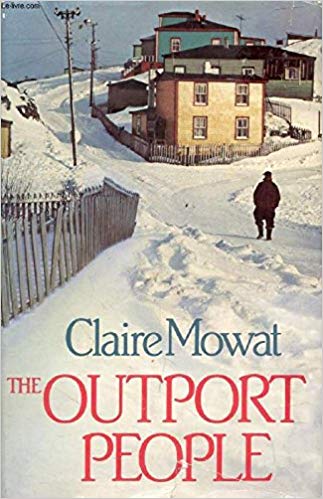 fictionalized bits are names and the occasional need for artistic license in order to make whole cloth of the ‘details’ and shape the story. Capturing the essence of this now lost way of life was, after all, the point of writing the book, something that’s clear from the reading. You can tell Mowat was truly in love with outport life and deeply respectful, in awe even, of the people who lived it.
What comes off as most extraordinary is that they, the residents, seemed oblivious to the increasingly modern world going on around them. More importantly, that’s pretty much the way they liked it. Most people never once in their life set foot outside their remote community and when then did, didn’t much like what they saw.
Once that ‘modern world’ began creeping in via telephones and televisions in the mid to late 1960’s (but remained a rarity in most homes); when the post office was rebuilt and the postmaster of 35 years, who knew everyone by name, retired and was replaced with a key to your own P.O. box so that there was no one to speak with at what used to be a communal hub; when the occasional car began to appear and the fish began to disappear along with the fish plants along with the young people who could no longer hope to make a living, changing the cycle of families so that elderly parents who were once cared for by their kids were now left to grow old alone… nothing was ever the same or as good in its maybe-it’s-crazy-but-it’s-worked-for-generations way.
But all this comes at the end of the book and the end of the decade. By which time Mowat has painted a picture of a strangely beautiful world… beautiful despite the fact that no one has more than a few dollars at any given moment, no reliable medical services, no actual shops (back to no one has any money to buy anything), limited food sources, and despite the howling cold weather and brutal life of families who fish for a living or work for the fishing industry (and receive ridiculously little $$ for it)… despite all that and more, there’s a warmth, from the people themselves, from the way they share what little they have, looking in on neighbours to make sure they’re okay, the way children have ten thousand chores but are also free to run and play and discover their enormous yet tiny world because there is nothing else, not a single other thing, to distract them. There’s a complete absence of fear (other than what weather and sea and fishing companies pose).
And the colours! in this grey landscape where no deciduous trees exist… the bright shiny orange of kitchen walls, a red painted floor, yellow table, lime green chairs, a turquoise exterior. (The fishing boats, however, are all proudly dory buff. A kind of beige. Which makes no sense to me… I’d have thought it would be an advantage to have brightly painted boats.)
Mowat also notes cultural peculiarities, what is considered polite conversation, the way it’s absolutely normal for anyone to walk into anyone else’s house and sit down, almost always in the kitchen, and talk or not talk. The tradition of mummers, the difficulty of unions in environments made up almost entirely of closely linked families, what’s important to people, most of whom, have never been or even seen pictures of… anywhere else.
The reason houses and roofs are specifically shaped and why windows rarely face the sea…
Oh, yes, and the sea.
The book feels like listening to a friend tell the story of living eight years in a place she was initially only curious about but came to deeply love… including, and maybe especially because of, the tough moments. And what’s more brilliantly beautifully Maritime than that?
(All of which aside, I’ve read that in some cases, residents of Newfoundland outports have not found the book as charming as mainlanders have, but that may be a case of being in the forest, unable to see the beauty of the trees. There were occasions Mowat outlines, where residents wondered why she was taking pictures of the water or the boats, things they found so ordinary. There is also the possibility that residents interpreted Mowat’s ‘details’ of outport life as being meant to be demeaning, when in fact it’s all about respect, admiration and awe, with more than a dollop of envy.)
♦
Somewhere in the process of my December reading it occurs to me that three very different and unlikely books share a series of similar elements.
Don’t you just love it when that happens, when you think… rum, again?? And it all begins to feel like a kind of reading serendipity is happening.
 It begins with The Book of Eve, by Constance Beresford-Howe. Written in 1973… it remains the classic, in my opinion, running away story. Woman fed up with boorish husband, chooses instead to live in a damp bare bones Montreal basement apartment, with a feral cat outside a window that’s impossible to open and a slightly mad, slightly inspiring Hungarian living upstairs. Hard to see as uplifting but of course it is. She is free, not of life’s yins and yangs, but free of those yins and yangs where the source is boorishness and which grate as intolerable because they are the yins and yangs of a life that is not of her choosing. Makes such a difference. The upstairs Hungarian is the well-intentioned budinski. There is rum (or is it whiskey?), also sherry. There is scavenging in order to survive, there is rain and redecorating with scavenged objets that indeed become a kind of art representing this new life. There is the confusion of what I have done? and there are answers.
 Next up, One Woman’s Island, by Susan Toy, which surely calls to me as an antidote to all that damp draftiness (see above). The story takes place in the Caribbean on the island of Bequia, which is an almost character itself in the way Toy offers not only island customs and sounds, fragrance, colour, but the lilt of language, the tinkle of ice in a rum-filled glass. She also gives us a peek at the ex-pat experience in all its happy hour island vibe and the sense of finding like-minded souls, but also the sometimes sense of claustrophobia, lack of meaningful ways to spend one’s time, and the major adjustment to another culture. The story is about a woman who leaves Canada after the death of her husband and heads to Bequia where she rents a house for six months, intending to simply relax. Turns out relaxation is limited given the dinner and drinks invitations from ex-pats, the occasions of possible murder, various other dangers and intrigues, and her own well-intentioned budinski tendencies toward a neighbouring family. Toy has a dry sense of humour that infuses the narrative voice with a conversational tone and makes for an easy, enjoyable, and compelling read. Also, Toy’s respect for the island comes through in the way she weaves references to serious issues such as literacy, island politics, traditions, and warns of the need for ex-pats (and tourists) to understand that life for the locals, while appearing to mainlanders as possibly needing improvement, is a life the islanders love. Budinskis butt out.
 Finally, Lynn Coady’s Watching You Without Me, The budinski connection is huge here. His name is Trevor and he’s employed to take Karen’s intellectually handicapped sister Kelli for walks twice a week. Karen has been living in Toronto for many years but comes home to Nova Scotia after the death of her mother, in order to look after Kelli and make arrangements for her future. Trevor, the personal support worker, has an excellent relationship with Kelli, who clearly adores him and vice versa. He is helpful re info on the home care system and long term care residences, all of which Karen is grateful for. Until. Without giving too much away, let’s just say Karen learns she should have followed her own instincts, and this is where the escape element comes in. Although I won’t say in which direction said escaping occurs. I will say that rum features large throughout.
♦
Lovely read, a couple of hours tops is all that’s needed. Pretty pics, very  lifestyle magazine in vibe, but don’t discount it because of that. The hygge principle is worth inhaling even if, like me, you’re already pretty hygge’d up, that is, you’ve got a life where simplicity, joy, chocolate and tea play a big role.
The Little Book of Hygge is still a sweet thing to thumb through on a grey afternoon.
— My favourite part is ‘Ten Unique Words and Phrases from Around the World’, which includes…
Iktsuarpok (Inuit) The feeling of anticipating that leads you to look outside to see if anyone is coming.
Friolero (Spanish) A person who is very sensitive to cold weather.
Hanyauku (Rukwangali; Nambia) Walking on your toes on warm sand.
Tsundoko (Japanese) The constant act of buying books but never reading them.
Schilderwald (German) A street with so man road signs that you become lost.
**
Hygge itself, a kind of deep comfort, is described by the author Meik Wiking (is that not the best name?) as “…humble and slow. It is choosing rustic over new, simple over posh and ambience over excitement. In many ways, hygge might be the Danish cousin to slow and simple living.”
There’s a lot about soft, comfy blankets and fires. Much chocolate. Doing simple things (simplicity is key). Much about friends, food, games, music. Much of hygge takes place indoors, the Danish weather, apparently being what it is, especially in winter. Many candles, much coffee, socks.
There are actual Hyggesocken.
In one of the wee sections (all sections are wee) the author tells of their own hygge TV viewing preference which is to watch only one or two episodes at a time of a favourite series, then wait a week or more to watch another one. The opposite of binging. Made me think of The World Before Taping Things Much Less Netflix and how restaurants would empty at 8:30 because the next episode of Shogun was on that night. I’m referring of course to the eighties.
Hygge also suggests that we allow ourselves to play.
“One of our issues as adults is that we become too focused on the results of an activity. We work to earn money. We go to the gym to lose weight. We spend time with people to network and further our careers. What happened to doing something just because it’s fun?”
Like I said, I think I’m already doing hygge.
Including leaving restos by 8:30.

♥
Seems I like reading about hygge every few years.
Also worth reading is this on Denmark’s social framework and its role in creating a deep-breathing, hyggesocken-filled society.
♥
— Willa Cather, (Letters)

♥
Ninety-five pages containing 240 vignettes on the colour blue.
And life.
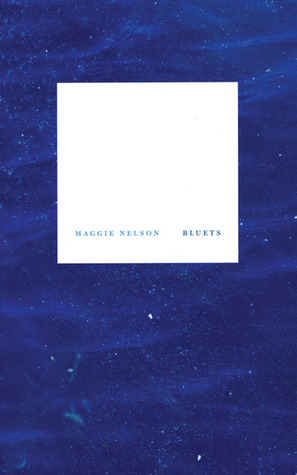 Maggie Nelson’s Bluets is one of those rare gems not only for the precision of her writing… there is nothing that shouldn’t be there… but for discussions of blue in literature, art and song, for feelings on love and loss and grief, the pleasure of learning that bowerbirds collect only blue things… bus tickets, buttons, other birds’ feathers.
Nelson writes about blue without writing about blue, but using it to tap into emotions and connections that exist everywhere.
A deceivingly clever little book.
“I have been trying, for some time now, to find dignity in my loneliness. I have been finding this hard to do… It is easier, of course, to find dignity in ones’ solitude. Loneliness is solitude with a problem.”
“I have enjoyed telling people that I am writing a book about blue without actually doing it. Mostly what happens in such cases is that people give you stories or leads or gifts,f and then you can play with these things instead of with words. Over the past decade I have been given blue inks, paintings, postcards, dyes, bracelets, rocks, precious stones, watercolours, pigments, paperweights, goblets, and candies. I have been introduced to a man who had one of his front teeth replaced with lapis lazuli, solely because he loved the stoen, and to another who worships blue so devoutly tht he refuses to eat blue food and grows only blue and white flowers in his garen, which surrounds the blue ex-cathedral in which he lives…”
“Why blue? People ask me this question often. I never know how to respond We don’t get to chose what or whom we love, I want to say. We just don’t get to choose.”
♥
If, like me, you love colours… here’s some.
Including blue.
 Matilda Magtree