the light getting in

There’s a beach where I sing Cohen’s Anthem to the seals, the chorus anyway, about cracks letting in light, the perfection of imperfection. I’m pretty sure that’s what the seals are singing too.

But this post isn’t about seals.

It’s about trees, which is part of the reason I’ve been inconsistently present for the better part of a year,

I’ve been wandering among what’s left of the them ever since Hurricane Fiona struck the east coast, when the island is said to have lost 40% of its trees on that single day in September, 2022.

Much has changed about the landscape since, not to mention the shoreline, not to mention the bridges, wharves, barns and houses demolished. The everywhere piles of timber have become a testament to the art of log stacking.

I’ve been wandering in what’s left of wandering space in the forest around my house, initially dazed, less so each time. We’ve done mammoth cleanups and have begun to cut a few new trails but we’re taking our time. I realize I don’t need a whole forest to wander through in order to feel awe.

There is new sunlight, saplings too, and mossy glades have sprung up among the still standing spruce and eastern larch (tamarack), the maple and birch, groves of beech, mountain ash, serviceberry, alder and aspen.

The other day I counted eight or nine new oak trees I’d never seen before. A few days after that I saw twenty on the same walk. This morning I stopped counting. This is the way of trees, I realize, the slow reveal of them. A forest at a glance is… green space. Up close it’s an unending universe.

Just the other day, at the edge of the tree line, I found two new apple trees, each a great distance from the other. One I call the galette tree for its tiny perfect fruit, tart enough for galettes, one of the few things I enjoy baking, precisely because the crust wants to be imperfectly shaped.

The old linden beside the house was perfectly shaped, but also imperfect because it had grown so large it almost touched the hydro lines and a month or so ago when another hurricane threatened, and because the direction of the forecasted winds (different than Fiona’s) would force the tree’s branches right onto the power lines, we took no chances, and had it cut down. I expected to be sad, pained even, but it wasn’t in the least painful, not a bit sad. There was a sense that the tree itself knew it had become a danger and the space it left was given like a gift, not only to the bee balm and juniper, lilac and witch hazel that have barely survived in its shadow but to me, personally. Its stumps invite me to weave ribbons around them and carve them with Cohen’s words.

Now every morning I salute these stumps and the space once filled with the old linden’s canopy, thank it for its willingness to continue standing despite (we realized) rotting from the middle and something eating its leaves, for making it easy to do what was necessary, and for the light its absence allows.

The other day in my ramblings along the tree line, I noticed among the ‘greenery’ a tiny grove… of linden saplings.

What else to say…

Here’s to the cracks and the light.

Ring all the bells.

light gets in

summer postcards — call the library

library, cardigan

When I was a kid the local library was a kind of household guru where not only the books were revered but also anyone who answered the phone. My dad’s mantra, call the library!, used whenever he was stumped by one of my questions and didn’t feel like guessing. And it wasn’t a suggestion… but delivered as a godsend solution, a way of contacting The Oracle itself. And while I don’t remember any of the calls, what I asked, what they answered (and there were many calls) I have the feeling they always came through. Wait. I remember one call. I’d received a chain letter warning me to make X number of copies… or else. Heaps of carbon paper and cramped fingers would have been involved not to mention I didn’t know enough people to send them to. Still, I didn’t want the ‘or else’ fate so asked my dad what to do and, erring on the side of caution, he decided The Oracle would probably know how to proceed and if they didn’t no one would. As it turned out, The Oracle was brilliant, I can still feel the relief in my ten year old self. Just send out a couple letters to cover your bases, they said. Maybe I’m paraphrasing. But only slightly. The Oracle never minced words.

A library is a medicine cabinet. What can heal one person may not work at all for somebody else.

—Sandra Cisneros, A House of My Own

Long postcard.

But, books.

I was speaking the other day with a friend about home library/bookshelf organization, the categories we have and I loved hearing the sameness and difference of her method to mine. For the record, mine is alphabetical and separate categories. A small room lined with thrift shop and IKEA shelving holds the majority. Novels and short stories get separate spaces. Non-fiction is divided into four categories: essays, memoir, biographies, general info. There’s a poetry shelf. One for gardening (two categories: essays and how-to). Another for nature, generally. A Canada shelf. An anywhere-but-Canada shelf, which mostly includes Florida, Austria, and a tiny island in the Caribbean. A shelf for my favourite children’s books. A small, pared down, collection of literary journals. A shelf of miscellaneous wotnots including greek mythology and holistic cat care. Dictionaries and writing related books live in my office. Art books are in a second sitting room. All food related books are in the kitchen. Yoga and anything I find inspirational, lives on a small bookshelf in my bedroom.

I used to know someone who refused books as gifts because her shelves ONLY held books of the same size and specific colours. Note: used to know.

I often wonder at the origins of a person’s bookish habits, The What and How of what we keep and Why. And, our love of books to begin with, is it a nurture or nature thing, the fact of growing up with many books or almost none, of being read to daily or never being read to, that makes a difference or is there some other mystery involved? Not sure if it qualifies as an origin story, but here’s mine.

me, cardigan

summer postcards — the dna in h20

july24.6 - Copy

Earliest beach memory is picnics, my mum and dad coming home from work, he from a factory, she from the warehouse of a local Towers department store, neither of them easy jobs and I realize now they must have been tired but maybe, like me, never too tired for the beach, so they’d make coffee for one thermos, koolaid for another, throw some bread, meat, cheese, fruit and veg from the garden into a plaid metal cooler and then my dad would start up the little black oldsmobile he called fatso. It was the sixties.

The only other things we brought were towels and a blanket to sit on. The idea of needing anything to amuse ourselves surely never entered their minds, or mine I guess. After all, there was The Lake. And sand. Shells and pebbles and the endless search for beach glass. There was food to eat and clouds to look at. And there was the effort it took to pretend you knew how to swim, thinking no one would figure out you were still touching bottom. My sister, much older, said she’d learned by being tossed into the lake. I wanted to avoid that lesson.

Most vivid beach memory is the night a storm was brewing. My dad and sister were swimming way out in the lake when big rain and thunder started. My mum was frantic, waving, shouting for them to come back. My dad was laughing and waving from a distance. I don’t know what my sister was doing.

Same beach a few decades later. Me and my mum picking rosehips. My dad gone, my sister too, a decade before him. My mum would make a tea blend with the rosehips, adding (also hand picked) calendula, chamomile, linden, whatever she fancied in the moment, whatever she found in season.

Pictured above: the scene a few days ago. Different beach, entirely different body of water. The grandchildren, great grandchildren and great great grandchildren of my parents, most of whom they never met, and watching them (I’ve since learned to swim for real by the way) I see new watery memories being made and can’t help think there’s something deeper that runs through generations, that whether people have actually met in life or not isn’t what determines how much they carry of each other, how much they already know of their history without even trying.

summer postcards – too posh for words

napkins

It’s a funny thing, the how of things remembered.

I remember making these napkins seven hundred at least years ago on a sewing machine I no longer have and that the fabric is a Ralph Lauren print, which I bought from a remnants table not because of Ralph but because… blue and white. I used to have a thing for blue and white (now more drawn to turquoise, orange, yellow and green). Children with mustardy faces who now have messy children of their own used them daily to wipe that mustard and more from lips and hands and while I wouldn’t advise looking too closely, they’ve held up well (maybe thanks in part to the magic of Ralph, not to mention the magic of line drying in the sun) and I remember too a certain few folk for a patio lunch one summer day who snorted when the cloth napkins came out, insisting I needn’t treat them specially, that they weren’t above using paper like everyone else and how for a moment I had no idea what they meant by ‘treating them specially’, assumed some kind of joke going on over my head then found out they were sadly serious, that the napkins meant something on a level I couldn’t de-code and when I tried to assure them I wasn’t fussing (because this was becoming A Thing with them), that we used these napkins all the time, that we never used paper, they took even greater offense at what they assumed was a lie.

I no longer see those people (surprise!), but the napkins (and the lineage of children with mustardy faces, also a clothesline) are still happily part of our daily lives, summer, winter, fall, and spring.

summer postcards — see glass

glass.birds

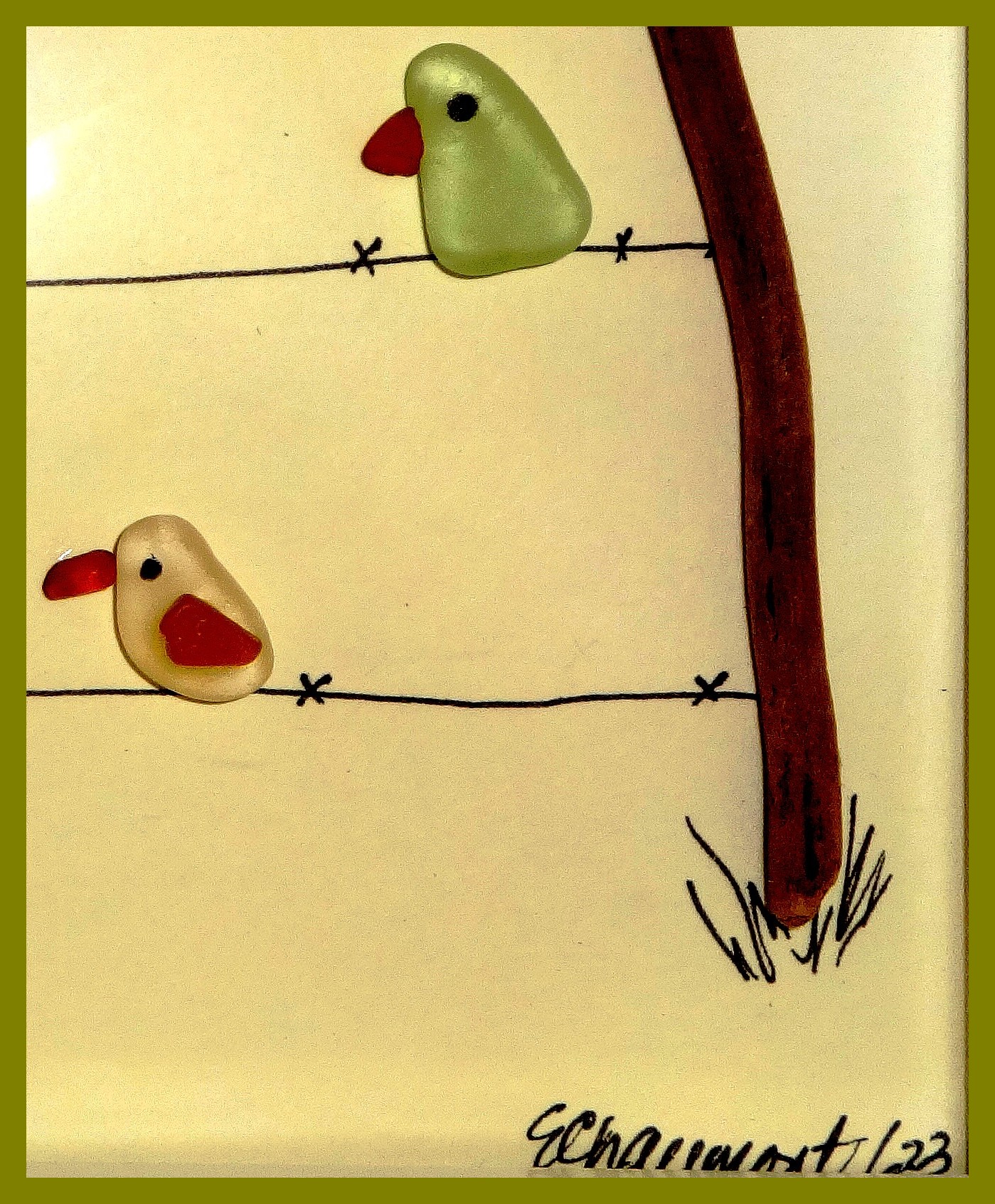
Various forms of found glass keep crossing my path, old blue jars dug up in the garden, an unusual piece of pirate glass on the shore, a whole little village made of bottles, and at the farmers’ market (on the sprawling lawn of a farmhouse where the owners make our newest addiction: their excellent pizza), I stop by a table where a woman and her grandson sit behind various crafts fashioned from seaglass. Did she find it all herself, is it tumbled, is it all from PEI, even the tiniest pieces because you hardly ever find tiny pieces here... I ask, trying not to sound like I’m filled with suspicion that maybe she isn’t a true glass forager but then she answers, so sincerely, (yes, no, yes, and yes) and the conversation easily turns entre nous in that way it often does when you find yourself connecting with mutual appreciation, a kind of recognition almost, and her grandson, eight or nine, waves from the chair beside her and tells me how he hunts glass with his gran for hours and how he puts what he finds into little glass jars of sand, which he sells for $5, and so I buy one for family in France, who were visiting last year but I’m thinking surely the sand has washed out from between their toes by now and needs to be replenished. And I buy a framed picture as well, tiny seaglass birds on a wire because Cohen’s words are part of the soundtrack of my summers.

it’s been too long and i miss this space

Hard to fathom it was back in September last year when I was last on this site, no intentions to take a break of seven months, no idea then that Hurricane Fiona was days away.

The aftermath of which was certainly a big part of my absence. And not just in the way of getting over the shock, or even the clean-up, which will be years in the doing, but because big events cause big shifts in ways you sometimes don’t even know are possible. Big shifts in the crevices of our lives. The way we think about things mostly.

Not the least of which is how I’ve come to think about the forest. When we first arrived here to this house near the sea and at the edge of the Wald (a german word that I love), I remember looking at some leaning trees in the distance and bemoaning the fact that they were too far away to cut or straighten, that they cluttered the otherwise beautiful Wald, gave it a messy look because of course trees should be upright, never dead, and full of twittering bluebirds. The best forests are like that. Aren’t they?

Turns out they are not. If you look closely at any healthy forest (not a park setting but a natural woodland) you’ll see dishevelment. You have to look closely though. A quick glance only gives the Disney impression, moss and ferns and rich earth, dappled sunlight, etc., all of which is there too. But look at the dead wood, the fallen trees, the decay that becomes new habitat, the saplings that find slivers of sky and sunshine that reach out and take those saplings by the hand and say this way!

Even so.

Fiona created more than dishevelment.

I spent hours every day walking through our ravaged Wald. Wept at the number of trees down, hundreds of them, like piles of enormous pick-up sticks, only most of these will never be moved except by time and the elements. It occurred to me that I was walking in the Wald more often than I did before Fiona, when the trails were clear. I was always drawn to the shore then, the forest was right there, it could wait. But now the forest called to me several times a day as if it had something to teach, it actually felt that way, and as I took in the devastation daily, sat amongst the debris breathing deeply in sadness but something else too, I noticed a huge white pine I’d never seen before, still standing, and named her Mother for the comfort of her presence, how she seemed to suggest that, despite appearances, all was in fact well, that life goes on. I soon realized that the yin yang of everything is here too, renewal in disaster. I was in anguish for the forest but the forest didn’t feel troubled. And pretty soon neither did I.

The forest, it turns out, is an excellent teacher.

I began to notice all kinds of things that felt new, things I’d walked past before. The tiniest twigs, which I now took the time to identify and celebrate as young birch, maple, oak, or beech. I watched red squirrels move into piles of brush as we cleared new paths and thought how the space had never been so alive with birds (had it?), chickadees greeting me every morning, landing on my outstretched hands, the way sunlight came through new gaps in the canopy. I’ve always embraced nature in a huge way, even as a kid. Outside is my favourite place to be, trees were always my friends, and the cycle of regeneration was something I’ve always known about but didn’t think about it in a deep way, something I just took for granted. Fiona made it impossible to take much for granted.

So this is part of what I’ve been doing all these months.

Falling in love in a new way.

And loving the surprise of its domino effect.

cathedral

this is not a review: ‘a tale for the time being’, by ruth ozeki

Tra la, tra la, you go, thinking you’re reading a book about a journal that gets washed up on the BC coast (possibly after the 2011 tsunami but we’re not sure), written by a teenage girl in Japan who is telling the story of her grandmother Jiko’s life before she (the girl) kills herself. In the process the girl of course tells the story of her own life in a voice reminiscent (though also entirely different) of Baby in Heather O’Neill’s Lullabies for Little Criminals. That voice is how Ozeki captures the specific brand of un-selfconsciousness unique to someone (especially young) who is both dramatic and casual (in the same moment) about most events in their life whether they be major… such as trauma, or minor… say drumming, or lunch.

So there you are, tra la, reading this tale…. A Tale for the Time Being, told in alternating voices and perspectives — one being the above-mentioned young girl and the other, a woman in BC, a writer named Ruth, who finds the journal and becomes drawn into the girl’s words and life and of course the possibility of her death, either by suicide or tsunami, and not only that but you are getting the added loveliness of bits of Japanese culture such as the custom of saying tadaima when you enter your house… which means ‘just now’, as in ‘just now, here I am’.

This is what you THINK you’re reading.

Then as you near the end it occurs to you that what you are actually reading is about quantum physics.

That, essentially, in a nutshell, is it.

Head-spinning, but in the best way.

And I will not spoil it by saying more.

“While I’m [drumming], I am aware of the sixty-five moments that Jiko says are in the snap of a finger. I’m serious. When you’re beating a drum, you can hear when the BOOM comes the teeniest bit too late or the teeniest bit too early, because your whole attention is focused on the razor edge between silence and noise. Finally I achieved my goal and resolved my childhood obsession with now because that’s what a drum does. When you beat a drum, you create NOW, when silence becomes a sound so enormous and alive it feels like you’re breathing in the clouds and the sky, and your heart is the rain and the thunder. Jiko says that this is an example of the time being. Sound and no-sound. Thunder and silence.”

The person who recommended this book said: I read this six years ago and I’m still not over it.

I get that.

Much to think about, much to like.

Also, a beautifully told tale. For any time at all.

this is not a review: ‘a serious widow’, by constance beresford-howe

Like many people, I fell in love with Beresford-Howe’s work after reading her gorgeous The Book of Eve. She writes so well about the experience of womanhood, of middle age and beyond, freedom often being a theme. Like ‘Eve’ (a senior citizen who reinvents herself)… the title character of A Serious Widow  (Rowena) finds herself suddenly ‘free’ of a loveless marriage. Unlike Eve, however, Rowena is more bitter than celebratory and that seems to make at least some of the difference.519ty8GB2NL._SY346_

Turns out that Rowena’s husband has for decades been leading a double life and has a whole other very normal family in Ottawa, where he spent one week a month ‘on business’. Rowena discovers this only after his death. The other family is equally clueless about the duplicity but, unlike Rowena, the other wife was The First Wife, making that family more legit. At least as far as the estate goes.

To further complicate matters, no will can be found.

The premise of the book is pretty much to find the will and in the process Rowena finds her sense of self. As with Eve, she takes up with a few unlikely-but-nice, usually older, frumpy chaps but who surprise her sometimes in Fabio-like ways.

I thoroughly enjoy Beresford-Howe’s writing and her style and respect her feminist leanings at a time when such leaning may not have been entirely popular (I read somewhere that she was a tiny innocuous-appearing firecracker of a thing who quietly, yet fiercely, stood for what she believed in— including Canadian spelling when publishers tried to convince her to go U.S.). While I’d recommend the book, I’d add that I’d have liked it better as a novella. Not everything needs to be a full length novel. (And do not get me started on foie gras books, i.e. those stuffed mercilessly with fatty content…)

However…

Despite my opinion on the unnecessary word count, there is indeed much loveliness in the book. Relationships mostly between older people, and parents and grown children. It would appeal to anyone who liked Hotel du Lac, for example, by Anita Brookner or, more recently, And The Birds Rained Down, by Jocelyne Saucier, where themes of change, aging, loss are not seen as a negative but merely part of life to be lived with as much pleasure as the bits that preceded it. And often more.

This from a scene where one of Rowena’s lovers tells her what it was like entering his mother’s room after her death.

“She looked exactly as she did when I left her just a few hours before, as if she were asleep. But it was different, because she wasn’t there anymore, Rowena. She’d gone—somewhere. For good. No mistake about that. Nothing could possibly be more empty than that room”

And later, in the same scene, this from Rowena’s pov after her bereaved lover has finally found sleep:

“With care I draw off his glasses and tuck the afghan around him. Outside like another voice the November wind shakes the windowpane. Wiping my own eyes, I turn out all the lights and leave him sleeping there. Sooner or later, one way or another, I think, we’re all orphans. It should make us kinder to each other than it does.”

I’ve been reading and re-reading Beresford-Howe for years and was sad when she died in 2016 at age 93. I’d always meant to write her a note to thank her for her work. (I wonder now, what was my plan? To wait until she was 94?) Ah well, this post will have to do instead.

summer postcards: what stays

swings - Copy

When asked about books that have stayed with me forever, what comes to mind immediately is a childhood collection of stories (can’t recall the title but something totally obscure; I remember those obscure stories still, the one about the farmer who sent his son to deliver three perfect cherries on a velvet pillow to the king but the son ate two of them en route and when the king read the accompanying note from the farmer saying here’s three perfect cherries for you, he asked the boy what happened to the other two and the lad said he ate them — I remember loving this kid’s honesty, how he had no sense of being afraid of the king — and the king said you ate them!!! how could you have done that?? and without missing a beat the boy picked the last one off the velvet pillow, popped it into his mouth and said, in all innocence, like this! I mean, how does a story like that NOT stay with you forever?). Also Nancy Drew mysteries, which I remember devouring but not as voraciously as a girl in my class who used to boast about how quickly she read them and for a wee moment in time I was jealous, thinking how grand to be able to read a thousand books a week but fast reading has never been my thing and over the decades I’ve come to accept and embrace a sloooow read. Girl of the Limberlost (I coveted her forest life and the contents of her lunch pail); Fires of Spring, by James Michener (it felt so grown up), I was thirteen and it was summer and I’d been biking through the orchards of Niagara near my home; I read it in the shade of a giant maple or similar while eating stolen peaches; The Velveteen Rabbit (only discovered as an adult and with possibly the best life lesson ever); The Little Prince (ditto about discovery); The Stone Angel; Roughing it in the Bush; Hotel du Lac; Animal Farm, The Road Past Altamont, the best book about home (regardless of where home is) I’ve ever read, The Book of Eve (a different view of home), Drinking the Rain (home as self)…

But this is meant to be a postcard, and a quick top of mind answer to the question.

What has ACTUALLY stayed with me is probably… everything. And that would take at least a letter.