it’s not them, it’s us

Several years ago I was picking my mum up from the hairdresser and as I waited in the parking lot of a small plaza, a huge green pick-up truck pulled in beside me. The window was open and the guy driving was heavily bearded, ruddy-faced, plaid-shirted, the kind of guy you just know spends a lot of time outdoors; you could almost smell the pine boughs and bait—I guessed fisherman, hunter, lumberjack. Maybe all three. When he opened the door I expected a giant to emerge but what happened was he lowered a tiny step-stool attached to a rope, then turned and slid himself off the seat and onto the running board and, with a cane for balance, hopped down to the step stool and onto the pavement. Then he tossed the stool back into the truck, shut the door and made his way into the plaza.

He was maybe three feet something tall.

A few minutes later he was back, walking just ahead of my mum and her fresh perm. He reversed the stool routine and got into his truck as my mum sat down beside me.

Poor man, she said. It must be terrible to be handicapped.

Had I just glanced at him I might have agreed, but I’d had time to watch, time to think what it means to be handicapped, because this man certainly wasn’t. He was a short man functioning very well in a world designed for people who fall into certain categories, certain heights.

I wondered how well I’d do in a world designed for his height. A whole world where everything, everything, was way too low. My back aches just thinking of it.

The word handicapped just doesn’t seem right somehow, the way we use it, except to suggest that anyone could be handicapped in a situation not ideally suited; we, who thrive in this world, would be handicapped in a world not constructed for us—not by our limitations, but by the limitations imposed on us by awkward ‘constructions’.

It seems that in our narrow view of what’s ‘normal’ we’ve built a rather limited world, one for sighted, right-handed, hearing people of a certain size. I suppose it’s a ‘majority rules’ kind of thing, which really isn’t a good answer but if that’s the best we’ve got then you’d think at least we could get our perceptions straight and see things for what they are—that very normal people who happen to be blind or smaller than the ‘majority’ are seriously inconvenienced as a result of those ‘majority’ rules.

They are not handicapped.

If anything, our thinking is.

I’ve been meaning to write about this guy ever since I saw him. He came to mind again when, the other morning, I heard about Oscar Pistorius qualifying for the Summer Olympics.

“My disability is that I can’t use my legs. My handicap is your negative perception of that disability and thus of me.” – Rick Hansen, Man in Motion, 1987

i have met my muse and she is green

Did I say green?
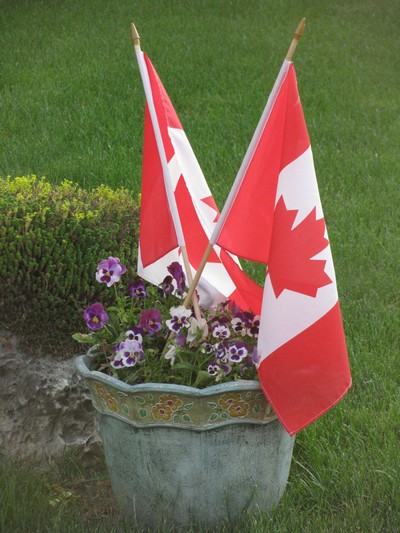
I meant she’s outside.

Which rather surprised me and it shouldn’t have. I’ve met her before, always outside—at the beach or the ravine or in the sunrise or sunset on Goose Hill (yes, it gets both, this magical place at the end of my street). She’s often on the streets and sidewalks that run through my neighbourhood and once I found her in a little patch of milkweed that’s easy to overlook.

But mostly she’s in the garden right outside the back door, among the weeds.

It’s with a hoe that I find her every time.

She speaks through fistfuls of creeping charlie and chickweed and pretty soon—no matter how daunting, no matter how much needs to be dealt with before it’s done and no matter that I won’t get it done today—just doing whatever I can, an hour’s worth, a half hour—makes an enormous difference to the whole thing, allows me to move around inside it a bit better, see it all that much more clearly.

Less chickweed, more clarity.

It never fails.

And she is never not there.

Yet, fool that I am, I forget… and wait for her at my desk.

Where do you find yours?

one thing

They will have you believe the only way is in numbers.
And they will count on you believing the numbers will never be in your favour.
That there will never be enough of ‘you’.
They will let you believe that ‘they’ have power—governments, corporations.
And of course, they have.
But not without us.
Not without you.

They will not encourage you to believe the power of one person.
They will not ask you: what is the one thing you could do differently?
Not once but always, one thing that you can do differently forever.
That if you did it forever, it would change one sliver of the world.

They won’t ask, I guarantee it.

Because you might answer; it might cause you to think.
You might say: I will only buy local apples in the month of October.
Or, I will buy fewer books this year but all of them from an indie book store.
Or you might say you will turn off the tap as you brush your teeth.
Or find a better place to buy your coffee, your lunch, your shoes.
You might choose as your one thing to write a letter a month to an MP.
Or a letter a year.
Or walk from here to there instead of drive.
Or pick up a piece of litter every Friday afternoon.

They won’t ask.
But you can ask yourself.

What is the one thing you can do differently?

You can do as many things as you like of course.

But this is just about doing one.
Big or small.
Just choosing it.
And doing it.

That’s all.
There’s no rally, no meeting, no placards.
No marching.
No club dues or posters.
Well, maybe posters.

All of that has its place.
But not in this game.
It’s private, this.

Be prepared; they will laugh.
Say things like ‘frivolous’ and ‘inconsequential’.
Words of fear.

They will point out that they’re winning.
Will hope you see it that way too.
Will hope you feel small and give up.

They will never, ever tell you the truth about the tiniest actions.
How they have immense power when they’re consistent.
And they will pray you never believe it’s true.

So this is my proposition: a movement of One Things.
One person at a time.
Changing just one thing you do.
Just one thing.

You can tell the world what it is.
Or you can tell no one.
It’s harder to tell no one.
Harder to just keep doing it.

The difference is in the action.
And the action will be felt.

Millions of people doing one thing differently.
A hard target for ‘them’ to attack.
Millions of individuals.
Silently changing the world.

sounds of summer

Gulls. Always gulls.
Then something else, a party of black birds, a celebration.
Ten thousand voices in the reeds.

The sound of roses.

—Wilting in the heat, the kerplunk of falling petals almost lost against the din of all that invisible black bird revelry.

Seaweed drying.
It sounds like this: schwimfftmtzwuft
You have to lean over to hear it.

The splash of a dog named Winston belly-flopping into the drink.

The slosh of my feet and the surf blocks voices of walkers, strollers, the breath of joggers, a herd of cyclists and a grown man working out on the monkey bars.

But a woman comes through loud and clear, warns of dog poop ahead.
“Somebody let their dog just poop, poop, poop…”

The skip of a stone.

Scrunch of pebbles.

Me cursing the mentality that appreciates beauty enough to come here, then spits in its face.

But no one warns of litter ahead…

Inhale.

Exhale.

we had to make them beautiful

“For me, feminism is not a theory, but a way of living one’s day-to-day life, its origins made up of incidents and observations stitched together. Some of them remain such odd shapes it’s difficult to make them fit, these old scraps of cloth that I recognize, that I wore with shame or joy. Above my desk I’ve taped a quotation that circulated around women’s groups a decade ago. Attributed simply to ‘a pioneer woman’, it reads: “We had to make the quilts fast so the children wouldn’t freeze. We had to make them beautiful so our hearts wouldn’t break.””

from ‘Piecing Together a Childhood’, by Lorna Crozier, in the anthology Click: Becoming Feminists, edited by Lynn Crosbie) (Macfarlane, Walter & Ross, 1997)