My reading usually goes something like this:
See/hear about some new title and check library to see if they have it. If yes, then I put it on hold. If I fall in love with it after reading library copy I will order from bookshop. If not available at library but looks REALLY good, I will order from bookshop directly and hope to fall in love.
A good system but one can only read so many books so what happens is that the books who live on my shelves (or stacks on my floor) (including those from bookshop) get read last because all those books on hold come swooping in continually from the library.
Except during a pandemic when the library is closed.
One of the joys during this time of isolation has been the luxury (i.e. no other choice) of reading my own shelves. Some of which has included time with old favourites but the most fun has been had in reading books whose spines I’ve stared at for years but for whatever reason haven’t taken off the shelf.
A sampling mixture follows:
 The Road Past Altamont is possibly my favourite recent long-on-the-shelves discovery. What absolute joy to be embraced for a few days by Gabrielle Roy’s gorgeous sentences evoking landscape in and around Manitoba, including Lake Winnipeg and the eponymous Altamont, which reminds one of the characters of her childhood home in Quebec and which serves as a metaphor for how everything is connected and how knowing that changes our perspective on, if not everything, then much.
In the preface to City Poems, by Joe  Fiorito, A.F. Moritz describes the poems as “very short, shooting stars”. I like how the image ties these ultra urban scenes to something from the natural world, a subtle reminder that even in the darkest corners of street life, life IS nature. Human or otherwise. Fiorito is a pro at noticing the life that goes on in an environment where so much and so many are ignored. ‘Blink’ and the moment, the star, is gone.
The Hearing Trumpet by Leonora Carrington is a mad romp in the company of a perfectly (enviably) eccentric ninety-two year old woman in a nursing home who eavesdrops and offers straight-up thoughts about the world and the people in it, which sounds simplistic and it’s possible to read it that way, but it also veers heavily 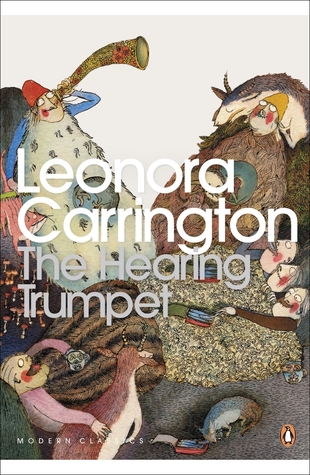 into a tongue in cheek surrealism of commentary on age, gender, family, animal rights, as well as offering a loose blueprint for changes to the current sad state of earthly affairs via starting over on another planet “… peopled with cats, werewolves, bees, and goats. We all fervently hope that this will be an improvement on humanity …”
Sheila Burnford is best known for writing The Incredible Journey in 1961, which was later Disneyfied in a movie. I haven’t read that book but will put it on my list because this is now An Author I Like based on The Fields at Noon which I’ve had on my shelves for who knows how long. An  absolute joy for its themes of outdoorsy pursuits such as mushroom hunting and walking and toads and general love of nature. I also like that Burnford, who (from her author pic) looks every bit a housefrau of the 1960’s but comes off as someone who would absolutely rather have a beer on the porch than vacuum.
The Very Marrow of Our Bones, by Christine Higdon, is one I like to re-read for the pleasure of the characters. Don’t you just love a book where you enjoy being the in the company of fictitious folk, where when you put the book down you hope they don’t get up to anything until you come back even though you 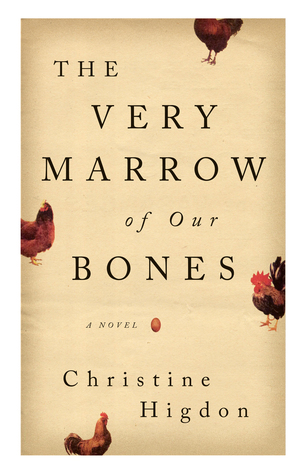 already know what happens. In a nutshell, and without giving too much away, the story is about a small community where two women have disappeared. But it’s not what you think. It’s not about the mystery, it’s about relationships and family, how they are forged, what they are based on and how (and why) they develop and how they evolve or de-evolve. Told in two alternating voices: Lulu, who grows up in the community, leaves and then returns. And Doris, who never leaves. There are roosters, beehives, greenhouses and gardens, barns and ponds, donkeys, a goat, an Airstream trailer, home preserves and foraging and among all this honest (never sentimental) beauty, there’s sadness too, and the contrast of life on the road as a musician and singer… and the sense of something that feels like a slow unravelling of darkness, but you’re never quite sure.
A few years ago Saskatchewan poet and naturalist Brenda Schmidt put out a call for  culvert memories and experiences, explaining that she was working on a new series of poems that would incorporate selected comments within the collection. Published in 2018, Culverts Beneath the Narrow Road is now that collection, poetry and prose that feels like a collaborative Paean to the large round silver objects that transport the lifeblood of water across the country and which are mostly never thought about. Each piece is prefaced by an italicized line, a contribution from an anonymous someone (contributors are listed in the introduction but are not linked to their specific memories, which creates fabulous and mysterious connections in itself) and which has Schmidt tapping into her own memories and experiences from various and surprising portals. I love work that inspires story through unexpected means. Schmidt has done that beautifully.
How to Catch a Mole, by Marc Hamer, warns the reader that by the end of the book they will know more than they ever thought possible about moles. And he’s right. And it almost put me off reading the book because  why would I want to know about moles? Well. Turns out that mole catching is a pretty interesting metaphor for life. But isn’t it cruel? Yes. And no. Like life. The book is a sort of casual memoir about this mole-catching-career slice of Hamer’s life, which had unhappy beginnings and which saw him homeless for many years. He made some money initially as an itinerant gardener, which turned to professional mole-catching, which in the UK is/was apparently A Big Thing. Also, there is a WAY of doing it that’s ethical, which I found hard to believe but by the time I’d finished this very slim volume of a book I saw the other side of what appears to be cruel and unnecessary work. Surprisingly, it’s not a book that makes you squirm. On the contrary, it’s filled with honesty and sensitivity. Not just about moles, but life. It’s really about life. Excellent.
All Roads Lead to Wells. I read a review about this a few years ago and it appealed to me because it’s the true account of a hippie community that moved into the teensy tiny town of Wells, BC in the late 60’s and 70’s and stayed off and on throughout the 90’s. One of the original members stayed forever and is now a member of the town council. Another, Susan Safyan, is the author of the book. Safyan’s own memories as well as those of many  former hippies tell a great story about A Time. A time which really isn’t that different from This Time, when youth believes it alone can change the world. Then it was through returning to the land and forming a counter-culture by living simply, eschewing the establishment, and ‘not trusting anyone over 30’. Much of how they lived was admirable, much was questionable in terms of hypocrisy… some accepted pogey for instance. And they didn’t change the world exactly as they’d hoped, in fact many/most grew up to realize the difficulty of washing diapers by hand in cold water fetched from a stream beside your tumbling down shack and eventually sold out and accepted the gift of Pampers. But the hippies did make changes to the world, if not in diapers, they were instrumental in starting the organic and ethical food movement. Among a few other things. Lots of pictures and conversational material in the pages. A slice of history worth having.
 Beth Powning’s Seeds of Another Summer about her move to the countryside many years ago. Full of gorgeous photos and a shoulder-dropping, deep breath inducing narrative of someone who misses nothing.
On a similar note, but entirely different, Catherine Owen’s Seeing Lessons about Mattie Gunterman,  an 18th century “photographer and mining camp cookhouse worker”, written in poems and poetic prose about not only the times she lived but also the power of seeing and being able to retain something of what is seen.
♦
The next batch stacked and ready:
Land to Light On, by Dionne Brand (because I love how she writes about the/her Canadian experience)
The Cat, by Marie-Louise von Franz (because it’s a tale of feminine redemption and because she was great pals with Carl Jung, so should be interesting)
Structures of Indifference, by Mary Jane Logan McCallum and Adelle Perry (because it examines one life, and death, which begins with the 34 hours an Indigenous man spent in a Winnipeg emergency room before dying, unseen and untreated)
A 1987 copy of the journal Fireweed, the ‘Class’ issue, because I think it will be interesting and because Kate Braid is one of the contributors and her bio reads that she is a “carpenter living in Vancouver who writes her poems on lunch breaks and at STOP signs”.
Autobiography of an Elderly Woman, published in 1911 under no author’s name but research shows that it was written by Mary Heaton Vorse, a 37 year old Greenwich Village bohemian, journalist, and editor, who wrote it in the voice of her mother, and which (in 1911) has lines like this: “Each generation permits a different type of young girl, but the older woman must not change; her outline is fixed and immovable. She must be like [anyone’s] grandmother, ‘always there’.”
Portraits of Earth, by Freeman Patterson, a book of extraordinary photographs and contemplation on things like icebergs, leaves, wet sand, sky, air, forests, fish, water, driftwood… and how we mere mortals fit in. Or might if we tried.
Birds, Art, Life, by Kyo Maclear (a re-read because more beauty).
Virginia Woolf’s To the Lighthouse, because I never have.

 Matilda Magtree