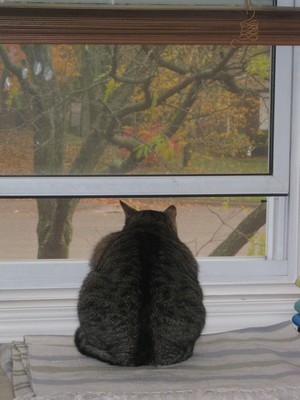
let it rain, let it rain, let it rain

I’m happily ensconced with my new purchases…

To complement each year’s subscriptions (which change annually) I find myself occasionally at the local Chapters perusing their sometimes good, sometimes poor, selection of magazines and journals. (For the record: the only things I buy there are magazines and journals; I buy my candles and sofa throws elsewhere…) Anyway, on a recent visit I was actually somewhat (pleasantly) surprised with the selection. I hope this bodes well, as in maybe more people are discovering the myriad joys within these little treasures??

So here’s what I chose and why:

Arc, because, as Anita Lahey states in the Editor’s Note: “…this is the most colourful, visually rich issue ever to have been produced in the lifetime of this modest, non-profit magazine.”

And because, among many other lovely things, there’s a Conversation with Anne Simpson, who marries poetry and art so very beautifully.

CNQ, which I didn’t even notice was the Spring/Summer issue but who cares because, more importantly—it’s the Short Story Issue. I’m especially looking forward to a piece by Douglas Glover, whose writing I so enjoy, on Alice Munro.

And Granta, whose theme is ‘Pakistan’, and because of this:

Life and Time

We grow up
but do not comprehend life.
We think life is just the passing of time.
The fact is,
life is one thing,
and time something else.
—Hasina Gul

Seems only right in the face of all this anticipated pleasure to say thank you to those who not only publish these works of art in a climate that isn’t exactly welcoming, but do so with heart and passion. 

It shows.

~

bird season

Come October I begin putting out seed for the birds (and the squirrels—and no, I don’t get involved in turf wars; they seem to work it out well amongst themselves—and anyway, I like squirrels).

I used to do special mixes to attract certain birds but a lot of those had some amount of millet which sprouted in Spring and I don’t like grass and it grew in great thick patches—so, out with the millet. Now I serve only the black sunflower seeds which a good vareity of birds enjoy, including the millet loving doves, who simply wait for the sunflower seed crumbs other birds leave behind.

Am feeling more birdy than usual this year because, thanks to info from a birder, poet, artist, bookish Leafs fan, I have happily discovered Bird Studies Canada and have signed up to make note of birds in my backyard this winter. AND, even more exciting, I’m giving a Bird Studies Canada Xmas Bird Count Kit to everyone in my family with kidlets, so they can document the avian visitors to their own backyards over the Xmas hols.

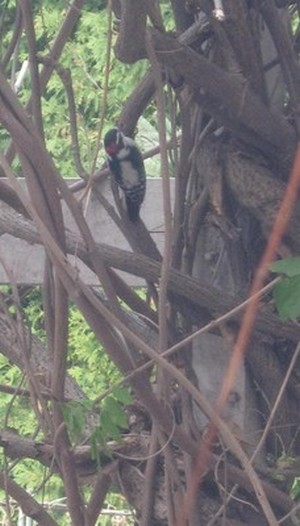
Unfortunately this chap arrived several days before my tabulations begin…

'sort of' red-headed woodpecker?? as seen through the kitchen window

Maybe he/she will come back and be counted. And identified.

~

once upon a morning

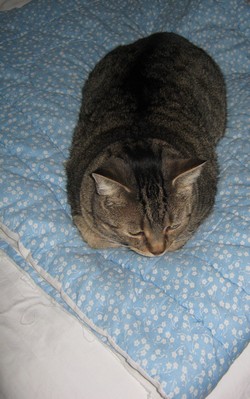
Once upon a morning (yesterday to be precise) I couldn’t find Jake the Cat. He’s not known to be elusive at breakfast time. Something was wrong.

I ran, not walked, all over the house, upstairs, downstairs, checking behind every closed door, every closet, cupboard, expecting to see his little oxygen starved body curled beside a note scratched into a baseboard: I give up, help obviously isn’t coming… p.s. do NOT give Cuddles my bowl

At this point Peter joined the search, shaving cream still on his face. He did a re-check of the basement while I did yet another circuit of the main floor.

Then I found him.

I called down to Peter. “I found him!”

“And??” He sounded cranky. As if I found him wasn’t quite enough info.

“He’s okay, he’s hunting something.”

We watched Jake pace around a basketful of fresh firewood and then, figuring whatever it was must be under there, we lifted it. As I ran out of the room I caught a glimpse of something running the other way.

Watching from the front hall through the glass of a closed door I saw Jake chase a mouse across the room and corner it near the kitchen where he then sat with his little cat arms crossed as if to say: think you’re smart doncha…what’s the big plan now, sucker?

You could tell that awful cat and mouse game was about to begin, where, instead of receiving a fast and clean, humane kill, the mouse gets batted and tossed and nipped and eventually has a heart attack while bleeding from the head. Which, by the way, Desmond Morris in Cat Watching tells me happens not because the cat is sadistic but because it’s not particularly sure of itself—so it’s essentially testing the waters. Either that or it isn’t all that hungry, in which case the hunt and kill instinct doesn’t click in but stays on permanent ‘hunt’ instead. This is the behaviour, in other words, of domestic rather than feral cats.  

The mouse, at this point, was hunkered down, head low, trying to be inconspicuous I guess, hoping maybe to not look like such a scrumptious morsel.

Nice try, mouse.

After some serious staring and tail twitching, and before Peter could intervene, Jake grabbed Mouse and carried him across the room, set him down, presumably to begin the pummelling—at which point Mouse keeled over onto its side, little legs pointing east.

I turned my head as Peter scooped him with a yoghurt container and took him outside. Meanwhile Jake, who loves and trusts us and would never dream we’d take away his mouse, assumed the thing had escaped and continued to look for it. Like Desmond Morris said, there’s a difference between feral and domestic kitties…

I went back in to console and thank Jake. He seemed so tired, must have been stalking the thing all night, for which I’m still very grateful. Only doing what he’s meant to do. Even so, more than a slight pall hung over things what with the demise of poor Mouse who was also only doing what he was meant to do.

And that would normally be that, except you can’t have a Once Upon a Morning story without a Happy Ending…so, yes, there’s more.

There’s Jake’s version of ‘happy’, where he got extra portions of treats for being a good mouse catcher—and then there’s everyone else’s, which is that the mouse was only playing dead. Peter said that when he went to scoop it, the little varmint got back to its feet and tried to run away and that when he let it go outside, Mouse let out a long, grateful sigh and headed, smiling, and at lightning rodent speed, toward the cedar hedge.

The End.

—Happy?

Recuperating

“I don’t get it—it was there one minute, and then…”

~

one tin soldier

Each morning I visit the nursing home where my mother now lives. I help her dress and give her breakfast. I always leave by 10 a.m. But this morning, Remembrance Day, when we walk to the common room for a bit of exercise, the chairs, each with a photocopy of ‘O Canada’ on its seat, are lined up in rows facing a podium. There’s a large screen at the front and poppies everywhere.

I consider staying the extra hour or so but Phyllis isn’t interested in ceremonies. Me neither. I prefer observing my own two minutes of silence, alone and in my own way. We find a sunny spot at the back of the room, and I read Barbara Kingsolver’s piece about water in the National Geographic while Phyllis sleeps in the chair beside me.

It’s nine thirty. I’ll take her back to her room at quarter to ten.

But at twenty to ten they start arriving.

Soon there’s a row of four men and one woman seated beside the podium, facing the rows of chairs. “Residents who served” I overhear someone say. One, in a wheelchair, sleeps with his head back and mouth wide open. The woman sits quietly confused with her ankles crossed, and a happy man with a British dialect tells everyone who passes “you’re wonderful”, and to the man with dementia beside him who’s beginning to nod off and fall sideways, the happy man says Are you alright, Tom?

Someone straightens Tom out and asks what it was he did during the war but Tom just looks straight ahead. The happy guy says: What we all did… sink or swim.

More residents are wheeled in. A few come with aluminum walkers or a nurse. None come unassisted. The room is filling up with bodies and sounds. Phlemgy coughs, orphaned words, mumbles. The woman who yells all day I want to go home, somebody help me, what am I going to do? arrives, pushed in her wheelchair by a nurse and placed at the front of the room. Where am I? Where are you taking me? she yells. She has terrible teeth and long thin hair. I’ve never seen her family; she may be one of the many abandoned to the system, completely dependent on the mood of staff and Ministry guidelines, at the mercy of Long Term Care politics and rubbery cream of wheat.

‘One Tin Soldier’ plays in the background. By The Original Caste. I remember being young and hearing it for the first time and not really understanding what it was about. Listening to it now, surrounded by so many drooling tin soldiers of yore, it takes on even deeper meaning and I realize I’m staying for the ceremony.

I stay for these men and women who did, and others who continue to do, in a mad world because it’s, sadly, still the only way any of us knows to say thank you. I stay because we’re all a product of our past and because we’re all connected whether we like it or not.

I stay for my dad whose only comments about the war had to do with unexpected kindnesses from all sides. He didn’t speak of heroics.

The German man down the hall from Phyllis is brought in to sit with former enemies, which makes me wonder at the word ‘enemy’. Circumstantial at best. They all sit quietly confused together now, eating the same gruel, wondering perhaps what it was all about anyway.

Oh, yes. A madman. There’s always a madman.

Tom keeps falling over so his son moves him off to the side where he can keep him upright. He’s brought his dad’s beret and medals and pins them on a slightly stained beige pullover. The son takes pictures of Tom, asks Tom to salute. Tom just stares straight ahead.

It would be easy to leave. Wake Phyllis and go. I don’t want to hear ‘In Flanders Fields’ and cry with strangers. But I stay because it’s such an honour to sit in among the muddle of their confusion, their dignity and continued bravery in this forgotten place of forgotten people where the beauty of old age is seen as ugliness, as something to pity.

During the ceremony I watch a daughter put a pink sweatered arm around her mother, pull her close and kiss her face. Another daughter is her mother, thirty or forty years earlier, so striking is the resemblance. A man in a motorized wheelchair wipes his eyes with a facecloth, says it bugs him that he can’t stand up to pay his respects. The happy man occasionally blurts out: Too much talking, too much talking and he’s right of course; there’s always too much talking. I notice his breathing is difficult, like my dad’s the year he died.

I notice the woman who yells all day is quiet.

And when eleven o’clock comes the whole room is suddenly hushed except for the sleeping veteran who snores loudly beside the podium and the happy man who says Hallelujah. But the muttering and coughing and shuffling stop. It’s like these people, who aren’t sure of much, can still sense what’s important. Maybe that’s what makes us human.

As the ‘The Last Post’ is played, and while I blow my nose, Phyllis wakes, looks at the rows of silent backs in front of us and says: Wow, it must be a good movie.

The ‘residents who served’ are recognized and the anthem is sung and then later a video clip is shown, based on a true story about a guy in a Shoppers Drug Mart who was outraged that the store observed two minutes of silence, causing him to wait—two minutes—to pay for his purchases.

The happy man is again saying Too much talking, too much talking, and when the video and the ceremony end, and we’re thanked for being there and all is done, the happy man, breathing hard in his veterans’ seat, says: Peace at last, peace at last.

On our way out, I stop and ask Tom’s son if I might shake his dad’s hand. He beams, says Sure! and explains to Tom what I want. Tom in his beret and strip of medals pinned to his sloppy sweater, stares back, silent. His son helps him extend a hand. It feels soft and weak, the kind of hand that hasn’t worked in years except maybe to scratch an ear, adjust a bib at lunch. I hope that on some level he might still understand what a handshake is. And even if he doesn’t, I do.

I try to find something in his eyes to connect with but they stare in a kind of trance; I wonder what they’ve seen and whether I’d have the stomach for knowing.

Thank you, sir, I say, and Tom’s son tells him: Say you’re welcome, dad!

And ever so quietly, Tom does.
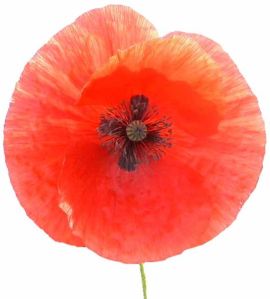
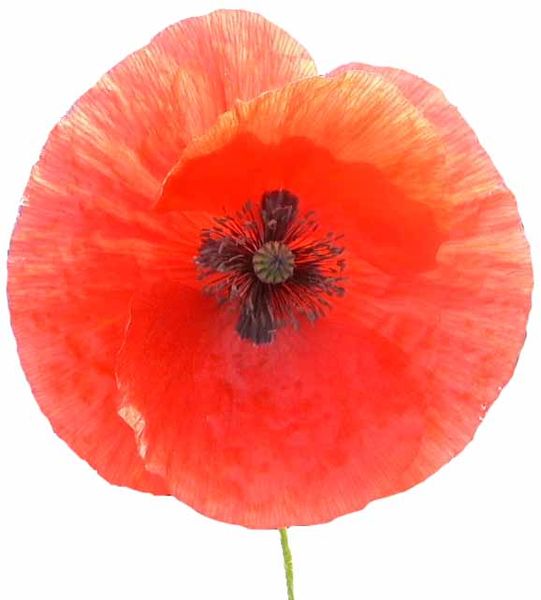
541px-Poppy-closeup

questions

“Questions, doubt, ambiguity, and dissent
have somehow become very unmasculine.
Authoritarian maniacs are
premiers, czars, and presidents.
Each one is more righteous than the next.
Each town they bomb
each human they kill
is done for ‘humanitarian’ purposes.

“People don’t own the water in their own village
and they certainly don’t own the diamonds and gold.
Millions are forced to make dinner out of garbage and dust
while Russian businessmen and movie stars
are buying 500-million-euro villas on Cote Sud.

“Bees have stopped making honey.
People are drilling in all the wrong places.
The U.S., Russia, Canada, Denmark, and Norway all claim the Arctic
but none of them seem to care that the polar bears are drowning.

“They are fingerprinting, photographing our licenses and teeth.
Big Brother is now in our phones, our pods, our PCs.
Not one of us feels even a little safer.
New Age mental health providers turn
out to be former war torturers with beards.
And the pope in a dress showing off his
ermine trim and cuffs
is telling everyone that
people kissing people they love is the greatest evil.
A woman running for U.S. vice president
believes in creationism
but not global warming.

“Why is everyone so much more afraid of sex
than SCUD missiles?
And who decided God wasn’t into pleasure?
And if the hetero nuclear family is so great
how come everyone is fleeing it
or paying their life savings just
to sit in a room with a stranger and cry about it?

“The Iraq war cost nearly $3 trillion.
I can’t even count that high
but I know
that money could have
would have
ended poverty in general
which would have cancelled terrorism.
How come we have money to kill
but no money to feed or heal?
How come we have money to destroy
but no money for art and schools?”

—from I Am An Emotional Creature, by Eve Ensler

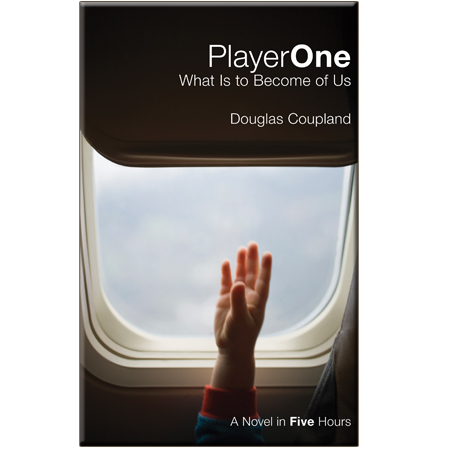
this is not a review: player one, by douglas coupland

The Massey Lectures begin broadcasting today.

I’m curious to see how they come across, given that this year they take the form, not of essays, but of Douglas Coupland’s novel, Player One, in five parts.

The book is, essentially, about disconnection in a wired world.

I heard Coupland read briefly a few weeks ago in a fairly intimate setting (an event hosted by one of my favourite booksellers) and to be honest, I think the ‘lectures’ may be more than a little hard to follow… if only because it’s difficult to get into any kind of listening groove. One minute you’re hearing the narrative of a novel, you’re hearing dialogue, expecting plot and character development, action and reaction—but what happens instead is that the dialogue has suddenly morphed into a mini essay.

And not in a way that works to any kind of advantate in the context of the book. In fact, it’s almost like the book is merely a vehicle for the author’s personal thoughts, theories and musings—which are vast and clever and endlessly discussable—but they are clearly his, not the characters’. That’s the other thing—every character has the same basic view of life. Hard enough to tell them apart as I read the book at my own pace—I can’t imagine listening to the lecture series and being able to keep track of who is who. There are few distinctions.

Not that it matters much. It’s the philosophy, the big questions posed, the commentary on humanity’s impending doom that’s the point.

All of which is good stuff. Especially in Coupland’s hands. But why write a book of clever theories posing as a ‘novel’?  Why not go non-fiction? Or, here’s an idea: a book of five essays.

I thought maybe I was missing the symbolism, that the sameness of characters, their flatness and non-reaction to the world ending outside their window, was to suggest that increasing ‘disconnection in a wired world’. But really, if that’s it, it still doesn’t work as a novel. It’s a book of possibilities and deep reflection, but unfortunately mired in a storyline that exists only enough to intrude, and with one-dimensional characters who constantly say things like this:

“Karen, tell me, what is the you of you? Where do you begin and end? This you thing—is it an invisible silk woven from your memories? Is it a spirit? Is it electric? What exactly is it? Does it know that there exists a light within us all—a light brighter than the sun, a light inside the mind? Does the real Karen know that, when we sleep at night, when we walk across a field and see a tree full of sleeping birds, when we tell small lies to our friends, when we make love, we are performing acts of surgery on our souls? All this damage and healing and shock that happens inside of us, the result of which is unfathomable. But imagine if you could see the light, the souls inside everybody you see—at Loblaws, on the dog-walking path, at the library —all those souls, bright lights, blinding you, perhaps. But they are there.

Great writing. And I like what he’s stirring up, but as dialogue throughout it does not a great novel make. The characters simply haven’t earned that level of wisdom. 

Having said that, can the record please show that it’s not overly philosophic, theorizing characters I object to. On the contrary. If done well a strong philosophic bent is a beautiful thing—in a context that delivers, rather than fights with itself. 

And god knows I’m not criticizing the brilliance of Mr. Coupland’s mind, a writer whose work I respect and enjoy very much. Just questioning why he felt it necessary to take material that would so perfectly suit five brilliant Couplandesque essays—that might have actually had us thinking in new ways—and isn’t that what the Lectures are all about?—and clutter it instead with undeveloped characters and a rather ineffectual storyline. Was it just to be different? Because (thankfully) he’s already different. He doesn’t have to try.

Then again, maybe it’s just me. Maybe I read it at the wrong time, in the wrong circumstances. Maybe I should have had less tea or more wine. Or vice versa. And maybe no one else will find the packaging of Player One’s  weak story a distraction from what could be a powerful and important message.  

~

jj cale vs the beatles vs the bellows

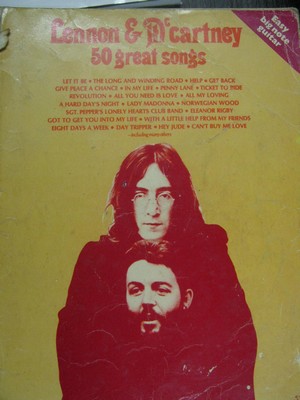
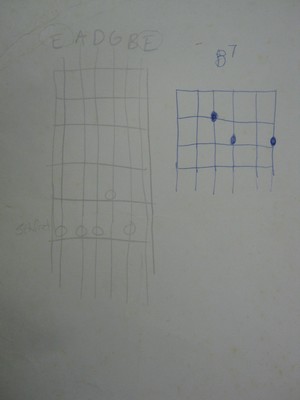
Recently found this old music book from when I took guitar lessons in the back room of a vacuum cleaner repair shop at Avenue Road and Lawrence ten thousand years ago.

My instructor, who was into JJ Cale, said Bah to the Beatles! This was scribbled on the inside  cover.

After a series of I can’t remember how many lessons, the only thing I could play was a version of ‘With a Little Help from my Friends’, with hints of ‘Magnolia’, ‘After Midnight’, and ‘Cocaine’.

I don’t blame my instructor.
I’m an accordionist at heart.

~

you rang?

A new cat has moved into the neighbourhood. No idea where it lives, but it does sport a responsible birds-beware bell which Jake can hear from two storeys up, across the street and 50 metres away, and while in the midst of a snoring-deep, tummy-pointed-to-the-ceiling, chirping-in-his-dreams kind of nap.

Before I even hear what amounts to a faint and distant tinkle—and I’m sitting right beside the window—he’s leapt into serious Not that bloody cat again! mode, shot past me and has his nose pressed up against the screen, sending out Stay off my driveway if you know what’s good for you, bucko vibes.

Or maybe he’s just admiring the bling?

~