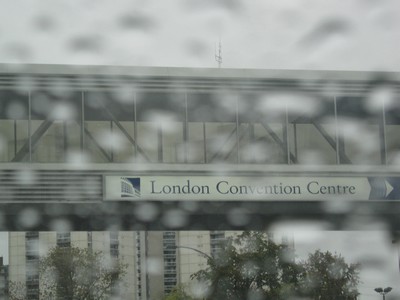
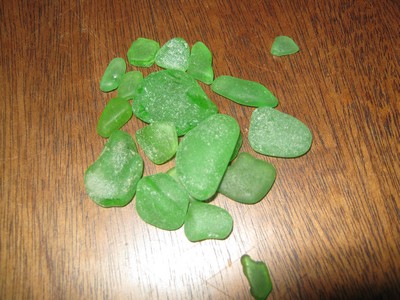
london things

My version of this but Ontario.

Okay, this is not anything like that.  


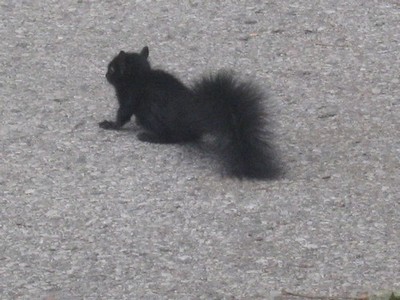
Possibly the world’s smallest squirrel. Hard to tell from this, I know. In fact a guy on the street said when I was taking the picture: You’ll never be able to tell how small it is from a picture, you need context. Fine. Imagine a penny beside it.


Cats playing in the road. Yes… those cats.


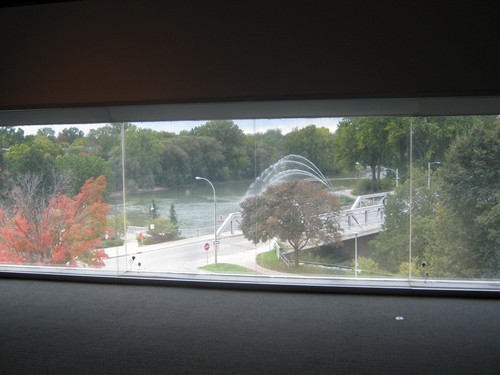
Thames River as seen from inside Museum London.


Red sky. At night.


Rain on windshield.


Rainbow over hydrangeas.

~

diary of a room (with a view, a pen, and a book)

—Writing from a garret in London, Ontario. 

8a.m.— Gorgeous golden day. Huge trees outside the window. Blue boxes line the street. Yesterday when I arrived, I shoved two arm-less arm chairs together to make a sort of chaise lounge in the 3rd floor bay window alcove, then wrote like mad. It’s quiet here, the only sound an occasional car, glass and tin cans being dumped, and there’s very good food in the restaurant downstairs (I recommend the mixed greens with dried cranberry and pistachio, and goat cheese/yoghurt dressing), a porch also for contemplating, which I did some of after lunch. Mostly on the colour grey. Surprising results.

Today I’m devoting time to reading Emma Donoghue’s  Room, which I brought with me not knowing that Ms. Donoghue lives in London, Ontario. Possibly in a garret?? It doesn’t say on the  jacket.  Anyway, I found that a strangely lovely coincidence.

So because I’m out of my usual routine, and am using a keyboard that is driving me slightly bonkers, I decided that instead of trying to write one coherent post I’ll write several small incoherent ones throughout the day—a sort of real time account of reading progress and life in the garret generally.

Have only just begun the book and, although the rhythm takes a minute to get used to, I’m thoroughly enjoying the narration by a five year old as he introduces us to his world and to his mother.

“I still don’t tell her about the web. It’s weird to have something that’s mine-not-Ma’s. Everything else is both of ours. I guess my body is mine and the ideas that happen in my head. But my cells are made out of her cells so I’m kind of hers. Also when I tell her what I’m thinking and she tells me what she’s thinking, our each ideas jump into our other’s head, like colouring blue crayon on top of yellow that makes green.” (—from p.10 of Room)

While this perhaps should leave me doubting that a five year old can put things into terms that involve cells, it doesn’t— it just leaves me looking forward to finding out how he can.

“Bunnies are TV, carrots are real…” (p.17, Room)

9:15 a.m.— A man walking three dogs on three leads passes a woman walking two children on two leads. Honest to god.

11 a.m.— On the street opposite my window a black cat and an orange cat have been playing together for hours. They cross the road together, jump on stone walls together, stand around the sidewalk, then run off and disappear for a while, together, then reappear, at first just the black and then seconds later, the orange. Seems there’s never one without the other. It’s a very nice little vibe watching them. When do you see anyone, kids even, so consistently, without argument, for this long, enjoy each other’s company? Must take a walk later, have a closer look, maybe say hello.

1:30 p.m.— Smoothed out some wrinkles in the final chapters of the WIP. Celebrated with perfectly cooked Arctic char in mustard and cider reduction, and arugula salad. Am enjoying this garret life.

2:30p.m.— For Jack, the boy narrator of Room, having a grasp of what cells are is the least of his accomplishments (see 8a.m. entry). He’s a little genius who, literally, lives in a world ofhis own making and with the help of his twenty-six year old mother, who’s spent the past seven years living in the trumped-up and sound-proofed garden shed of her abductor, Old Nick. Because of her, Jack has a better grasp of reality, however unreal, than most people. She has, it seems, taken enormous strength from the need to protect and nurture and teach him, in turn, to be strong. Together they’ve invented dozens of games using ordinary objects or just their senses and words. They have rituals and traditions and rhythms to their days. He trusts her completely and is shocked and frightened when he learns that she’s hidden some chocolate to keep as a surprise for his birthday. If there are “hidey places”, he thinks, then there are places for vampires and bogey men. In such a confined space that would be a very bad thing indeed. Secrets are equally not tolerated.

Because he was born in the room (a stain on the carpet marks the spot), and has seen nothing else (other than TV, which he believes is a two-dimensional ‘unreal’ place) this tiny universe makes perfect sense to him. His mother, on the other hand, is becoming increasingly unhappy, concerned that Old Nick will eventually leave them to die, and begins to tell Jack about the ‘real’ world, about her parents and her life as a child. At this point I’m not sure if she’s doing it as a gift to him, some new exciting thought to fill his mind, or a way of consoling her own grieving self.  

“Stories are a different kind of true.” (p.71, Room)

5:45p.m. A few weeks ago there was some flap about how writing in the present tense was a cheap trick employed by three of the six Man Booker finalists, of which Room is one. It struck me as an absurd discussion at the time, even moreso now that I’m reading Room. The reason—for Philip Pullman’s and Philip Hensher’s information—that Room is written in the present tense is because if it were written any other way it wouldn’t have the same brilliantly creepy effect of drawing us into that place in real time, which is a place we don’t want to go but can’t stop peering into. Perhaps I’m in the minority but I enjoy first person, present. Like anything, it has to be done well, and unlike some possibly ‘easier’ POVs, it’s very hard to do well. I’m guessing Donoghue chose it for a few reasons: 1) the story itself demanded that form, 2) the feeling of being there in ‘real time’ works exceedingly well in unsettling the reader, and 3) there is something almost subliminal about present tense, a kind of tacit reminder that what you are reading did not happen then… but is happening still. And for this book, that’s exactly what you need to feel. For many reasons.

6:15p.m.  The orange cat is across the street; I run over expecting to find the black one nearby, maybe capture their extraordinary relationship on film. But the orange is on his own (orange tabbys are always boys). Where’s your friend? I say, and he rubs against my leg, looks up at me and purrs What friend? 

So much for my brilliant cat loyalty theory.

10:30p.m. At about the exact middle of Room the thing I expected to happen at the end happens, and I’m left stunned and thinking: how the bleep will the author sustain the next 150 pages?? Well, sir, she does in the most surprising and amazing way, turning our perceptions about ‘freedom’ upside down and having us look at ourselves in the process. And I don’t care if you hold your breath, gnash your teeth or utter vile words, I will not divulge even one more tiny piece of the story, except to say I loved it so very very much—one of those books that begs to be read again, not necessarily to understand better—because the story is simple and clear—but to benefit from its truth. 

~

just thinking…

Truman Capote, Rumi and my mother-in-law were all born today. Now there would be an interesting dinner party.

Happy birthday, MCO.

“A conversation is a dialogue, not a monologue. That’s why there are so few good conversations: due to scarcity, two intelligent talkers seldom meet. ” —Truman Capote

dear mr. postman

Dear Mr. Postman,

Can I tell you that when I see your merry little van driving about, or when (all too rarely) it stops in front of my house and from my window I see you walk to my front door and ring the bell or when if I’m not home you leave a package or a note saying to pick up a package at the nearest post office—can I just say that it’s a happy occasion. Always.

And while we’re at it I think you should know that I’m always slightly amazed that for a pittance my own packages are taken to wherever in the country I say. That for about fifty cents someone will deliver a letter to a friend in B.C. and for under a dollar I can enclose shells or pebbles or sand and send it to my niece for her fairy beach. Who else but you would do that??

I’d like you to know that in this ever more frenzied world I find the tempo of post office mail almost soothing and that I’m grateful to see you arrive in all weathers, cutting through the small space between the tall grasses and the quince bush with a fistful of envelopes. I don’t (usually) mind if the mail is late or takes a week to get to me from Mississauga. It’s actually refreshing (occasionally) to wait for things, to not feel the need to demand or expect and then be disappointed or angry when responses don’t come at once. It’s like postal zen.

Because, as much as I admit to googling, I’m really quite tired of instant everything. I like postcards and handmade cards and red wine stains on crumpled stationery. I like the smell of writing paper and sometimes of the writer. And I like how I can prop the card up on the kitchen table and look at it a hundred times a day. How I can hold the letter and feel close to the person who wrote it because I know that not long ago they held it too.

Oh, sure, sure, I like email and all the other ways of communicating (no, wait, that’s a lie; I don’t like all the other ways…) and they each have their own advantages of course, but none—none—delivers sand or Halloween candy or feather boas or lipstick kisses, but you.

(For the record, I do not like the lady at the new post office outlet in the Shoppers Drug Mart. She’s snarly and un-postal and I don’t think she truly ‘gets’ the industry she’s in. Plus she charges packet prices for envelopes that sail through that magic measuring slot thing. I know, it’s her tiny bit of power. Still.)

Anyway, Mr. Postman, I won’t rattle on. I really just wanted to say this: cheers.

Sincerely yours,

A Correspondent.

~

this is how it happens…

I’m in love with Nikolai Gogol. I say this based on one story in a recently purchased four by five inch book, published by Penguin in 1995—a Penguin 60s—part of Penguin’s 60th anniversary celebrations. The book contains two stories: ‘The Overcoat’ and ‘The Nose’. It was ‘The Overcoat’ I read Sunday morning. And it was then that I fell in love.

Here is a chap with a mighty sense of humour. And that’s always irresistible. Plus control and subtlety and things that really aren’t at all what they seem. The story centres around Akaky Akakievich, a titular councillor—essentially a lowly civil servant in early 19th century Russia—(a whole beautiful long riff is done on how he got his unfortunate name, which culminates in…”The child was christened and during the ceremony he burst into tears and made such a face it was plain that he knew there and then that he was fated to be a titular councillor.”)

In a nutshell, the piece is about a man who needs a new overcoat to survive the winter; he doesn’t ask for much in life and gets even less. But in his way, he’s happy. Though he lives an extremely simple life (the list of his possessions include two buttons that have fallen off some clothing) and has been a devoted employee to his ‘company’ for many years, he has to scrimp and practically starve to save money for the coat and then when he has it, it’s stolen. And no one cares. When he dies he returns as a ghost to steal the overcoats of others.

But of course that’s not what it’s about at all. It’s actually a brilliant political statement that (sadly) still resonates today…

Here is my favourite sentence—

“Even at that time of day when the light has completely faded from the grey St. Petersburg sky and the whole clerical brotherhood has eaten its fill, according to salary and palate; when everyone has rested from departmental pen-pushing and running around; when his own and everyone else’s absolutely indispensable labours have been forgotten–as well as all those other things that restless man sets himself to do of his own free will–sometimes even more than is really necessary; when the civil servant dashes off to enjoy his remaining hours of freedom as much as he can (one showing a more daring spirit by careering off to the theatre; another sauntering down the street to spend his time looking at cheap little hats in the shop windows; another going off to a party to waste his time flattering a pretty girl, the shining light of some small circle of civil servants; while another–and this happens more often than not–goes off to visit a friend from the office living on the third or second floor, in two small rooms with a hall and kitchen, and with some pretensions to fashion in the form of a lamp or some little trifle which has cost a great many sacrifices, refusals to invitations to dinner or country outings; in short, at that time of day when all the civil servants have dispersed to their friends’  little flats for a game of whist, sipping tea from glasses and nibbling little biscuits, drawing on their long pipes, and giving an account while dealing out the cards of the latest scandal which has wafted down from high society–a Russian can never resist stories; or when there is nothing new to talk about, bringing out once again the old anecdote about the Commandant who was told that the tail of the horse in Falconet’s statue of Peter the Great had been cut off; briefly, when everyone was doing his best to amuse himself, Akaky Akakievich did not abandon himself to any such pleasures.”  (—from ‘The Overcoat’ by Nikolai Gogol)

And this in 1842.

And you wonder why I’m in love?

~

the book that started it all

 
My family was not what you would call literary, or even an especially bookish lot. Oh, there were books in the house—some came free with special offers at the grocery store—that’s how we got our partial set of encyclopedia (it ended at EAR–FIS); others were from the Book of the Month Club, which I think my father signed up for to get the free ones then god only knows how many peculiar titles were delivered at full price for god only knows how long before he could figure out how to make it all stop. There were also a few stolen books, mostly from schools my sister went to though I think a few came home with me from the library, permanently. All of it unintentional—I swear.

And it’s not that my parents didn’t read. They did, in their own way. Apparently more when they were younger than when I knew them. My father, who could build anything, and loved the outdoors, once said his favourite book was Robinson Crusoe; my mother was the sewing, cooking, growing vegetables, hanging laundry outside kind of mother who read what she called ‘love stories’—books with pretty blonde heroines on the cover, petting horses in meadows while dark-haired men stood in the background looking confused and handsome.

In any case, ours was a pitiful collection to say the least, and you can probably guess there was no encouragement toward reading, yet I gravitated to it anyway and from a very young age read whatever I could find, the way one might read every dog-eared volume on a dusty plywood shelf while stranded in a cabin for a rainy week a million miles from anywhere. In other words, grateful for anything. Best part in cases like that: sometimes you find a gem or two in the debris.

My own possibly pilfered, possibly purchased copy.

One of the highlights on our shelves was A Girl of the Limberlost, by Gene Stratton-Porter, which is stamped with the name of a local school but has a price of $2.50 marked inside in pencil. So it may have been one of the few acquired legitimately.

I read it at about ten, eleven, twelve years old, I’m not sure, but I remember connecting immediately with Elnora Comstock who wore hand-me-down clothes and lived in the woods communing with nature when she wasn’t arguing with her mother. I didn’t live in the woods but I wanted to. I can still practically smell the spice cakes her mother packed in the bucket that carried Elnora’s lunch to school. And I remember how those cakes were one of the few but important signs of her mother’s otherwise unexpressed love. I’ll have to read it again to be sure but I don’t believe Stratton-Porter sentimentalized the mother’s role in any way, which to me was refreshing. A change from all those love stories cluttering up the house, the Cherry Ames, Student Nurse, and books where everybody was so bloody happy and the only problem was something outside the family—a ghost in the vestibule, a murder in the vicarage, etc.  Yeah, right.

It was, I suppose, my first character driven story, one that suggested interior journeys were possible in literature, that it wasn’t all about ‘the other’, meeting someone who changed your life after a series of predictable problems, or climbing the mountain, or solving the murder.

All this reflection, BTW, came as a result of stumbling across a short video at The Guardian. Before that, I hadn’t given ‘the first book’ much thought, nor its many and varied influences on me (too introspective to rattle on about). Maybe the sort of thing that requires a certain age and perspective in order to see it clearly. Anyway, it’s all got me thinking that it’s probably quite often, maybe even always, a book, rather than a person or even an environment, that nudges us around a corner of our early reading. That maybe the love of words is a nature rather than nurture affair, in our DNA, and it’s just a matter of time before we find that book that connects with an inherent understanding or curiosity about the world—and reflects it back to us. True, if we’re surrounded by people who bring us sacks of lovely things to read we may find it sooner, but even if we’ve got nothing but a dusty shelf in a cabin, I’m convinced we will find it.

And then off we go. Never to be the same again. And more ourselves than ever.

Funny how stuff begets stuff.

So, latest dinner party question: what was the first book that made you think differently about books?

~

today’s colour

I wasn’t going to do another colour so soon but it’s the last day of summer and wandering about the garden just now, in that beautiful early evening light—the yellows just stood up and shouted to be noticed. Everything seems suddenly golden in a way that’s not yet Fall but also like nothing you ever get in July or August (when ‘yellow’ can sometimes be too ‘hot’ to like much).

Wisteria leaves, just beginning to turn.
Black-Eyed Susans all over the place!
Last of the zucchini…
Someone’s been having hosta for dinner…
Goldenrod, starting to fade
Bye summer…

peter’s peppers

Peter’s freshly picked but as yet unpickled peppers: Italian Roaster, Belgian Carrot, Banana and Jalapeno (every one of them grown and babied from seed then planted outside the day before the heat and humidity struck in June; who knew there was an early heat wave scheduled? (The Farmers’ Almanac that’s who, probably.) Anyway, plenty of innocent and tender seedlings perished—fast and painless for the most part—but these guys made it, making them, hopefully, bearers of super hardy seed for next year)

So… with the addition of vinegar and a few magic ingredients, presto

Peter's Proverbial Pickled Peppers