Sun sets today [in Southern Ontario] at 9:03 p.m.
~
Sun sets today [in Southern Ontario] at 9:03 p.m.
~

… and I’m thinking: I hate this.
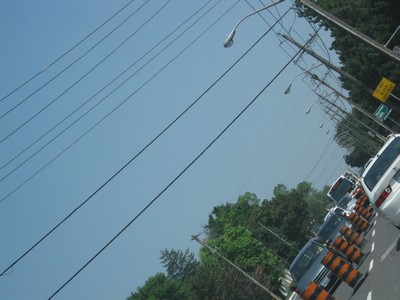
I hate all this traffic and construction and all these cranky people and how I’m one of them—and where is everybody going anyway, doesn’t anyone work where they live??—then I exit onto Bayview and I’m thinking why doesn’t the guy ahead of me turn already—for god’s sake turn, buddy!! and excuse me, what the ????—they’ve closed a lane even though it’s technically still rush hour?? On a main street?
I hate them. Whoever them are.
It’s because of them that all of us—the idiots who don’t know how to drive, and me (because of course I do)—are stuck like rats in a… a something that’s such a pain in the ass stupid I can’t even define it.
Oh great. Now some yutz cuts me off and nobody’s letting me merge—moron! I do the international what—are you nuts? combo–move with my hands and eyes.
I turn off the radio because it’s too pleasant, all that brilliant CBC morning banter gets in the way of being fully tense and angry. I shout in my hermetically sealed container, make what I believe to be rude gestures but in my supreme annoyance with all things other drivers and stupid summer roadwords I’m momentarily confused about which finger is the rude one and I’m pretty sure I’ve just flashed my pinkie.
Perfect, now we’re not moving and the guy I flashed is staring at me.
I call where I’m going even though it’s against the law (and yes I know this is wrong and I’m consumed with guilt and shame but—please—who am I going to crash into at zero kms an hour??) and say I’m going to be god only knows how late and the relaxed voice at the other end says oh that’s okay, don’t worry—and this makes me nuts. Easy for you to say Ms. Sitting in an Air-Conditioned Office Where You’re Already Supposed to Be—try inching, inching along Bayview Avenue sometime, try being caught in a cesspool of moronic city/street/roadwork planning for a few dozen years or however long I’ve been out here this morning. Yeah, sure, relax. Thanks. Why didn’t I think of that?
So inch inch inch we go until finally, finally, the other lane opens up and things are normal—which isn’t great, merely better— then, at last, I land at my destination, a major achievement—all I need is to park but the parking lot is full and by some weird bad miracle the very same dorks that were on the road, or their nearest kin, are now circling the lot and it takes forever—by which I mean a good twenty minutes—and we’re inch inch inching around and waiting to see if that guy, or that couple, is coming or going and we collectively mutter under our breath when it’s obvious they’re coming and while some of us get spots, others of us inch down down to various levels until we’re super subterranean and I’m one of them and when I finally at gd last park, I head for the stairs and I see this: 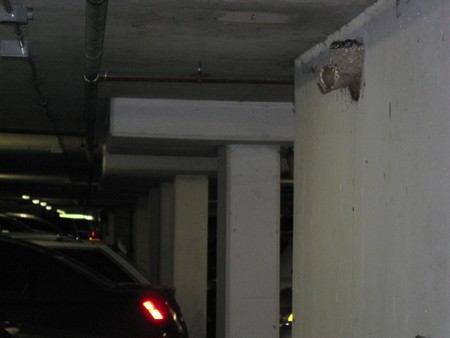
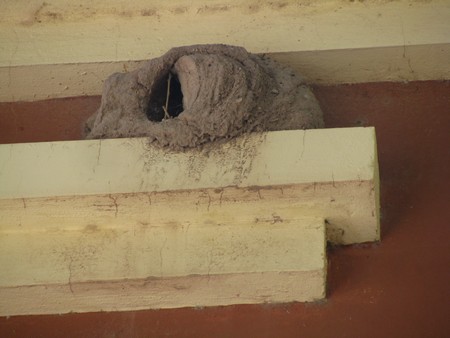
And my huff mellows just a titch.
And I get closer.
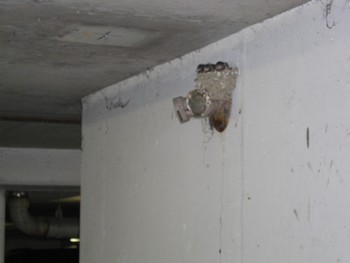
So I stop and watch these gorgeous gormless faces just sitting and waiting and I think: what patience, what peace. Happily whiling away the time til mum returns. Possibly even humming (I’m sure I hear them humming). Fully engaged in the moment. Hmm, hmm, hmm.
What is the problem? they appear to say when I stare up at them with my wild, frazzled, flushed, just-stuck-a-fork-in-a-live-socket look.
You can almost see them smile and blink hello.
And I think: what an idiot I am.
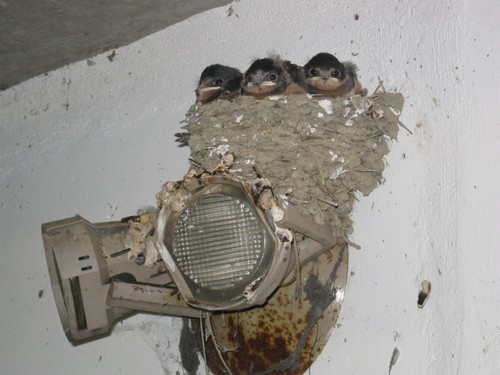
This is what it’s all about.
And just like that—presto magic—my return drive is entirely different.

The picture doesn’t do this bounty justice. All of which was less than seventeen bucks. And yes, that’s the last of the asparagus (sad to say goodbye—it’s been sooo good). The first (for me) of the strawberries—which, by the way, I learned recently, are best picked and eaten in the morning when the dew’s still on them—just in case any of you are heading out to a strawberry patch in the coming dewy days.
To the left, a pile of mini hothouse cukes, most of which got left out of the snap. (Tomatoes are also hothouse; I normally wait for vine-ripened, but it was my first day at the local farmers’ market, the sun was shining, and, well, I had a mad moment…)
From the garden, there’s this—

I’m slightly insane about salads. They would be my preferred last meal were I to face a firing squad and be offered a choice.
This one includes nettles, dandelion leaves, mesclun, arugula, lambs’ quarters and purslane. Oh, and nasturtium leaves and flowers for oomph and a peppery je ne sais quoi-ish quality that never hurts and is not hard on the eyes.
Also garlic. I couldn’t resist pulling one from the still ripening crop. Normally the ‘First Garlic Bulb of the Season’ is almost a ceremonial event around here. Not this year. I just yanked one out and diced a few perfect, crisp, translucent, completely-unlike-the-stuff-from-China cloves, then topped the whole schmozzle with my favourite dressing: olive oil and fresh lemon juice.
Anyway, definitely oodles to choose from at this time of year, right from our own ‘backyard’. (It’ll be months before I step inside a grocery store again, except to buy detergent and sardines.)
I’m convinced cats have powers of the Samantha Stevens kind. How else to explain things that just ‘happen’ as a result of little more than a glance…
Judge for yourself:
Example A—
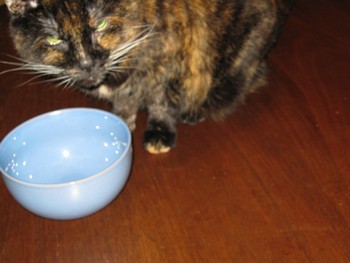
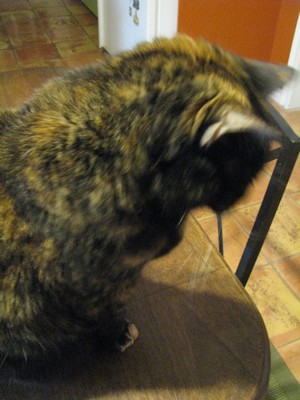 Cat sits on table.
 Stares at bowl on floor.
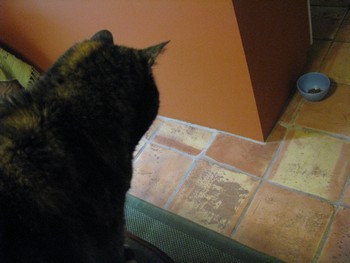 A slight nose twitch.
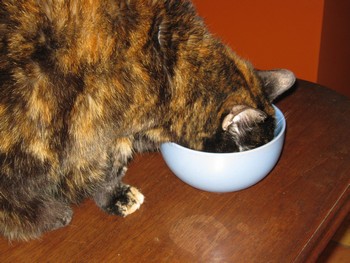 Bowl ends up on table.
~
Example B—
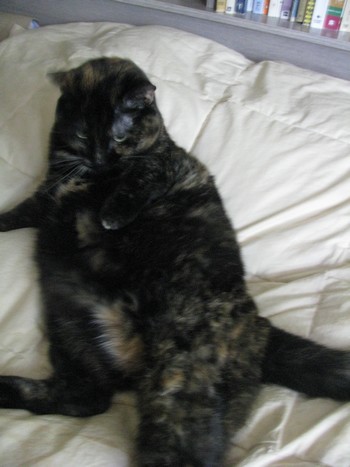 Cat stares at hand on other side of room.
 Hand appears exacty where it’s meant to.
~
Example C—
Cat stares at door until door opens.
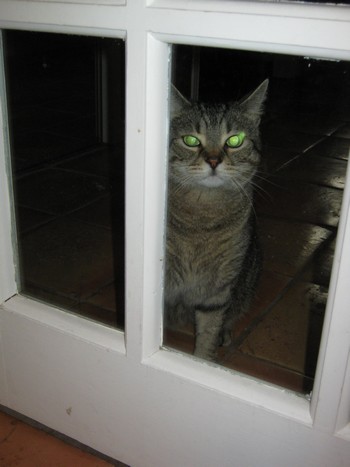 … and we all know it will.
The gardening robin is in the serviceberry tree. The fruit’s just ripening and he’s all over it these days, flapping amongst the leaves, hopping nervously from branch to branch. He used to be more relaxed about things but I guess he’s twigged that I’m also fond of the stuff.
It breaks my heart to see him looking over his tiny shoulders, scanning the yard, wondering when my berry bucket will appear.
He needn’t be so afraid, I want to tell him; I’m happy to share.
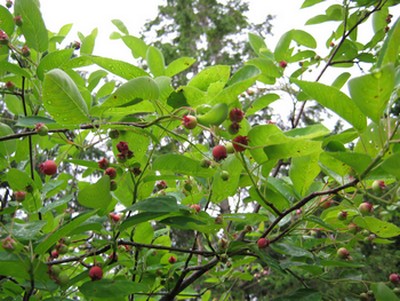
Update: Now the cardinals are in on things.
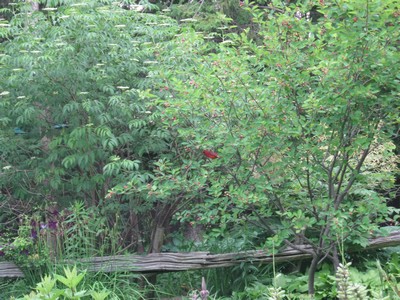
Can you see how his beak is twisted into a tiny worried frown?
Being originally from Niagara I’m wired to think it’s a kind of viticultural sin to eat grapes from anywhere else and normally I don’t. I very happily wait for the deep purple Coronation ones of September, which every year take me back to an abandoned vineyard I used to walk through on my way to school, picking whole bunches en route.
This year I’ve even planted my own crop (oh that’s rich—my crop—who am I kidding? the birds and squirrels are already huddling, scratching out complicated plays in the cedar mulch)—a single seedless dark purple called Mars.

But I digress.
The point of this post is confession.
I wouldn’t normally eat grapes outside grape season—much—but having recently been to Chile and fallen in love with the country, I’ve been making some [many] off-season exceptions.

So sue me.

Question: If a grape falls in a Chilean table grape forest, and there’s only one semi-remorseful Southern Ontarian there to hear it—does it make a sound?




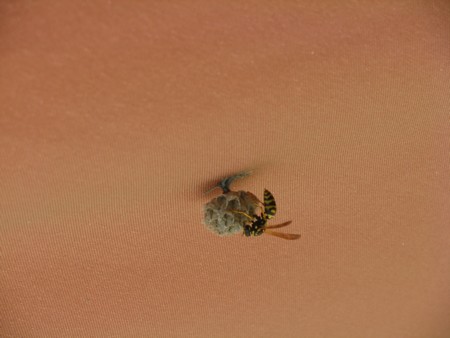 The underside of a patio umbrella.