life, in three parts

PART 1— The last day.

The vet’s been called. And now I’m painting.

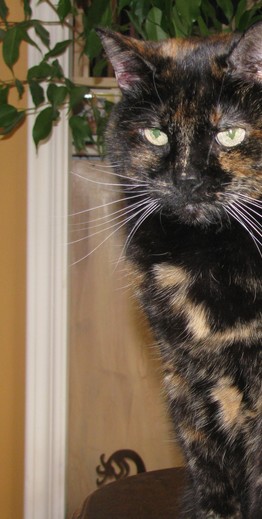
Hard decisions have been made. Our little tortoiseshell girl who was on the edge six weeks ago, then rallied like no one could believe — returning to almost her perfect nineteen year old self — has come to another edge. But this time she’s leaning over it so far there’s no coming back.

The vet is due at 5 p.m. and all day I flip-flop between wanting it to be 5 p.m. and 1994. I move between tending to her on the couch and milling about the kitchen where I can see her, where I’m preparing to paint cupboards that don’t especially need painting.

And I wonder why about the cupboards until I receive an email from a friend with a link to a quilting blog and I think how odd… I don’t quilt. I used to sew but the friend doesn’t know that. It’s a puzzle, this gift of a quilting link, and yet it reminds me of one of the last times I actually enjoyed sewing — years ago, when we had three cats. When the first of those three died, in the days right after, I sewed like crazy. Hideous things no one needed. Carrier bags and pillow cases in cabbage rose and bright pink patchwork.

And then it occurs to me that when the second of those cats died I dug over a new garden bed where a new garden bed was not required.

I simply needed to dig.

The majority of the painting will happen later. For now I just need to set the stage, to make a mess that must be dealt with, ensuring I’ll have an activity when I can’t think of what I’m supposed to do in the absence of a face I love.

The tins of paint, the taped cupboards, will be a blessing then.

PART 2— THE FIRST DAY

It was summer, 1994. We were having dinner. A loud mewling, a wail through an open window. I went out to see what it was and found a young tortoiseshell cat crouched at the base of the cedar hedge. Our two indoor cats were watching. I wanted to assure them no strangers would be tolerated. I chased the tortoiseshell away. I returned to the dinner table. The wailing resumed. Back outside, I chased the cat again and again but each time it turned and followed me. Finally, with conviction and some seriously stern language, I picked the little bugger up and carried it out of the yard.

It purred in my arms.

I called the Humane Society.

Luckily, there were no lost cats fitting her description.

We named her Cuddles.

PART 3— ALL THAT BEAUTIFUL BIT IN THE MIDDLE…

Cats 026 - Copy

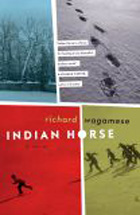
this is not a review: indian horse by richard wagamese


I didn’t know exactly what to expect when I began reading Richard Wagamese’s Indian Horse . Everyone seems to be talking about it, I’d seen reviews, it’s a Canada Reads contender. I knew there was hockey. I’d heard the descriptions: ‘powerful’, ‘stunning’, ‘heartbreaking’. But I hadn’t heard the details.

Now I understand why.

The details are hard to talk about, hard to accept. Harder still to read but impossible to stop reading.

The in-a-nutshell version is this: An Ojibway man who is a mess due to a family history of residential schools, booze and unemployment, ends up in rehab after almost making it to the NHL.

If you think you’ve heard the story before, believe me, you haven’t. Not like this.

The book opens with images of life before the white man, before indigenous peoples were made to accept a pittance for the job of helping the government devastate their own land, before they beganindianhorse trading berries for bottles.

It soon moves ahead a few generations with the focus on Saul Indian Horse’s childhood and family: a nurturing grandmother; a father who’s fine when he’s working but work for Indians is rare; a mother who is already a wreck from her own years at residential school and is now forced to watch as her children are taken to the same place, one at gunpoint.

Saul himself ends up at the school—where, among other atrocities, children die standing up, bodies hang from rafters, wrists are slashed on bathroom floors and a young girl fills her pockets with stones and calmly walks into the creek to drown. Where another child, already dead inside, speaks matter-of-factly about the priest and the nuns coming to her in the night to share “god’s love”.

“They called it a school, but it was never that….There were no tests or examinations. The only test was our ability to survive.”

Despite the horrors there is not a trace of rancour in the writing, not one gratuitous scene to drive home a point. Quite the opposite in fact. Wagamese wields a strong but subtle hand on the subject, the power being in what’s left unsaid. One gets the terrible idea that what Saul knows, what any of us know, is merely the tip of the iceberg.

How Wagamese kept what must be his own deeply rooted feelings out of the story, focussing only on Saul, telling The Bigger Story through him… is a feat not many writers manage, much less manage so beautifully.

“When your innocence is stripped from you, when your people are denigrated, when the family you came from is denounced and your tribal ways and rituals are pronounced backward, primitive, savage, you come to see yourself as less than human. That is hell on earth, that sense of unworthiness.”

Escape for Saul comes in the form of hockey—and these are some of the most beautiful passages in the book. While I can watch a game and be soothed by the sound of skates on ice, puck meeting wood—even though I really know very little about what’s going on—I didn’t think I’d like reading about hockey and it was one of the reasons I initially hesitated picking up the book. Turns out reading about hockey the way Wagamese writes it is an utter joy, even for someone who doesn’t know a crease from a blue line. The passion and lyricism of those chapters could easily be applied to a description of any artist or athlete doing what they love.

Saul has the talent of a Gretzky or a Crosbie and he moves quickly up the ranks, becomes a local hero where ‘hockey brings unity to a fractured society’ and “Every reserve in the North had a team.” But the system has him move up even higher, to minor leagues, to big city games in the south where an Indian on skates is an event, a cause for racist headlines, jeering and jokes.

“During one game [the fans] broke into a ridiculous war chant whenever I stepped onto the ice…. When I scored, the ice was littered with plastic Indian dolls… A cartoon in one of the papers showed me in a hockey helmet festooned with eagle feathers, holding a war lance instead of a hockey stick.”

What once was his salvation proves to be just another thing that belongs to the white man. Hockey is metaphor for the “white man’s game”… the game of life. They expect him to play the role of savage Indian, and eventually, fueled by a lifetime of suppressed rage, and against his better instincts, he obliges them.

From there he spirals down until he’s at the New Dawn Rehab Centre where he discovers perhaps the most difficult layer of his past [a shocker I did not see coming…] and begins the long process of healing.

This is the part of the book that was hardest to take. We white folk in Canada pride ourselves on our multiculturalism, our supposedly easy acceptance of all races. But we don’t talk about the aboriginal population when we talk about race and racism. We don’t talk about the aboriginal population at all. Because, well, they live “up there somewhere” and very little that happens to them is reported in mainstream media, and even when it is, it’s a news blip not a serious problem. Contaminated water in Walkerton? A very big deal. Heads rolled. In Attawapiskat? Where’s that?

Ditto mould, insufficient housing, suicide.

But it’s not that we don’t care, it’s that we don’t know.

The Idle No More Movement has shown, at least to some degree, that there are large numbers of us, people of all description, that do care. And we crave information. Yes, we can ferret it out online, but perhaps the day has come where equal air time and ink in mainstream media is given to aboriginal issues.

The long and short of it is this: we know too little about the history of native communities. For this reason books like Indian Horse are important in that they convey a hard story that needs not only to be told to heal the teller—but heard, to help heal our world.

Indian Horse  is available for purchase on-line at Blue Heron Books. 

And Hunter Street Books.

Support indies!

maybe the kids’ll be alright after all…

1. At the No Frills, where I go looking for a box to make a temporary three-sided bed for our elderly cat and for the first time in history find NO boxes in the discard bin — just as I’m giving up on that plan, a young man walks by, an employee, with a carton of just the right proportions, which he’s just about to pitch… and in the most happy-to-have-bumped-into-me way says yes, of course, I’m very welcome to have it as if he couldn’t be more delighted to have found such a good home for this stray bit of cardboard. And I think: what are the odds of that — the timing, certainly, but the gift of such good cheer from an unlikely source… especially when much needed.

2. A scruffy looking boy with dyed jet black hair, long and unkempt, smoking, jeans that begin somewhere around his thighs and a ragged shirt. Very bored, very detached demeanor, standing outside the plaza. I drive by [the carton from No Frills in my back seat] and notice an elderly woman exit the dental office with what looks like a large pizza box. Ten or so metres along, l look in my rear-view mirror, curious as to whether I’m imagining the pizza box and I see her fall on the icy pavement. I stop the car and in that instant of thinking I must go back to help, I see — still in the rear-view mirror — that, without missing a beat, the scruffy boy has leapt to her aid. They chat for a moment and then she and he go their separate ways.

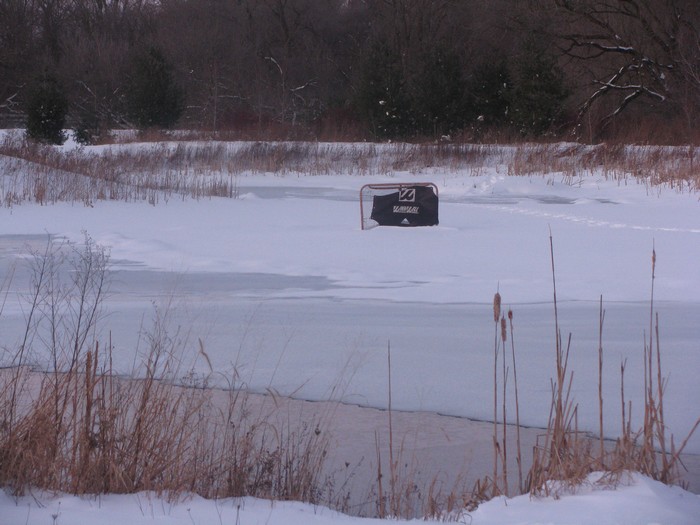
3. On the way home I notice a hockey net on the frozen pond, and when I stop to take a picture, a boy appears, alone, with a hockey stick, heading in its direction.

That’s it.
That’s enough, I decide.
There’s hope still.
IMG_0634_1

dear person who

Dear Person at Sobeys Who Left a Cup in the Cup Holder of Shopping Cart:

What is it you’re buying that takes so long and creates such a thirst that you can’t do it without knocking back a little something in the process? And while we’re at it… why, Ms/Mr Sobeys, do you encourage people to drink while they shop by installing cup holders on your otherwise fine chocolate brown carts? I would have thought it counter-productive. After all, thirsty people will buy more juice and pop and bottles of Clamato. And so forth. Those who are suffonsified will buy less. And so forth.

I’m no expert in these things but I’m guessing that if you were to add TV trays, cutlery and condiments to the carts, you would see a significant drop in deli, whole roasted chicken, and possibly other, sales.

So I’m advising you against it. Not that you asked.

But back to you, Dear Person Who Can’t Shop Without a Drink. For god’s sake, pull yourself together. Surely you can function for twenty minutes without one.

And if you can’t do that, then would you please have the courtesy to place your pacifier in the garbage (or better yet, take it home to your recycling bin) and not leave it in the cart for the next person to find… Some of us like to use that space to store our tulips.

Thanks a bunch.
And have a nice day.
IMG_0505

(at) eleven with darcie friesen hossack: mennonites don’t dance

My plan of action for the (At)Eleven series of chats with writers has always been to include some element of food. I believe that books and food go together. Food in the pages, food on the pages. So I look for some, even tiny or remote, connection to food with the writer or with the book. In Darcie’s case, I didn’t have to look hard—food is everywhere, connected to everything.

We met during a Humber School for Writers mentorship program where much of the chatter was often about food thanks in large part to Darcie, who was then [and still is] working as a food writer, and Susan Toy, who had the rest of us jotting down notes on how best to froth cream or shave chocolate in between discussing the finer points of character development and plot structure. This small group of food/word advocates has stayed in touch over the years and when, this past October, I finally had the pleasure of meeting Darcie in person on a trip to Kelowna, tea, coffee, and sweets were involved. The time was too short.

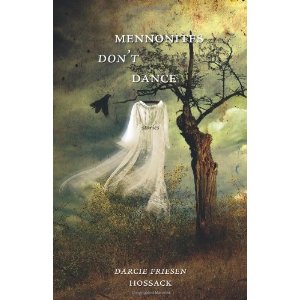
As a group, we have shared in the excitement of her first book, a collection of stories, which has garnered some not insignificant attention. Mennonites Don’t Dance has been shortlisted 51Hs0UgdX-L__SL500_AA300_for the Commonwealth Prize and was a finalist for both Danuta Gleed and the Evergreen Award. The stories focus on mostly rural Mennonite life and the constant tug of war between what is respected and what is desired.
There is also food.

Among the trauma, someone is always baking, preserving; kitchens are fragrant despite drops of blood on the tiles. There is life and nourishment among the darkness.

I’m grateful and delighted that she has taken the time to answer a few questions—some are even about the book.

And so, without further ado… may I present writer and foodie, Darcie Friesen Hossack:

 1.   What literary figure did you relate to as a child? Who did you want to be and why?

DFH—Okay, don’t laugh.
Velveteen Rabbit. I think I’ve said too much already.

2.   How did you come to writing? Do you remember the moment you realized this was what you wanted to do?

DFH—I remember writing a story for a fourth grade Language Arts class, and begging my teacher to let me skip recess so I could finish. It’s the first time I remember being specifically delighted and fascinated with what words could do.

3.   What were you reading at fifteen?

DFH—I really want to lie here. While I read excellent children’s literature, there’s a black hole between then and when I began to discover authors in university. At 15, I was secretly reading dreadful romance novels and a “Based on the Screenplay” novel of a Julia Roberts movie.

4.   Can you share a favourite passage from any book? And if you’d like to say why it’s special, please do.

DFH—“Things shouldn’t hinge on so very little. Sneeze and you’re highway carnage. Remove one tiny stone and you’re an avalanche statistic. But I guess if you can die without ever understanding how it happened then you can also live without a complete understanding of how. And in a way that’s kind of relaxing.” Miriam Toews, A Complicated Kindness

Miriam is who I wanted to be when I grew up. I’m still working on it.

5.   I’m always interested in process. Do you have a discipline, a routine, a favourite place to write? And how do you deal with distractions? I’m thinking of phones, people assuming you’re always ‘free’ or, heaven help us, the internet—but any distraction will do. (Hunger is a big one for me. No sooner do I hit a roadblock than I find I’m starving for a piece of cheese.)

DFH—I write almost entirely at my antique (of no known maker) desk that my dad found and cleaned up for me. It’s scratched and banged up and the drawers require routine candle wax rub downs to keep them from squeaking.

6.   What has surprised you most about the writing and/or publishing process?

DFH—Mennonites Don’t Dance was banned from a library in its early months. That surprised me! That it’s been taken seriously by reviewers and award juries and other writers, though, was, is still, a wonder. I remember coming across the Globe & Mail review (I knew to expect it, but not when, and not what) while in line for coffee. I must have looked like a nutter, standing there, reading, laughing and crying while everyone got their lattes.

7.   There’s a tenderness to the stories, understanding mixed with respect, even in the bleakest moments. Makes me think of a cheetah running, beautiful, the grace of a gazelle, then cheetah tears gazelle apart but there’s no guilt or malice on either side. It’s not always pretty but that’s how they survive. The beauty is in the honesty and the violence isn’t gratuitous. In the stories, there’s often a perception of unkindness, but you’ve managed to find the honesty in the actions. A bit of long lead up to the question: which surprises you more, the cruelty inherent in people, or the tenderness inherent in people who appear to be cruel?

DFH—Neither. Which, when I look at it, reads like a non-answer and I’m sorry! What surprises me, though, is laughter. That people are most capable of it after being at the centre of such dark stories.

8.   One of my favourite stories is ‘Ashes’, in which is the line: “Tomatoes make Anke nervous.” This just so beautifully represents your overall theme, the [Mennonite] fear of [what others see as] basic elements of life. Also Anke and Libby, in this story, exemplify both sides of what feels like the same coin, each wanting a little of what the other has without losing the important parts of self.  And yet, what they each lose couldn’t be more personal. Or more universal. Can you talk a little about this story, perhaps as it relates to the others, its history?

DFH—Without going into too much detail, I knew someone who miscarried in a bathroom, then went on to serve dinner to invited guests. That was going to be the story. Grief and hospitality. Then Anke wandered onto the page, and tomatoes made her nervous. I had no idea why. It simply became clear that she’d come save Libby from the story I meant to tell.

9.   The category of ‘Mennonite Writer’ is interesting in that it doesn’t refer to any specific style and is different [I think] to ‘Mennonite Writing’, which suggests a specificity of topic. So, I wonder then, what does it mean to be a Mennonite Writer? Is it determined by the being Mennonite [regardless of subject matter or perspective] or is the matter of culture within the story essential? How do you see yourself in this context?

DFH—People have been trying to answer this question, with an entire scholarly discipline unfolding in since Rudy Wiebe’s “And Peace Shall Destroy Many.” There’s a fantastic lecture about “The Trouble with Mennonite Novels”, given last winter by Paul Tiessen at Conrad Grebel University College. Part of a series of lectures by Mennonite writers and scholars, each attempting to answer some part of “What does it mean to be a Mennonite Writer?” http://uwaterloo.ca/grebel/events/celebrating-mennonite-literature/videos

10.  If you could spend a weekend with one of your characters, who would it be and what would you do?

DFH—The grandfather in “Magpie.” We’d sit on the swing and eat roll kuchen and watermelon and spit out the seeds.

11.  Choices:

Brunch or lunch? Brunch. At lunchtime.

Mountain or prairie? Mountain. With ocean if it can be arranged.

Motorboat or canoe? Houseboat.

Apple or orange? Apple. No peels. September through November, only.

Poetry or Song? Song. No, wait. Poetry. Wait. Song…

Starch or Salad? Pasta’s a salad!

First lines or last lines? My music teacher used to say, “Begin well and end well, and they might forgive a small mistake in the middle.” I really appreciate good beginnings, though.

Tent or trailer? Cabin. With climate control and running water.

Rain or wind? Both, at the same time!!! Watched from comfort of said cabin.

Atwood or Laurence? Pen or paper? Both are needed!

Chocolate or vanilla?  Swirl.
andre-kertesz_the_fork_1928_500px

Matilda’s suggested menu for Mennonites Don’t Dance

Tomatoes

Anything with Cream Gravy

and to drink, a stiff shot of vanilla

Darcie Friesen Hossack is a graduate of the Humber School for Writers in Ontario, Canada, where she studied under Giller Prize finalist Sandra Birdsell. Her first book of short190789_10151184624000264_2061826719_n fictions, Mennonites Don’t Dance, was published by Thistledown Press in September 2010. Acclaimed in the Canadian press, shortlisted for the Commonwealth Prize in the First Books Category, the book was also a runner up for the Danuta Gleed Award, and a Globe & Mail Top 5 First Fiction pick in 2011. Darcie grew up in the city of Swift Current, Saskatchewan, though was as much at home on her grandparents’ farm in the Mennonite village of Schoenfeld. She eventually moved to Kelowna, British Columbia and married her high school sweetheart, international award-winning chef, Dean Hossack. Being Mennonite, with its accompanying experiences of farm and food, shaped the author’s faith and love of land (even though she’s never successfully grown anything in dirt), and led to a syndicated food column. Darcie has never had to kill a chicken, though she’s plucked more than a few, and once brought a pig’s snout to school for show and tell.

She can occasionally be found at darciefriesenhossack.wordpress.com
squirrelyard bully

Oh sure. He looks sweet enough.
IMG_0434
But he’s a little red dictator.
IMG_0433
Screaming and chuntering at anything that even thinks of interrupting his meal.

And he prefers to eat alone, thankyouverymuch.

See that blur of black in the background?
IMG_0432
That’s a much bigger fella waiting his turn.
Sometimes there’s a queue.

Everybody knows the rules.

The [seriously more dignified] greys and blacks hide out in the spruce, watching, waiting, drumming their impatient little claws, not daring to grab a morsel because that only means being chased unceremoniously into the next yard by a little twirp. And who has the energy for all that running on an empty stomach?

Plus it’s embarrassing.

The smart ones don’t even bother showing up until His Twirpness has burped and moved on.

Moral of the story: it’s not as easy as one might think, being squirrely.