signs of doubt

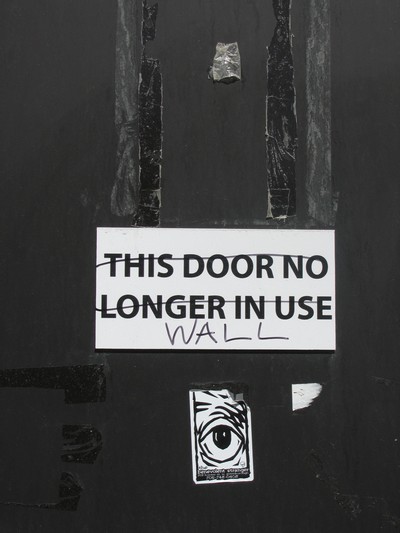
I couldn’t find an inside. But this, I feel, is hardly reason to be cavalier.

Translation: this door is now a wall.

They also make signs. Fast… easy.

As with all surgery related decisions, go with whoever’s offering the discount.

And furthermore… Xkoxofmos Jddd Kmfberp. Don’t say you haven’t been warned.

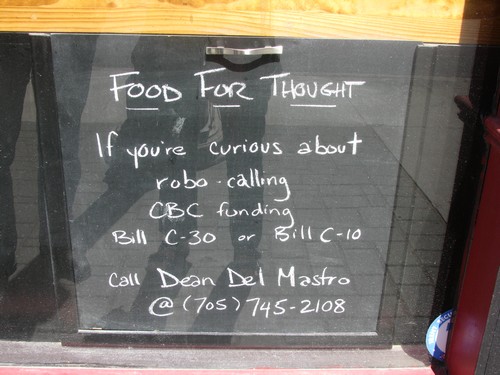
I’ve blacked out the number so Petes won’t be overrun with calls. There are surely only so many bottles to go around but, if you want one…well, you know…I’ll give him a dingle.

Thank you, Peterborough!

may and i

 
I should have known I couldn’t let May slip by without a note of reverence. We have history, May and I. It’s the month when I seem to both lose the most and find the most; the month that makes me pay attention.

It’s the month my dad died twelve years ago, the month my mum had a stroke in 2010; the month she died a year later. It’s the month I was married and the month—in a completely different year—that I was close to snuffing it too. It’s also the month I didn’t.

The details of finding and losing are never as important as the lessons.

And there’s little point in going on about either.

Cryptic, yes.

And personal, in way that’s worth celebrating with others.

That’s May.

~

I went walking this morning, although I didn’t feel like walking. I’ve buggered up my neck. Don’t ask how. It doesn’t matter. It’s a long story. It’s the usual story. It’s no surprise. It’s my own fault. It happened a few weeks ago. In May.

Anyway. Everything hurts. Walking, sitting, swimming, driving, writing, thinking, looking around.

Like I said, the details are unimportant.

Halfway to the beach I remember I’ve forgotten my camera, which almost makes me turn around and go home and stay there. Wallow a bit, the way you feel you have a right to when everything hurts.

But the car keeps moving toward the lake and I don’t have the strength to argue.

So to the lake we go.

And once there, I walk.

First, past the hot pink wild roses that smell just like gift soap, then past gulls sunbathing on the pier, past the guy, young, maybe his first summer job, with ear protectors and a weed whacker in the garden donated by the Rotary Club. I think how much more he might get out of the experience if he could hear the waves and the birds, the laughter of an older couple in matching helmets as they cycle by. I have a set of clippers I’d be happy to lend him.

The sand is warm, the lake calm and glassy. Sky blue. Clouds fat.

A woman approaches in lycra. I lift my head for eye contact, prepare to say hello, but she marches by, all purpose and form. I have the feeling a pedometre might be involved. She’s walking for health, for fitness. No time for niceties. Best not to get in the way. Best not to judge. We all walk for our own reasons.

I’m carrying my sandals, sloshing through the water, hoping I don’t have any open wounds; a couple of seagulls paddle along just ahead of me, stopping when I stop. I like this connection, all three of us aware of each other. Then a story I heard on the news this morning comes to mind, about that guy who sent body parts in the mail, the things he did to kittens, and I wonder what happens to some people that they don’t feel connected to things, and I wonder how much of that can be fixed… and whether we’re a society who even knows how to fix broken people.

I watch a mother and a young boy, maybe four years old, approach the lake. She is so scared for him, clutches at him as he makes for the shore. But he’s scared too. He walks slowly, tentative. Both of them stand at the edge not knowing to pick up a stone and skip it. Eventually, they leave, make for the swing sets up on the grass, but even there I can see her face, anxious, telling him to be careful. He moves around stiffly, checking to see if she’s watching; he wants to please her. He’ll be careful.

After that it’s just me.

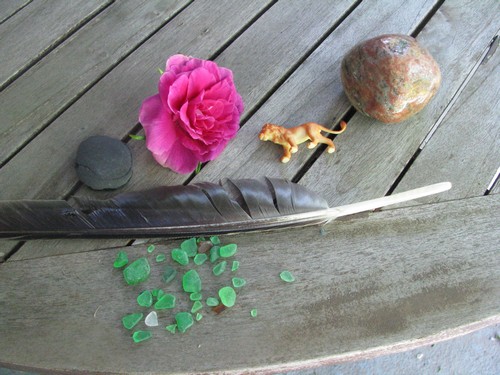
I collect beach glass, more than I’ve ever collected in one day. Mostly green but a couple of browns and a nice sized clear. Most are tiny, but it doesn’t matter. That my eye finds them is what counts. I’m grateful whenever I can see what’s right in front of me.

I fill a grocery bag with litter.

I find a plastic lion and almost leave it but then it makes me think of Bert Lahr and I smile, pop it into my pocket with the glass. I hope its owner wasn’t too distraught when s/he got home and found the lion missing. Maybe s/he’ll come back to search for it and find something else, something much lovelier, in the process. Maybe I’ll take it back, leave it in the crook of a tree. Or on the swings. Maybe the frightened boy will be the next to find it.

I’m sorry I don’t have a camera to take a picture of a low-flying gull over clear stoney water and tufts of seaweed.

Or four feathers that look more like ancient pens discarded on the sand.

By the time I get to the large flat rock where I once saw a young girl meditating, seemingly oblivious to anyone who passed, I’ve stopped thinking about pictures, about capturing things, and I remind myself it’s good sometimes to let things go, that there are other ways, many ways, of remembering.

Things lost.

And found.

ink and stamps and a sidewalk, oh my

I wrote a postcard today.

I like postcards.

I like getting them and I like writing them.

I think, in a way, I like them more than envelopes and letters. Although there’s much to be said for envelopes.

Postcards are the original ‘tweet’, a status update. But with no expectations, no demand for immediate response. No pressure.

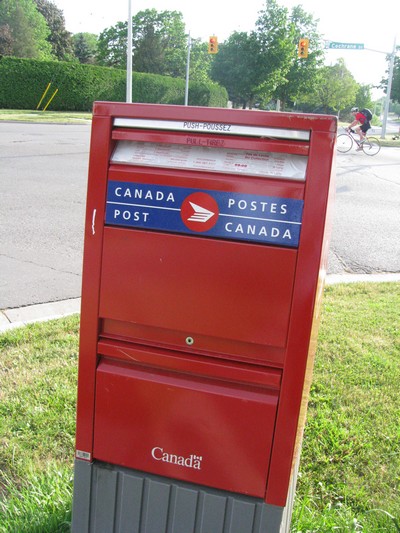
I walk along the sidewalk, drop the postcard into the box.

And someone will find it, take it to wherever I’ve said.

I never get over this amazing fact.

And then I walk home.

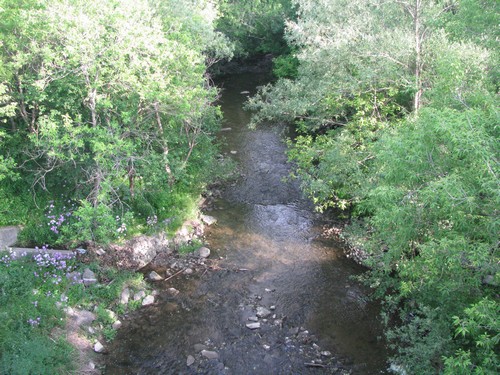
I cross a bridge on my way, stop a minute, look down.

I think I’ll write another postcard tomorrow.

(at)eleven with john wing — when the red light goes on, get off

(AT)Eleven is a series of Q&As with writers whose paths and mine have crossed in one way or another and whose books I want to discuss—ideally in person, over lunch (my favourite meal of the day)—but given how we’re all in different parts of the country and beyond, it’s a bit simpler to do a vicarious version. So here we are. If you’d like to take a moment to get something to eat, I’ll wait. And if, after the Q&A, you’re inspired to read the book, you might be interested in my suggestion of the perfect meal to go with the reading.

—bon appetit.

“Eating is our earliest metaphor, preceding our consciousness of gender difference, race, nationality, and language. We eat before we talk.”
~Margaret Atwood from The Can Lit Food Book

~
I’ve never met John Wing—we were introduced online by a mutual friend—but he’s a familiar face; I’ve been watching him on the Comedy Chanel for years. He’s a regular at Montreal’s Just for Laughs, and various other festivals and clubs throughout the country and the U.S. where he has long made his home. (It’s amazing how many of the best comedians working in the States hail from our side of the 49th.)  I was delighted when he agreed to do this Q&A, partly because he’s the only person I know who’s been on the Tonight Show (something like eight times), but mostly because I thoroughly enjoyed his book.
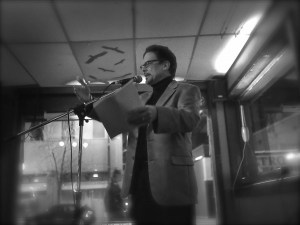
Beginning with the title—When the Red Light Goes On, Get Off—there’s a very engaging kind of instructional entre nous vibe in Wing’s writing; hey, he seems to be saying, if you think comedy is all laughs, think again: here’s the real deal, here’s what the road is like, the people, the venues, the hotels, the food, the hours and years devoted to a single joke. And while we’re at it, here’s how to write a joke—“Take them somewhere, until they’re sure of where it is, and then go somewhere else at the last second. The juxtaposition of the incongruous…”  He makes it sound simple but then talks about rhythm, sound, word choice, pacing, why the ashtray in a sex joke must be cold… He tells stories, dozens of tiny, perfect anecdotes, how 25 years ago he hired a couple of guys to help him “shpritz” jokes for his act; they worked for three hours (at $50/hour) and at the end of it he had one excellent joke, which he shares, and which he still uses and so “got his money’s worth”.

Here is what I didn’t know before reading this: a good comedian is a good writer. They have to be. I can see that now. Like a lot of people maybe, I assumed it was all about the performance, but that’s zip unless the words are there first… tight and perfect and rehearsed and balanced and revised and updated and and and. One difference Wing notes between writing standup and writing anything else, is that “The audience has the final say, and it’s by their sound that you make the corrections.”

Wing is a good writer. And this is a good book… should be required reading for anyone thinking of going into the business, as well as anyone curious about the ‘other side’ of the business, as well as anyone who enjoys a well told story. As much as we learn about the business, Wing also candidly shares personal moments. He talks about the addiction to attention, the solitude, drug use, the need for a good memory, his penchant for photographing cemeteries, meeting Eric Idle, rivalries, strange but solid friendships and the ‘private club’ that is comedy—a hard place to make friends ‘on the outside’.

Wing has also published a number of poetry collections… a form he says is not dissimilar in process to writing standup. That in itself sounds like a whole other conversation…

Overall, I was left feeling I’d grown up a little. My naive idea of comedy considerably changed, I found myself more drawn to the form than ever. I’m watching the acts on the Comedy Chanel in a different way, laughing, yeah, but with a deeper, new-found respect. Awe, even. This is one tough business and you wonder why anyone sticks with it. A question that could be asked of many professions that require mere brilliance, passion and dedication.

Let’s just be glad they do.

And now, may I present…  comedian, writer and poet, John Wing.

~

1. What literary character did you identify with as a child?

JW:  Probably Tom Sawyer, which was the first novel I read. The idea of coming to one’s own funeral was as delicious then as it is now. And there is such haunting beauty in the note he was going to leave. ‘We ain’t dead. We’re just off being pirates.’

2. Can you recall an early piece of writing?

JW:  I wrote a speech in grade eight about the Canada-Russia hockey series of 1972. I started writing poetry about that time, too. Lyric poetry, unimaginably bad. I tried to use large words, many that I had to imagine the spelling. I remember my version of ‘epitome’ was ‘epittamy’, which is, to this day, how I think it should be spelled. I tried to write a novel with my sister when I was around that age, too. I wrote the even-numbered chapters. Unfortunately it didn’t work out, as she hated and rewrote all of my chapters and I had no real idea what hers were about. I also wrote a funny newscast about that time. My brother and I performed it at a family gathering to huge laughs. The first jokes I ever attempted were in there. I recall one: “Studies show that the best way to avoid a hangover is to keep drinking. There is one side effect, however. In two months, you’ll be dead.”

3. Do you find recurring themes in your work that surprise you?

JW:  Of course themes are recurrent, sometimes to an embarrassing degree. I try to branch out occasionally, but it is very difficult. I don’t know that I have themes that surprise me. They all come from a deep well somewhere. I am more surprised to find new stories in the well at times, since one always wonders when one book is finished if there will ever be another. The why of things is always my fascination. The truth of what you think is true. A poet friend of mine once mentioned he was trying to get a Canada Council grant. I asked what he would do with it if he got it and he said, “Oh, you know, go up to Baffin island for six months and write poems about my father.” I suppose I have written more than four or five poems that reference Moby Dick. Probably just wishful thinking.

4. A few questions on process. Given the amount of travelling you do, it must be a trick to find time to write or create an ideal work environment—or does the how and where and when depend on the ‘what’, i.e. poetry vs. performance material vs. memoir? Did I read that you’re also working on a novel?

JW:  It’s not a trick at all. I write voluminous amounts on airplanes, which are almost perfect places to write. My routine is not a set thing, despite the warnings of all my literary heroes that it should be. My ideal work environment is a deadline. I need goals, concrete goals. I wrote thirty pages of ‘When The Red Light…’ in about ten months, and then was told by the publisher that he needed a full draft in three weeks. I wrote the whole thing in twelve nights, midnight to six, on a cruise ship. I finished the draft so quickly that I had time to do a polish, thanks be to God. Regarding the various types of writing, I tend to stick with one for a while, then switch to another. Where I am generally has very little to do with what I’m writing. The deadline creates the energy. Comedy and poetry are very similar types of writing, so that’s an easy switch. Prose is the hardest for me. I have started many novels and rarely reached a second chapter. However, hope springs eternal. If only someone would put a gun to my head. My favourite writing is the rewrite. I have three editors for my poetry books, and one gets the first draft, critiques it, then I rewrite it, send it to the second for another sandblasting, then another rewrite and the final editor and the final rewrites. Those are the best sessions. Making things better than they were.

5. In ‘When the Red Light Goes On, Get Off’, you mention that you’re good at being alone; I’m interested in the idea of solitude as it relates to art and wonder: is ‘being good at’ the same as being ’happy’ alone? And if we were to take work out of the equation, would the need for a certain amount of solitude still exist? It’s a kind of chicken/egg question, i.e. do the kids who are good at being alone become artists or do artistic kids learn to like being alone?

JW:  Yes, being good at being alone is the same as being happy alone. I don’t know why I’m happier alone, but undeniably, I am. This job requires one to live in one’s head a lot, and being alone helps with that. I don’t know if I would like it so much if I were in another profession. I don’t know if my liking it was bred in me and came in handy when I chose comedy or if I adapted when I had to. As a boy I was fantastically homesick, to such a degree that I was razzed about it by my siblings. I was hosting a documentary film last year and we worked full days, 8:00 a.m. to around six. Four of us: me, the director, the cameraman, and the sound man. We would get back to the hotel after a long day and the director, who was the friendliest of fellows, would say, “Okay, boys, dinner in forty-five minutes!” And I would just groan inwardly. Not that I didn’t like all three of them. I did. But God in heaven, I just spent all freaking day with you guys! I have to have dinner with you as well? I have for thirty years been used to going back to my room alone having the rest of my night free. I need the recharge. Or to put it another way: Once I was doing a panel on addiction among comedians, and I said to the host, “I’m not good at interacting.” “You interact with the audience,” he replied. “Yes,” I said, looking out at the crowd. “I love to perform for you, but I don’t want to meet any of you personally.” Cold, I suppose, but it was true. Do I need lots of alone time as an artist? Absolutely.

6. Speaking of art, I was struck by your description of comedy as a skill not an art, how you remind us that art is open for interpretation, yet a joke can’t be ambiguous… you don’t want fifty different reactions, or people leaving the show debating what everything meant. You want laughter, a visceral, immediate response. In that way it’s more like a science. This is what’s so great about the book, this quality of opening the readers’ eyes to the industry in a way that allows for an appreciation of the work as something beyond being able to tell a good joke, which I’m pretty sure is how most people see comedy. (I’m wondering if even newbie comics think it’s as simple as that.) In a nutshell, what would you say is the most important quality any successful comedian has… is there a common denominator?

JW:  This is difficult. You need three things to be successful. Writing ability, performance ability, and business ability. The amazing thing is you can do very well on a smidge of the first two if you have a lot of the third. The business ability has always been my weakness. The common denominator I have always seen is enormous insecurity. You need something you failed to get from your parents or siblings or peers when you were very young and impressionable. A prodigious memory helps, also. And persistence, which is the real problem now. Almost all comedians are going to just suck in the beginning. It takes two to five years to really develop an act. And there are going to be a lot of painful nights in that development. And you have to believe in yourself, and what you’re doing.

7. Any thoughts on why the majority of comedians are male?

JW:  Well, the road might be harder on women than it is on men, partly because every week you’re working with someone who’s hitting on you. It is an utterly nomadic life, where extended periods of time at home make you really itchy and hard to be around. Also, if your partner doesn’t do stand-up comedy, you can’t really share much of it with him or her. Do women enjoy being alone as much as men do? I don’t know. I married a stand-up comedian. She pretty much stopped when we had children. Women have other pulls on their psyches. I hope none of that sounded idiotically sexist. It has nothing to do with women being funny or not. They are amazingly funny. The club owners are almost all male, and they prefer booking males. Sad but true. Women have a harder time getting booked, because it’s either an all-woman show, or there’s only one. Not as many spots. So it’s a hard life, and a harder living for women.

8. I enjoyed the road stories; you tell them well and I can see how it plays a big part in the lifestyle—the road being almost a character. Does it ever feel like a friend/enemy at times? There are also some nice bits about the culinary (or lack of) side of things and a lovely riff about which hotels/motels have the best amenities, location, bedspreads… I was stunned to learn that the best rooms are next to the elevators. That surprises me. Is it true?? Just curious.

JW:  The reason the best rooms are next to the elevators is because they’re the shortest walk with a lot of baggage. and the further down the hall you go, the smaller the room is. You’re also close to the soda machine when you’re near the elevators. Yes the road is a friend, a companion. Have I been here before? Where did I go? Was it good? Let’s go there again. I’m going to Niagara Falls, London, and Toronto next month, and have favourite places in all three. And one of those favourite places will be the hotel room.

9. Of your poetry you say that you started doing it as a way to appeal to women. Did it work? And, more seriously, what about poetry speaks to you? Who are your influences; who do you read? And, finally, of all the genres you write in, which feels most comfortable? Which allows you the most freedom, if freedom is even the right word…?

JW:  Did it work? I suppose it did, to one degree or another. One wished to be seen as soulful, or the word we used at the time– deep. In college, all my dorm mates thought I was gay, which was a wonderful way to recognize the idiots. Poetry was something my father loved deeply, and I wanted to impress him, too. In learning about it and reading it out of spite for his criticisms of my poor reading habits, I grew to love it. Housman and Kipling were early influences, also e.e. cummings. The first book of poems I ever bought was The Collected Hart Crane. I thought it was a nice copy, and I thought his name was interesting. His poetry was a new world. I also bought Leonard Cohen’s Selected Poems around that time. Both were large influences. Then I began to get poetry books as gifts from relatives. My aunt bought me Earle Birney’s Near False Creek Mouth, and my grandfather bought me Don Coles’ Sometimes All Over. My grandfather was friends with Don’s father, Jack. And Don had been a school friend of my father. Don became the greatest influence over my writing, and one of my great friends now. He is my first reader, and second editor of my manuscripts. His poetry is among the best I have ever read, and I have learned much from him. In college, my first writing professor was John Ditsky, who had a huge influence upon me. We corresponded for twenty years and he was my first reader and his critiques were brief but telling. His letters usually said one of two things. ‘Liked the poems’ was what I craved, and ‘Not up to your usual standard’ was what I feared. Sadly, we stopped writing each other for a time, and had just started again when he died suddenly. I owe him a great debt.

I read and collect reams of poetry. British, American, Canadian, and some Irish. Philip Larkin, D.J. Enright, Thomas Hardy, John Clare, Dylan Thomas,T.S. Eliot, Robert Burns (technically not a Brit—a favourite of my father) among other U.K. poets. Many Americans, Gary Snyder, Allen Ginsberg, Gregory Corso, Theodore Roethke, Carolyn Kizer, John Ciardi, Walt Whitman, Cummings, Crane, Ezra Pound, Lawrence Ferlinghetti, and James Tate, a Boston poet who is so original you can’t put him in any category. My Canadian brethren include Susan Holbrook, Julie Bruck, Erin Moure, Phil Hall, Al Purdy, John Newlove, Raymond Souster, Marty Gervais, and Joe Rosenblatt. On road trips, I always take two or three to keep me company, almost always a Don Coles or a Phil Hall. I feel most comfortable writing poetry or jokes, which are very similar disciplines. The hardest thing to write is a funny song, where the jokes have to rhyme AND scan. The only thing I find harder is to perform a new song. The first performance is so scary. What if they hate it? And every song has a weak line or a weak couplet, and every single time you sing that part you think, “Goddamnit, I should fix this piece of crap line.”

10. The memoir ends with your first appearance on The Tonight Show. There’s a whole lot more to your story since then. Will there be another book?

JW:  I doubt it at the moment. It’s not on my radar. In the future, who knows?

11. CHOICES:

Chocolate or Vanilla?
Vanilla. No doubt. Vanilla

Prairie or Mountains?
Difficult, as I live within sight of mountains and grew up in a flat place. Though I like mountains, my heart is prairie.

Pizza or Pasta?
I like pizza pretty much one way, and I love the variations of pasta, so I will pick pasta.

B. Dylan or D. Thomas?
I’ll take the poet.

Chopsticks or Fork?
Man is this easy. Fork, fork, a thousand times fork.

Large Room or Small?
I have spent the majority of my life in small rooms, so I would hope it’s my preference.


Editor’s Note:  food and drink inspired by When the Red Light Goes On, Get Off

—one perfect grilled cheese sandwich, *sponge cake, strong coffee, Pepsi and beer

*read the book and the reason will be clear; still laughing about this one

~

John Wing was born in Sarnia Ontario during the Diefenbaker administration.
He has published seven books of poetry, all with Mosaic Press, and one memoir
with Black Moss Press. He has been a standup comedian for over 30 years,
logging more than 250 television appearances. His new book of poems,
Almost Somewhere Else, will be published in the fall. You can find John’s club dates on his Facebook page, and his books on Amazon.

this is not a review: elle, by douglas glover

 
“What do you with a girl who has journeyed to the Land of the Dead (Canada), has consorted with savages, left her soul on an island inhabited by demons, given birth to a fish, disappeared into a labyrinth of dreams and turned into a bear? At best, if I return to the place I once called home, I will be a spectacle. Now I have no home nor self nor soul.” (from Elle, by Douglas Glover, Goose Lane, 2003)

When, on p.167, I reached this passage in Douglas Glover’s novel, Elle, I thought: oh, I’m so glad someone’s put things into context because for a moment I feared I might be losing my mind…  not that that would have stopped me reading. The book was, despite my confusion at times, unputdownable for its quirky take on history and its sensuous imagery mixed with perfectly pitched satirical elements.

Its shape takes the form of an anti-quest, best explained in Elle’s words:

“… You go on a journey, but instead of returning you find yourself frozen on the periphery, the place between places, in a state of being neither one nor the other. Instead of a conquering hero, you become a clown or fuel for the pyre or the subject of folk tales.”

In a nutshell:

A wealthy and young nymphomaniac slightly bored tart living in 16th century France, who has disappointed her father (seems he disapproves of rampant lustfulness), sends her to Canada on one of Jacques Cartier’s ships. On board, she’s soon at it with a handsome but seasick tennis player—mostly to distract herself from a raging toothache (a tooth later removed by tying one end of a string to it and the other to a dog named Leon, who is then encouraged to jump overboard, taking the tooth with him).

Perceived as being more trouble than she’s worth, Elle is abandoned en route on a tiny island at the mouth of the St. Lawrence, along with her nurse and her lover. Soon after, they both die and she’s left alone to cope with the elements, hunger, and eventually a kind of weird dreamlike madness where she maybe/maybe not turns into a bear and maybe/maybe not gives birth to a fish. (One of the most beautiful scenes follows this ‘birth’ with Elle’s initial horror being replaced by love and the realization that the ‘creature’ will not live long; she then begins to tell it everything she knows…)

Eventually she befriends the indigenous people and ultimately comes to understand something of them, all of which leads to her transformation from acerbic child obsessed with trivialities to deeply thoughtful woman respectful of life and connected with the earth. It’s in this new, improved state that she returns to France to face a kind of culture shock of the soul.

What I loved:

Elle’s voice. She may be afraid, confused, possibly going doolally at times, but her delivery is consistent and crystal clear—casual almost—whether she’s reducing the most horrendous or inane events to brilliant satire, or being philosophical on the deepest level.

(Also loved the cover photo of a statue in Pere Lachaise Cemetery, in Paris; cover design by Chris Tompkins)

Favourite Character:

Richard, the tennis playing lover who does little more than build a tennis court (and rebuild it each time the tide goes out). He has almost no dialogue but is clearly, and cleverly, drawn by his actions; every scene with him in it made me laugh.

What I Questioned:

Possibly a few too many dreams. The story can be confusing at times—though this confusion parallels Elle’s experience, is essential, and works beautifully. However the dreams, and certainly the number of dreams, began to  detract from the surreal-ness of her experience by virtue of their mundane-ness (I mean, we all have dreams).

Three Impressions Overall:

Memorable characters. Beautifully strange journey. Smart, subtle, and delicious humour.

~

From the Re-Run Series: originally posted March, 2010.

_____________________________________________

—Purchase Elle online at Blue Heron Books.

(at)eleven with karen shenfeld — my father’s hands spoke in yiddish


“Eating is our earliest metaphor, preceding our conciousness of gender difference, race, nationality, and language. We eat before we talk.”
~Margaret Atwood from The Can Lit Food Book

I met Karen Shenfeld a couple of years ago through a series of events set in motion by a short post on Matilda about her lovely 2007 film— Il Giardino: The Gardens of Little Italy. To my surprise, she saw the post when she happened to be writer in residence at Open Book Toronto in December, 2009, from which vantage point we conducted a back and forth until we decided to meet for lunch in her College Street ‘hood. That it was winter didn’t matter—no gardens in bloom but one of her neighbours invited us into her house to see the most charming and amazing xmas display.

Ever since, I’ve had the feeling that where Karen Shenfeld goes, serendipity and the best kind of magic follows.

I was delighted when she agreed to a Q&A for my new (at)eleven feature on Matilda. Still evolving to some degree in my wee brain, but essentially meant to focus on writers and books, with a culinary slant. Because, in my world, good books inspire thoughts of food, and vice versa.

~

1.  I’m always curious about process. Where do you work best, do you have a writing routine, an ideal environment? And the all important question: what about blocks? Do you write through them, or do you feel they’re a necessary piece of the whole, a sign maybe that it’s time to step back for a bit and play?

KS:  I’m heliotropic. In the morning, I work at my kitchen table to catch the light of the eastern sky. In the early afternoon, I move to my west-facing study, which I confess looks like the study of a Victorian poetess: high ceiling, plaster mouldings, wood-burning fireplace, oak bookcase, Persian rug.

I tend to write from around 10 in the morning until 4 in the afternoon, only stopping briefly to snack. And I often work on several projects at once: the writing of a poem, a magazine article, or a grant proposal; the editing of a documentary, etc.

Ah, blocks… Yuck! I’m a harsh taskmaster. I chain myself to my chair and force myself to work through blocks. I try not to quit working until I have something–at least a line or two. Even a word!

2. Here’s an even bigger question: how do you deal with the distraction of the Internet, Twitter, FaceBook, etc.?

KS:  I get distracted!

3. What were you reading when you were fifteen?

KS:  On the Road by Jack Kerouac. The Electric Kool-Aid Acid Test by Tom Wolfe. Under the Volcano by Malcolm Lowry. I and Thou by Martin Buber. Shakespeare’s sonnets. The metaphysical poetry of John Donne and Andrew Marvell.

4. Are there certain themes that often appear in your work and surprise you?

KS:  I’m surprised by how often Jewish themes crop up in my works, because I don’t think of myself as particularly observant. (though, for complex reasons, which I can’t quite explain, even to myself, I do attend services at a tiny historic Toronto shul, a little ‘shteibele,’ many Saturday mornings, and I often light Sabbath candles on Friday night—a ritual, which, as I note in an early poem, my mother, a devout atheist, conscientiously  refused to do). I think Jewish themes crop up because, as a poet, I’m drawn to create works that somehow transcend the everyday.

5. My first taste of My Father’s Hands Spoke in Yiddish was when the book opened to p. 41, ‘Sweetheart of Second Avenue’; I was immediately struck by the ‘sound’ of the language, the joy and playfulness of the structure and rhythms, the way you combine English and Yiddish (in several pieces), mixing the two in a way I’m guessing comes natural to your childhood memory of growing up with these two ‘sounds’, these two cultures, yes?

KS:  You’re absolutely right. On two counts. I did hear lots of Yiddish when I grew up. My father spoke solely in Yiddish to my paternal grandmother. And my parents also spoke in Yiddish to each other when they didn’t want my brother and I to understand what they were saying. (No wonder we kids picked up so many great words and expressions!) You’re also right in surmising that I grew up in two distinct cultures simultaneously: a distinctly Jewish culture and a 1950s/60s Canadian culture.

6. Your poem on reciting Archibald Lampman is one of my favourites. That reversible skirt! And the innocence expressed in that back and forth motion, ‘reversing’ from the power of reality to the power of poetry. Can you talk a little about early influences, or The Moment it occurred to you that poetry would be an important part of your life?

KS:  I can honestly say I wanted to be a poet for as long as I can remember, but I’m not really sure why! I think the idea of it appealed to my heightened sense of romance. I also remember reading, at school, the poems of Pauline Johnson and, as the poem you mentioned reveals, Archibald Lampman. Those poems seemed to contain the power of a spell. I was tempted to try to create something that possessed that incandescent charge.

I started to scribble down a few poems when I was around 10 or 11. Later, during my undergraduate years, I studied the art and craft of poetry with Irving Layton at York University. (I’m still influenced by Layton’s sense of aesthetics, and return often to his signature poems for pleasure and inspiration.) But, I don’t think I really began to write poetry in earnest, or truly realized that poetry was going to be an important part of my life, a defining part of my identity, until I’d finished school. After fourth year university, I went on a long trip to Europe and North Africa. It was then, within the confines of cheap hotel rooms, that I began to spend substantial time calling upon the muse and wrestling with words.

7. One of the things that surprised me most was how physical the reading felt. Very much a journey, not only across time but actual space, and the way those ‘spaces’ featured, not as backdrop, but prominent characters—Bathurst Manor, northern Ontario, Auschwitz-Birkenau, a classroom, a skating rink, the shade of a tree—diverse mini universes in their own right, yet connected to a distinct and singular path. Was this intentional, this visiting of ‘place’, or something that became apparent to you along the way, as being essential to the greater, internal, journey?

KS:  Carin, you’ve made me super happy, because the visiting of ‘place’, the revelation of the genius loci of Bathurst Manor, was indeed one of my conscious intents in writing My Father’s Hands Spoke in Yiddish. What drew me to this? Perhaps because, as I said, I’m a traveller. Throughout my twenties and early thirties, I was fortunate enough to spend years back-packing through Europe, Africa, India, and South America. I hitchhiked across the Sahara desert through Algeria. I rode the top of trucks transporting coffee and tea across Zaire. I trekked in Nepal and floated idly on a houseboat on Dal Lake in Kashmir. In my mid-thirties, however, I decided I wanted to have a child and travelling became more difficult. (My husband, mathematician Stephen Watson, and I didn’t mind taking our son, Oren, out of school for long periods of time. But we did mind that, as he grew older, he began to get very lonely for his friends on long trips away.) So, I guess what I’m saying in this perhaps roundabout way is that travelling initially inspired the writing of my poetry, and now, the writing of poetry itself has become a means for me to travel.

I probably should also tell you that I love reading poetry that’s about ‘place’. I love, for example, the poems of Seamus Heaney, Dannie Abse, and Douglas Dunn. And, yes, travelling, for me, both literally and metaphorically through poetry, is an exploration of the self.

8. Golems! I sense mystery, reverence (also a hint of fear?) mixed with humour—I’m intrigued. Can you share something of what this figure represents in the context of ‘the neighbourhood’?

KS:  I’m so glad you’ve asked me about the golem! Because the golem poems are truly at the heart of my book. (In fact, I originally wanted to call the book The Golem of Bathurst Manor, but my publisher, Antonio D’Alfonso, did not think that enough people would be familiar with the Jewish folkloric figure.) I was striving to use the golem in the book as a leitmotif to connect the luminescent Eastern European Jewish Old World, which was essentially destroyed in World War II, to the Jewish New World in suburban North America. I was also, through the use of humour, striving to reference the Jewish people’s eternal, very unhumorous struggle against anti-Semitism.

By the way, a Toronto indie band, by the name of KlezFactor, has coincidentally put out a CD of klezmer-infused jazz music called The Golem of Bathurst Manor. I listened to KlezFactor’s music on the band’s Myspace site and I think it’s great! The music is available for sale from CD Baby and iTunes.

9. ‘Elm Tree’ is, for me, one of the most powerful pieces in the collection. It feels like a vantage point from which the past is seen through wisdom, experience, love, and everything suddenly has a deeper meaning; a final inhalation before the slow exhale of the denouement. I would love to know the background to this poem.

KS:  Thanks so much for your sensitive reading of this and other poems! Bathurst Manor, the suburban neighbourhood in which I was raised, was built on previously cleared farmland. So that particular elm tree truly was, as the poem states, the ONLY tall tree standing for blocks and blocks from my house. It actually stood right across the street from me in the backyard of an ever so slightly older girlfriend named Linda Schatzker (with whom I have recently reconnected). I grew up of course long before the time of central air conditioning. So, on hot summer days, all the kids on the block would go into Linda’s backyard to play in the shade of the tree. I was absolutely shocked and saddened when the tree died, along with millions of elm trees in Europe and North America, from the terrible Dutch elm disease.

10. Why poetry?

KS:  I love the compression of poetry. The distillation. The transformation. The transcendence. The unconscious connections. The physicality. The intellectuality. The abstraction. The sound. The fury. The music. The rhythm.

11. Choices:

Coffee or Tea?  Cappuccino!

Bob Dylan or Dylan Thomas?
Carin! Do I have to choose between these two? I love them both! And I was just in Wales!

Desert or Ocean? Ocean.

Sweet or Savoury? Savoury.

Pen or Keyboard?
Both. I begin composing most poems on paper using a fine-point rolling pen. I used to write on narrow-ruled graph paper, but, a little while ago, a friend and colleague, the wonderful documentary filmmaker, Dany Chiasson, gave me as a present a Moleskin notebook. And, now, I really like writing the first drafts of poems in it. Once I’ve written the first draft, I revise the poem on the computer.

Primary or pastel? Mediterranean pastels.

Editor’s Note, aka Culinary Slant food and drink inspired by My Father’s Hands Spoke in Yiddish:

a perfectly made espresso and a grilled cheese on matzo.

(To which KS added Campbell’s Tomato or Mushroom Soup—an after school staple in her mother’s kitchen!)

~

Karen Shenfeld has published three books of poetry with Guernica Editions: The Law of Return, 1999 (which won the Canadian Jewish Book Award for poetry in 2001), The Fertile Crescent, 2005 and, My Father’s Hands Spoke in Yiddish (November, 2010). Her work has appeared in journals and magazines across North America, and in South Africa and Bangladesh. Her poetry has been featured on CBC Radio, and on the U.K.’s 39 Dover Street.

Her personal documentary, Il Giardino, The Gardens of Little Italy, was screened at the 2007 Planet in Focus Environmental Film & Video Festival. She is currently at work on two new documentary films and on writing her fourth book.
~

My Father’s Hands Spoke in Yiddish, can be ordered on-line at Blue Heron Books. Support Indies!

From the Re-run Series: originally posted May, 2011.

this is not a review — aka: ‘stuff’ as story arc, plot AND character development

 
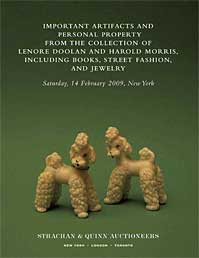
Leanne Shapton’s Important Artifacts and Personal Property from the Collection of Lenore Doolan and Harold Morris, including Books, Street Fashion, and Jeweleryis such fun I’m not sure I can do it even a smidge of justice here.

Presented as an exquisite auction catalogue, the book is 129 pages of photographs and ‘Lot’ descriptions of items belonging to the fictious Lenore Doolan and Harold Morris from the time they meet until their breakup some years later. Sheila Heti ‘plays’ Lenore to Paul Sahre’s Harold and the photographs of them are so real (goofing in photo booths, cooking, hanging out with friends) disbelief is well and truly suspended; they are Lenore and Harold. Sheila who?

The catalogue, in essence, catalogues the couple’s meeting and courtship through postcards sent, unique gifts, books with inscriptions, souvenirs and so on, through their relationship and ultimate breakup.

Despite there being no ‘story’—not one bit of narrative or dialogue—there is a definite rhythm and tension to the ‘stuff’ as it’s presented and we come to know these people intimately through their shoes, musical tastes, playbills, party invitations, dishes, clothing, sunglasses, handmade cards, tea towels, recipes, various doo dads and quirks.

LOT 1174 / A half a wishbone / The winning side of a turkey wishbone. Kept by Morris in his bedside table. Length 3 1/2 in. / $5-10

LOT 1197 / A small headlamp / A halogen headlamp, affixed with an elasticized cloth band. $12–15 / Used by Doolan for reading in bed.

A black and white photograph of the item (and often Doolan and/or Morris) accompanies each Lot description.

Towards the end of the catalogue the items slowly reveal a change in the relationship. A broken coffee mug, notes of apology, a white noise machine, restaurant receipt showing the main courses cancelled. Among the last items are pressed flowers and four-leaf clovers kept by each, separately.

Very cleverly done.

Apparently Shapton, a former Torontonian now living in NYC where, at the time of the book’s publication (2009) she was the art director of the New York Times op-ed page, got the idea after attending an auction of Truman Capote’s belongings (at which she purchased his overcoat).

I can only imagine the planning and execution of the book must have been both daunting and a complete blast.

Note: After writing the above, I then googled around for links and, to my horror, stumbled upon this. Good god. The whole magical point of the book is that there is NO action; the ‘stuff’ is what brings the people to life. I somehow can’t see Brad Pitt taking a backseat to a salt shaker.

And that may very well be unfortunate.

~

Important Artifacts is available for purchase online at Blue Heron Books.

Indie love.  ♥


From the Re-Run Series: originally posted in June, 2010.