from the bookshelves

 
The culling continues.

New shelves = less space for books = the slow process of reading obscure things in order to make Keep/Toss decisions.

This weekend’s obscurity mission turned up one toss and one brilliant gem.

The toss: a paperback on the monarchy in which one learnt (among other things, how to use words such as ‘one’ and ‘learnt’) that the Queen travels with dozens of merrymakers (many many more than one can even bloody believe), including a Yeoman of the Plate Pantry and a Yeoman of the Glass and China pantry. Yes, they travel with her, and no, the plate guy cannot do china. (And the fact that one does not know the difference between plates and china is exactly why one is not in the monarchy.) Also a hairdresser, footmen, Household Cavalry troopers, ladies in waiting and maids for the ladies in waiting, various clerks and secretaries and personal assistants. A page for pity’s sake. To name but a few. Oh, and her own water supply, which deeply offended the Austrians on a trip to Vienna, given all that fresh mountain stuff they have there.

The gem: A Tough Tale, by Mongane Wally Serote, which I’d paid 99 cents for at Goodwill who knows when and had never read. I was blown away; published in 1987, it’s one long poem about life under apartheid but contains not a whiff of anger. Frustration, sadness, disbelief at the depths humanity can sink, yes, but no rage, no resentment. In one passage Serote refers to the futility of complaint by comparing what’s happening in his country to a mother who’s gone mad, “…you would rather help her to sanity than just talk about her madness.”

My favourite bit comes near the end and though not quite the last word, it could be. It stops me dead and I read it over and over again before I can carry on with the last few pages. I keep thinking about the ‘gift’ of sudden freedom, the reality of And Now What?—that all important question after liberation of any kind, including that currently being experienced in Libya, Tunisia, Egypt and elsewhere, the ‘freedom’ given to the aboriginal people to live in their corrugated houses of mould, the freedom of an abused woman who, after somehow finding the courage to walk out, after the women’s shelter, the counselling and a bag of clothes, one day finds herself holding a set of keys, opening the door to her new home and standing, with the memory of her bruises, in an empty room.

… one morning
my people will hang on a sunrise
as a child after falling would to its mother;
the morning
we shall stand face to face with the sun
like a woman would
who has been raped and raped and raped
a woman whose eyes will stare
whose face will be there without expression
for indeed
many words, many deeds and many things
shall have lost their old meanings;
we shall stand face to face with the sun
we shall hang on a sunrise
perch on the dawn of a day
leaving behind us
so many dead
wounded
mad
so many senseless things
we shall have buried Apartheid—
how shall we look at each other then,
how shall we shake hands,
how shall we hug each other that day?
ah
how shall we smile and laugh
what first words will we utter?
We are a wounded people
so many nights
have we huddled into our dark night
hurt
crying
learning to fight anew
so many nights—
what shall we look like when that sunrise
comes?
what shall we do with its first minute
first hour
first day?

from A Tough Tale, by Mongane Wally Serote

this is not a review: the forgotten waltz by anne enright

Oh, Anne Enright. I do love your words so. The way they lie there on the page, end to end, magically forming sentences. I’m sure it’s all quite effortless of course, this brilliant way you have of conveying things. I have no doubt it’s as simple as wandering about your life, observing, thinking, mulling, fashioning bon mots almost accidentally as you shine your shoes or select grapes from the fruit monger’s stalls, and then having them fall out of your head, the words I mean, clunk clunk, onto the pages at just the right time in just the right order. Oh look! you might exclaim, That’s exactly what I meant to say, exactly what I was thinking, I don’t need to change a comma… someone peel me a grape…

The Forgotten Waltz, Enright’s most recent novel, begins simply, with a glance over a shoulder and a child. It’s classic girl meets boy. Gina meets Sean. Both are married. Both of them not especially unhappy or happy, not especially well matched or mismatched.  And then there’s the child—his, Evie, who is not quite right—a tendency towards seizures or something never clearly defined—a situation that parallels Evie’s eventual role in Gina’s life, and vice versa. There is little emotion expressed yet it’s all about emotion, driven by a thirst for it and then regret in its inevitable passing and morphing into something resembling real life. The way things do.

What gives the book a delicious tilt is the vantage point Enright chooses to tell the story, i.e. from Gina’s current status happily (happily?) living with Sean. The thrust of the story is her recollection of the affair, its building blocks and motivations, the changes that occur, things given up and left behind in the pursuit of what feels like love and in fact may well be. The eager or reluctant, sometimes regrettable, tradeoffs and surprises en route, hidden costs and, most importantly, the thing no one ever thinks of: the landscape at the end of the day— the stuff that comes with as well as that which is forgotten once the music stops and the lights come on.

… In which case, Evie’s room is like something after the tide went out: dirty feathers, scraps of paper, endless bits of cheap, non-specific plastic, and some that are quite expensive:

Do you know how much those fucking things cost? says Sean, going through the compacted filth of the Hoover bag, looking for a game from her Nintendo.

My stuff, on the other hand, does not matter. A Chanel compact, skittering across the floor, my phone pushed off the arm of the sofa, the battery forever after temperamental.

Gawd, says Evie.

She does not say ’sorry’, that would be too personal.

Evie was always a bit of a barreller, a lurcher; her elbows are very close to her unconscious. At one stage they were going to have her checked for dyspraxia, by which they just meant ‘clumsiness’, but I guarantee you I have seen her move with great finesse. In this house, she is only clumsy around things that belong to me.

She eats nothing she is asked to eat, and everything that is forbidden. But she eats. Which I consider a minor miracle. She filches, she sneaks and crams. She waits—a bit like myself indeed—until her father is not there. The place we meet most often is at the fridge door.

Two months ago, when Sean was at the gym and Evie was complaining I had finished all the mayonnaise, I tossed my bag on the kitchen table and said, ‘Why don’t you go and buy your own fucking food?’

Not pretty, but true.

Evie looked at me, as though noticing me for the first time. Later that day, she said something to me—something that wasn’t just a whine, like, ‘Why don’t you have Sky TV?’

She said, I can’t believe you have so many shoes.

And I had to leave the room to stuff my knuckles in my mouth, and pretend to bite into them, behind the door.

—from The Forgotten Waltz, by Anne Enright (McClelland & Stewart)

read me a story… no, wait, don’t

“Readings can be tricky affairs,” Irish author Aidan Higgins wrote. “There’s nothing more calculated to cause a gritting of the teeth, a shudder of the spirit or even a rising of the gorge than to be voluntarily confined in a Function Room to endure an hour-long ranting by the author in person, of predigested matter now regurgitated, delivered in a monotonous drone. It is enough to make a cat laugh or a dog throw up.”

So begins a piece by Douglas Bell in Saturday’s Globe, in which he goes on to wonder why readers “…who experience the writer’s work as an entirely private matter turn out in such numbers to experience it again as a public performance?”

Good question, though I’m glad they do. While it’s true that a bad reading can make you look around for something tall to jump off, a well executed one can be great fun, enhancing the private read and giving another dimension to the work. Also, not everyone at a reading has read the book; for many it’s their introduction. This is a good thing, no? People who haven’t read it are likelier to buy it. Which is why I can’t understand authors who don’t make the most of these events by making it an event rather than a dry reading. How hard is it to offer up a little background to the story, for instance? A bit of chat. A merry anecdote or two about the research or the way such and such a character wouldn’t take no for an answer. Anything.

Granted, public speaking and/or reading is an art and some people are just easier with it than others (recently heard Claudia Dey ‘do’ How to Become a Bush Pilotnow there’s an event; and the first time I heard Ann-Marie MacDonald, well, you forget she’s reading, you think you’ve bought tickets to a one woman play) still… readers seem to fall into three categories.

1/ Naturally brilliant (usually meaning they’ve taken the time to prepare and treat the whole business in a professional manner even if they appear ultra casual).

2/ Naturally enervating (often due to an over-infatuation with one’s own voice).

3/ Naturally somewhere between brilliant and enervating (a tolerable scenario, but why not, with just a soupcon of effort, be so much more… I mean we can all read the stuff ourselves… what the audience wants is not to hear the words but to experience the book through the experience of the author).

I say all this as if I know what I’m talking about. As if I spend my days poncing about entertaining the masses. Pay no attention. Just random thoughts on how maybe to enhance a fairly essential aspect of the The Process, for both reader and listener.    

Additions to the list would be welcome!

—  use a mic if you’re a soft speaker or if the room warrants it; it’s a rotten business to have to strain to hear

—  unless you’re reading a whole short story (in which case, dear god, please make it short) let the audience know a bit about the overall premise of the piece/book

—  best not to read the dullest bit even if it has the cleverest words; action is good, humour is best

—  mark up places to pause, and then pause there (you will not come off looking like a dork, honest)

—  slow down; however slowly you think you’re reading… slow down

—  preface and/or break up the reading with those afore-mentioned bon mots and asides to the audience

— leave time for questions, and have a few favourites from past readings that you can share to get things started

Finally, as an audience member, pack a few general questions— even if we haven’t read the book we can ask about the subject matter, or what inspired the writer to begin the project. It’s always so painful when no one raises their hand for the first five minutes. Heart-breaking if it goes on any longer.

Happy reading, happy listening.

Let’s see… I think I’ll start with the bruschetta…

today’s great garbage idea

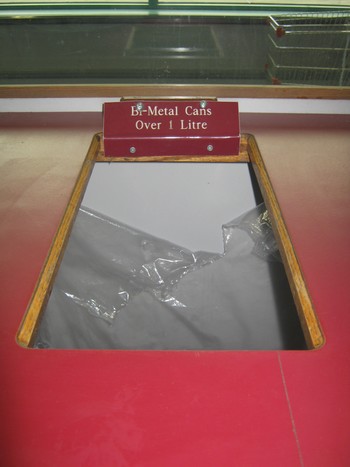
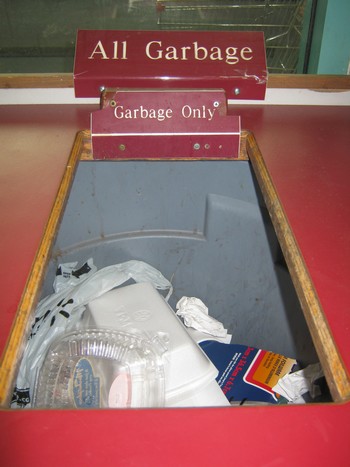
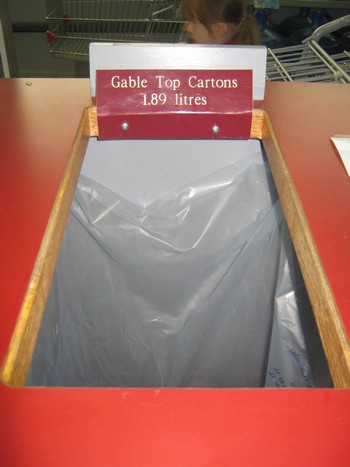
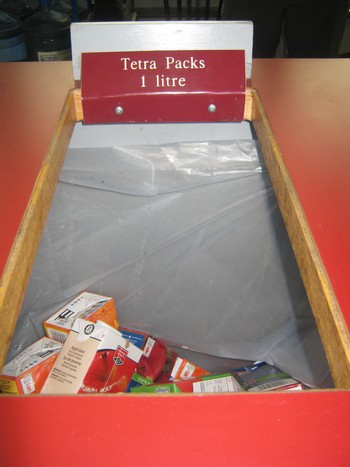
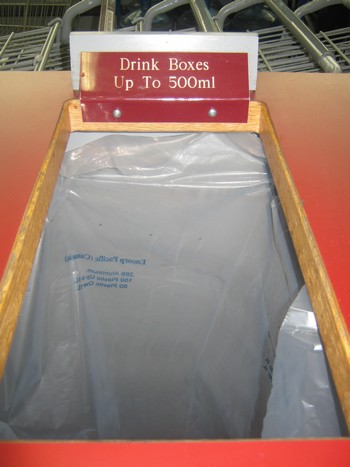
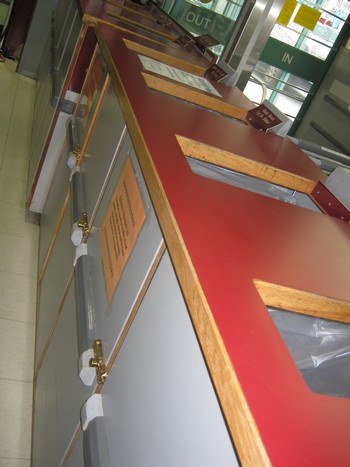
Best system I’ve ever seen (actually had more bins/categories than I’m showing). I get excited about well-organized garbage. Also about garbage well used. Like these beautiful duds made entirely from recycled pop bottles (amazing; stuff like this makes my heart sing).
And all this, in a teeny weeny grocery in teeny weeny Keremeos, B.C. All of which begs the question of how to make this level of ‘separation’ normal everywhere— and more clothing manufacture (etc.) from the takings… aka: Garbage for Good.

excuse me a minute while i navel gaze

 
While I don’t completely love the fact that our tidy new bookshelves hold considerably fewer books than our old disorganized disaster, I’m enjoying the eclectic reading it’s allowing as I do a very careful scan of every volume before chucking on the Keep, Toss or Not Sure pile. This weekend included a few memoirs, one by May Sarton—Recovering—about the writing life, solitude, loss, the need for occasional navel gazing, and ultimately getting back in gear. Written in 1980 when Sarton was in her late sixties, it smacks of a gentler time in some ways, yet, at the root of things, not that much has changed. We still thrash about when it comes to ‘the writing life’, still need solitude—maybe more than ever—still need to limit the navel gazing and find ways of getting back to work, no matter what. Because that’s what the whole shebang is about, n’est pas?  

Another was an obscure book of tiny essays, observations mostly, some letters, reminiscences, Creative Living, by someone I’ve never heard of, Doris Henderson. I didn’t mean to read every word, but before I knew it, I had. Born in 1900, she writes about her involvement with the Esperanto movement in 1961; she remembers the first world war, the second…

While the people of all lands had been relaxing from [WWI] and drugging themselves with the uncomfortable belief that another war would be unthinkable, their military establishments had been increasing the quantity and efficiency of their arms, with great financial profits to all concerned.”

… the Korean.

She writes about the privileges of being a British woman in China in 1920 and how that made her both grateful and uncomfortable. About the shock of racism in 1950’s Louisiana and how in 1965, she and her husband were in Wales and on a whim decided to drop in on Bertrand Russell, someone they admired but didn’t know from Adam.

“When we knocked on the door of his home, a grandchild came and invited us in. After we told the child we were from Canada and hoped Lord Russel could spare us five or ten minutes of his time for a brief visit, Bertrand Russell greeted us and invited us into his office.”

Okay. Some things have changed.

One of my favourite bits is from 1970 when she found hippies camping on her property and instead of shooing them away she tried to understand their philosophies and in the process began a long friendship and correspondence with one of them, a young woman named Gail, who wrote: “…This is one of my reasons for my optimistic outlook for my generation. We may appear to be rebels, but we are not rebelling against the basic philosophies of religion and the Good and Right. We are rebelling against [the hypocrisy of nationalism] that can rationalize war, capitalistic Americans who can rationalize exploitation, and religious loyalists who can rationalize bigotry and prejudice.”

—and signed off with Love and Peace.

Then again, some things don’t change…

I also found a thin volume titled Mark Twain: By The Riverside, which contains many of his bon mots, short essays, pictures of Hannibal, Missouri, and something called a Mental Photograph Album, a short questionnaire, sent to him by an unnamed New York publisher. Am thinking of making it my xmas card this year, sending it to friends with a return envelope. (You know who you are and you’ve been warned.)

For now, I thought I’d include it here—and then follow it with my own answers. Which is where the navel gazing really begins.

~

Mr. Twain’s—

WHAT IS YOUR FAVOURITE TREE?

Any that bears forbidden fruit.

FAVOURITE GEM?

The Jack of Diamonds, when it is trump.

WHAT IS YOUR IDEA OF HAPPINESS?

Finding the buttons all on.

WHAT DO YOU MOST DREAD?

Exposure.

WHAT DO YOU BELIEVE TO BE YOUR DISTINGUISHING CHARACTERISTIC?

Hunger.

WHAT ARE THE SADDEST WORDS IN THE WORD?

“Dust unto dust.”

WHAT ARE THE SWEETEST?

Not guilty.

WHAT IS YOUR AIM IN LIFE?

To endeavour to be absent when my time comes.

WHAT IS YOUR MOTTO?

Be virtuous and you will be eccentric.

~

And mine—

WHAT IS YOUR FAVOURITE TREE?

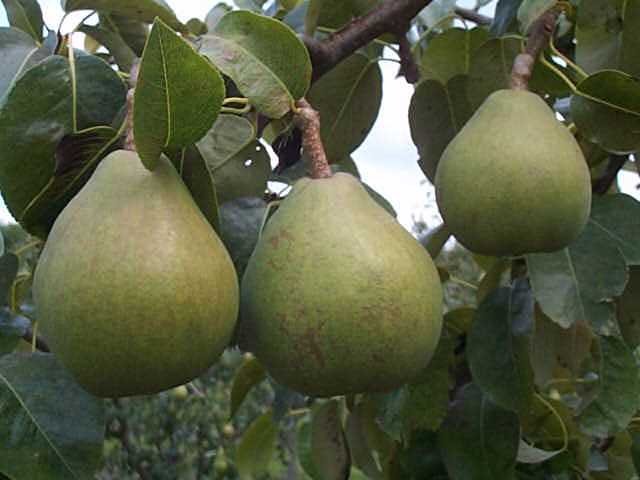
Pear. Have spent many happy hours in one (some years ago now).

FAVOURITE GEM?

Beach glass.

WHAT IS YOUR IDEA OF HAPPINESS?

Radish sandwiches in a cabin in the rain.

WHAT DO YOU MOST DREAD?

Running out of garlic.

WHAT DO YOU BELIEVE TO BE YOUR DISTINGUISHING CHARACTERISTIC?

A combination of something naive, earnest and skeptical.

WHAT ARE THE SADDEST WORDS IN THE WORD?

I hate.

WHAT ARE THE SWEETEST?

Hello you.

WHAT IS YOUR AIM IN LIFE?

To finish all those projects.

WHAT IS YOUR MOTTO?

Remember to say thank you.

apropos of nothing

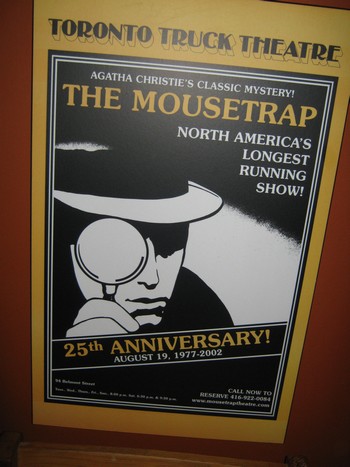
The Mousetrap played at the Toronto Truck Theatre on Belmont Street from 1977 to 2004. For years I walked past the place on my way to and from work, yet didn’t see the production until minutes before it closed for good. Lucky for me, I’d never read a thing about it or spoke with anyone who’d seen it or heard the slightest peep about the premise. In other words, I was completely and blissfully in the dark—the perfect condition for going in. Certainly Agatha Christie would have approved. It’s said she requested that audiences be asked, at the end of each performance, not to divulge who-dunnit to those ‘on the outside’.

It might be worth mentioning that I’m the kind of person who doesn’t flip to the end of a book to see how it turns out and if you give me a journal filled with juicy bits of gossip and ask me not to open it, there’s a very good chance I won’t. Nor do I poke, shake or otherwise try to determine what’s in a wrapped gift before its time. I’m not especially blessed with willpower, my curiosity just doesn’t live in those areas. Well, okay, the journal would be interesting…

Plus I tend to prefer a natural unfolding of events.

In any case.

And apropos of nothing—

—except that the dust on the poster on my wall caught my attention recently and reminded me how, a couple of days before we were about to see the show—in the last week of its 27 year run— Andy Barrie, on CBC’s Metro Morning happened to be talking one day about having seen the Mousetrap in London and how he was late getting to the theatre and forgot to tip the cab driver who was so pissed off he yelled after him: The (XXX) did it!

Only in his version he said Who did it.  (I’m omitting that bit in respect of Ms. Christie’s request…)

Ha ha! Oh that Andy Barrie, I thought. He does tell a good story… and then it occurred to me that… pffft… just like that, a whole lifetime of useful ignorance on my part was down the pan. 

The good news is that, in the end, it didn’t actually matter because the story is brilliant and much bigger than Who.

 [Does it ruin it for you to know the ending of a book/play/story/film?]