altered reality
uh oh
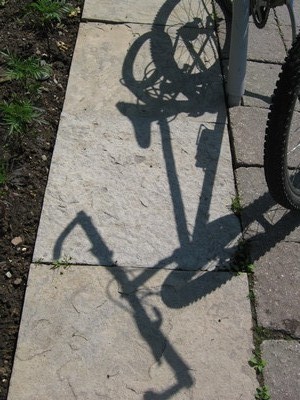
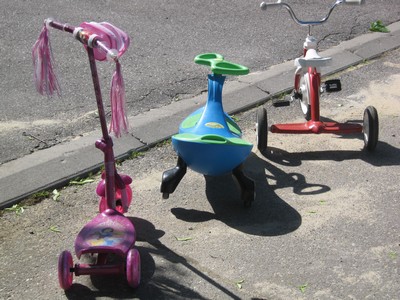
Seems our neighbourhood is home to a bike gang.
salt, etc.
I don’t know where to begin exactly. Aren’t endings supposed to come with their own beginnings? Doors and windows closing and opening…that kind of thing…
When my mum (we called her Phyllis although her name was Elizabeth) died on Friday, a door slammed shut. Well… it closed anyway, firmly and forever. And then I got up and closed all the windows. And despite what I’ve been doing since: arrangements, calls, notes, wandering, staring, I’ve been doing it in this unfamiliar and increasingly airless room. The metaphor feels right and comfortable; no need for oxygen when you’re holding your breath.
But today, not quite a week later, I notice the sun is shining. It shows up the dust that’s accumulated from the ongoing basement reno, which, ironically, we began so that we’d have a place for Phyllis after her stroke. When I told her we wanted her to live with us she smiled, was grateful but said she hoped she’d die first, that she didn’t want to be a bother, that we might not get along. I worried about that too but I thought there might be enough that was good to make it work—and anyway, she’d be useful, she knew things I kept forgetting: how to prune the blackberries, make pumpkin compote, remove burned on stains from pots, cure sore throats and earaches with herbs from the garden—the original nature girl, raised on a farm, she used to milk cows, make butter, spin wool, grow flax, weave her own linen with it for god’s sake. She carried sacks of grain on her head to have them milled into flour. She had no idea any of this was interesting. I had to pry the stories out of her.
I open a window. There’s a breeze. Kite weather.
Not only is there dust everywhere, the house is in disarray, debris all over the kitchen table, a puddle of stationery that would take two seconds to stack, sling an elastic band around, but it’s more time than I care to give. And I’d have to walk to the kitchen drawer for the elastic.
The very idea exhausts me.
So I leave them spread out and messy instead, along with a box of Sifto from the nursing home where the eggs were always bland she said. What am I supposed to do with a box of Sifto? I prefer sea salt. Should I throw it out? I don’t know. I don’t know… I’ll think about it later. And anyway it’s not hurting anything standing there next to a pair of green gloves from my coat pocket (it’s May, I don’t need gloves; where do they go?) and a new dust mop cover—pale blue, soft like a baby’s washcloth; I may use it soon. Or not. There’s a crossword, a tea stained mug, a basket of seeds, a few pens, a notebook, the Saturday comics with a Pardon My Planet that shows an old woman in her casket and beside her a man—husband? son?—telling the priest he’d like a few minutes alone with her while her mouth is shut. I’m not sure if I should find this funny or not but I leave it there next to the salt and the gloves and a stone from the beach that meant something once, I don’t remember what, and a bill from one of her caregivers and a letter I’d been writing to a friend before all this happened. Should I still send it? The old news is relevant though overshadowed by recent events…
I have no idea how to tidy this mess. The best I can do is ignore it, walk past it a dozen times a day, watch new things appear: sunglasses, lip balm, sixteen dollars and sixty two cents.
It’s the salt that finally gets to me.
I open a 1963 Pocket Book edition of Hints from Heloise—Phyllis thought Heloise was a genius for solving modern day problems such as getting gum out of shag rugs but the only use she offers for salt is to reduce suds from a dishwasher or washing machine. I do a google search. There are, apparently, 44 other things to do with salt. #18 for instance: “Remove old stains from teacups by rubbing with salt and a bit of water.”
I take a long breath, pour some Sifto into a badly stained mug, add a drop of warm water and presto it’s like new.
That’s one.
It’s a start.
thirty truths: 29
I said I didn’t care, that it was just a wedding, a couple kids getting married, what’s the big deal? All that money down the pan. Who cares about The Dress? The whole thing’s a little too ‘too’ for my taste. I said I wouldn’t watch.
The truth? Ah well… didn’t they look happy?
Balcony kiss still to come.
And much to my own bewilderment, I’ll be there.
yes, virginia…
And there’s an Easter Bunny too.
(caught here leaving the scene of the chocolate early yesterday morning, and yes, I do know it looks like it might just be a cat out for a stroll or a fox or possibly a miniature deer, but I assure you, it’s a bonafide cottontail)
delinquent paths
So I have a labyrinth in the backyard this year…. Doesn’t everyone? Really just a series of paths I’ve paced out in the snow, all connected, most of which follow the regular paths underneath, but some—and I love these best—run like delinquents straight through the middle of perennial beds, through the tall grasses, behind the spruce, across the veggie garden. Places I normally don’t walk. (There’s something very freeing about traipsing cavalierly over ice-encrusted earth where in just a few short months tender asparagus will present itself for my dinner.)
Cheap thrills, I know.
It wasn’t planned; I made this accidental circuit one night when I didn’t feel like going out for my usual walk through the neighbourhood. I wasn’t in the mood for cars and street lights so I walked in the yard instead under Orion’s Belt, up to my shins in virgin snow.
Only afterwards did it occur to me that I suddenly had my own personal head-clearing, right-outside-the-back-door well trodden walking ‘circuit’. I’ve come to love how I don’t have to plan A Walk, that I can just throw a jacket on over my bathrobe, stick my feet into boots and do a quick ten minutes before breakfast.
At first, of course, I felt like an idiot walking in my backyard. I think that’s what gave it the labyrinth vibe—the way it reminded me of years ago at Trinity Bellwoods Park in Toronto, how I’d been a minute into the labyrinth there, wondering when the magical life-transforming meditative qualities I’d read about would kick in, when a group of teenage boys showed up. As I tried to focus on my steps, they got comfortable, leaned against a wall, laughing and pointing. Apparently I was a scream.
I so desperately wanted not to care, to be already transformed, above such piffle. Instead I found myself concocting a plan where I’d make a quick and dignified exit, muttering just loud enough… something about that damned earring—where could it have gone??
But I’m not a very good actor, so I kept walking. One foot in front of the other. And then the other. Again and again and so on. Finally, finally, finally, as I made the last turn to come out, I realized I wasn’t thinking about the boys anymore, in fact I couldn’t remember when I’d stopped thinking about them—I hadn’t even noticed they’d gone, that the place was quiet. For how long, I had no idea.
It was the first time I’d tuned out. In a good way.
A testament, I guess, to the power of the labyrinth, essentially the absence of destination that lets the mind relax. Also a repetitive quality helps, a constant looping back and forth.
Qualities my own faux labyrinth has in spades.
True, it takes time to get past thinking the neighbours might peek through the hedge and call someone, but I love how eventually I forget about them, and most other things, and just walk—just following my own circuitous, well-trodden paths between Echinacea stalks, behind the blackberries, down this way, then that, turning right, left, along the cedar fence, criss-crossing the patio, past the bird feeder, the serviceberry—knowing it’s there but seeing none of it—and back again.
At least until the snow melts. After which, it’ll all disappear into a distraction of well-behaved stone paths that beg to be followed, perennial beds too crowded to walk through, things to cut and trim and pull and plant. Not to mention the big invisible sign over the asparagus that reads: Trespassers Will Go Hungry.
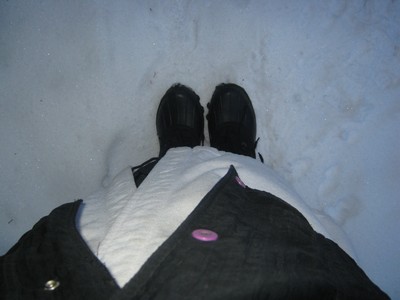
Until then, consider me occasionally and happily tuned out.
~
the year as ‘found’
In the spirit of reflection… (and following a prompt from The Indextrious Reader) I’ve rounded up the first sentences of the first post from *each of the past twelve months to create… uh, well, a document of first sentences, which I then rearranged slightly—in the spirit of amusing myself…
Et Voila!
2010 as Found
Snowing gently this morning as I sit outside with a cup of rooibos tea and watch geese, hundreds of geese, fly over the backyard—so quiet is the world I can almost hear each one of their wings. Over at Front Door Back Door—I note the moment we felt the earthquake, the sismo. I don’t know why Rona Maynard’s post on pilates and writing should make me think of something I read the other day about Marina Abramovic—the performance artist who recently closed what sounded like a most bizarre and amazing show in NYC, and is known for her ‘experiments’ in art through human nature—but it does. Find a lonely tree that needs some love.
“Man has no body distinct from his soul, for that called body is a portion of the soul discerned by the five senses.” (Wm. Blake)
Depending on who you listen to—either today, yesterday, or tomorrow is the Feast of St. Mary of Egypt, patron saint of penitent women who formerly lived in sin. Am celebrating the 143rd birthday of our grand beau pays with my favourite things: words and food. Parsley, sage, rosemary and thyme. And I don’t mean cheerio as in ‘goodbye’, but as in cereal…of course.
“Tea should be taken in solitude.” (C.S. Lewis)
Writing from a garret in London, Ontario. Coming along just swimmingly thanks.
~
Hoping everyone has a safe and happy one…
Amusez vous bien!
~
*From whence they came…
January Snowing gently this morning as I sit outside with a cup of rooibos tea and watch geese, hundreds of geese, fly over the backyard—so quiet is the world I can almost hear each one of their wings.
February “Man has no body distinct from his soul, for that called body is a portion of the soul discerned by the five senses.” (Wm. Blake)
March Over at Front Door Back Door—I note the moment we felt the earthquake, the seismo.
April Depending on who you listen to—either today, yesterday, or tomorrow is the Feast of St. Mary of Egypt, patron saint of penitent women who formerly lived in sin.
May “Tea should be taken in solitude.” (C.S. Lewis)
June I don’t know why Rona Maynard’s post on pilates and writing should make me think of something I read the other day about Marina Abramovic—the performance artist who recently closed what sounded like a most bizarre and amazing show in NYC, and is known for her ‘experiments’ in art through human nature—but it did.
July Am celebrating the 143rd birthday of our grand beau pays with my favourite things: words and food.
August And I don’t mean cheerio as in ‘goodbye’, but as in cereal…of course.
September Coming along just swimmingly thanks.
October Writing from a garret in London, Ontario.
November Parsley, sage, rosemary and thyme.
December Find a lonely tree that needs some love.
~
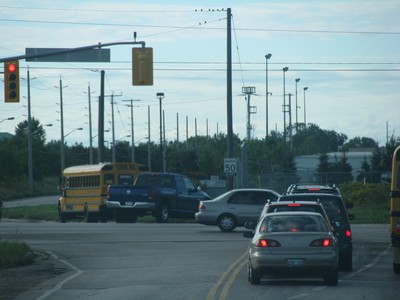
bus therapy
Is there a name for a fear of school buses?
Whenever I see one I think of an unfortunate grade five field trip to Martyr’s Shrine in Midland, which involved lunch en route. The details are unimportant—let’s just say it was a long time before I wanted another egg salad sandwich.
I blame it entirely on the bus.
 I remember heat and diesel fumes and kids screeching and shouting and black leather seats stuffed with something like concrete and how you could feel every pebble and bump on the three hour road trip.
All of which made it difficult to read.
I hadn’t yet learned that reading in a moving vehicle makes me woozy. Or that the whole point of everyone singing was to ward off the woozy in the first place…
There was much ewwwing in my direction after the egg salad. Mortifying of course, but there was also less general shouting and screeching, which at least improved the ambience a titch.
Yin yang.
I remember almost nothing of Martyr’s Shrine. It may be a big white building, it may be orange stripes. I think there are stairs and flower beds and I do recall a pile of canes somewhere and being told they belonged to people who’d come and been ‘cured’ by saying a prayer. I don’t remember doing so but if I’d been smart I would have taken the opportunity to say a little something for the trip back.
It seemed eons before I saw another school bus—or maybe I was just blocking them out. Then a few months ago, I notice I’m on some kind of Laidlaw route—following, passing, waiting behind, at  least a dozen school buses each morning—each one a reminder of egg salad gone bad. I braced myself for life in a very uncomfortable world.
Oddly though, as time goes by and, annoying as the bloody things are with their little stop-sign power trips, habit of driving the speed limit, and the way they linger at railway crossings—which is so creepy and only makes everyone else wonder if they know something we don’t—it’s actually turning out to be a good thing, a kind of exposure therapy. The more I see them from the outside the less I think about their butt-numbing acoustically horrible bump bump bumping endlessly stopping and starting and stopping and starting and stopping and starting diesel spewing nausea tub insides.
So, yeah, the more the merrier, I say.
In fact, I can hardly remember the whole Martyr’s Shrine fiasco. Martyr’s Who? What egg salad?
See?
So nice to be moving on.
~
ways of spreading holiday cheer: #1
Find a lonely tree that needs some love.

Add baubles.
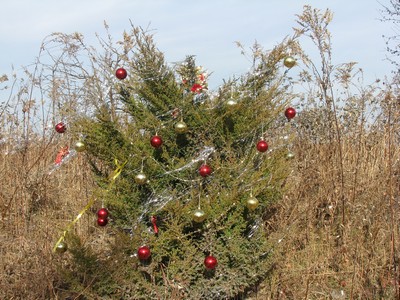
—Voila!
When I saw two very merry women giggling in their sneakers, throwing tinsel onto this tree—all rosy cheeks and grey hair (god bless femmes d’un certain age)—I just had to stop, didn’t I. They looked a little tense as I walked over, then one says Oh, man, for a minute there we thought you were the cops. I considered pointing out that I drive a toast coloured Toyota, but they’re already back to laughing and when I ask why they’re decorating the tree, they say for fun.
Of course!
Makes sense to me.
Although popcorn or cranberry garlands are preferable to tinsel. Better for wildlife.
And don’t forget to clean up after the hols!
~
one tin soldier
Each morning I visit the nursing home where my mother now lives. I help her dress and give her breakfast. I always leave by 10 a.m. But this morning, Remembrance Day, when we walk to the common room for a bit of exercise, the chairs, each with a photocopy of ‘O Canada’ on its seat, are lined up in rows facing a podium. There’s a large screen at the front and poppies everywhere.
I consider staying the extra hour or so but Phyllis isn’t interested in ceremonies. Me neither. I prefer observing my own two minutes of silence, alone and in my own way. We find a sunny spot at the back of the room, and I read Barbara Kingsolver’s piece about water in the National Geographic while Phyllis sleeps in the chair beside me.
It’s nine thirty. I’ll take her back to her room at quarter to ten.
But at twenty to ten they start arriving.
Soon there’s a row of four men and one woman seated beside the podium, facing the rows of chairs. “Residents who served” I overhear someone say. One, in a wheelchair, sleeps with his head back and mouth wide open. The woman sits quietly confused with her ankles crossed, and a happy man with a British dialect tells everyone who passes “you’re wonderful”, and to the man with dementia beside him who’s beginning to nod off and fall sideways, the happy man says Are you alright, Tom?
Someone straightens Tom out and asks what it was he did during the war but Tom just looks straight ahead. The happy guy says: What we all did… sink or swim.
More residents are wheeled in. A few come with aluminum walkers or a nurse. None come unassisted. The room is filling up with bodies and sounds. Phlemgy coughs, orphaned words, mumbles. The woman who yells all day I want to go home, somebody help me, what am I going to do? arrives, pushed in her wheelchair by a nurse and placed at the front of the room. Where am I? Where are you taking me? she yells. She has terrible teeth and long thin hair. I’ve never seen her family; she may be one of the many abandoned to the system, completely dependent on the mood of staff and Ministry guidelines, at the mercy of Long Term Care politics and rubbery cream of wheat.
‘One Tin Soldier’ plays in the background. By The Original Caste. I remember being young and hearing it for the first time and not really understanding what it was about. Listening to it now, surrounded by so many drooling tin soldiers of yore, it takes on even deeper meaning and I realize I’m staying for the ceremony.
I stay for these men and women who did, and others who continue to do, in a mad world because it’s, sadly, still the only way any of us knows to say thank you. I stay because we’re all a product of our past and because we’re all connected whether we like it or not.
I stay for my dad whose only comments about the war had to do with unexpected kindnesses from all sides. He didn’t speak of heroics.
The German man down the hall from Phyllis is brought in to sit with former enemies, which makes me wonder at the word ‘enemy’. Circumstantial at best. They all sit quietly confused together now, eating the same gruel, wondering perhaps what it was all about anyway.
Oh, yes. A madman. There’s always a madman.
Tom keeps falling over so his son moves him off to the side where he can keep him upright. He’s brought his dad’s beret and medals and pins them on a slightly stained beige pullover. The son takes pictures of Tom, asks Tom to salute. Tom just stares straight ahead.
It would be easy to leave. Wake Phyllis and go. I don’t want to hear ‘In Flanders Fields’ and cry with strangers. But I stay because it’s such an honour to sit in among the muddle of their confusion, their dignity and continued bravery in this forgotten place of forgotten people where the beauty of old age is seen as ugliness, as something to pity.
During the ceremony I watch a daughter put a pink sweatered arm around her mother, pull her close and kiss her face. Another daughter is her mother, thirty or forty years earlier, so striking is the resemblance. A man in a motorized wheelchair wipes his eyes with a facecloth, says it bugs him that he can’t stand up to pay his respects. The happy man occasionally blurts out: Too much talking, too much talking and he’s right of course; there’s always too much talking. I notice his breathing is difficult, like my dad’s the year he died.
I notice the woman who yells all day is quiet.
And when eleven o’clock comes the whole room is suddenly hushed except for the sleeping veteran who snores loudly beside the podium and the happy man who says Hallelujah. But the muttering and coughing and shuffling stop. It’s like these people, who aren’t sure of much, can still sense what’s important. Maybe that’s what makes us human.
As the ‘The Last Post’ is played, and while I blow my nose, Phyllis wakes, looks at the rows of silent backs in front of us and says: Wow, it must be a good movie.
The ‘residents who served’ are recognized and the anthem is sung and then later a video clip is shown, based on a true story about a guy in a Shoppers Drug Mart who was outraged that the store observed two minutes of silence, causing him to wait—two minutes—to pay for his purchases.
The happy man is again saying Too much talking, too much talking, and when the video and the ceremony end, and we’re thanked for being there and all is done, the happy man, breathing hard in his veterans’ seat, says: Peace at last, peace at last.
On our way out, I stop and ask Tom’s son if I might shake his dad’s hand. He beams, says Sure! and explains to Tom what I want. Tom in his beret and strip of medals pinned to his sloppy sweater, stares back, silent. His son helps him extend a hand. It feels soft and weak, the kind of hand that hasn’t worked in years except maybe to scratch an ear, adjust a bib at lunch. I hope that on some level he might still understand what a handshake is. And even if he doesn’t, I do.
I try to find something in his eyes to connect with but they stare in a kind of trance; I wonder what they’ve seen and whether I’d have the stomach for knowing.
Thank you, sir, I say, and Tom’s son tells him: Say you’re welcome, dad!
And ever so quietly, Tom does.

 Matilda Magtree