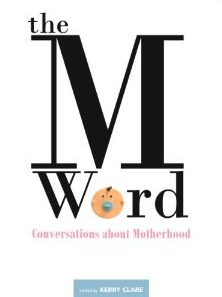
this is not a review: ‘the m word’, edited by kerry clare

 
Warning: today’s ‘Not a Review’ includes internal organs. But not until nearly the very end.

I’m not normally drawn to mothering books but I like Kerry Clare’s work, so it was impossible not to be drawn to her anthology, The M Word: Conversations about Motherhood. I knew I’d be in the hands of good taste and good writing, even if, as a Childless Woman, I couldn’t actually relate. Well, what happened was this: I found myself not only enjoying the read, but relating. In a major way. Because, as it turns out, the essays are both about mothering and not mothering, about the exultant and the reluctant, the non-mothers by choice, the stepmothers by circumstance, women who will do anything to be come a mother and those who will do anything to not. And in every scenario, the difficulties, joys, fears, the way life is changed for the better and sometimes for the not entirely better. There are celebrations, regrets, and such honesty that it’s really quite impossible not to relate.

In other words, there’s something for everyone. Even me. Because if you’re a woman, you fall into some category where motherhood is concerned. This, whether you like it or not. You have the parts. And if you don’t, that may be the problem, or the celebration, depending on your outlook, your personal goals.

And that it is so personal is what I most enjoyed about the book. The writing, yes, but I wasn’t merely reading, you see, I was being drawn into this conversation, being reminded that yes, I also have a story, some history on this subject. And let’s hear it, the conversation seemed to say, because as you can see, no woman is excluded from this club, for here is a truth: if you’re a woman it’s pretty hard not to have a few thoughts on the motherhood thing.m-word-cover

The book is arranged alphabetically, which happens to fit nicely with its ‘lettery’ title, but more importantly it allows for accidental juxtapositions rather than any kind of predictable narrative.
I read it backwards.

Michele Landsberg in the Afterword, on the surprising role of grandmother: “Even though I haven’t had to consider the effect of a child on my lifestyle, the negative or the positive, less is said about that—guilt? It’s interest/improving to help understand friends who’ve been through it because still decades later they talk about it.”

And on over-thinking, a beautifully rendered piece by Julia Zarankin. “If I have a baby in March, when should my husband begin taking driving lessons?”

Sara Yi-Mei Tsian considers the implications on her work: “Motherhood is a study in conflicts, which is why it attracts me as a writer.” and this… I just love this: “…there is a certain nugget of truth… that all writers would like to avoid. We cannot give voice to a character based on someone real without silencing, at least in part, the person who inspired us.”

Patricia Storms presents a graphic essay about the joy of “working for” kids and living without them. And how that’s not something a lot of people seem to understand.

Kerry Ryan on ambivalence about motherhood: “Do you have to have a maternal instinct from the get-go, or does it kick in with your breast milk? And if not, can you wing it, or is your child destined to become a serial killer?”

Heidi Reimer begins with ambivalence, then an adopted daughter, then gets to the “bone of my bone”, “the flesh of my fleshness” when she gives birth and experiences a different kind of love. “I had made a person! I would never do or become anything more important than this.” (Actually, that statement made me wonder about generations past. Did they feel this rush of omnipotence? Now there’s a conversation.)

To her credit, Reimer is painfully honest when writing about these differences.

“I am in love with Aphra, a feeling as effortless and unstoppable as breathing. My relationship with Maia is more akin to an arranged marriage: I made a choice I believed was right, and through that choice, over time a bond solid and close and beautiful as grown. A connection inextricable. If I am sometimes aware that this love was a choice, if that choice is sometimes taxed, so, too, are my relationships with almost everyone I love. Of the several people integral to my existence, Aphra is the only one who came from my body.”

On single motherhood: Fiona Tinwei Lam writes, “Not wanting to be married didn’t mean I didn’t want to have a child.”

And from Ariel Gordon, the need to protect her writing time and space and the choice to have only one child. “When it came right down to it I didn’t think I could be a working writer with more than one child. And I was unwilling to take a break when my writing and my writing life—the time I spent in the company of other writers at readings and conferences and retreats—were finally starting to gel.”

I admire her conviction, the wisdom to know her limits insofar as achieving her goals and how she sees there is more to give her child than a brother or sister to grow up with… but it’s interesting that the ‘maternal’ concern is still there.  “And so, even though the girl won’t have siblings to lean on… I’m hoping that she can lean on the texts I’ve left behind.”

Nicole Dixon chose to not have kids for a variety of reasons, not the least of which is an over-populated planet and consumerism run amok. More diapers and toys don’t help the situation. She justifies her position with a desire to allow herself to be a good citizen in so many other ways. that parents may not always put first.

“People often think that saying no to having kids means saying no to life. My choice not to have kids, however, is a choice made from love. I’ve realized that the legacy I want to leave on the earth after I’m gone is as small a mark, as tiny a footprint, as possible… My choice not to have kids does not close me off from my community or my planet. Instead, it allows me to nurture my own life and to mother everyone’s mother, Earth.”

Most are young or youngish mothers. Myrl Coulter is perhaps the single entry from a very different generation, and this is nice to see. Her piece on unwed mothers in the 60’s is especially moving. She was eighteen and in love with a seemingly nice guy. But marriage didn’t make sense. She became a ‘girl in trouble’ and was whisked away to one of the maternity homes that existed from the 1940’s through the 80’s.

“To call these places maternity homes is highly ironic: maternity homes were not homes nor did they function to promote maternity. They were institutions to house and hide those deemed maternally inappropriate. Also known as homes for unwed mothers, they were busy places in those days. Winnipeg, a small city, had three.”

These girls were not just thought to have made a bad decision one night in the rumble seat, but their whole character was judged and they were vilified. They were also thought to be without maternal instincts yet, curiously, they were denied contact with the babies they delivered, which only proves that everyone, even judgmental pricks, realizes the connection between mother and child.

**

So yes. I read, I enjoyed, I related, I remembered, and the remembering led me to a few other words. The N-D word for instance, as in Near-Death, because it seems fallopian tubes are not a welcoming environment for growing children and near death follows for the host but, before that, after much mysterious pain, internal bleeding, a severe drop in blood pressure and eventually, in the Emergency Department through an increasing haze as one slowly drifts away, the words: you’re pregnant. The only time I would ever hear that sentence where the ‘you’ was me. I remember it was oddly euphoric, even as I lay nearly dying.

The S word is also in my repertoire. Stepmother. I keep forgetting. Easy enough to do in a society that likes its consumers clearly defined as demographics and that doesn’t apologize for the twisted version of things that results when we slap a narrow label on something as big as ‘mother’.

The bottom line is this: The M-Word does what the best conversations do… it shares the stories of others while reminding you of your own.

**

Small note: If forced to offer a quibble it would only be with the choice of colours for the cover. In an effort to leave the pink and blue behind as we move forward, I’d have preferred anything but.

two things for a holiday monday

1.   Dear Moody Long Weekend Mornings… that conspire to keep their skies grey long enough to insist that I linger in bed fluffed with pillows and layered with pages—books, newspapers—and a pot of tea. Peppermint. Sometimes even going so far as to demand I have a square of dark chocolate.

My deep gratitude.
DSC00531

AND 2.   Dear Literary Press Group… who sent me a box of books that fit so well in the above-mentioned fluffing and layering. And all I did was like you on FB. How lovely you are, but please know my like is sincere and goes beyond any number of books (having said that, please also know I am beyond thrilled).

As for the books, well, they are perfectly exquisite gifts. The cover of each is a joy in itself.

I’ve already dived deeply into Rosemary Nixon’s Are You Ready to Be Lucky? because how can I do otherwise with an opening that goes: “Roslyn high-steps up Bantry Street on an icy Alberta evening buffeted by late-December gusts, holding high her sixty by forty centimetre tray of pineapple-stuffed meatballs, trying not to look like a woman who, at the yearly No Commitment Book Club Christmas gift exchange, received a can of gravy and… How to Seem Like a Better Person Without Actually Improving Yourself…”

There is also The Wondrous Woo, by Carrianne K.Y. Leung, and The Fleece Era, poetry by Joanna Lilley, which I’ve only peeked at and already love—not to mention that exquisite stock, the typeset, the black flyleaf. The words, did I mention the words? “I don’t look at paintings/ but at the walls on which they hang.”

Then there’s Swarm by Lauren Carter, a mildly dystopian novel about “a world only one turn of the dial from our own”, and a matter of survival by fishing, farming and beekeeping. My sort of thing. Finally—as if this bounty isn’t enough—A History of Breathing, a play by Daniel MacDonald that, based on a quick scan, I can’t wait to properly spend time with.

All of which to say: a thousand thanks, dear Literary Press Group. A box of books is no small event in this house.
DSC00532DSC00536DSC00537DSC00539DSC00540DSC00521_1

(at) eleven with barbara lambert: the whirling girl


I have a thing for Italy. For its food and the sound of its language, for its chianti and soave wines, for the way people yell at you to eat more (I adore people who yell at me to eat more); for what I imagine is the quality of the setting sun in the countryside and the voices from piazzas in the city as heard from a balcony.

I was in Venice once. I was ten. It’s not a romantic story, although I did paddle a gondola. I need to go back. In the meantime, the next best thing is reading and vicarious travel and Barbara Lambert’s The Whirling Girl  is one ticket to that chianti’d world.

In a nutshell: Clare Livingston, a botanical artist, has inherited a house and property in Tuscany from an uncle who leaves a cryptic message in his will.
A message that niggles and eventually works its way into the deeper spaces of her memory, to a place that touches on the painful, and seems so very incongruous with the quality of that setting sun…

She arrives in Tuscany, to claim her house, to wonder about the why of this gift, and with the idea of researching material for a book of flora (the descriptions of the images can be quite steamy) “Those stamens with their delicate stems… striations on the ovary at the centre of this cluster, and the almost-invisible hairs on the closed bud and on the poppy. But a distraction presents itself in the form of an ongoing Etruscan archeological dig and the people involved with it, which, ultimately, changes her life.

There is love. There is magic. There is history and mystery. There is food.whirling_girl_large

“…tagliatelle  with seafood bathed in saffron, and a noble white wine from Montepulciano… a sorbetto  of passion fruit.”

There is a most wonderful character in the form of Marta, a housekeeper, who is every matriarch that ever lived in any society. A woman who understands life, who has a whole lot to teach anyone who cares to learn.

There are unicorns. As metaphor anyway, insofar as representing that you either believe in something or you don’t; that not everything is provable. This is no small philosophy as Clare tries to unearth her uncomfortable past and to weigh the realities of the present.

Have I mentioned the humour? Lambert writes with a dry wit: “A word of warning, though. Never try to carry a fountain pen through airport security in Brazil. They’re terrified you’ll barge up into the cockpit and try to write a sonnet.”

Annabel Lyon calls this a fairytale for grownups  and I agree. It has just that quality. It’s a book of revealing history, in relationships and in society, the things we search for, what’s left behind, and why. It’s also about a small slice of Italy, a place its author clearly adores. At its essence though, it’s a book about the importance of finding something to believe in—starting with yourself.

But enough from me… I’m thrilled to present, by way of Eleven Questions, Ms. Lambert herself… to whom I’m so very grateful for taking this time.

So, without further ado, the extremely bellissimo  Barbara Lambert…

1.   What literary character did you want to be as a child?

BL— Bagheera, from The Jungle Book — the first story I recall my mother reading to me (the Rudyard Kipling original version). And now, reminded what a thrilling character Bagheera is, I can’t resist quoting two passages. (Substitute “she” for “he”, and imagine a tiny girl becoming that glorious powerful creature):

“A black shadow dropped down into the circle … inky black all over, but with the panther markings showing up in certain lights like the pattern of watered silk. Everybody knew Bagheera, and nobody cared to cross his path, for he was as cunning as Tabaqui, as bold as the wild buffalo, and as reckless as the wounded elephant. But he had a voice as soft as wild honey dripping from a tree, and a skin softer than down.”

And here, “she” speaks for herself:

“I had never seen the jungle, they fed me behind bars from an iron pan till one night I felt I was Bagheera – the panther – and no man’s plaything, and I broke the silly lock with one blow of my paw and came away; and because I had learned the ways of men, I became more terrible in the jungle than Shere Khan.”

2.   What’s a favourite passage from any book, and why?

BL— I am currently reading the collected stories of Anton Chekhov, in 13 volumes, some already familiar to me (or so I’d thought), and many more that I’d never come upon. I remembered The Kiss as a brilliant “Chekhovian” example of a story in which nothing – and at the same time everything – happens. But I had forgotten the searing poignancy of the final sentence, summing up as it does the entire future of a young soldier, in one lethal blow.

“For an instant there was a flash of joy in Ryabovitch’s heart, but he quenched it at once, got into bed, and in his wrath with his fate, as though to spite it, did not go to the General’s.”

3.   Do you sometimes find themes in your work that you weren’t aware of?

BL— What an interesting thought. And looking over my answer to your first question, I’m wondering if those passages appeal to me particularly because in my own work I do seem to keep dealing with people who secretly picture themselves as capable of dropping down like black shadows, but who may never break the locks imposed by their need for safety, self defeat. Is this what The Whirling Girl is really all about? Art and archaeology, yes, and love and lies, as the jacket suggests: but at heart, the exploration of a character so imprisoned by secrets in her past, that in truth even I kept wondering, as her “Tuscan adventure” progressed, whether she’d ever be able to break free?

4.   My theory is that we write what we need to learn. Not directly, of course, but on some, perhaps, subconscious level. So, if that’s true, what do you think you were “exploring” in writing The Whirling Girl? (Of course you may well debunk this theory.)

BL— It’s hard for me to separate out what I needed to learn as a person from what I needed (and need!) to learn as a writer. At first I was going to talk about archaeology, here, as I certainly did need to learn a lot about that fascinating discipline. But on reflection, what I most needed to learn was to trust my characters, trust their true natures I mean: not merely to allow those characters go the way they needed to go in the story, but to look really closely at what their story was: and also, not let them bamboozle me into looking away from some things they wanted to hide.

There is one particular episode in my central character’s background that she really didn’t want to look at; and for a long time I didn’t look squarely at it, either. I changed it, made it less creepy. I suspect that, subconsciously, I feared that readers would also find this episode a place they did not want to go. I have to thank my brilliant editor, Marc Coté, for catching me out on that, giving me the courage to write my complex character Clare as she truly was. What did I learn? Well, aside from what a huge mistake it is to try to appease readers, I hope I have learned to trust the true needs of my characters – and to develop the kind of ruthless bullshit detector that a fiction writer needs, to tell the truth.

5.   We have to talk about the cover, from a Charles Pachter painting. How did it become “yours” … because it’s perfect.

BL— I’m so glad you think so. Choosing a cover (or just “okaying” one) is a crucial and hair-raising business. But I was lucky. Angel Guerra, of Archetype Design, has done many brilliant covers for Cormorant Books, and when my editor sent me a selection of Angel’s ideas I immediately fell for the detail he’d zeroed in on from Charles Pachter’s painting, “The Party”. There’s a theory that a book cover should not show images of people “full face” for fear or supplanting the reader’s own idea of what the character or characters might look like. (That’s why you see so many showing the back of someone’s head against an evocative scene of some sort.) But the secretive and dreamy and perhaps guileful expression on the face of the woman in the painting struck me as so revealing of Clare’s inner nature…. Plus the whole scene is so rich and compelling. I wanted to be at that party. I hoped that anyone who saw the book would want to be there too. So when I learned that Charles Pachter had given his permission for Cormorant to use the image, I felt very lucky indeed to have work by such an iconic Canadian artist grace my novel.

6.   I’m interested in how characters develop. How do you get to know yours? Do you outline, assign qualities and give them strict orders, or do you allow them to surprise you en route? If the latter, can you share one of those surprises?

BL— I suspect that the process, if I can call it that, goes back to before I was school age, an only child on an Okanagan orchard, where I spent most of my time wandering around under the trees “imagining”. I didn’t realize I was making up stories – or that later in life the imagining process might lead to writing. The people in the adventures I made up were not pretend friends though. I never imagined myself as part of that gang of bold girls who swung through the jungle on vines to rescue captured princesses in Indian temples, or out-rode and out-shot bad guys in the wild west, or captivated the hearts of desert sheiks, generally by astounding skill with very sharp scimitars – leaving the whole veiled dancing thing to shadowy others. Though now I do recall that those adventures would often involve a delicious moment when — veiled, or crinolined, or meekly aproned — one of those girls would throw off the socially demanded bonds, and flash a hidden six-gun or scale a mountain peak to rescue the handsome man who’d somehow foolishly come a cropper, thereby winning his stunned admiration and love.

So now your question has made me wonder if what most interests me about the men and women who inhabit my adult imagination is whether they are also packing hidden six-guns so to speak, in the form of suppressed emotions, histories, desires: and whether they are going to turn those powerful forces on themselves, to subvert their own desires, or if they will manage to call on them, at last, to free themselves?

Certainly, as a writer, the moments when a character does burst the bonds of what I’d scripted are the most exciting moments. One example in The Whirling Girl involves the young Italian, Gianni, whose imagination frequently leaps beyond the practical. He runs a sanctuary for endangered species. Clare – who is trying to resist falling disastrously in love with him — has not allowed herself to take his elaborate and fanciful plans too seriously, till, unexpectedly, he makes up a poem for her — of the names of all the butterflies in Europe that have gone extinct. And she is sunk. So was I.

7.   “Tonight a man who believed in unicorns would take Clare Livingston to a wedding that had happened seven hundred years before.”The Whirling Girl has a distinctly ethereal feel at times, the beauty of the Tuscan landscape, the heat, mysterious doings, the unicorns! Okay, the last is merely an in-joke between characters, but so appropriate in this enchanted tale. In the acknowledgements, you refer [tongue in cheek?] to long hours in a hammock… My question is this: how much effect did place have on the style and tone of the novel? [In other words, what would have been different were it not for that hammock…? Be it real or metaphoric.]

BL— I think place had everything to do with the style and tone of the novel. But there’s nothing metaphoric about that hammock. On my initial trip to Tuscany, day-long explorations of the countryside almost always ended with me settling into the gently gently-swaying netting outside the 500-year-old mill house where we stayed, in the valley below the ancient hill town of Cortona. Journal in hand, I’d begin to record the day’s adventures; and even then — well before I began conjuring up a novel set in that countryside — as I drifted off into a sweet rocking snooze, “she” began creeping into my thoughts – someone who (unlike me) might never have to leave this enchanting setting, Now who would she be…? Many pages of my Tuscan journals are tinted grassy-green where the book slipped from the writer’s hands and the scent of flowering lime trees drifted in, spinning magic in my dreams.

But as to unicorns, I must protest. The young man (Gianni) really did believe in them: as a symbol, at the very least, of the possibility — if we humans put all our energy and belief into imagining the seemingly impossible – that we can, by practical effort, save our expiring world.

8.   What was it about Etruscan history that compelled you to write this book?

BL— The Etruscans played no part in my original concept for the novel. But the longer I spent in Tuscany, on succeeding trips, the more fascinated I became by this puzzling race that once ruled almost the whole of Italy, and who — after their conquest by the Romans — disappeared almost completely from the historical record. When their culture did come to light again, little by little, it was mainly through the contents of their underground tombs. But what a culture! The twelve hilltop cities of the Etruscan League were architectural dazzlers looming over countryside made fertile by brilliantly engineered irrigation schemes. At the society’s peak, Etruscan merchant ships dominated the surrounding seas, bringing back riches to their avidly-collecting families. Indeed, it’s thanks to their love of finely-crafted objects that we know so much about Greek society of the same period; for the majority of the famous Attic pottery in museums around the world, with those finely-painted and detailed scenes, were discovered in Etruscan tombs, part of the furnishings the wealthy intended to take along to the “after world”. Those same tombs give us proof that Etruscan women were powerful and literate (a unique combo in ancient times) and stunningly dressed and be-jewelled (we are talking about the “elites” of course; though tomb frescoes do portray the clothing and accouterments of many levels of society in fascinating detail). The Etruscans were avid lovers of food and wine and dance, too, as so many frescoes reveal.

Yet here is a conundrum. This was a culture deeply steeped in religion and a sense of fate.

It was this split mind-set that particularly intrigued me, in relation to my novel. The Etruscans believed that their civilization would last just ten generations. And indeed that was almost exactly its span before it was swallowed by the Romans. How did one thing work upon the other? Did a priestly assurance that it would all end (and when) spur on the vibrant and uncannily beautiful art objects of every sort that they created: even the most every-day utensils packing a wallop of intriguing design? Did this ominous foreknowledge set them free to live with an artistic intensity not seen again until the Renaissance? Or is this theory “a load of codswollop!” (as one of the characters in the novel kept declaring, though in the end he got edited out)? In any case, an aspect of comparable tension between two very different cultural traits seemed to seep in and enrich what I came to know about my central character, Clare: an artist, and idealist — living an undermining life of secrets and lies.

9.   Marta is a favourite character, a sort of inherited housekeeper. She doesn’t have a lot of ‘stage time’ but, in her own way, is essential to the quality of life on the Tuscan property. This is true of so many matriarchs, especially those in patriarchal societies. What drew you to this quality? How is she different from Clare? And… how did she come to have her own blog on your website where she so passionately discusses tradition and food?

BL— Marta has always felt to me to be a downright gift. I don’t know where she came from. She just plonked herself down in the novel and everything she said or did felt right, what a gift indeed. So really, all I can say is that this is what drew me to her, and that through her I felt the novel was able to connect with some essential qualities of Tuscan country life. Also, thinking it over now, I liked that she was so much the opposite of the members of the quasi-aristocracy whom Clare, for better or worse, shortly becomes involved with. But how is Marta different from Clare? Perhaps, not very. They both have their shifty aspects, don’t they: and Marta’s canniness is certainly match for Clare’s secretive nature.

As to Marta’s blogging career: Not long after the novel was published, I was out walking – feeling a little blue, because I’d spent so long on the novel, and I just plain missed being in Tuscany. For that matter I missed the whole process of being immersed in the writing. I started thinking of an early scene, the one where Marta Dottorelli first appears, with a bag of nettles that she’s gathered by the roadside on her way. Marta starts making a pot of nettle soup. She insists that Clare sit down and eat it, which Clare is dubious about…. And as I walked, suddenly a voice popped into my head. “Don’t make me have to tell you how you got that wrong!” Marta’s voice. Complaining that not only did I, the author, know nothing about making nettle soup, but that I knew nothing nothing nothing about her life, and had absolutely no business trying to trap her inside a novel, and that she had not the least intention of staying there. Well. I rushed home and channeled that voice, setting up a blog (starting with her recipe for Nettle Soup) where right off the bat she sets things right about what life on a Tuscan farm is like, and how I have got everything wrong not just with her life but with Clare’s life. And since then, every now and then, a new recipe of hers appears, often with seasonal descriptions of her life, and always with something snarky to say about “that writer”. There are a number of her recipes up there now, at: http://www.barbaralambert.com/writer/author/books/161-Tuscan%2BRecipes/subject/11

10.  Which do you find harder to write… the first sentence or the last? What was the first scene [you wrote] of The Whirling Girl? And did you always know how it would end?

BL —Often a story starts for me with the final sentence popping into my head. And the question: Okay, so who is this about, what’s been going on? But with everything I’ve ever written, by the time I get to the end, that sentence has to go. The first scene I wrote of The Whirling Girl involved Clare driving up the Italian autostrada to Cortona to the property she’d inherited from her uncle. It gave me a huge amount of trouble, draft after draft. There seemed to be so much information I had to get in, right at the start. Eventually I somewhat resolved this by starting with her uncle’s obituary instead. But (a confession) when I do readings, now, from the start of the novel, there are still a few bits that seem superfluous, which I chop. As to whether I always knew how the novel would end — yes. But, in this case, not just the final sentence got cut, but – in a very last-minute edit — the final several paragraphs. A Wow moment.

11.  Choices:

Pasta or Pizza? Pasta

Chianti or Coffee? I refuse to choose.

Ocean or Lake? Lake (if it can be either Trasimeno or the Okanagan)

Thesaurus or Dictionary? Can’t live without either but the Thesaurus comes more frequently into play.

Primary or Pastel? Can I go with some rich in-between shades, like for example (quoting from the novel) terra rosa, ultramarine, moonglow, raw umber…?

Salmon or Steak? Salmon.

Poetry or Song? That’s tough. But I’ll have to say “song”.

Theatre or Film? Theatre.

Canoe or Bike? Canoe.

Cherry or Eggplant? Well I live on a cherry orchard, so…! On the other hand, I hear Marta’s got a bumper crop of eggplant this summer. I wonder…!

Florence or Rome? Florence.
andre-kertesz_the_fork_1928_500px

 Matilda’s Menu for The Whirling Girl

 Antipasti

Zuppa di Ortiche (Nettle Soup)

Pasta Puttanesca

Spiedini al Limone (Skewered Meat in Lemon Juice)

Insalata Verde

Melone di Vino Dolce (Melon with Sweet Wine)

Pan Forte

(But I’m a mere amateur. For the REAL meal to eat with this book,
talk to Marta…)

lambert571 highresBarbara Lambert’s novel The Whirling Girl was published in the fall of 2012. Her previous work includes A Message for Mr. Lazarus (2000) and The Allegra Series (1999). She has won the Danuta Gleed Award for Best First Collection of Short Fiction and The Malahat Review Novella Prize, and been a finalist for the Ethel Wilson Prize and the Journey Prize. Lambert is currently editor of Dr. Johnson’s Corner, an online gathering place for writers too in love with their own words. Further information about The Whirling Girl and Lambert’s previous work is available at: www.barbaralambert.com .

The Whirling Girl is available online at Blue Heron Books. Support indies!


this is not a review: pondlife by al alvarez


I’ve been talking a lot about this book ever since having read it in less than 24 hours, unheard of fast for me. Mind you, it’s written as diary entries so it’s hardly heavy going. And, just to be clear, it’s not the speed at which I read Pondlife  that I’ve been talking about, although I mention it every time, but the quirky wonderfulness of its pages.9781408841006

As I said, diary entries. Each noting the temperature of the Hampstead Heath ponds where the author has been swimming daily, and year round, for something like sixty years. Seventy by the time we get to the end of the book (which goes from 2003 to 2011). This is referred to as ‘cold water swimming’… also madness, but the former is the official term. Have I mentioned that the ponds are outside?

I mean, they’re ponds. Ducks and everything. (Also magpies, grebes, moorhens, thrush, coots, swifts, hawks, heron, terns and more; he watches them as he backstrokes his return to shore and his descriptions of them are some of the loveliest bits of the book.)

“The terns were fishing for breakfast: soar, pause, then the sudden plunge. They seem to fall apart as they hit the water and, for a moment, they’re gone. Then they surge out and beat upwards again, scattering drops of light. If angels existed they would look like terns…”

The water temperatures in January and February go down to  30′ F.  This does not deter the cold water aficionados (of which, surprisingly, there are more than just Alvarez)… they happily report that on the coldest days the water is actually warmer than the air, as if making the obvious case for slipping into your Speedo and joining them for a dip.

Thing is they don’t ‘dip’. Some wear wetsuits (Alvarez is a purest; he goes in bare nekkid but for the swim trunks) but all swim, that is, stay in for many, many minutes. Alvarez spends as close to an hour in the water as he can… the time does shorten in the coldest temps.

At first I read this as braggadocio. It felt like the swimmers were competing, that the reason they never miss a day, or rarely, is because they don’t want to be seen by the other kids as wimps. After all, you don’t swim year round outdoors unless you pride yourself on your heartiness. And there are those that surely do it from some exterior motivation like that, but I don’t think Alvarez is one of them or, if he did, he changed his focus somewhere along the line.

He has a bum ankle, a source of much annoyance to him. Walking becomes increasingly difficult over the eight year span of the ‘diary’ and the only time he doesn’t hurt is when he’s swimming. He refers often to the way the cold water rejuvenates, makes him feel ‘reborn’ and how it feels to emerge from it.

“…you are… naked… feeling the weather on your skin… it strips away the comforts and protections that Shakespeare called ‘additions’.”

He is also having a difficult time accepting the changes that come with age. An ex-athlete and serious rock climber, he hates having to slow down, give things up. The swimming is the last of his athletic pursuits, and while that’s the book’s overall theme, and perhaps his original idea for keeping notes, as the years pass, he changes in ways he couldn’t have expected and seems almost reluctant to share those bits, as if the book was becoming something he hadn’t planned. Of course these are the best moments, witnessing the study of his own reluctance.

“I like the water cold. It reminds me I’m still alive.”

This could be about swimming, about his passion for it, his solace from it or addiction to it (because surely it’s that), but it turns out it’s about something else entirely, something that, I’m pretty sure, comes to him as a surprise in the writing. If you ask me, it’s about the way cold water makes some things disappear while bringing others into sharp focus. It’s a way of seeing and feeling the world. Some people run. Some meditate.

He admits that he’s keeping a journal with the idea of it becoming a book, although doesn’t ever delve deeply into his own psyche so I sometimes wondered what it was that he wanted to record (I would have liked a little more reflection, actually; and I would have LOVED knowing about the psyching up that’s necessary to dive into water at 30 F). Still, something in the very fact that he’s sharing these private moments suggests he’s exposing the very essence of who he is. Ultimately, this intimacy without personal details, is what I liked best, leaving interpretation of pain and pleasure up to the reader. What I liked least was his curmudgeonly way of seeing past his aging body… but that may be an unfair judgement; he complains but he also hobbles—after recovering from a stroke, and still with a painful ankle—through snow and across ice to swim alone in frigid water.

The structure of the book should be mentioned for its magical qualities—the repeated reports of weather, birds, flora, fauna, water temps, ankle soreness—sounds dull but is just the thing that kept me reading. I’ll admit that early on when, for the umpteenth time he began with weather, I considered giving up, or at least skimming the rest of the book, but then I’d decide to read just one more entry and then the next. That’s the magical part. Bordering on the hypnotic, something about the rhythm created in that structure mirrors the act of swimming… that movement through what seems to be nothing new… only to come out oddly refreshed.


Support indies: Pondlife  can be purchased on-line at Blue Heron Books. 

this is not a review: ‘toxin, toxout’, by bruce lourie and rick smith

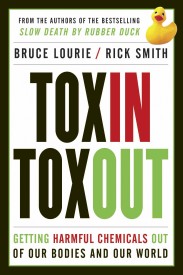
My intention was to skim through this book (subtitled: Getting Harmful Chemicals Out of Our Bodies and Our World) as I assumed there wouldn’t be tons of new information, i.e. we pretty much know that chemicals + bodies and/or environment = bad. What I was looking for was not confirmation, or more to grumble about, but some clear and realistic ideas as to what can be done about this noxious issue—not what the purveyors of chemical-laced products should do, but what WE can do. Us. The simple folk. The minions with wallets. The ones who say we care.

Turns out this is precisely what Toxin, Toxout  serves up… a do-able plan for the minions. Along with some eye-opening background as to how and why all that chemical ooze exists in the first place. (Bottom line: we are a species of sheep-like beings that too often chooses cheap and convenient and lots of it) Also clarification on things like the importance of ‘organic’, which is not just to put less crud into our own bodies, but to allow agriculture to work in a way that’s beneficial to a whole chain of events, including environment and economy.

Toxin-Toxout-canadian-cover-e1384688557263I especially liked the conversational tone of the book and that it’s not smothered in stats, nor is there any fear-mongering or the drama of doom and gloom. It’s simply well-researched (a bounty of footnotes and source material provided) and straight-forward in its message: yup, there’s a lot of bad stuff out there but we can make a huge difference by what we choose to buy. Of course corporations and government hope we’ll never figure this out, or believe it…

Best of all, Lourie and Smith remind us that it’s actually possible to improve the world. That WE are not necessarily at the mercy of THEM, nor do we have to wait for THEM to smarten themselves up. WE can begin today  to create change by the purchases we make. And the path to doing this is a simple one. Really, REALLY simple… 

So, no, I didn’t skim. I devoured every page in fact, and am happy to say the book’s info-factor is surpassed only by its offer of serious hope to a seriously growing problem.

Three thumbs up.

Here are some excerpts.

Photos are mine. (Wanted to find a mountain of cell phones but apparently they live in China where they’re sent by the boatload to pollute the air, land and water horribly as they’re broken down and re-shaped into toys and other novelties we don’t need and shipped back to us.)

Another image that’s missing is what’s happening in the oceans with all the plastic.

*

“I like to describe organic agriculture as the hundred-year diet. It’s a system of agriculture that perpetuates itself, that creates a healthy ecosystem that will in turn continue to support plants in the long term, so you’re not in this deathly cycle of creating short-term nutrients—which then can contribute to pest infestations that need to be counteracted by immediate and short-term chemical pesticides, which then kills the life in the soil, which then requires another synthetic input. Just like we need to give our bodies the right tools and conditions to do their detoxifying jobs, organic tries to enable and facilitate the natural predators and the natural nutrition and micro-flora and fauna that should be in the system.”

img_9442

“A smartphone is replaced, on average, every 18 months, and by 2015 over a billion smartphones will have been sold world-wide. And they don’t just sell themselves: In 2012 Samsung and Apple spent over three-quarters of a billion dollars on advertising campaigns trying to convince us to buy new ones. How much did they spend dealing with the e-waste from the phones they encouraged people to toss out?”


“The big issue isn’t simply what kinds of stuff we should buy; it’s the fact that we need to buy way less stuff, period.”

img_7847

“We need to be working on all fronts to stem wasteful production  and consumption. And consumers are part of the equation… the big issue isn’t simply what kinds of stuff we should buy; it’s the fact that we need to buy way less stuff, period. Furthermore, that stuff—whether it’s a car, a soft drink or a smartphone—needs to be regulated by governments, not by the companies who have no interest apart from endless growth in sales. These regulations need to cover what the products contain and how they are disposed of.”


“If there is one simple thing that every human can do to improve environmental conditions, it is to stop buying bottled water.”

DSC00200_1 DSC00199_1


“The rules of the game we’re playing now are best defined by the Malcolm Forbes maxim: “He who dies with the most toys, wins.” We need a different game, with different rules—perhaps “Those who use the least stuff win.” And our economic and regulatory systems need to reinforce that motto with another one—such as this: The more you use, wasted, pollute and discard, the more you’ll lose financially.”

img_7845


this is not a review — ‘in the spice house’, by marnie woodrow

 
Only just recently discovered this quirky and quite lovely book, published in 1996—another testament to the riches that are CanLit and the fact that so many gems are present for but a moment, before the next thing takes its place… for but a moment.

In other words, it’s easy to miss a few.

I divide books into four categories: new-new, old-new, old favourites, and books I’ve heard nothing about and got merely on a whim. Often, that’s where the treasures are found and, to be honest, it’s my favourite pile. No prejudice nor expectation, no hoopla to live up to… a book from this pile can just be a book.
[Is it just me or does it seem that titles receiving the most hoopla are very often the least hoopla-worthy, while so many gems fly under the radar….]

Blather aside, in the spice house was a delicious find indeed. And a much-needed palate cleanser from the recently hoopla’d.

The food references are not accidental.

Each story [there are 16] in this collection centres around or focuses on or incorporates food and relationships in bold and unexpected ways, which, in my world, is more important than plot. Although there’s plenty of that detail also.

In ‘Mamamilk’ a woman is confronted by a child she lost due to neglect and other slovenly habits. ‘Belly’ is a bit of sarcastic pleasure about home ownership. It begins: “I’m holding a brunch in honour of my lucky friends, the ones with two-car garages and split level lives.” [FYI: brunch takes an ominous turn.]  ‘Suck’ is about a chef who loses all self control while watching people eat, and ‘King Cake’ offers up traditional New Orleans fare along with some distinctly original revenge. In ’32 Flavours’ a rapist rues the day he walked into an ice-cream parlour. ‘To Market To Market’ takes us on a ride in more ways than one, and in ‘Obvious Need and Senseless Longing’ Elizabeth David’s death leads to a dangerous romance with the knife obsessed. It begins, “I gave up drinking in favour of buying cookbooks.” 

The shortest piece is ‘One Lip’, a sort of fairy tale about the end of love and its inherent difficulties.41twt9hKaVL__SL500_AA300_

The longest, ‘Madame Frye’, is about an unhappily married woman who works in a fish and chips shop and longs to go to Bora Bora or have an affair with a patron named Melinda, whichever comes first. It takes the form of something like diary entries, alternating in the wife’s voice and that of her ultra savvy daughter Penny [it’s her voice that makes it].

The stories are short, bite-sized things, and written in prose that feels like a conversation over lunch with some wonderfully wild and free-thinking companion who never uses the same voice twice in her ‘tellings’—here, listen to this one, each narrator seems to be saying as we sip our Chardonnay, break a piece of baguette, lean forward.

And then we start on the cheese, the olives, order some more wine, all the while leaning in even further…

Viva long-lost gems.


(at) eleven with fran kimmel: the shore girl

They’re everywhere. A certain kind of young mother, single, unemployed, pushing prams, kids in tow as they walk and walk… yet something suggests there’s no real destination—that hours, days, years, are merely something to get through… until… what?  More kids maybe, another guy, another unfortunate choice. Because for some people life is a series of unfortunate choices or, worse, unfortunate events. Whatever the reason, they keep moving, these mothers, as if in the hope it’ll all somehow ‘become’ right. They’re recognizable—not by any expression of hope—but by their sadness, sometimes by the look of fear in their eyes. We worry about them for a moment but mostly do nothing. We wring our hands for the children: what chance do they stand?
and then we drive on by…

This is the impression we take. We of the narrow minds.

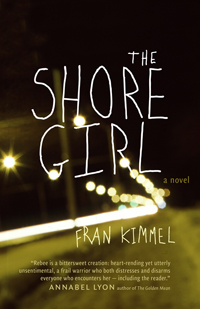
Fran Kimmel either doesn’t have a narrow mind or is just a lot brighter than many of us. Or more aware. Her book The Shore Girl, the story of Rebee Shore, shows the world of single The%20Shore%20Girl_1motherhood and their kids from the inside out, through a child’s eyes and [in dedicated chapters] through the eyes of everyone who is—by blood or choice—connected to her.

But there’s a difference: Rebee’s mother [Elizabeth, who prefers to go by Harmony] isn’t a pram pushing sort of mum. She’s on the run, rejecting her past and doing her best to dodge the present, which happens to include her daughter. From infancy into her teens, Rebee’s life alternates between moving constantly from van to motel to trailer to relative’s couch. “… Harmony gets restless. For her, a new place has a three-month expiry date, same as fruit bars.”

And if she’s not moving with her mother, she’s being temporarily abandoned by her.

In other words, the kid has every reason to be angry, to follow suit, to make a mess of her life. She has the excuses. But that’s not what happens. Rebee is one of those miracles who, instead of becoming resentful, learns through the very debris of her childhood that she has to be strong because her mother is preoccupied just keeping them alive.

“I thought how rage must hurt in the beginning,
but a person gets so used to it, she thinks it’s
a heat a body’s supposed to feel.”

She gets it.

It’s why she keeps a box of fingernail clippings, mostly Harmony’s, the various shades of nail polish reminding her of places they’ve stayed; it’s the only constant in her life, the only thing that reminds her of where she’s been and the only part of her mother that she can protect from disappearing.

“We rumble along the highway under a watery sky, past wheat rolled into giant soup cans, cows frozen in muck. I think about where we just came from. I can’t remember the colour of the walls or feel of the curtains or shape of the bathroom sink. Blank as water, like on a test day in a new school and I end up at the fountain, gulping, drowning… I slip off my runners and slide my toe across my bag until it touches my nail box. We’ll get to wherever we’re going tonight… I’ll wait awhile. Sprinkle the brittle bits on my blanket. Sift them like seashells.”

While often told from Rebee’s perspective, it’s very much Harmony’s story too, one that has her cemented in shame and anger.

All that and yet… The Shore Girl  is ultimately hopeful. It’s about connection, the small and unfathomable ways we touch each other and thereby save each other. About reclaiming what’s ours and how family comes in various forms. It’s about getting beyond what’s ‘normal’. About using the scraps you’ve been tossed.

Above all, it reminds us that our story is never obvious to others, nor is it entirely ours alone.

**

As is customary with the (at) Eleven series, a meal of my choosing—appropriate to the book—follows the Q&A, because… “Eating is our earliest metaphor, preceding our consciousness of gender difference, race, nationality, and language. We eat before we talk.”  ~Margaret Atwood from The Can Lit Food Book

And now, without further ado, may I introduce Fran Kimmel… who I thank so very much for her time, her insight and her kind heart.

**

1.   What literary character did you most identify with as a child?

FK—As a young kid, I devoured Trixie Beldon books. I loved all her insecurities and her grumbling about chores and homework and brothers.

2.   Can you recall one of your earliest pieces? (Crayola poem, a finger-painting storyboard…?)

FK—Okay, here goes:

Across the shadow of the moon and ever so slowly gliding

Through the leafy-figured trees, a starlit shape was sliding

Up and down with swirling streaks, across the snowy hills

With patterns of rejoicing grace, and lacy moving frills

It’s so bad, it’s memorable. This poem won a contest in Grade 4 and I had to read it in front of the whole school on assembly day. I cried a lot beforehand, trying to get out of going on stage, but neither my teacher nor my mother would give in. I made it to the end without collapsing, but this marked the end of my poetry career.  (Likely a good thing)

3.   What were you reading at fifteen?

FK—Girl gets boy stories, killer gets caught stories, town goes berserk stories, world on verge of collapse stories. Lots of junk sprinkled with a hearty dose of the Bronte sisters, which I could not get enough of back then.

4.   Can you describe what was on the bookshelves, or on one specific shelf, in your childhood home?

FK—While my sisters and I usually had stacks of library books beside our beds, our family bookshelves were pretty sparse. I remember a shiny set of A-Z Encyclopaedias with more pictures than words, as well as a few volumes of Girl’s Own Annuals, leftovers from Grandma’s house. These were huge tomes from the 1930s, 800 plus pages, packed with illustrated stories and ridiculous amounts of sage advice about how to sit still,  take care of your stockings, or knit the perfect skating outfit.  Hah!

5.   A favourite passage from any book and why.

FK—This is such a hard question. Every week I read a new passage that blows me away. But here is a long-time favourite taken from Girls by Frederick Busch.

“The dog and I live where it doesn’t snow. I can’t look at snow and stay calm. Sometimes it gets so warm, I wear navy blue uniform shorts with a reinforced long pocket down the left hip for the radio. I patrol on foot and sometimes on a white motor scooter, and it’s hard for me to believe, a cop on a scooter in shorts. But someone who enforces the law, laws, somebody’s laws, fall down like that. Whether it’s because he drinks or takes money or swallows amphetamines or has to be powerful, or he’s one of those people who is always scared or because he’s me, that’s how he goes—state or federal agency or a big-city police force, down to working large towns or the dead little cities underneath the Great Lakes, say, then down to smaller towns, then maybe a campus, maybe a mall, or a hotel that used to be fine.”

This quiet, understated passage comes early on, page two. With these words alone, the reader is given everything needed to fall hard for Jack, the book’s main character. Such tension and bitter regret here, the unravelling of a life. You know Jack will get only halfway near the harsh truth, but you’re rooting for him already. My favourite passages and phrases are almost always deceptively simple.  The eight-word sentence, “I can’t look at snow and stay calm,” gives me shivers.

6.   Do you ever find recurring themes in your work, things that surprise you?

FK—I seem to want to write about life’s damages. (My husband grumbles, Can’t you try to be a bit funny?) And it does surprise me that loss keeps coming back again and again. I’m not sure why exactly, except that I’ve been forever interested in the fragile connections that hold us together and what happens when these connections are broken.  I think I’m drawn to what I don’t want to know about myself.

7.   The Shore Girl opens with the heartbreaking scene of Rebee as a toddler, alone in a motel room, thirsty for a glass of water and yet reluctant to disobey the parent who isn’t there. How do children like Rebee manage to find such resilience?

FK—I’m left speechless by what children are able to endure. I think that kids like Rebee are always on the outside looking in, which gives them a lot of time to observe and to reflect on what they’re observing.  They learn to somehow distance themselves emotionally (and physically) from the source of their heartache. Some of these kids – the lucky ones – are able to become stronger in the process. I’ve met some amazing women at book clubs who endured childhoods much like Rebee’s and they’ve gone on to lead brilliant lives.

8.   Rebee’s mother, ‘Harmony’, is a wonderfully drawn character, and the only one [of the central cast] that we don’t hear from directly. She’s alluded to, pined for, despised, misunderstood, tolerated, fallen in love with; she makes us want to give her a shake one minute and then breaks our heart the next. No matter what, she’s the ‘always elephant in the room’ There’s an expectation, a desire to hear Harmony tell her side of things, yet if she did, the book would be less. It’s the very absence of Harmony’s voice that creates the character; she emerges as both the problem and the appeal and the lack of her own platform is a kind of metaphor for her life, also her choices. The ‘silence’ fits her confusion and her abdication of so many things and, most importantly, it reflects for the reader some of the mystery, frustration and longing that Rebee feels. My question is this: how did you ever find the courage [read: wisdom] to NOT give her a platform? It surely must have been tempting to do otherwise. [and I’m guessing she probably kicked up quite a fuss!]

FK—Harmony did kick up a huge fuss. She was a powerful presence underneath everything else that went on in this book, and I was inside her head and heart all the way through. I feel a huge swell of tenderness towards Harmony, but if I had given her a voice, she would have taken over the book and the story would be hers and hers alone.  I wanted more for Rebee than that. It took me a ridiculously long time to figure this out.

9.   Was there any unexpected outcome in writing the book that you might share? (I’m thinking of characters that resisted where you wanted them to go or who walked on or off the stage spontaneously; something you discovered in research, elements that you cut/added because of info gleaned ‘en route’…)

FK—The book itself was its own unexpected outcome. I’d been writing short stories for some time and this, too, began as just that – a short story about Rebee and her fingernail clippings.  After I sold the fingernail story, I thought well that’s that, but then I’d wake up night thinking about her. I wanted to know what it would feel like to run across a girl like Rebee, a girl who stumbles out of a run-down van, bedraggled, and then just disappears again. Who would reach out to her? Who would turn away? I wrote and wrote, character after character, story after story. It wasn’t until a long way in that I started to see these pieces melding into a book.

In earlier drafts, I had a large section told from the town’s point of view after Rebee moved to Chesterfield. And a section by a crusty old neighbour named Gunther who I absolutely adored. But in the end, I cut huge swaths and whittled the writing down to this small band of characters who I felt told Rebee’s story best. On a side note, I didn’t intend for Joey to keep puking. No matter how many times I wrote that out, I’d turn around, and he’d puked again.

10.  In your opinion, what are some positives in the ‘new publishing industry’?

FK—Since the self-publishing industry has blown wide open, there is an infinitely large space for writers who want to go it alone. New spaces for writers is a positive. Some excellent books are coming online that might not have made it past the gatekeepers in the old publishing world.  This brings a crazy surplus of junk, too, but that’s a whole other issue.

And despite doom and gloom forecasts, small independent publishers are still alive and well in Canada. If I want to be assured of a good reading pick, I check out my favourite inde publishers’ new line up and am seldom disappointed.

11.  Choices:

Pen or Keyboard? Keyboard definitely. In a coffee shop, I’m one of those high-maintenance laptop users who pulls out the wireless mouse and huge portable keyboard and cushy wrist rest.

Tent or Trailer? Tent trailer.  I love the smell of canvas and all the zipping before bed, a solid floor beneath my feet and the half-aluminum door between me and the bears.

Poetry or Song? Leonard Cohen.

Theatre or Film? Film if I want to kick back and absorb. Theatre if I want to lean in and participate. I love both (but nothing coming out of Hollywood these days).

Prairie or Lake? Yellow fields and the big, open sky. Although prairie lakes are pretty cool too.

eReading or Paper?  Paper. I keep promising to buy myself an e-reader, but really, how serious can I be.

Salad or Cheese? I’ve become a bit more flexible since my tuna-salad decade, but lunch without lettuce doesn’t work for me. I throw in everything I can find, including lots of cheese.

andre-kertesz_the_fork_1928_500px

Matilda’s Menu for The Shore Girl:

Peanut Butter on Graham Crackers

Choice of grape juice or bottomless pitcher of cool, fresh water

Wintergreen Lifesavers for dessert

(to be eaten in the dark)

◊♦◊

Fran 2013 for CarinBorn and raised in Calgary, Fran Kimmel has worked all kinds of jobs including youth worker, career counselor, proposal writer, communications coordinator, and VP for a career consulting firm. Fran’s short stories have appeared in a number of anthologies, including twice in The Journey Prize Stories, and her first novel, The Shore Girl, was a 2013 Canada Reads Top Forty selection and winner of the 2013 Alberta Readers’ Choice Award.  Fran now writes and teaches in the small prairie town of Lacombe, Alberta, where she lives with her husband and overly enthusiastic Labrador retriever. www.frankimmel.com

The Shore Girl is published by NeWest Press.

this is not a review: ‘to love what is’, by alix kates shulman


I received this book as a gift from someone who knows that I’ve been a fan of the author’s work since reading her memoir Drinking the Rain some many, many years ago. One of the few books I re-read on a regular (used to be annual) basis. Go ahead. Ask me anything…

To Love What Is is her latest gem, an account of what happened after Shulman’s husband suffered brain damage from a fall—it will appeal to anyone who enjoyed Joan Didion’s The Year of Magical Thinking.

Only this is better.

Much better.

Heresy, I know. But there you are.

What I felt about Didion’s book [just to clear this up] was that rather a lot was missing. Here is what happened, she tells us, here is how mad I was with it, and we empathize, we’re with her, but after a while I wanted not just to read lists and repetitions of her [understandable] mania but for her to offer something deeper, how she felt and how she was changed by this extraordinary period in her life.

I thought its honesty was bordering on superficial and maybe she held back because she simply wasn’t ready or able to give more. Her prerogative of course, but then why write a memoir? I actually read Year of Magical Thinking  twice because I couldn’t believe I was the only person on the planet who didn’t wholly embrace it. And then I stopped trying, and I began to wonder how it would rate or be discussed or ignored had it been written by an unknown. In other words, was the buzz created by the magic of Didion’s words… or was it our interest, and faith, in a beloved literary icon?

Shulman’s book, for whatever reason, didn’t elicit the same widespread reaction. At least I don’t recall it being discussed and applauded ‘everywhere’. Too bad. It’s an excellent piece of writing on a subject that has broad interest.9780374532055

As in Didion’s book, things begin with a moment between husband and wife… after which everything changes.

“On a moonless summer night my husband fell nine feet from a sleeping loft to the floor and did not die…. though X-rays taken several hours later showed that he had broken most of his ribs and both feet; punctured both lungs, causing perilous internal bleeding; and suffered so many blood clots in his brain that each CAT scan of that precious organ resembled an elaborate filigree.”

Shulman dips into the past only enough so that we understand who her husband was [a sculptor, among other things], what their marriage was made of and how his limited recovery affects every aspect of life.

“Never again will we be able to mull over a problem together, negotiate a decision, chew over the news, arrange to meet on a street corner, discuss the meaning of a remark, consult each other for advice, dispute the wisdom of an action, confide our secret anxieties, appreciate each other’s wit, plan a trip, weigh our options, fantasize about the future…”

In the course of years—from event to completion of the book—she meets with countless doctors, reads tons of material and manages to condense it in a way that we begin to understand the mechanics of brain function, the various effects of brain injury, impact on memory, and how her husband Scott, while able to recover to the degree that he resembles, outwardly at least, an intelligent, charming, normally functioning man of his age, no longer has any concept of how a coat is buttoned.

“How can you think or reason without remembering the facts to reflect upon? How do you know which way to turn when you’ve forgotten where you’re trying to go? With no recall of time passing or of what has transpired, you are bound to be in a state of perpetual confusion or apprehension. And along with confusion, agitation and upset. No matter how eagerly you may wish to cooperate, you can’t respond to others’ expectations if you can’t remember what they are. If a minute is the same as an hour, when your wife goes to the bathroom, how do you know she hasn’t ‘evaporated’—and, without her, how you will survive?”

She writes of the time it has taken to arrive at this point, the dedication on both their parts, but doesn’t play the victim card, not even once. Though she admits to exhaustion, frustration, fear, doubt, cowardice, she does all this without ‘drama’. Shulman doesn’t do drama.

“Facing squarely for the first time the bleak prospect of spending the rest of my days as caretaker of a well-meaning, loving, but helpless and clueless man, I find myself succumbing in odd moments to unexpected bouts of grief, as if a life as ended. Not his life, but mine.”

She tries to make things as normal as possible; she mounts a show of his work. He mingles, chats, appears almost himself… “But once the show has been taken down, he has no memory of it, not even that it occurred. None. And again I face the recurring question: was it—is it—worth the effort? If so, for whom? I had thought it was for him, but if he remembers nothing?”

Aside from all else, the book broadens our understanding of brain injury and aspects of memory loss.

“… since memories of different kinds of things (colors, numbers, music, places, faces, names, among many others) are ‘stored’ in different, specific areas of the brain and can be altered over time with subsequent recollections, the generalized concepts of long-term and short-term memory are no more than theoretical constructs…. Cognitive scientists disagree as to how many  kinds of memory systems there are, and they often divide memory into ever finer categories, including sensory memory (input from the senses), procedural memory (of skills and habits, such as tying your shoes or playing the violin), semantic memory (of the facts that make up or general knowledge of the world, as opposed to our personal experience of it…) episodic memory (of events that occurred to us…), associative memory (which can connect the taste of a madeleine, for example, with a flood of feelings from the past)…”

Initially devoted to ‘curing’ Scott, she finally accepts the reality of the situation and requires only “minimal conditions” to keep her spirit alive: “to be able to cook a meal without steady interference; to be free to read without constant interruption; to work on my writing every day.”

Shulman takes us to the brink of hard decision-making, not in a dithering way, but clearly thought out. She reads each passage of the book she’s writing [the one we’re reading] to Scott, and for as long as he can remember it, mere moments, he is able to comment honestly and intelligently. And this means everything to her.

They return to the Nubble, the cottage off the coast of Maine where the accident happened. This is also the setting for Drinking the Rain and a place on earth that is almost sacred to Shulman. She can’t bear the idea of giving it up. Or giving in.

“How little it takes to lift my spirits and restore my equanimity! Someone to spell me with Scott whom he accepts and I trust, a walk along the shore, a meal I can cook with imagination and freedom, and I am myself again.”

The title refers to many aspects of her situation, including the future, whatever it may bring—and I close the book hating the inevitability of what that future may hold for Shulman, but by then I’ve been assured, too, by her courage and straight up love of life, that whatever is thrown her way, she’ll manage to find the joy.

And all without a trace of saccharine.

Or self-indulgence.

And there it is, the challenge of memoir: how to write without myopia [or sticky sweetness in the case of love and loss… or to over-compensate and become one dimensional— self-protection disguised as aloofness, or vice versa]. Easy enough to circle the area but to venture anywhere close to that precarious edge without losing balance is the trick. And this, I suspect, has less to do with the brilliance of the writer than an ability to manoeuvre through the fearful territory of honesty without constantly looking in the mirror… or, worse, over one’s shoulder.

To Love What Is, is available online at Blue Heron Books. Support indies!

impoverished spinsters may apply

“According to the usual pattern, she was educated at home with a series of governesses, and a weekly parade of drawing and dancing masters. Boarding schools, although increasingly popular as the century waned, were considered not quite good enough for gentry, since they were now infiltrated by rich merchants’ daughters in pursuit of the social graces of their superiors. It was much more genteel to be educated at home. The curriculum included English literature, a little geography, a very little arithmetic, and a smattering of languages, particularly French. At least half the time, however, was devoted to ‘accomplishments’, which included lessons in painting, music, embroidery and deportment. ‘Accomplishments’ were considered essential bait with which to trap a husband. Young ladies, after all, were educated for matrimony; there were no careers open to them, although it was considered respectable for gently born but impoverished spinsters to turn their hand to governessing, or to novel-writing.”

~ from The Embroidered Tent: Five Gentlewomen in Early Canada, by Marian Fowler (Anansi, 1982)

~

Am loving this book. Have read only the section on Elizabeth Simcoe so far, who I was prepared to label an entitled heiress [which of course she was] and dislike her for that reason. Turns out that despite her not so endearing trait of having zero compassion for underlings, or pretty much anyone of ‘lower class’, she was completely and utterly enchanted by the Canadian wilderness and heartbroken when her boring, whinging and militaristic husband John, decided to return to England. Her marriage was pretty loveless but for the [scads of] children [though children at that level of society were no trouble once ‘produced’ as they were farmed out to wet-nurses and nannies and had only a daily appointment with mother] and there’s a suggestion that she either had an affair, or thought about it a fair bit, with a much more upbeat and outdoorsy chap who lived on the shores of Lake Erie.

She was, it seems, a woman once the epitome of British upper class sensibility, raised to be ‘proper’, who discovered the joy of wading barefoot through a stream, who was never happier than when her husband went on extended sojourns, who learned to drive a wagon on her own over rough roads and who was only too happy to give up the daily round of social engagements and fancy dress balls she once enjoyed in order to watch eagles soar, seasons change, to paint fearlessly on the edge of Niagara Falls as her tight, precise watercolours changed to a wilder and freer style. She could have lived anywhere in Upper Canada but chose to build a home, ‘Castle Frank’, near the Don River, in a spot that, at the time, was no where near ‘civilization’. And then she obligingly gave it all up to return [at her husband’s insistence] to ‘society’ back in the U.K. where she ‘did her duty’ but apparently never completely embraced that world again…

Some of her paintings are in the British Museum, others, in the Province of Ontario Archives.
IMG_4942

Read this for origins on the word spinster.

(at) eleven with susan toy: island in the clouds

 
When I met Susan Toy through the Humber School for Writers online program some years ago, the first thing I learned about her was that she was obsessed with food and books. I’ve since learned that cats and coffee are a close third. [They may well be first…]

The other quality that made her stand out was a need/desire/talent for sharing information. I used to call her our ‘clipping service’. [For readers of a younger vintage, I’ll clarify: clipping service = google alerts with scissors and newsprint.]

We connected for all of the above reasons but also because she lived on an island in the Caribbean. And so had I for a short while. We traded some ex-pat joys and commiserations in between commiserations about our works in progress.

Her WIP eventually became Island in the Clouds, a murder mystery set on the island of Bequia, which Susan has called home for close to twenty years. It begins as all island mysteries should: with a dead body in the pool playing havoc with the pH balance. Toy writes with tongue-firmly-in-cheek, a pull no punches style that shows island life from an ex-pat perspective not afraid to laugh at itself while wringing its hands at the tribulations of island bureaucracy, customs and general shenanigans. The sounds, scents and sights of island life are always just there, not too far in the background. Ice-clinking is big here…

13456503Her protagonist, like so many ex-pats, is running away from a bad deal back home, but no one asks questions on Bequia; this is part of its charm. Days are made up of food and drink and gossip and oh yeah!  the need to make a living. But don’t be fooled by the palm trees and laissez faire vibe, there’s also a lot of nastiness going on and duplicitous friendships and, like any small town, everyone knows everyone else’s business, even if they don’t always talk about it. A lot of smiling through one’s teeth. Add island politics—and this is no small thing—and the result: when a murder is committed, the question is not so much who did it  but who’s willing to admit who did it. Everyone’s scratching someone else’s back.

If you’ve ever lived on an island, you’ll smile and nod your way through the familiar. If you haven’t, but think you’d like to, it’s a good eye-opener. And if you read it while on an island, even better. The mystery element is but a bonus in my view. For me, it’s all about the place.

As always, in my (at) eleven series, the Q&A is followed by a menu chosen by me of a meal the book most inspires. Or, put another way, the perfect nosh while reading, because food and books just go together…

“Eating is our earliest metaphor, preceding our consciousness of gender difference, race, nationality, and language. We eat before we talk.” ~Margaret Atwood from The Can Lit Food Book

And now, may I introduce… Susan Toy, island reporter, on-line pal and oh-so-generous clipping service…

~

1.   What literary character did you most identify with as a child, or want to become?

ST—It’s a toss-up between Harry the Dirty Dog and Curious George.

2.   At age fifteen, what were you reading?

ST—Everything I could get my hands on from the library about Down Syndrome, because the daughter of a family friend who played with my younger sister and me when they came to visit had me intrigued. I thought I might like to work with Down Syndrome children when I grew up. Then, that summer at the cottage, I read through an enormous stack of Harlequin romances with a babysitter the same age as me who had been hired to look after the neighbour’s children. I know … weird. I didn’t really discover real literature until after that year.

3.   Do you find there are recurring themes in your work, generally, that surprise you?

ST—The main issue that comes up, and this is mainly in my short stories, is of being trapped in a situation and not being able to get out of it. Reconciliation is another.

4.   What is a favourite passage from any book, and why…

ST—Finally! Someone has asked me this question, and now I can tell everyone about this wonderful passage from Ivan Doig’s Dancing at the Rascal Fair:

“There in the gap, Herbert whoaed the horses.

What had halted him, and us, was a change of earth as abrupt as waking in the snow had been.

Ahead was where the planet greatened.

To the west now, the entire horizon was a sky-marching procession of mountains, suddenly much nearer and clearer than they were before we entered our morning’s maze of tilted hills. Peaks, cliffs, canyons, cite anything high or mighty and there it was up on that rough west brink of the world. Mountains with snow summits, mountains with jagged blue-grey faces. Mountains that were free-standing and separate as blades from the hundred crags around them; mountains that went among other mountains as flat palisades of stone miles long, like guardian reefs amid wild waves. The Rocky Mountains, simply and rightly named. Their double magnitude here startled and stunned a person, at least this one—how deep into the sky their motionless tumult reached, how far these Rockies columned across the earth.”

This is one of the best descriptive passages I’ve ever read, because Doig put the exact words to my feelings the very first time I saw the Rocky Mountains, when I moved to Calgary in 1978. This passage still causes goosebumps.

5.   What is the writer’s role in society?

ST—I attended a seminar led by Aritha van Herk in which she said that the writer translates or interprets for the reader.  That’s the way I think of writers—we are translators and interpreters of experience.

6.   Island in the Clouds  begins with a wonderfully candid description of, and introduction to, the ‘character’ of contemporary Bequia via the book’s narrator. In this way, we meet the island before we meet our protagonist. How important was ‘place’ to you in writing this story? And the accuracy of place… versus a fictitious island, for example.

ST—Place was the most important aspect of this novel. It was suggested by early readers that the setting be fictitious, because I was perhaps a little too accurate—and honest—about the island. But I knew the greatest appeal of this story was that it was about Bequia, so I never considered telling the story any other way.

7.   Some elements of island life, especially local politics, are not always shown in the best light. Islands are small places… how was the book received by locals?

ST—I’ve received mixed reviews, but mainly positive comments, mostly from foreign tourists and ex-pats who say that I’ve nailed the place and what goes on here. I believe I portrayed the general local population in a generally favourable light. I know a few (very few) local people have read the book, but no one has criticized me for what I’ve written. I was told that one foreigner thought I had been too harsh in my depiction of the police – until she was robbed and had to deal with them herself. Then she said I had not been harsh enough. (I gave a signed copy to one of the gardeners who works for Dennis, and he said, “Sue, I will cherish this for the rest of my life!” That choked me up!)

8.   What brought you to Bequia?

ST—We first came to Bequia as tourists in 1989 after a customer at the Calgary bookstore where I was working suggested it as a possibly vacation spot. We were hooked from that very first time, kept coming back every year, and before we knew it we bought land, built a house, and moved here permanently in 1996.

9.   Any challenges/differences writing a male protagonist?

ST—No. Geoff’s was the first voice that came to me when I began writing this novel and that seemed quite natural for the story I wanted to tell. The second novel in the series is about a woman, and I really don’t notice that much difference writing in her voice from writing in the voice of a man in the first novel.

10.  Your background is almost entirely industry-related so you were not unfamiliar with the process of editing, publishing and marketing. You also developed your own imprint and chose the self pub route.  I’d like to think you knew the ropes so well there were no surprises…[ but I’m guessing there were surprises]. Would you share a few?

ST—No real surprises as far as publishing, editing and marketing were concerned. In fact, I discovered that I enjoyed the publishing end of the business so much that I set up a new imprint, IslandShorts, and am now ePublishing short fiction, poetry and novellas by other authors. I will likely only ePublish from now on, with a limited edition print run to pre-sell, so I won’t be stuck with unsold stock, as I still am with the first novel.

I have to say though that the biggest surprise of all was how little support I received from colleagues in the business. NO ONE came forward to say, Here, let me help you promote and sell your book like you’ve done for me. All the promotion ideas were my own; all the attempts to get publicity were my own; trying to get distribution in bookstores and setting up events were as a result of my own efforts. That was extremely disappointing, especially as I had been promoting and assisting so many other authors all along (and still do), and numbered many authors, booksellers and librarians among my personal friends. The reason I didn’t receive equal support was clear to me in hindsight—I’d gone the self-publishing route, and there’s still a lot of prejudice about self-published books and their quality … even though everyone knew I’d done a very professional job on this book. Other self-published authors I met along the way have supported me, but not the traditionally published authors. So that was the biggest surprise of all, and I’ve kept quiet about it until now, but since you’ve asked … A big disappointment for me.

11. Choices:

Vanilla or Chocolate? Chocolate

Ocean or lake? Both. I’m a swimmer.

Atwood or Munro? Ummm … Neither. Joan Barfoot

Pen or keyboard? Keyboard

Poetry or song? Song, because I have a musical background, but I do prefer the poet songwriters, like Van Morrison, Bob Dylan, Paul Simon

Mango or papaya? Banana

eBook or Paper? eBook

andre-kertesz_the_fork_1928_500px

Matilda’s Suggested Menu for Island in the Clouds:

Turtle soup, goat stew, tropical fruit salad and anything in a glass with ice.

Lots of ice.

And don’t be shy with the anything.

~

Susan M. Toy has been a bookseller, award-winning publishers’ sales rep, author impresario and publishing consultant. She has recently begun ePublishing short fiction, long-form creative author picnonfiction, and poetry under the imprint IslandShorts. Her eBook, That Last Summer, a novella set in Ontario cottage country in 1965, has just been released. She divides her time between Canada and the Caribbean island of Bequia and blogs at Island Editions.

~