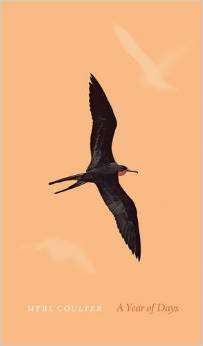
how myrl coulter and me are both the same and different when it comes to birthdays

 
Myrl Coulter’s ‘Those Pesky Natal Days’ (one of the essays in her lovely collection A Year of Days)  begins like this:untitled

“The human ritual of marking individual birthdays started with the advent of the calendar, when people began to track time according to the sky, to notice when it got dark, when it got light, when the moon appeared, and when it didn’t.”

She continues with some background to the origins of birthday celebrations, considers the idea of birth and what, exactly, we’re celebrating, then moves into her own personal likes and dislikes about the occasion.

This just happens to be one of my favourite things to discuss and so instead of responding out loud to the pages from a park bench, which only frightens passersby, I decided to bring the conversation here.

Warning: the following might not be suitable reading for traditionalists, or anyone who shops at The Party Store.

How We’re Slightly Different:

Coulter says she doesn’t like the Happy Birthday song. Calls it grating and trivial with only five words to the lyrics, and a sixth to be added by the singer. “The sentiment is a tedious repetitive demand to be happy.”

Hard to argue. It’s not the greatest piece of music ever written (she tells us the copyright is worth five million dollars), yet I sing it loud and proud to a circle of lucky souls each year. And they do the same for me. And I kind of love it. When I was a kid the song made me cry. I think that had more to do with how my parents liked to go through the whole day pretending they’d forgotten what day it was and then after dinner a cake would come out, a few gifts would appear, and the song would be sung. Tears of relief followed. To be honest I still weep a little, though for different reasons now.

How We’re Very Different:

Coulter enjoys planning parties for friends and family. I don’t like parties. (Could I plan the party and not attend? Because then I could get into it.)

How We’re the Same:

She describes how kids’ parties have changed, how today they have themes and décor and tapenade and rules about everything. She says it used to be simpler and I get the feeling she prefers the simpler.

Me too. Pin the Tail on the Donkey; pound cake with rosettes and a misspelled name; (what’s a loot bag?? kids go home with extra piece of pound cake)

How We’re Different:

Preference for simplicity aside, she says she’s actually impressed with these parties but relieved that her kids are grown and she doesn’t have to throw them.

Me: I am less impressed than cringey at the very idea. I once organized a birthday party for a nine-year old in a bowling alley. Lunch was included. Plus bowling. Plus a few jokes from my repertoire. And  I pretended to enjoy myself. (There was lunch, I mentioned that, right?) When the parents arrived to pick up the little darlings, they asked where was the loot bag… I had no idea what they were talking about. Can’t even remember how I answered. But there was a distinct ‘attitude’ as they left. (Hey, there was lunch!!)

How We’re Really Really the Same:

She says she likes other people’s birthdays but not her own, that the thought of it approaching actually tightens her throat.

I know just what she means. And it’s not an age thing. It’s an expectation thing.

She writes:

“To distract myself after that initial birthday thought wanders in, I start thinking about how I want to spend my day. My first idea is always the same: I just want to disappear. No obligations, no hanging around to receive birthday wishes, no smiling when I really fell like roaring into the wind”

I get that. I hate handing my birthday over to someone else (shades of childhood trauma, i.e. late-in-the-day cake?)… I think that’s a lot of pressure on the other person and anyway, it’s my day and I want to be responsible for it. I’ll make the dinner or the reservation or run away somewhere, or take a friend… I’ll give the gifts, I’ll bring home a cake, I’ll light the candles. You can sing if you like…

And Here, More Same than Different:

About gifts, she says:

“I don’t like opening birthday presents, especially in front of the people who have given them to me, who sit in my line of vision smiling with eager anticipation.”

For me, it depends on the circumstance, because some people are a delight to share these moments with. But then there are those others, the ones who have pretty much given the gift for what they get out of your reaction, which better be what they expect.

“When I open gifts in front a large group of people, what falls into my hands is secondary, because I’m hoping that my smile is big enough, that I’m not over-reacting or under-rewarding my donor, that I’m appropriately grateful without resorting to an ‘I’ve always wanted one of these’ gusher statements. I wince when I recall times I have gushed.”

Agree. I would love it if birthdays were a time to give rather than receive.

We’re Different:

She says birthdays ending in zero or five are toughest.

They make no difference to me. Numbers are not my thing.

Yet We’re the Same (Is anyone Different on this one?):

“The frenzy exhausted me. Surrounded by people I love, I looked forward to the moment they all left.”

And this:

“What I do know is that the day after my birthday will be a good day. I will feel normal again, relieved, and somehow refreshed.”

It’s that kind of essay. Sits you down and says, so what about you?

—So what about you?

A Year of Days  is available online at Blue Heron Books.  Shop indies! ♥

this is not a review: ‘magnificat’, by k.d. miller

One of my annual pleasures is Steven Beattie’s, 31 Days of Stories, a tribute to the short story form by way of highlighting and reviewing a wide variety of work, from current to classic. I try to make a point of reading the daily posts (printed out on paper even) with tea each morning. I’m a little behind.

Just got to ‘Magnificat’ from K.D. Miller’s gorgeous collection All Saints.9781927428634_Cover_
It’s been a while since I read it but I didn’t remember it quite as described.

So I read it again.

And this is the most wonderful part about art of any kind, that there are several takes to be taken. The artist’s. Yours. Mine. And the millions of yours and mine’s out there reading/hearing /seeing/experiencing the same thing.

This never fails to fascinate me.

As a writer I enjoy hearing various takes on my own work, the way something I thought so obvious is missed or, conversely, something I hadn’t even seen appears to someone else as THE WHOLE POINT.

Who’s to say what’s right? The artist’s version, in my world anyway, merely counts as one opinion, one vote for ‘what it is’. It may appear to carry more weight because it has all that intention attached, but what it becomes when it flies through the atmosphere of our individual experience, can’t be denied.

And so, with ‘Magnificat’, for instance, my take is a little different from the one I read this morning…

In a nutshell–

Julia, an unattached, never married, middle-aged woman with blisters on her feet and a pretty ordinary life notices a young couple, Cathy and Gabe, having it off in the park. Only something’s not right about the scene and it makes Julia remember an incident of sexual abuse at the hands of a man who recited religious passages, which caused her to sing the Magnificat … essentially, a  survival technique.

“She remembers lying in bed, imagining herself the Virgin Mary.     Imagining the eyes of the angel on her. And his next words, the ones that would change her life forever, giving her cause to sing the Magnificat. My soul doth magnify the Lord…”

Beattie saw Julia as someone who has not experienced sex on any level and who witnesses the rough play in the park between Cathy and Gabe with a kind of lust. Whereas I see her watching with a sense of helplessness. Because of her own experience, she senses Cathy’s complicity in the situation and knows there’s no point in intervening and no crime to ‘report’. That for whatever reason people, often women, feel they deserve abuse of various kinds and, in order to survive it, are able to find a twisted sort of pleasure therein.

This experience of abuse may be the very thing (coupled with her parents’ cold relationship) that put her off the idea of marriage. Oddly, it may also serve as one of the reasons she’s drawn to the church… a convoluted means of putting things right that were made so wrong in *god’s* name.

That she sees not taking a husband as a “choice”, I think is a reference to burying the memory of the abuse. Anything that triggers it, is a source of discomfort.

And yet… she follows this strange couple, Cathy and Gabe, into a remote area of the park. She is afraid as she does so,  “… In a queer, thirsting way.”  The way she takes off her shoes, puts them on her hands to relieve her blisters, daring herself to continue past the pain… mirrors, in a way, what Cathy is doing, allowing herself to be drawn into the relationship with Gabe, hating it, fearing it, yet fearing it might end.

I see this as Julia wanting, at last, to confront her demons.

And yet… another reference to angels, this time from Cathy’s perspective in the middle of the aggressive and degrading sexual act:

“The grass is chafing her knees. Her fingers dig into the dirt… But she is surrounded by angels… Gabe. And Owen. And now this lady who is watching her… She is in a blue robe and a kind of white headdress, like a nun’s. Her feet are bare. She is wearing shoes on her hands.”

Julia watches the scene unfold as Cathy (also dressed in virginal blue and white) is undressed.

“When she saw the blue tunic come off, she pressed her palms flat to her heart. Prayed through dry lips… Then when the white T-shirt and the flesh coloured bra were shed, she wrapped her arms around herself to stop the swaying of the freed breasts.”

Julia begins to sing the Magnificat, and Cathy receives it with gratitude while her fingers dig into the dirt during the sexual act. This brief and unspoken connection, this understanding between the women is powerful, transporting Julia back to her childhood and when she comes back to reality, she finds herself checking to see her clothes are intact, “clutching at herself” as if to protect Cathy from the hands of this man, and herself from the hands of the abuser in her past.

Note: The Magnificat is a hymn of praise to god, in which god recognizes “the lowliness of his handmaid”. A song, no doubt, written by a bloke.

UPDATE: Was gob-smacked to find Steven Beattie’s re-visit to Miller’s story; even more gs’d to know my interpretation resonated. Because, well, what do I know?? Anyway, this is CanLit at its best: stories, discussion, open-minds.

I doff my cap.

All Saints  is available for purchase online at Blue Heron Books. 
Show indies some love.

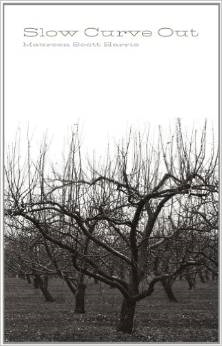
this is not a review: slow curve out, by maureen scott harris

 
I’ve read Maureen Scott Harris’ beautiful Slow Curve Out  twice so far—once in a skimming summertime kind of way on the patio where I am prone to being distracted by butterflies and motes of dust and pitchers of watermelon juice. And the second time on a Sunday morning in bed (fortunately motes of dust are so common in my house they are not distracting).

The book, a collection of poems, is divided into three sections.

Well, five, actually, if you consider the opening poem, ‘Walking in Saskatchewan with Rilke’ in which we are being prepared for what’s ahead, i.e. walking in the world with Maureen Scott Harris.

                                                                           —the way
things surge into being, here, claim eyes, claim
mind, claim my very heart, beating and beating,
bird in the breast, this longing for sound—

And the closing piece, ‘Homecoming’, that ends with warning and a powerful two word punch.

In between is Part One: ‘Back Up, Begin Again’, a paean to nature. The rhythm of recurring themes… birds, trees, light, wind, earth, the colour white, flight, dreams, walking and silence, begin in such a way that you don’t even notice the tapestry that’s being woven until you’re right there in the middle of that deeply textured landscape.

If I can get it right
my arms will sprout feathers, and I’ll bring home
the taste of poplars surprised by pale sun.

I read Part Two, ‘The Ten Thousand Things’, as a meditation on sound. The birds,untitled more visual in the earlier section, are now singing, calling, crying; voices enter, cacophonous, raucous, there is holler, hum and mutter; subtle references to songs; bleat and mourn; ghosts are a choir, slippers tap; yodelling fiddle, guitar, the thump of thunder, a siren, Rain and longing—what a racket on the roof!  Even the foliage makes a sound and sound canopies the street.

One day slides into another, sunshine
dissolving clouds which reassemble
overnight, and a whole week has drifted
past in birdsong and silences. Like
the tide going out, then coming in again.

By now we’re immersed in place. We know what’s around us, but do we know our place in  this place?

In Part Three — ‘Another Animal’ – the tapestry is plenty rich, but there’s an additional element: us. Or at least the focus is on us. How we change things, how we  change, how we interpret our  world vs the  world. Some hard truths are revealed and they’re not always the prettiest, but may be the most important.

Remember when we weren’t our own
gods but lived by the grace of animals?

I love this book for its energy, the way it takes me by the hand and, like the narrator in the opening poem, points out the sound, the silence, the colours, the textures and movement of the world around us.

It asks us to consider what it is we see, versus what we want to see.

And this thing, this motion I thought to show you,
tell you, is for the moment only
a smear across the view obstructing and obstructing
like the sheep dog that turns the sheep
in a slow curve out toward the stony pasture, their little hoofed
feet lifting and descending on the rocky path, slippery
in the aftermath of deep snow, a stutter,
like this  this    this    thing

Slow Curve Out, available online at Blue Heron Books. Support indies!


(at) eleven with tracy hamon: red curls

 
This (at) Eleven series of Q&A’s began as a place to celebrate books written by people I know, or have come to know even in a small way (and usually with a food connection). Very occasionally it includes people I don’t know at all.

Tracy Hamon is such an ‘occasion’. I only recently discovered her work through Brenda Schmidt, who mentioned something about Red Curls  on FB, and I value Ms. Schmidt’s literary taste. Also, I loved the subject matter: an Austrian painter and his mistress living the Bohemian life at the turn of the (last) century.

While a collection of poems is a wonderful thing, I was very pleasantly surprised to see that this is not a collection of poems. Instead, it’s a sort of  ‘discovery’ shared… of the artist, the times he lived in, his inspirations, his work. And his effect on Hamon, who travelled to Austria to gain a deeper perspective of Egon Schiele, on his turf. In poems, yes, but also in narrative pieces from various perspectives, and in voices other than the poet’s.

It’s also a tribute to the muse, an often overlooked element in an artist’s career. And often a woman. In this case the muse was Valerie Neuzil, known as ‘Wally’.

We begin in the washroom of an airport as Hamon arrives in Europe. The piece is called ‘Modernist Movement’ and describes the woman whose job it is to sell squares of toilet paper in a room where “soap hangs like scrotum from a plastic mesh bag”. And with it we’re immediately there with Hamon in the centre of what feels like a strange new dimension, unsettling and yet we recognize something about it, and so begins the journey…

The first section of the book is from Hamon’s perspective. On a train“the seat cripples my back with right angles.”  She looks at buildings, rooftops, landscapes, trying to see through Schiele’s eyes, to find the things he painted, to understand what drove him, inspired him, to imagine the power and mystery of the relationship with his red-headed muse and mistress.

“Egon, I arrive at your door as one/ who watches, one who knocks/ needing to be among the why/ of what you do…”

The second part of the book is from Schiele’s perspective as Hamon takes us back to his childhood and early life, touches on events that shaped him, the loss of his father, his work with Klimt, society’s perception of him as debauched, his marriage to Edith and the end of his affair with Wally.

What might be my favourite piece, ‘Interview with Egon Schiele’, opens with a question: “What were you doing when they came to take you away?” which is then answered in the perfection of simplicity; he was watching a fly, sipping wine, “I was studying the stem of a tulip I had bought at the market.”

The last section of the book, the last word almost, is given so fittingly to Wally. I suspect she would be pleased.

Also worth mentioning is the cover (a painting by Virgilio Neto).

So, with many thanks to Tracy Hamon for taking this time, may I present, the author of Red Curls…

1.   What literary character did you identify with as a kid?

TH—Pippy Longstocking.

2.   Can you recall one of your earliest pieces of writing?

TH—I remember writing something “Poe” like, it was slightly dark, maybe a little mysterious, though I can’t remember much more. I must’ve read the style in one of my mother’s many magazines and emulated it. I seem to have the faint recollection of the piece being chosen for some children’s writing magazine, but then again, my memory is faulty enough (and my ego large enough) these days that maybe I just imagine my first writing would get singled out.

3.   What were you reading at fifteen?

TH—Probably Stephen King.

4.   I’m always curious about process. Where do you work best, do you have a writing routine, an ideal environment? And the all-important question: what about blocks… what’s your remedy for getting around/through them?

TH—I work best in my head. Getting the writing out of there and onto paper is sometimes hard. While I can write anywhere, I need quiet to do so. I can write on paper or on the computer, although if I start on paper, I’ll eventually have to type it in a Word program so that I can play with it. I take a lot of notes and I go back and use these a lot when writing.

I don’t believe in blocks—I either write or I don’t write and if I’m not writing I don’t worry about the not-writing. When I’m ready, I’ll write. I’ve been on a really long dry spell as of late, but I’m not worried. I’m doing more reading, but I’m also just too busy to write.

5.   Are there often themes in your work that surprise you?

TH—Not usually.

6.   How did Schiele enter your life in such an important way—was it the ‘red curls’ that drew you?

TH—My first encounter with Schiele resulted from a postcard sent by a friend. red-curls-cover3After I received the engaging card (Boy in Red Robe), I did some internet research and began thinking about his art work. As I read about Schiele and Neuzil, I grew curious about their relationship, and how and why their social situations and eccentricities (mostly Schiele’s as there isn’t much written about Wally) came to shape their relationship as a couple. The red hair connections were not the source of inspiration, but the bond that kept me writing—if that makes any sense.

6.  The love poem on page 48… for Wally, but for Klimt too? And the poem on the facing page: ‘Black and White Study for Transfiguration’, rising from the painting itself, yet the subject of the text is something else again. Can you talk a little about these two ‘shape’ poems?

TH—Part of the process in writing this book was to explore various ways of writing poems about Schiele’s (and in that one poem, Klimt’s) art, without each poem solely focusing on responding to the artwork. I was exploring perceptions (mainly mine) of how, why, and what I see in both poetry and art. So to do this, I started playing with form, using the shape of various poems such as the two you mention, to reflect the images within the artwork, but then utilizing the content of the poem to create another aspect of the story.

I was exploring the idea that images we perceive are often not necessarily the story behind the painting, and the juxtaposition of image and text can work with the historical drama inasmuch as the prose poems work to “frame” the poet and the model’s story. Klimt’s “The Kiss” frames a picture of Wally and Schiele meeting, and the two Schiele’s arising from the poem (albeit, slightly off kilter because it’s a poem and really hard to recreate those images with the space bar) mimic the paintings, but offer different stories than what is seen.

Of course, when writing about a painter and paintings, I needed to keep the writing fresh and this was also one way.

8.   What would have been different about this Schiele-inspired poetry, what would you not have known/felt/imagined had you not gone to Europe? And was there one moment when you thought: this is what I’ve come for.

TH—Without the trip to Vienna and Cesky Krumlov, the journey aspect into the book would never have been there, and I think the book would’ve simply ended up a collection of poems (not that there’s anything negative in that). The discovery element of research was vital to shaping my imagination to be able to create the poetry. Also it enabled me to write true to the era, and the locations, buildings, culture encompassed in seeing many of these places helped with the historical aspects and details.

I would have to say, it was when I arrived at Cesky Krumlov, I realized this is what I came for—much of that city, at least the old part, is exactly the same as almost 100 years ago. It was easy to spot locations of some of his paintings, the house he wanted to buy, etc. I could stand and stare at the same river he did, the same landscapes, and the same every day scenes. I can’t describe how it felt to walk in the world they lived in and the energy it gave to the writing—it was part surreal, but partly tangible.

9.   In the poem ‘Consent’, on meeting Schiele, we have the sense that Wally was in charge. “I tell him to invite me in.”  Her meagre belongings feel like simplicity, freedom, emblems of the Bohemian life. By ‘Death and the Maiden’ they’ve become tawdry… “I look down at my jagged pink dress, the bottom frayed from washing, my bare feet callused from months of walking the blunt edge of rumour.”  She has become the “pornographer’s muse”. So how does this vibrant, young woman slide from Bohemia to what feels like desperation and Shame? (Is there a touch of Elizabeth Smart about her, in that she was more in love with being in love, than with the man?)

(I notice also, in ‘Portraits of the Artist’s Wife’, that Edith goes from a “multihued, striped dress”  to a “light tinted skirt” . I like how you portray the emotional change in both women through clothing.)

TH—What I wanted to create in Wally was an inherent strength, which at first emanates from innocence in a bold bravado when she arrives at Schiele’s house, to a strength of self that comes from love, and from the experience of the era’s changing social and cultural morality. I wanted her to grow up in the poems, from a young fearless girl to a woman that wasn’t apologetic for her actions. I believed that she understood the consequences of her actions and Schiele’s behaviour enough that she could grow from her shame and come away with a strong sense of self. I felt she had the strength of character that she needed to move past the sense of betrayal she felt after the marriage of Schiele and Edith.

Edith I imagined to be quite the opposite of Wally. I saw her as a young woman with little bravado, yet someone excited by Schiele’s looks and talent, and I thought that being in love with a high energy artist would be electrifying in the beginning, but that somehow all those eccentricities and sexual exploits would begin to overwhelm her, making her more withdrawn after a few years. The hardest part was to write these emotional changes into the poems, and I must say, I’m glad you noticed.

10.  I was initially amused and puzzled, then a little shaken by the opening line in ‘Tourist’: “We were thankful for Starbucks.”  Talk about bringing the reader back to earth! The piece returns to the Schiele story but there’s a sense of requiring this abrupt ‘departure’ also, that to linger or allow sentimentality would be too difficult. The way it is sometimes when leaving a loved one, better to make the goodbye quick, clean and as painless as possible. Is this how you felt on leaving Vienna?

TH—No, not really. The first part of the research trip had been spent in Vienna and the second had been in Cesky Krumlov; however, we returned to Vienna before leaving as it was our departure point. I wasn’t really sentimental about leaving Vienna, although I think I was overstimulated by the end of the trip, and so we were happy for some comforts of home, which is what Starbucks did for us. Those small things that keep us sane!

To me the focus was on the relationship between two people, and my relationship with them. Sentimentality would’ve been over the top at the end of the book. I’m a romantic, but I’m not very sentimental. I wanted a little sanity at the end of the book. A small sip of reality to keep the reader sane.

11.  Choices:

Coffee or tea? Coffee

Summer or winter? Summer

Landscape or portrait? Portrait

Canoe or bike? Canoe

Tulips or Lilac? Lilac

Pen or Keyboard? Pen

Chocolate or Cheese? Cheese

andre-kertesz_the_fork_1928_500px

Because I believe food and books go together, I like to offer my idea of food that the book inspires. The ideal menu for reading…
For Red Curls, I would suggest:

bratwurst and freshly made bread

linzer torte

at least one bottle of red wine

(and tulips on an oil cloth covered table)


Tracy-Aug-2013---high-res-(3-of-18)Tracy Hamon was born in Regina, SK and grew up traveling between Regina and her parents’ farm near Edenwold, Saskatchewan. Her first book of poetry This Is Not Eden was released in April 2005 and was a finalist for two Saskatchewan Book Awards. A portion of her second book Interruptions in Glass won the 2005 City of Regina Writing Award and was also shortlisted for two book awards in the 2010 Saskatchewan Book Awards. Red Curls was published by Thistledown Press in fall of 2014.

Shelley Banks photo credit.

My webpage is www.tracyhamon.com.
this is not a review: ‘and the birds rained down’, by jocelyne saucier


I haven’t the foggiest as to why fat books are so popular. Is it because there’s more to wade around in, that the reading will last longer? A double cheeseburger vs a cup of soup?

Yes, but,  I say.

Skinny books, being pared down to their sweet essence, have a tendency to stay with you long after the yummy saga of a fat book has slid into the oblivion of a happy gamorph. (After which you’re hit with the craving for another fat book.) A skinny book, on the other hand, often begs to be read again. And the re-reading gets sweeter (and more nourishing) every time.

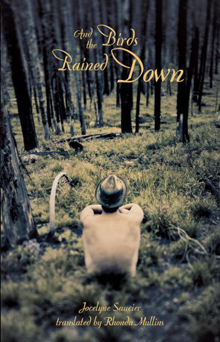
And the Birds Rained Down is a skinny book of the most delicious kind, one of five Canada Reads selections, for which I am truly grateful.andthebirdsraineddown-220

I’ll be honest though. It took me few beats to relax into it and I wondered why this was… because I liked the story. Then it occurred to me: I was reading at the wrong speed; I was looking for something rather than letting the something contained within the pages find  me.

Also, the ‘something contained’ wasn’t what I thought. So I’d never have found it by looking.

For instance, what it’s NOT about is a few feisty and elderly men who have chosen to live in the woods where they rely on their wits and each other and occasional supplies from town courtesy of a couple of pot growers. Neither is it about the two women who arrive, one a photographer, working on a project about survivors of an infamous fire; the other, a former inmate of a lunatic asylum.

Neither is it about a small Northern Ontario community that was devastated by fire, or the way the fire’s effect has touched various unconnected people in the decades since.

It’s not about dogs named Drink and Chummey, or a cat named Monseigneur.

And it’s certainly not about the worry of death, though it’s mentioned a lot and figures prominently. And, well, there is  strychnine.

It is… however, about dignity. How we see people, how we expect or allow them to live. How we can choose to help or hinder or judge. It’s about the kind of communities we want and the kind we build. (A roadside hotel—a rather old and often overlooked shell of a place with an interesting past that still serves a real purpose to those with an appreciation for authenticity—offers a powerful metaphor for aging.)

“I like places that have given up any pretence of stylishness, any affectation, and that cling to an idea waiting for time to prove them right: prosperity, the railroad, old friends… I’m not sure what they’re waiting for. The region has a number of these sorts of places that stand the test of time as they revel in their own dilapidated solitude.”

It’s about respect for generations that have lived lives we can’t possibly understand; it’s about breaking down age barriers.

“The eyes are what are most important in old people. The flesh is hanging, sagging, gathered in wrinkled knots around the mouth, eyes, nose and ears. The face is ravaged, illegible. You can’t know anything about an old person unless you look into their eyes—their eyes tell the story of their lives.”

It’s about friendship and the surprising places it’s found. In one case, in an asylum where one inmate (who had her own baby taken from her) helped another mourn the loss of her child.

“I rocked her baby. That’s how we became friends. I asked if I could rock her baby. She passed him to me very carefully and I took him just as carefully, and I rocked the baby too, for a long time, singing songs to him. And that’s how, taking turns rocking a baby that didn’t exist, we figured out how not to be where we were.”

It is about love and sex in old age and the latter not working quite as it used to. Never mind. There are other ways. Saucier doesn’t shy away from this subject but treats it with exactly the right amount of ‘natural’. We might ask ourselves why this isn’t talked about more… is it just so terribly shocking to know that the elderly feel passion?

It’s about creativity.

The way these men have built their lives, and an unknown stash of paintings in which more is revealed about the artist than ever could be shared in friendship.

And, yes, it’s about death. Not in any maudlin or sentimental way but in the way it’s connected to both life and independence and the choices we make. Not only how we live, but how we die…

“Too many deaths,… Too many bodies, too much black coiled at the bottom of his paintings, never any light, or, if there is any, it’s to illuminate blacked bodies, cries of horror, hands out stretched where death surprised them. No one can live with that deep within. Ted tried to free himself from it, to hurl all of that horror onto the canvas. Maybe he succeeded in a sense. His final painting, the one on his easel, had light—very little a faint glimmer, but enough to created a space from which he could slip away gently. That’s what I hope for him, it’s what I hope for all of us. To slip away gently.”

It’s a book that celebrates the realities of life in its not always perfect perfection. And it does so quite perfectly.

All that in 155 pages.

And the Birds Rained Down, available online at Blue Heron Books.

Cr2015-375-banner


this is not a review: ‘plainwater’ by anne carson


While each of my Not A Review pieces are distinctly not reviews to varying degrees… this one is REALLY not   a review. I haven’t even finished the book. Which is part of this particular Not a Review’s angle.

It seems I have a sort of love/huh?? affair with Anne Carson’s work, of which  I’m only beginning to know. I’m drawn to it, get angry around it, leave it, then I come back and make tea and snuggle up with it again, blissfully content in my confusion until it all becomes too much. And the cycle continues. The addictive element appears to be the occasional bouts of holycrapletmereadthatpartagain! that come over me. In a good way, I mean. (Because there are plenty of moments when I have almost exactly the same reaction in a bad way, as in holycrapwhatthe#@*#isshesayinghere??? )

Is it just me or is there a certain type of poetry that feels like it comes with a fence and a Keep Out sign? Stupidly you stand there thinking it can’t mean you and so you holler let me in!!  Leaping up and down, you try to see over it, try for even the tiniest glimpse but you’re sweating and your feet hurt and you start to wonder: is it supposed to be this complicated?  Is maybe the fence greased?? So it’s in all seriousness when I ask: is there an actual category of poetry designed to make it seem more pleasant to gnaw off your own hand than to turn one more page?

Not that I’m saying I feel this way about Anne Carson. No no no. True, there is the huh?  part of things, but there is also love. (I’m here aren’t I?)

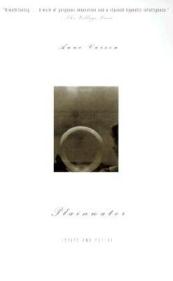
And what I’m happily not reviewing today is Plainwater, published in 2000, and whose entire first section (called ‘Mimnermos: The Brainsex Paintings’)
I skipped because of things like this… “Yes lovely one it’s today forever now what’s that shadow/ unzipping/ your every childfingered wherefrom?

I just wasn’t in the mood for all the leaping.

9780375708428What I did instead was zip ahead to the last section, ‘The Anthropology of Water’, which consists of various pieces, essays… to which I’ve been happily returning each morning for the past few days, champing at the bit to pick up where I left off in ‘Kinds of Water: an essay on the Road to Compostela’, wherein Carson and her travelling companion, identified only as My Cid, walk the Camino, musing on what it is to be a pilgrim, to thirst, to question, to live with faith, or not. To live among people. Or not.

“You come to understand travel because of conversations, not vice versa.”

It’s said, she tells us, that a traveller becomes addicted to the horizon. She tells us that she is a pilgrim, not a novelist, “and the only story I have to tell is the road itself.”  She compares this with telling a story through a character, the difference being that a character moves. “He changes according to the company he keeps…”

I’ve read other writing from the Camino. This is different. Less about the experience, more about the questions posed by the experience.

“… it is an endeavour as old as civilization to set out on a road that is supposed to take you to the very end of things… What do you find there?… Who would you be if you knew the answer?”

She’s writing about the Camino. Or is she? The layers are uncountable.

I was sad when the road ended. But then, it doesn’t really. That’s kind of the point.

So, I approached the fence again. I dipped back into that first section and I’m glad I did but thank god for google because I didn’t know Mimnermos was a Greek elegiac poet from 600 something BC and while I normally wouldn’t care, Carson makes me care.

And all the sections in between… The one that contains miniature essays on orchids and rain and Sylvia Plath. On walking backwards and Ovid. And the section that is a long poem, which seems impossible, and the one after that—poems on various kinds of towns.

I care.

Could it be that we come to understand because of caring, not vice versa?

After all, the writer’s job, the poet’s job, is not to clarify, but simply to make us care.

The copy I’m reading is from the library. This won’t do. Where once I thought I might not even read the whole book, it now seems I’ll be calling my bookseller and ordering my own Plainwater. To love and to huh?  my way through as the moods take me. But then this is the way of love and huh?…

Love always wins.

Plainwater is available on-line at Blue Heron Books. Support indies!


this is not a review: ‘what we see when we read’, by peter mendelsund

That I can’t decide if I like this book best for its visuals or its text is, I think, a big part of the point. After all, the author is associate art director at Alfred A. Knopf, whose designs (according to his bio) have been described… “as being the most instantly recognizable and iconic book covers in contemporary fiction.”

It makes sense then that What We See When We Read  comes across as a crafted, multi-sensory experience.What+We+See+When+We+Read

The subject matter is ‘narrative’… both from a reading and a having-been-written perspective—how narrative is displayed, how it enters our eyes and our minds, what stays with us and why; what we look for, what we find, what we can expect from the writer, and what’s down to the reader.

The paragraphs are bite-sized and pages often contain acres of white space (or, alternatively, are almost entirely black), with only a few bullet points or a single word.

The style is ‘essay-in-fragments mixed with graphics mixed with illustrations mixed with photos, mixed with something like the memoir of a passionate reader’. (May I add that pages have a wonderful satiny feel, serving as a reminder that the physical experience is part of reading.)

In about the middle of the book (pp. 152/53) all is black, and in tiny white print, in an arch from bottom left to bottom right, this quote from Italo Calvino’s Invisible Cites:

“Marco Polo describes a bridge, stone by stone. ‘But which is the stone that supports the bridge?’ Kublai Kahn asks. ‘The bridge is not supported by one stone or another,’ Marco Polo answers, ‘but by the line of the arch that they form.’”

Mendelsund’s use of a visual arch, with reference to an actual arch, to show the theory of narrative arc… is typical of how this book is constructed: he not only explains how we read and what we see while we do it, but he has us walking through the experience at the same time. An obvious move of course, but it takes a minute to realize exactly how it all works and to just relax with it.

In places the book feels almost chatty, as when the author shares his distaste for elaborate descriptions, which he sees as nothing more than ‘misdirection’… “They seem to tell us something specific and meaningful (about a character, a setting, the world itself), but perhaps such description delights in inverse proportion to what it reveals.”

While both aspects of What We See When We Read are equal and both can be seen as simplistic or as layered as you like, I found myself becoming frustrated with the choice, as if I was being asked to read/experience two different books. This may be part of the overall plan to illustrate the reading/visual experience but I find it a tad too much of a muchness, a few too many graphics and ‘design’ elements that begin to have the opposite effect of what they’re intended for—they become less illustrative and more overload of the same multi-senses (which then begin to tune out simultaneously). For that reason best consumed, perhaps, by dipping into now and again, enjoying bits at a time instead of reading straight through.

Bottom line: despite its pleasures, at 417 pages, it feels a little over-done.

That aside, I can see this as a good book club choice. In which case, some knowledge of Anna Karenina and a few other classics would be helpful (various narrative devices are highlighted with examples from a number of books you thought you’d read but actually never have). Helpful but not necessary.

In fact, a book club might be the ideal way to savour it. Whereas the pleasure of some books is not enhanced through sharing, especially with people who see it very differently (read: one person’s exhileration is another person’s sleeping pill), What We See When We Read purports to be neither; it simply wants to be seen and discussed by as many and varying perspectives as possible. And if not everyone reads the whole thing, it matters not one whit. The whole thing can still be discussed, and enjoyment multiplied.

Because, you see, it’s not exactly a book, it’s merely about them. And therefore about us too.

Purchase What We See When We Read, online, from Blue Heron Books.

you say salon, i say pass the cheese ball

So I had a salon. In my living room. Which may be redundant.

Let’s just call it Writers in My Residence.
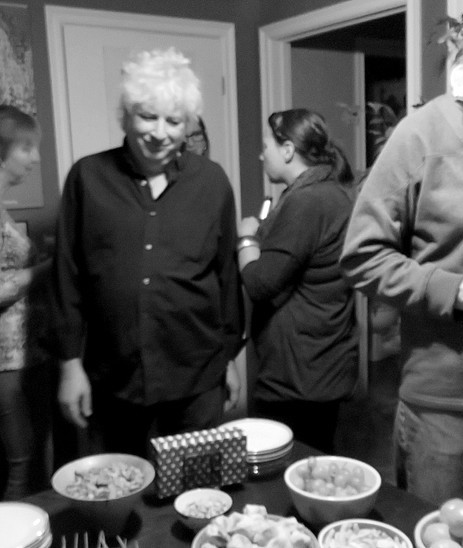
IMG_0102Bob Dylan came. He liked the samosas. IMG_0103I liked that I knew some people in six degrees of separation ways, but not really. It made for much to talk about. IMG_0104Sculptors and writers talking in the kitchen pleases me. IMG_0105Poets and painters talking in the front hall worries me. What are they plotting??? IMG_0106Here they are. Writers, artists of all stripes. Readers. Mostly readers. Word lovers. The best kinds of persons. Nestled in front of bright blue art by Rhonda Pearl.
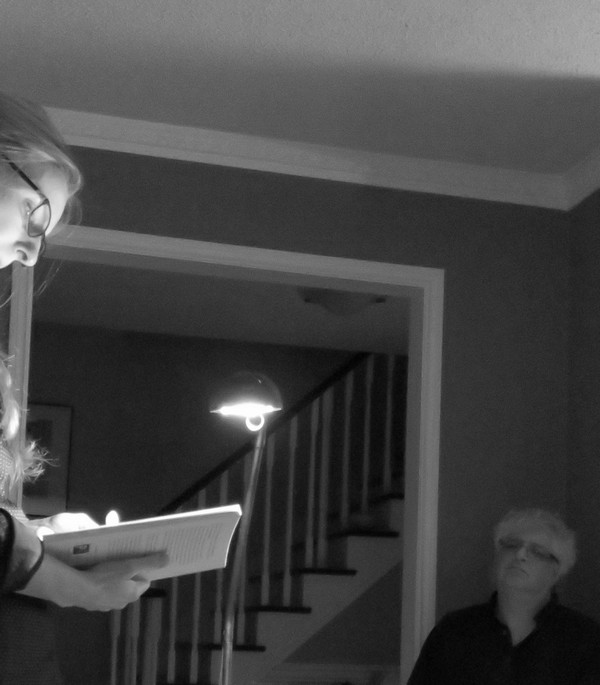
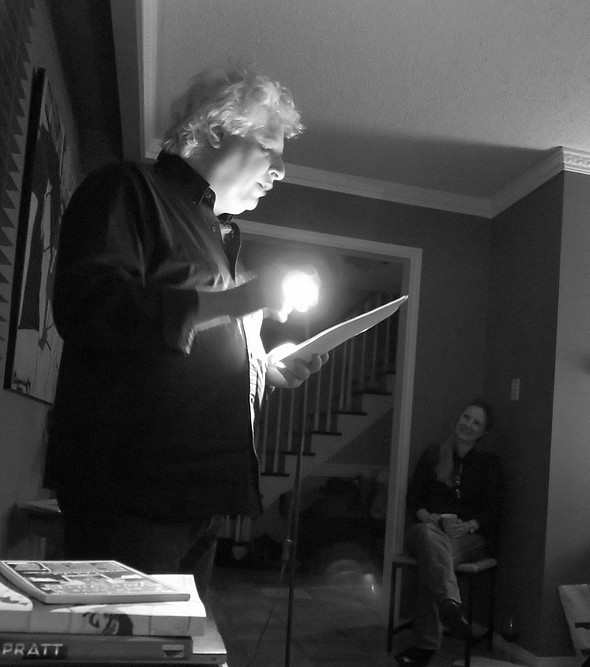
IMG_0109Reading and listening. IMG_0110One reading is about Anne Wilkinson, a little known modernist poet who is now being more known through The Porcupine’s Quill ‘Essential Poet’s’ series and the good work of Ingrid Ruthig, editor of the The Essential Anne Wilkinson. IMG_0116Another reading is new fiction by Stuart Ross, followed by poetry from his new book Our Days in Vaudeville (Mansfield Press). Here, the omnipotent poet holds in his hand an errant firefly that had been terrorizing the living room for months.IMG_0118 We laughed.
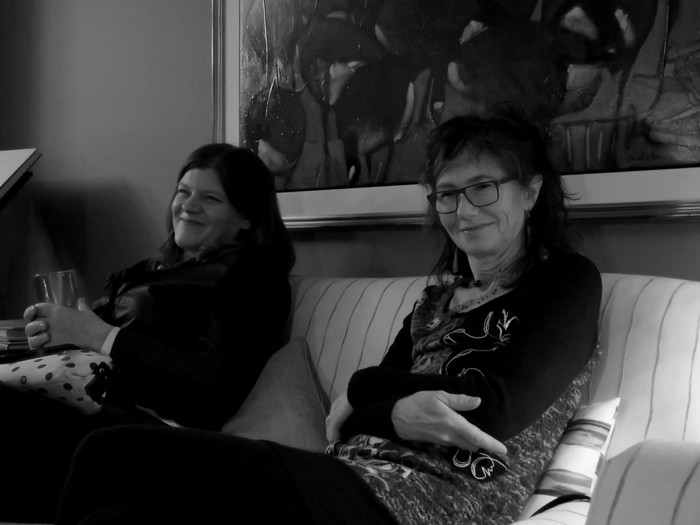
IMG_0119 We were enraptured. (Enrapturized?)
IMG_0120We had food and drink and indoor sunshine.

Such is the power of words in enclosed spaces.

Big thanks to a beautiful bunch of participants for this beautiful night.

<><><>

this is not a review: one hour in paris, by karyn l. freedman


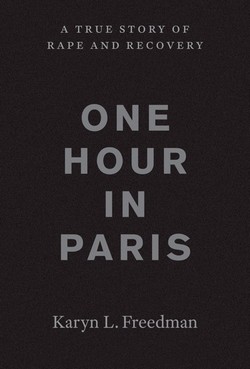
Academic approaches to writing are never my favourite way to tell a story, but in the case of Karyn L. Freedman, Professor of Philosophy at the University of Guelph, it works. Indeed, she may be exactly the right person to have written this-book-that-needed-to-be-written. While it surely must have been tempting to veer too much in one direction or the other, in One Hour in Paris. Freedman has managed, for the most part, to balance facts and eye-opening statistics with what feels like heart on her sleeve honesty about the extreme emotions following a brutal event.

The book is about rape.

OneHourInParisCoverFinalBut that’s merely the grit, the sand in the shell that gets things going. The pearl that emerges is a story about trauma and how it can be experienced in as many ways as there are people experiencing it. Freedman’s analytical take on the subject works insofar as presenting a case for PTSD through her rape experience and showing us how society’s focus on the rape, or indeed any ‘incident of violence’, instead of the resulting trauma, diminishes the understanding of violence, undermines the victim and slows or even prevents healing.

In other words, we don’t tend to take these things seriously enough. Especially the lingering and messy aftermath of trauma. We give it an acronym, attach it vaguely to returning soldiers or first responders in newsworthy events. We sincerely hope they ‘get over it’, ‘get better’. But acronyms and hope don’t help. Trauma is hard enough to understand for those who are living with its effects without having to deal with the assumptions and judgements of those who have not experienced it, or who may have experienced it differently.

I’m not sure I would have been able to write that last paragraph before reading Freedman’s book. The way she explains the clinical aspects of trauma has given me a deeper and more practical understanding, not a more emotional one, and for that I’m grateful.

Freedman was raped in Paris on August 1st, 1990. The date is repeated throughout the book, to a degree that becomes slightly irritating, until one realizes that’s the point. She can no longer approach August 1st without remembering what happened. The date is embedded in her memory. She doesn’t need reminding. But reminders are there. Every year. And so by virtue of this repetition she shares with us the ‘irritation’ of not being able to forget something she can’t bear to think about.

She writes about the rape, what happened after, emotionally, professionally, how her father was instrumental in helping her case in ways that many other victims would never experience. For instance, the French government flew her back to Paris (from Winnipeg) at their expense in order to proceed with the case… a case which ultimately saw her compensated financially. While the benefit of such privilege tends to suggest that her trauma has been ‘resolved’, what it actually does is ask the question: what about the women that are raped and/or abused every day, citizens and visitors alike, for whom nothing is ever done, many of whom don’t even know who to tell or how to be heard or believed, much less be compensated and see the perpetrator sent to prison. It’s easy to start thinking that for women who receive this kind of privilege, it’s done. But Freedman is quick to point out that it’s not done. She knows she’s privileged, that this is not how it is for everyone. But all that is almost beside the point. The money, while substantial, is a token, the incarceration is merely fair. None of it is closure.

What’s needed is understanding, by society, a change in how we discuss issues of sexual violence against women, and how we understand the very real effects of trauma on the body, mind and spirit.

“… the sense of responsibility held by many rape survivors is at least partly driven by a dominant worldview regarding personal safety and harm. Although this picture is slowly changing, historically, at least in the West, girls have been taught from a young age that the world is basically a safe place and that so long as you are sufficiently careful and intelligent, you can protect yourself from any serious harm.

“Underscoring this narrative is the fact that in our entertainment-saturated media culture, the everday-ness of sexual violence against women is overlooked in favour of sensationalized stories of extreme violence. And because rape is typically experienced in private… the clear evidence of its pervasiveness is obscured from our collective vision….

“So how does the rape survivor reconcile this dominant worldview with what has happened to her? After all, it cannot be true both that the world is a safe place and that you were raped, unless, of course, the rape was your fault.” 
 
**

Any quibbles with the book are insignificant to the larger message.

__________________________________________

One Hour in Paris is available online at Blue Heron Books. Support indies!


this is not a review: are you ready to be lucky?, by rosemary nixon

 
I began reading this book with the idea that it was a collection of short stories. And so, on finishing the first one, the title of which happens to be ‘Are You Ready to Be Lucky?’ I was sad. It was such a merry romp and I liked the characters so much and now they were gone. This was wrong, I thought. Just wrong. And terribly, terribly sad.Are-You-Ready-to-Be-Lucky-Cover

Then I began reading the next story. And I recognized the people. Stella and Roslyn and stupid Duncan the English twit, a personal favourite. (Duncan Bloxham; I mean is that the perfect name?) Good lord, I thought. Good lord…. Could it be??  I flipped forward a few titles…. and, yes, Roslyn, still there! Linked stories!
Oh wot a pleasant surprise.

Trauma behind me, I read. And read and read and read.

I drank peppermint tea with fresh leaves from the garden and put my feet up on the patio table. And hours passed and then the weekend, and clouds scudded by and the tea turned to wine. And I read til I finished this absolute delight of a book.

I will tell you nothing about it because sometimes I’m like that.

I will, however, tell you this: the chances are good you’ll enjoy this merry romp.

“The girl’s husband, thirty-five years her senior, cracks his sixth beer. He too is reading the Sunday Times. But only the pages that say what he wants to hear. The girl tries to remember how this man came to be her husband. How she became the third wife of a man only months after he divorced his second. She makes a disorganized list. It had to do with expensive dinners, a second-hand clothing store in Salmon Arm, with rutting elk, Canadian immigration, telephone calls across crackling wires, tears (his), frightening dreams of attacking ostriches (hers), a domineering ex-wife in England (his first), a suet recipe (bird pudding) using Crisco instead of lard. She adds the man’s talk of foreign places… How when he stood naked he reminded her of the pet turtle she had as a child, of whom she was very fond.”
Are you Ready to be Lucky?  (Freehand Books, 2013)