fuel for small talk of a purple nature…

“It is the irresistibly deep and beckoning colour of leather, heather, feathers, sagebrush, winter slush, Tibetan mush, age, sage, shade, grapeade, a forest glade, mince pies, winter skies, a harlot’s eyes, a baby’s cries, vicious lies, butchers’ dyes, and purple drifts of evening snow.” ~from The Secondary Colors, by Alexander Theroux

From the same book, and the essay titled Purple, come the following bits of essential trivia:

1.    Shakespeare never once uses the word violet as a colour, only purple; nor… does he ever employ the words heliotrope, mauve, lilac, or fuchsia. Burgundy was a place, a duke, and, by extension, a wine.

2.    The Nile, in literature, is often said to be purple.

3.    An amethyst placed under the pillow promotes pleasant dreams, and wine drunk from an amethyst cup is said never to intoxicate.

4.    The infamous [in some circles] shade of ‘Tyrian purple’ was discovered by the Phoenicians by extracting the dye from the cyst or vein near the head of a mollusk; 250,000 shellfish were required to make one ounce of dye as each mollusk secreted only one drop.

5.    Rimbaud regarded the letter ‘i’ as purple.

6.    There is, apparently, purple soil [somewhere] in Tahiti.

7.    Henry James saw Italy as picturesquely violet.

8.    A polar bear’s tongue is purple. [Also a giraffe’s.]

9.    Also the sunshine through a person’s paper-thin ears.

10.  The spaceship Endeavour went into orbit on March 2, 1995, with the specific mission to try to determine the nature of ultraviolet light in space emitted from stars and quasars.

11.  The rarest of food colours. There are no purple M&Ms, for instance, though they were made for a short time but proved so unpopular, they were replaced by tan ones in 1949.

12.  Horace on purple prose: “Often to a work of grave purpose and high promise, one or two purple patches are sewed on to give the effect of colour.”

13.  There’s speculation [in some circles] [what circles would these be??] that all seven of Salome’s veils were purple.

14.  The dominant colour of Gillikin Country in L. Frank Baum’s The Wonderful World of Oz.

15.  Except for plum, all shades of purple lose their lustre in candlelight.

16.  The naturalist, John Muir, wrote a letter to a friend on purple sap from a 4,000 year old redwood.

17.  Rumour has it Anatole France, Voltaire, Diderot, Flaubert and Balzac all wore a purple dressing gown while they worked.

18.  Sherlock Holmes, on the other hand, owned three dressing gowns. One brown, one blue, one purple.

19.  Daisy, in the film version of The Great Gatsby, wears a violet dress, scarf and hat, on her reunion with Nick, who sports a purple silk shirt.

20.  Twiggy’s favourite colour.

21.  Harriet Quimby, first women pilot to fly across the English Chanel, always wore a plum coloured flying suit.

22.  From The Colour Purple, by Alice Walker: I think it pisses God off if you walk by the colour purple in a field somewhere and don’t notice it.

23.  Gloaming = Twilight [and, according to Theroux, it is dark purple brown]

today’s colour

Another reminder this morning of how closely linked are the processes of gardening and writing—all that pruning and timing and structure-is-important-or-the-whole-thing-goes-to-hell-pretty-quickly-no-matter-how-nice-it-looks-when-you-plant-it.  Not to mention the yanking of weeds, watering, muttering about what needs to be moved, propped up, filled out, eliminated. Deadlines. Frost warnings.

It never fails. I go outside to air my brain, get away from the pages but they follow me and what I end up doing in the garden turns out to be some parallel version of what I’m working on at my desk.

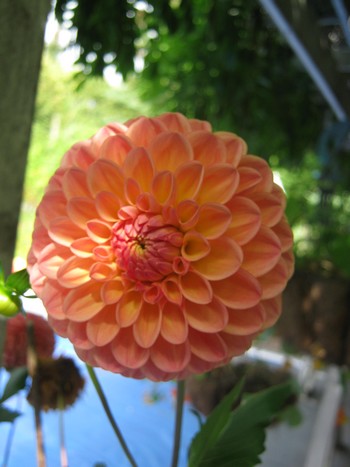
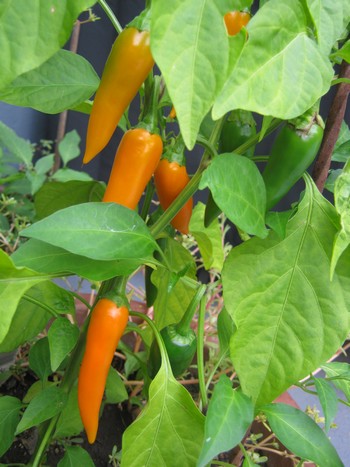
So this morning, after cleaning up some edges along a stone path, I decided to do a colour post; I was taking pictures of red things, tomatoes, bee balm, unripe blackberries, but none of it was grabbing me. Then I noticed the nasturtiums and they looked nice so I changed my focus to orange. I had no idea how much of it was out there, hadn’t seen it til I started looking (to my surprise, I was even wearing an orange shirt). I took these pictures then went back inside, inserted an orange scarf into a scene I’d been struggling with and, well, not exactly presto—there’s much more to write—but it changed the direction of the whole chapter for the better.  It was the colour, the ‘orange’ that did it: a red scarf, or blue or green, wouldn’t have worked. And yet I couldn’t see it…

Weird.

And wonderful.

Moral of the story: air your brain.   [and when all else fails, employ scarf trick]
thinking green

So I’m sitting around on the weekend the way you do, wondering how many shades of green there are in the garden. Peter points out there’s at least ten in a single hosta leaf, suggesting I may be wasting my time if I want real numbers.

“Imagine trying to paint them all,” I say as he quickly opens The Globe’s sports pages. “I mean, how in god’s name do you capture all those shades, how would you paint it, how would you know which green needs a dab of blue or orange or red or yellow or brown or black or—”

“I get it,” he says.

“And then there’s the light. How do you do the light, the dappled bits on the tops of spruce boughs, the dark bits underneath—I mean what colour is the spruce bough??”

He’s entrenched in his reading by now but I ignore that, continue sharing my amazement at green, the magic of painting, of nature, and then I start thinking about ‘doing’ green in other forms. What if, as an exercise, you asked someone to write it—in poetry, or represent shades of green through a short story, a novel, in music, or asked a dancer to interpret green in movement or an architect in design. Translate all that green to a blueprint.

Peter looks up from whatever the Jays are doing. “You’re going a little over the top aren’t you? Architects?”

“Why not?” I say. “Why not interpretation from every corner? Why not convey ‘green’ in meals and wine and quilts—”

“Wine would work.”

Seems I’ve struck a note with his inner sommelier. He glances at the garden, starts listing wines, describing them, throwing words around: pine needle, pepper, herbaceous, crisp, damp woodland floor, grassy, stalky, vegetal, sun shower over Miami. Okay, I made the last one up.

“See?” I say. “Now imagine a festival.”

“Excuse me?”

“A festival celebrating the Art of Green. Green the colour and green the concept. You get funding, sponsorship from the corporates, they like to appear green friendly—get chefs involved, restaurants, galleries, the whole arts community, painters, dancers, photographers, wineries, farmers, writers, sculptors, potters, and, yes, architects. Different expressions of green in different venues: schools, theatres, cafes, vineyards, street corners, studios and—if there’s any still open—libraries. It would last a week in…hmm… maybe late Spring. There’d be posters of greenness and tee-shirts and book bags and the proceeds would go to some form of conservation—a save the bees fund or field trips for kids to learn about the environment, something…I haven’t worked that bit out yet.”

[Rustle of paper as he gets back to reading.]

“And the following year, the Festival of Green could do the same thing in another colour: the Festival of Green celebrates blue or yellow or purple or—”

“You’re doing it again.”

He says he likes the idea, he’s just worried I’m about to organize a festival. I take a breath, sigh, assure him I’m not. I’d like to but it’s all a bit daunting and the fact is there are days I can barely figure out where to begin a new paragraph. Priorities. What I need to do is complete my novel before paper becomes obsolete. I know that. So, yup, for now, I tell him, festivals will have to wait.

“Unless of course someone else wants to organize it…” I say. “In which case I’m in.”

[Silence. Followed by more rustling of paper, followed by silence.]

More green…

green-0051