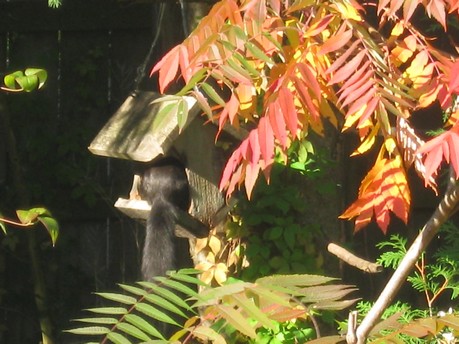
…at least long enough to eat his Thanksgiving seeds??
 Thank you.
Happy Turkey, Pie and Seeds Day!
…at least long enough to eat his Thanksgiving seeds??Thank you.
Happy Turkey, Pie and Seeds Day!
Another reminder this morning of how closely linked are the processes of gardening and writing—all that pruning and timing and structure-is-important-or-the-whole-thing-goes-to-hell-pretty-quickly-no-matter-how-nice-it-looks-when-you-plant-it. Not to mention the yanking of weeds, watering, muttering about what needs to be moved, propped up, filled out, eliminated. Deadlines. Frost warnings.
It never fails. I go outside to air my brain, get away from the pages but they follow me and what I end up doing in the garden turns out to be some parallel version of what I’m working on at my desk.
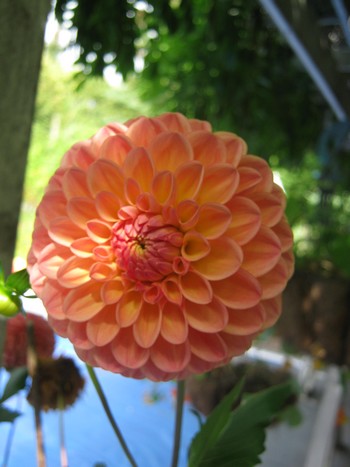
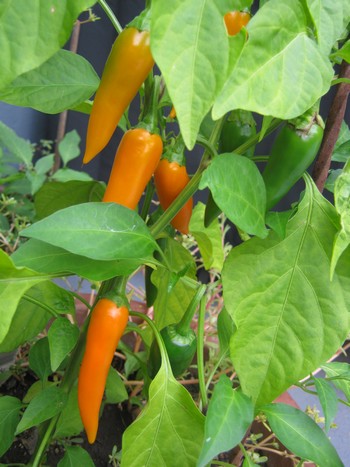
So this morning, after cleaning up some edges along a stone path, I decided to do a colour post; I was taking pictures of red things, tomatoes, bee balm, unripe blackberries, but none of it was grabbing me. Then I noticed the nasturtiums and they looked nice so I changed my focus to orange. I had no idea how much of it was out there, hadn’t seen it til I started looking (to my surprise, I was even wearing an orange shirt). I took these pictures then went back inside, inserted an orange scarf into a scene I’d been struggling with and, well, not exactly presto—there’s much more to write—but it changed the direction of the whole chapter for the better. It was the colour, the ‘orange’ that did it: a red scarf, or blue or green, wouldn’t have worked. And yet I couldn’t see it…
Weird.
And wonderful.
Moral of the story: air your brain. [and when all else fails, employ scarf trick]





Sunrise.
Sunset.
And repeat…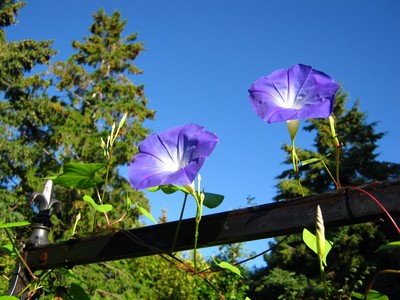
Seems I’ve outgrown many of my old gardening books. Not because I’ve learned so very much [mostly what I’ve learned is how much I don’t know] but because my style has changed. Used to be I liked a cacophony of colour from March to November, which meant endless planning and revising, wandering the crowded aisles of garden centres in a confused fog, pushing about a giant trolly, only to find all that consideration of height and spread and bloom time amounted to zip when somehow all the tall yellow stuff ended up together—not to mention the expense of annuals to fill in gaps and baskets and pots everywhere.
Worse, at the end of a day of ‘garden management’, I’d kick back on the patio with a glass of wine, look at the lovely vista in front of me and say: oh crap, the phlox is three inches too close to the Echinacea… and they’re both pink!!
And then one day, I’m not sure when or how, I changed.
Now my pots are filled with food: peppers and eggplant and basil, and what I like best is green with splashes of colour wherever colour chooses to appear. I like surprises better than control. There are few annuals and all the perennials are either native or very hearty. No wimps allowed.
And nothing is ever in the wrong place. Sometimes I move stuff, sometimes I don’t.
So goodbye fancy formal books that describe how to do Vita Sackville West’s white garden,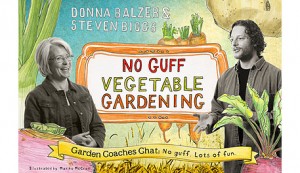 or Hugh Johnson’s idea of simplicity—something along the lines of casual Versailles—and hello No Guff Vegetable Gardening, by Donna Balzer and Steven Biggs.
That is where I’m at today. Food and simplicity.
And that, thank god, is where Balzer and Biggs are at.
Not only do they get the joy of gardening and, specifically, the pleasures of growing food, they’re able to share that enthusiasm—along with the wisdom of their experience—in a way that doesn’t feel like it’s coming from a book.
Written from slightly varying points of view—their differing opinions centre around gadgets, fertilizer, cauliflower coddling…[and getting both sides is part of the fun]—but overall there is agreement on the basics of organic and do-able gardens. The pages are a mix of beautiful photos, colourful illustrations by Mariko McCrae, charts, lists, refreshingly straightforward advice from starting a garden to succession crops to harvesting tips to composting—essentially everything any home veggie gardener needs to know or be reminded of, and then some.
With that much info coming at you it’s easy to slide into a cluttered look but they’ve avoided that with good page layouts—multi-coloured fonts and backgrounds and a balance of graphics and pics—making for easy to read bite sized chatty chunks… and [so clever] both the cover and the pages are a smooth glossy finish as if made to be delved into straight from the garden with mucky in-the-middle-of-a-situation-that-needs-an-answer-NOW hands.
Which is exactly how I approached the book the other day when I noticed my zucchini are all flower and no veggies and found out why in a small blurb on p.146 under the title: ‘Gender Roles Affect Squash Harvest’… wherein it was very simply explained [I’m paraphrasing here] that the bees haven’t done their job and hand-pollinating is in order. Male flowers have a long stem; females, a short stubby one. Get a tiny paintbrush and go to it. Directions are supplied of course, as is an aside by Biggs saying he’s never hand-pollinated and feasts on the blossoms instead. Which is what I chose to do. And may I say they’re delicious. (Dip blooms in egg wash, then bread crumbs, and sauté lightly in butter with a drop of olive oil so they don’t burn. If you want to stuff the blooms, do that before dipping. This is so good that I’m not even sad about no zucchini this year. I go out every day and pick the flowers instead.)
For me this book is a little like having that neighbour at your beck and call [the one who grows the best tomatoes and beans], dispensing not only answers but pearls of garden wisdom, anecdotes, recipes, back and forth exchanges and incidentals. You just want to hang around and hear more, ask questions.
Having said that, should you ever find yourself in the mood for the intricate details of herbal knots, Latin binomials or how to maintain French lavender topiaries in the shape of the Eiffel Tower—there are better books on the subject. What I like about the No Guff concept is its smart idle chat feel; you don’t read it so much as open it and find a conversation [or debate] that welcomes you right in, practically pours you a drink and never says a word about conflicting colours.
This one’s going straight onto the gifts-to-give list.
Every year I cut a basketful of hydrangea for the neighbour lady who dries them to use on her xmas tree. And every year I think: what a lovely idea, and then don’t do it myself… being stuck as I am on the ancient Elmo and Fozzie Bear I gave single Peter a hundred years ago and which he still loves, and the battered white dove that used to be the top of my own tiny singlehood tree—and how could we not hang the hideous Starship Enterprise that no one knows where it came from but if encouraged will tell you to live long and prosper. Ugliest thing you’ve ever seen but it is a nice message.
You should be warned there’s no point to this post except to say the heat wave’s getting to me and thinking about winter has a pleasing effect. Frankly, I’m about one step away from doing a whole pointless wintery riff that could easily morph from tree decor to ice-fishing to memories of snow forts and pretending icicles are freezies and having my face washed on the way to school while wearing big brown rubber boots with buckles, boots so big you put your whole big shoe inside them, and homemade mittens and a scratchy wool hat with pompoms—and didn’t there used to be more snow when we were little? and wasn’t everything uphill? and five miles away?—and how our parents let us go toboganning on our own, at dusk, on Suicide Hill (which, if you didn’t hit a tree, landed you in a parking lot, screaming and laughing hysterically as you swerved past cars)… anything to forget for a single minute that it’s 248 humid degrees out there…
Alas, it’s too late. My fingers are already sliding off the keys and my brain is a fried plantain chip. (in which case may I simply say this: let it snow, let it snow, let it snow! if only for five minutes…)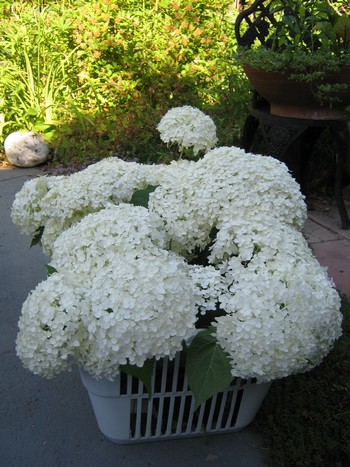
 I know what Jake the Cat and friends are getting for xmas this year… and it’s not rhubarb.
Just a matter of plucking off the leaves, letting them dry a few months and presto bongo… cheap drugs. So is it xmas yet?
Lunch, freshly picked, as yet unassembled.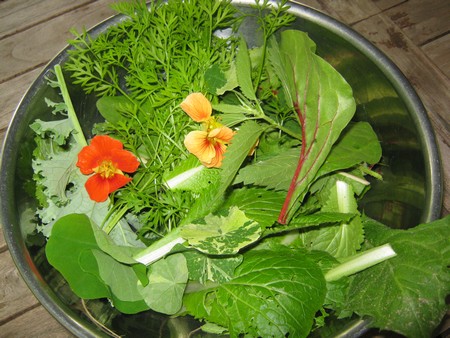
I’ve noticed that bees like wisteria.
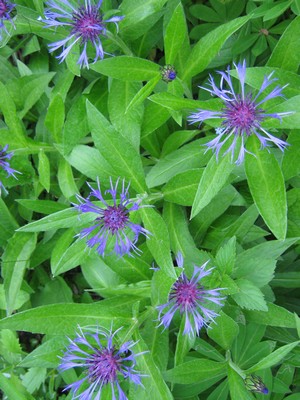
And cornflowers.
Ajuga too, especially at dusk.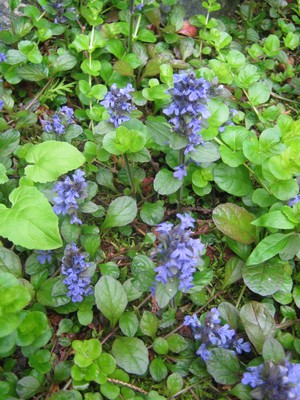
And lupins and iris.
All of which makes me think…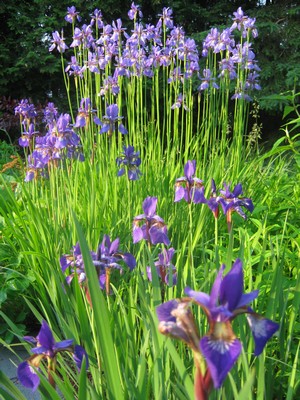
Bees like purpley blue stuff.
(although I have no photographic proof, not that I didn’t try—flighty buggers, bees—so don’t strain your eyeballs, there’s no buzzing in those blooms.)
“I have contemplated a well-hoed ridge of potatoes on that bush farm with as much delight as in years long past I had experienced in examining a fine painting.”—Susanna Moodie, Roughing it in the Bush, 1852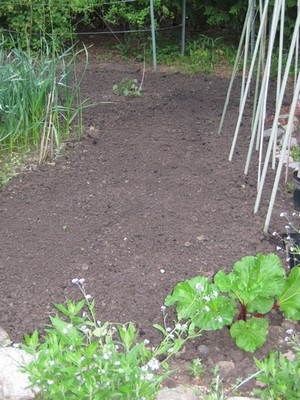
Ready for planting!
Is it possible that my well designed garden tools—which are worth the extra dough and I’m not complaining—are purposely made the exact shade of green that allows them to disappear in the shrubbery, forcing me to buy replacements… Or am I just being cynical?
Be so much simpler if they were orange.
 Matilda Magtree