pawsing the mantra

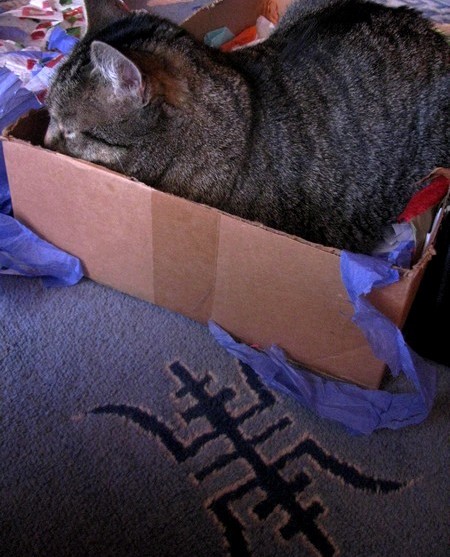
When—cross-legged on the living floor, palms up, silently reciting my ohms—I hear a rustling in the tissue paper next to me… I open my eyes and count this as part of my meditation.

And when tail and paws and one side of striped and whiskered face are sufficiently clean, another shuffle and re-shifting in cardboard nest is followed by stillness… then a deep breath is drawn—and we both close our eyes, Zen master and student.
IMG_5387

inject into rattling discourse as necessary

Am cheating today and scooping a little something that was sent to me— thought it might come in handy should you be socializing any time soon and require bon mots or merely questions to change conversational direction or stop people rattling on about pet bunnies [or equivalent]…

You’re welcome.

1.  IF A TURTLE DOESN’T HAVE A SHELL, IS IT HOMELESS OR NAKED?

2.  IF YOU GO INTO A BOOKSTORE AND ASK WHERE THE SELF-HELP SECTION IS, DOESN’T THAT DEFEAT THE PURPOSE?

3.  WHAT IF THERE WERE NO HYPOTHETICAL QUESTIONS?

4.  IS THERE ANOTHER WORD FOR SYNONYM?

5.  WHERE DO FOREST RANGERS GO TO “GET AWAY FROM IT ALL?”

6.  IS IT OKAY FOR ENDANGERED ANIMALS TO EAT ENDANGERED PLANTS?

7.  WOULD A FLY WITHOUT WINGS BE CALLED A WALK?

8. CAN VEGETARIANS EAT ANIMAL CRACKERS?

9. WHAT WAS THE BEST THING BEFORE SLICED BREAD?

10. ONE NICE THING ABOUT EGOTISTS: THEY DON’T TALK ABOUT OTHER PEOPLE.

11. HOW IS IT POSSIBLE TO HAVE A CIVIL WAR?

12. IF YOU TRY TO FAIL, AND SUCCEED, WHICH HAVE YOU DONE?

13. WHOSE CRUEL IDEA WAS IT FOR THE WORD ‘LISP’ TO HAVE ‘S’ IN IT?

14. WHY IS THERE AN EXPIRATION DATE ON SOUR CREAM?

15. CAN AN ATHEIST GET INSURANCE AGAINST AN ACT OF GOD?
Cleo's_Logo_and_Poem_Cleopatra's_Last_Cocktail_Party

what’s not litter

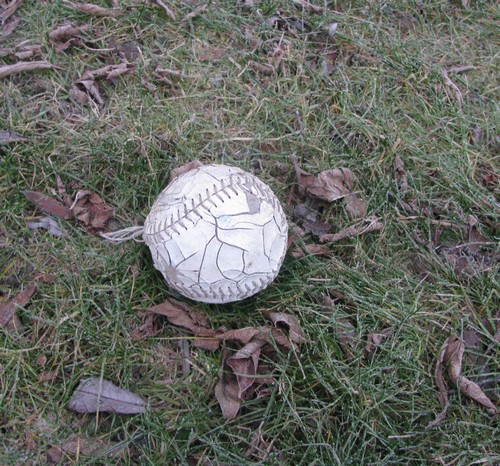
1.  A green tennis ball stuck to the ice, immoveable, which is just as well once I realize that a gallumping, tail-wagging, tongue-lolling beast will likely be back tonight or tomorrow to look for it. And if it’s not IN ITS PLACE there will be hell to pay.IMG_0298

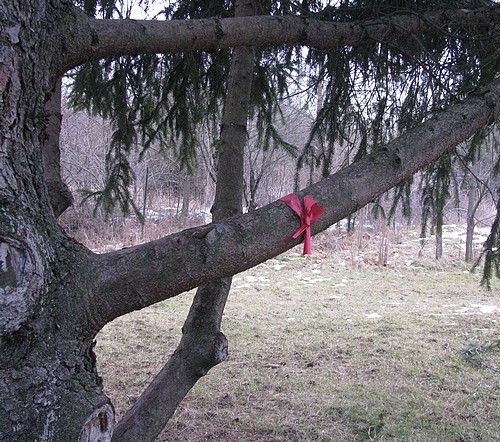
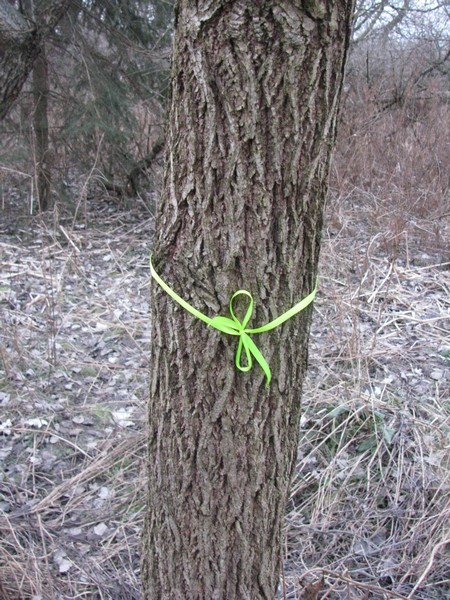
2. Anything red and ribbony and tied to a tree.IMG_0300IMG_0301IMG_0303Or indeed any ribbony colour.IMG_0324
IMG_0331

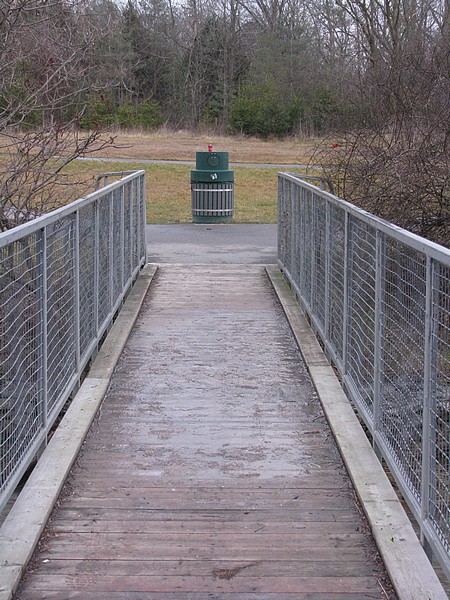
3. Things on TOP of a garbage bin.IMG_0314Especially if that thing turns out to be a full Timmy’s.IMG_0316

4. See #1 above. [No ice but same reasoning applies.]IMG_0335

this

I keep trying to stuff my meditation into a time slot. On a zen tuffet. While decked out in pristine white yoga-wear.

I don’t even own yoga-wear.

No wonder it’s been so difficult.

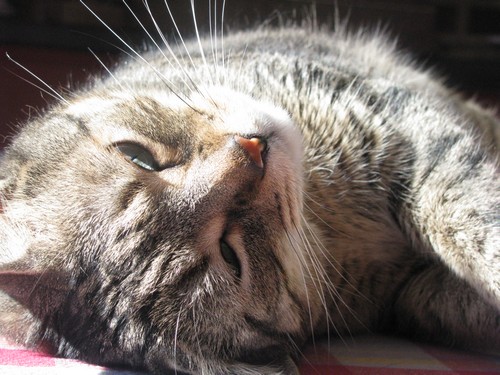
Then this morning, as a nineteen year-old cat stretched on the rug and I in my bathrobe rubbed her tummy while Gregorian monks chanted on the stereo and a beeswax candle flickered on the mantle and the darkness outside was so dark I couldn’t even see the BBQ… I thought: this is meditation.

And so is making soup. Or spaghetti sauce. Curry. Anything with much chopping and stirring.

Even toast. There’s an art to it… it’s about the butter and jam ratio, honey if you’ve got it. It’s about thinking where that honey came from.

Changing the sheets, smelling that fresh-off-the-line smell in your bedroom [or fresh from anywhere smell is good too]. That crisp feeling when you get in under them. With a book. Early enough so you don’t fall asleep in five minutes. This is meditation.

Walking. With a letter to mail, or just to get a paper, a few lemons. Around the block. With a dog or alone. There’s ways of doing it like a chore, but what’s the point in that?

Walking through an art gallery.

Stopping.

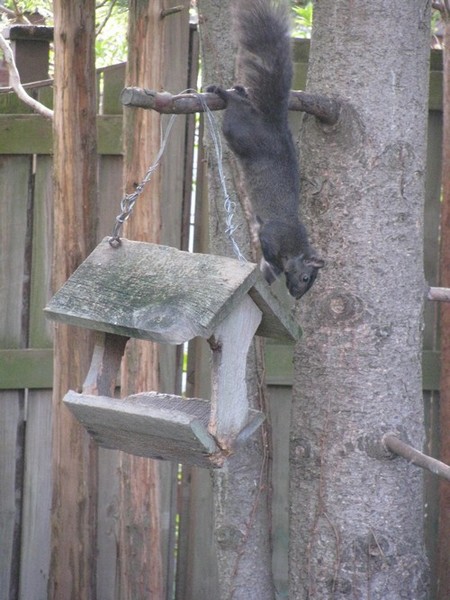
Staring just a moment longer than usual at a painting, a squirrel, a plane passing by.

Cleaning. Chucking out the bits that no longer serve a purpose.

Conversation. Snow shovelling, weeding, sketching, collecting beach glass. Doing a crossword. Drinking tea, really drinking it, tasting it; doing nothing else for a moment but drinking tea… [I wouldn’t know, but this may also work with coffee]

Writing a letter, with a pen. Or a crayon.

Breathing. Just that, done well… this is meditation.

Looking up.

Paying attention.

Eyes open, or closed.
IMG_9875

“The more I read, the more I meditate, and the more knowledge I acquire, the more I am enabled to affirm that I know nothing.” – Voltaire

You might also like Time Lapse
img_9481

And maybe even A Seagull Post
img_9139

living the metaphor

I recently ran away and joined the circus.

A metaphor, yes.

The intention was to get away from routine for a bit, let whimsy be my guide, fly through the air with the greatest of ease…

Then I googled the rules.

How to Run Away to the Circus:

Get into shape. To be a part of any circus, you should be highly capable physically. Before you join in the clowning about, practice your flexibility for a few months. If you’re interested in trapeze or aerial silk, make sure to stretch every day and practice flexibility exercises. Eat healthy foods, and stay as physically active as you can.

Choose an act. Circuses usually require auditions, and you should build a repertoire. Look into things like acrobatics, diabolo, unicycle, and trampolining. Once you’ve picked something to study, get equipment for it and begin practice. Build a bit of a show, perhaps with a theme for entertainment value, to attract possible employers and for use in auditions.

Find a good costume. Some performance attire can be revealing, tight-fitting, or simply wacky. Make sure you have the right costume for you, and that it fits your act. For example, you wouldn’t want long, flowing sleeves for fire dancing.

Make sure your makeup is pixel perfect. In the circus, you have to do everything yourself with no help from a makeup attendant. So purchase and collect your own makeup. Good things to use are shiny eyeshadow and diamond studs. If your show has a theme, play off of it. For example, a show based around fire might involve brightly colored makeup.

Practice your smile. Yours may vary based on your act and your own personality. Some performers may opt for a sexy, one-sided smile, but a friendly grin can also warm the hearts of your audience.

Consider the realities of circus life. The circus is a crowded environment by nature, and you may not have much time alone. If you can’t stand the thought, consider performing in another setting.

-—-

Turns out circus life [complete with clowns] is just like any other.

You have to pay attention.

Or you’ll fall off the trapeze.

drawing from humble springs

“Mechanically we have gained, in the last generation, but spiritually we have, I think, unwittingly lost. In other times, women had in their lives more forces which centered them whether or not they realized it; sources which nourished them whether or not they consciously went to these springs. Their very seclusion in the home gave them time alone. Many of their duties were conducive to a quiet contemplative drawing together of the self. They had more creative tasks to perform. Nothing feeds the center so much as creative work, even humble kinds like cooking and sewing. Baking bread, weaving cloth, putting up preserves, teaching and singing to children, must have been far more nourishing than being the family chauffeur or shopping at super-markets, or doing housework with mechanical aids. The art and craft of housework has diminished; much of the time-consuming drudgery—despite modern advertising to the contrary—remains. In housework, as in the rest of life, the curtain of mechanization has come down between the mind and the hand….

“….The answer is not in going back, in putting woman in the home and giving her the broom and the needle again. A number of mechanical aids save us time and energy. But neither is the answer in dissipating our time and energy in more purposeless occupations, more accumulations which supposedly simply life but actually burden it, more possessions which we have not time to use or appreciate, more diversions to fill up the void.”

~from Gift from the Sea, by Anne Morrow Lindbergh (pub. 1955)

You might also like:
planting solitude

how to spend a day in peterborough

If the day is Saturday…

…start with the market.

Buy potaotes from the Potato Guy who has a dozen different varieties at least and can tell you the history and origins of every single one. He will also tell you which ones make the best potato salad, the best for mashed, scalloped, boiled, baked, fried, potato-pancaked, you name it, he will tell you. He is the Potato Guy.

Buy mushrooms from the [you know what’s coming…] Mushroom Guy. Only in this case it’s the Mushroom Gal. But she’s not there in person in winter [though her ‘shrooms are]; in winter she’s in her lab figuring out how to cultivate morels.   I think she’s doing a PhD in mushroomology. Seriously. The Shiitake are always spectacular. And the Portobello are fresh and don’t need their insides scraped out before you eat/grill/sautee them the way they do when you get the ones from Outer Mongolia at the grocery store.

Buy chocolate from two lads who call themselves ChocoSol and whose [better than fair trade] endeavours are worth supporting. Not to mention the chocolate. Which is worth eating. Expensive, but that’s because it’s ethical and real. And that is the price of ethical and real food. The recipe is simple: buy smarter, eat less.

Buy clean, fresh greenhouse greens from the guy right near the entrance at a tiny table where you never know what he’ll have from week to week, but you know it will be excellent.

Buy apples from the St. Catharines guy, also apple cider; and for god’s sake, don’t forget the pulled pork pastry from The Pastry Peddler or a jar of freshly jarred honey—or cheese, or perogies, farm fresh eggs, homemade pies and cookies, sausages and a few samosas.

Buy flowers to feed the soul.

Remember to thank the buskers for their delightful ambience.

And be absolutley stunned that you spent all your money but applaud yourself for spending it so wisely and in a way that will directly help others, rather than helping already-doing-just-fine-thanks grocery store gazillionaires who bully farmers.

Make a mental note to get cat food on the way home.

Visit a 94 year-old uncle who has a fractured femur but that doesn’t stop him lighting up at the bag of mudpie chocolate cookies you bring him from the market. [p.s. bring him reading material also; Harlan Coban is a good choice.]

Have lunch at Elements. Have the wild boar pate. Have the mussel and fish stew. Have the vino verde. Smile. Sit back. Breathe. Be thankful.

Pop into Titles Bookstore. Buy a copy of something local.

Decide against visiting the many second hand bookshops on George Street [you can’t do it all] and walk west, along the river instead. If you see litter, pick it up. If you fancy a sit down, well then, for pete’s sake, sit down. [Make a note to try the patio at the Holiday Inn once the weather heats up; lovely view.]

Walk all the way to the art gallery, one of the best you’ll see anywhere, where you might find an exhibit by the students at PCVS, a local, downtown high school under threat of closure—and then wonder at the madness of the powers that be.

Choose as your favourite, an installation comprised of one large pink velveteen sofa with dark and ornately carved trim, above which are four standard paint-by-number style formal landscape paintings in gilt frames, each of which has been over-painted in Norville Morriseau style interpretations of ‘landscape’.

Second favourite installation: a text written on the wall, denouncing art. Heart-breaking in one way, given that the artist feels there’s no point in art because no one really gets it and it changes nothing. Oh dear. I want to find this person and say: it doesn’t matter. Do it anyway.

Admire the light.

Walk back along the river to your car and make a mental note to wear better shoes next time.

Stop to take pictures of a dilapidated building that was once a place to eat and drink and be merry.

Go home. Eat, drink and be merry.

[But not before picking up some cat food, otherwise there will be hell to pay.]
◊♦◊

More Travel:

Prince Edward Island
Miami
Montreal
Niagara Region
Chile
Stratford
Vancouver
read me a story… no, wait, don’t

“Readings can be tricky affairs,” Irish author Aidan Higgins wrote. “There’s nothing more calculated to cause a gritting of the teeth, a shudder of the spirit or even a rising of the gorge than to be voluntarily confined in a Function Room to endure an hour-long ranting by the author in person, of predigested matter now regurgitated, delivered in a monotonous drone. It is enough to make a cat laugh or a dog throw up.”

So begins a piece by Douglas Bell in Saturday’s Globe, in which he goes on to wonder why readers “…who experience the writer’s work as an entirely private matter turn out in such numbers to experience it again as a public performance?”

Good question, though I’m glad they do. While it’s true that a bad reading can make you look around for something tall to jump off, a well executed one can be great fun, enhancing the private read and giving another dimension to the work. Also, not everyone at a reading has read the book; for many it’s their introduction. This is a good thing, no? People who haven’t read it are likelier to buy it. Which is why I can’t understand authors who don’t make the most of these events by making it an event rather than a dry reading. How hard is it to offer up a little background to the story, for instance? A bit of chat. A merry anecdote or two about the research or the way such and such a character wouldn’t take no for an answer. Anything.

Granted, public speaking and/or reading is an art and some people are just easier with it than others (recently heard Claudia Dey ‘do’ How to Become a Bush Pilotnow there’s an event; and the first time I heard Ann-Marie MacDonald, well, you forget she’s reading, you think you’ve bought tickets to a one woman play) still… readers seem to fall into three categories.

1/ Naturally brilliant (usually meaning they’ve taken the time to prepare and treat the whole business in a professional manner even if they appear ultra casual).

2/ Naturally enervating (often due to an over-infatuation with one’s own voice).

3/ Naturally somewhere between brilliant and enervating (a tolerable scenario, but why not, with just a soupcon of effort, be so much more… I mean we can all read the stuff ourselves… what the audience wants is not to hear the words but to experience the book through the experience of the author).

I say all this as if I know what I’m talking about. As if I spend my days poncing about entertaining the masses. Pay no attention. Just random thoughts on how maybe to enhance a fairly essential aspect of the The Process, for both reader and listener.    

Additions to the list would be welcome!

—  use a mic if you’re a soft speaker or if the room warrants it; it’s a rotten business to have to strain to hear

—  unless you’re reading a whole short story (in which case, dear god, please make it short) let the audience know a bit about the overall premise of the piece/book

—  best not to read the dullest bit even if it has the cleverest words; action is good, humour is best

—  mark up places to pause, and then pause there (you will not come off looking like a dork, honest)

—  slow down; however slowly you think you’re reading… slow down

—  preface and/or break up the reading with those afore-mentioned bon mots and asides to the audience

— leave time for questions, and have a few favourites from past readings that you can share to get things started

Finally, as an audience member, pack a few general questions— even if we haven’t read the book we can ask about the subject matter, or what inspired the writer to begin the project. It’s always so painful when no one raises their hand for the first five minutes. Heart-breaking if it goes on any longer.

Happy reading, happy listening.

Let’s see… I think I’ll start with the bruschetta…