a few things

Allyson Latta was right when she suggested I might love what Rebecca Rosenblum is doing over at Rose Coloured (where anyone can join in)—i.e. making a list of Things We Like—because, it just so happens, one of the things I like most of all is making lists.

So here’s mine:

Things I Like—

—  making lists (and repeating myself)

—  ginger snaps with blackberry tea on the patio at the end of the day

—  BBQ’d shrimp and chilled sauvignon blanc on the patio at the end of the day

—  the family in my neighbourhood that are always making dinner together when I stroll past their house

—  seeing into people’s windows, especially in winter with all that coziness inside, especially at dinner time

—  seedless watermelon

—  shadows

—  the letter zed

—  my almond cherry torte recipe that I live in fear of losing so have made several copies but still worry constantly that I’ll lose them

—  Lake Ontario in the dark when the waves are crazy

—  Lake Ontario in the day… any day

—  the summer and winter solstice

—  driving long distances over empty roads, thinking out loud

—  swimming (first choice: lakes; second choice: pool with VERY little chlorine; third choice: oceans without jellyfish or sharks)

—  making soup or spaghetti sauce or anything that requires chopping, stirring, simmering

—  cooking smells in a house

—  sheets and towels and tee shirts from the line

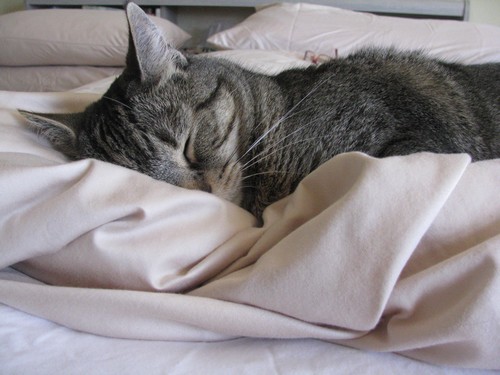
—  a cat snuggled up beside me like a teddy bear

—  sandals

—  the movie Guess Who’s Coming to Dinner

—  the [operatic] song from Big Night, first heard while having lunch al fresco at Quail’s Gate Winery

—  the sound of cutlery against plates in that final scene in Big Night

—  goat cheese omelettes with purslane

—  Cat’s Eye, the book

—  Drinking the Rain, by Alix Kates Shulman, which I read almost every year

—  the way insects and animals and birds and trees know exactly what to do

—  choosing well from a menu

—  painting with bold colours

—  discovering a new place in my own ‘hood

—  the word ‘hood

—  beeswax candles

—  walking, hiking, climbing, none of it too strenuously

—  the sight of the Andes from a small plane

—  the colour green, indoors and out

—  people who get excited about possibilities, art and words

—  the smell of dirt in Spring

—  the smell of snow and the way it looks in the sunshine

—  sharpened pencils and fast writing pens
a day

 
It begins with the discovery that I have no onions. It ends with a swim.

The part in-between goes like this:

I say bad words about the sudden and surprising lack of onions because I had intended to make bread and butter pickles at the crack of dawn before the heat set in. I’d already picked and salted and soaked the sliced cukes in ice water and chilled them in the fridge overnight. Seeing as how there are no onion mongers open at the crack of dawn in these parts—and I, like a wally, didn’t grow any onions—I have no option but to consider bread and butter pickles made without onions, which, really, is just sheer folly so I scrap the idea immediately. Instead, I pull out a bag of green beans I got from the farmers’ market the other day. Still fresh and snappy enough to pickle. My niece recently flattered my beans. I did them last year with jalapeno peppers and chili flakes. They had a nice zing. I said I’d do her a few jars.

I’m tremendously impressed with my resourceful flexibility—being able to move effortlessy from pickles to beans like this. Then it occurs to me that I have no jalapenos. The ones we’re growing aren’t yet ripe and the peppers that are ripe, aren’t zingy. My beans need zing. I wonder if I could just double or triple the amount of chili flakes but even as I think it I know it won’t be the same.

More bad words.

After that I go outside and sweep the front, pull out weeds and say good morning to Riley next door, a puppy of uncertain parentage.

Breakfast is scrambled eggs, homemade pesto and tahini slathered toast.

The tea is sage with lemon balm.

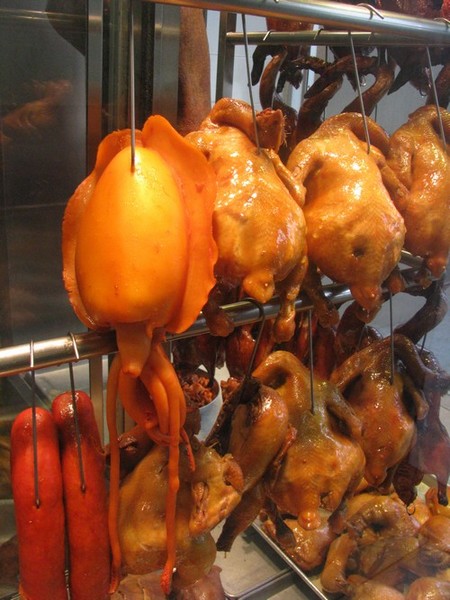
I take the tea to my desk and spend a couple hours moving a semi colon around the page then go to the dentist but not before stopping at the barbeque pork place that also does duck and a few other things, but I only ever get the pork. Today I point at a strange hanging bit of flesh and am told it’s cuttlefish—do I want some the woman asks. I say not today thanks. Cuttlefish, it seems, is a cross between squid and octopus and looks like a miniature orange bagpipe with an attitude. I ask her how to eat it and when she says you just eat it, that’s when I say oh, okay, maybe next time. She smiles and nods like she believes me.

On the way home I stop at a place that sells concord grape juice, made in Canada with Canadian grapes. You’d be surprised how few juices are made with our own fruit. Most of the orchards disappeared and packaging places in Niagara closed years ago because the brilliant minds behind giant manufacturers of fruit products decided that because it was cheaper to out-source fruit and packaging it must be better  to out-source fruit and packaging.

But I digress.

Last stop, the onion and jalapeno monger who also has some stunning apricots and a stunning apricot is a thing not to be overlooked. I have a fondness for apricots, having grown up with a tree in the yard until my dad one day mistook the gas pedal for the brake and knocked it down with his Toyota.

I buy the apricots.

Lunch is barbeque pork with a zucchini, carrot and beet salad. Similar to this.

After that I make the gd pickles.

After that I do some work.

After that I have a swim.

After that it’s night; the phone rings, there’s more food involved and a few other things go on.

But this isn’t about the night.

the shape of our blue monkey thoughts

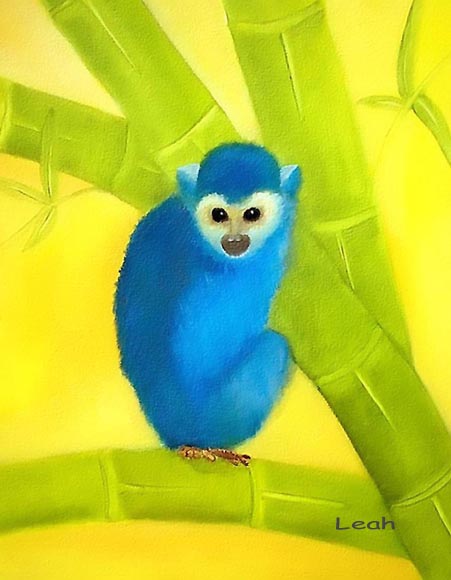
I was thinking why handwriting is read so differently than on-line type and have decided it has something to do with how in handwritten notes we not only share words but the shape of our thoughts. ‘Blue monkey’ typed, is a series of letters, identical no matter who types it. But write ‘blue monkey’ by hand and I have a better idea of what your particular blue monkey might look like.


I thought I’d invented the idea of ‘blue monkey’, but apparently not
—thank you, google…

places i will not be this weekend

If you’re looking for me, don’t look here—

1— Eden Mills Writers’ Festival. I can hardly discuss this, so disappointed am I to be missing it. I was especially looking forward to hearing Karen Connelly, Dionne Brand, et [so many] al, as well as Kerry Clare  who’ll be reading at the Fringe Stage. I read there myself in 2008 (aka the ‘wet year’) and it’s an absolute favourite part of the event for me. Not the rain, but the Fringe.

2— Thin Air, Winnipeg’s annual writers’ festival. Have I mentioned that I love Winnipeg? I’ve only been once. It was a September, the season between mosquitos and winter. I attended Thin Air, saw the masonic weirdness and beauty of the Legislative Building (built in the geographic centre of North America), had a few ‘nips’ on the Red, was happily surprised by the local foodie culture, the theatre, the commitment to the environment, the largest collection—stunning—of Inuit carvings in the world. And this is just what I remember without really trying.

3— Words Alive Literary Festival. Have never gone; am very curious.

4— Peterborough Arts Week. Just because I love Peterborough.

4— Garlic Festival, Stratford.  Sigh.

~

All of this due to my knee.  (Well, okay, the Winnipeg thing wasn’t going to happen even if I hadn’t mucked up my leg…)

But to anyone who does attend any of the above, detailed reports will be welcome. Vicarious travel is the next best thing to being there…

a short, sweet time in stratford

 
Sometimes it only takes one perfect day to re-jig and re-wire yourself, to see things in perspective again. Thing is you can never plan such a day—it just appears out of ordinary moments that turn magical for unknown reasons. Like yesterday when we played hookey and drove to Stratford with tickets for Michel Tremblay’s For the Pleasure of Seeing Her Againthe first ‘moment’ occurring when a detour in town led us to Romeo Street where we decided to stretch our legs awhile at Gallery Stratford. Co-incidentally, the main exhibit, ‘Natural History’ was about the evolution of zoos, a subject recently on my mind. One element of the installation was a two minute video of a deer and a wolf together in an empty and windowless room. Extraordinary to watch their behaviour, their eyes and breathing—so anxious are they in this unnatural space that they forget they’re prey and predator and become strangely equal in their discomfort. In another area are framed photos of animals in various North American zoos, their cages essentially ’empty rooms’ but for the jungle murals, or fake rocks, which may make the audience perceive the space as much more tolerable but (we can assume) does squat for the animals.

After that we went downtown and browsed Inuit art, stopped by Rocky Mountain Chocolate to inhale, visited the tea place (which could surely convert the staunchest coffee drinker) for supplies to re-fill our larder with lapacho bark, peach flavoured oolong, powdered rooibos and the various assams that Peter fancies.  Then on to lunch at Woolfy’s where the staff was delightful, the wine list excellent and well priced, and the Lake Erie perch crispy battered, delicate, and served with a delicious homemade ketchup. I’m not even going to mention dessert…

Finally, the play—a complete joy (but when is Tremblay not?). The premise being the playwright’s memory of his mother—a wildly passionate woman, dominant, loud, gossiping, yet loving and nurturing, who is also a master storyteller.

When, after 90 minutes (no intermission), it ended, I was stunned and horrified. Surely this was a mistake, it couldn’t be the end. Not like that. There must be an intermission.

But the lights came on and the actors took their bows. Ridiculous, I thought. Everything had been so brilliant up until then, every word, gesture, I wanted it to go on another hour at least, maybe two.

As we filed out of the theatre I seriously thought of writing Tremblay and pointing out his shocking error in judgment. Cher Monsieur Tremblay: Tout etait tres bon, sauf… I would begin. Then use google translate from there. Shuffling toward the exit, I was just getting to the part where I’d offer up my suggestions to improve the ending… when I suddenly understood.

I won’t spoil things with details but let’s just say if you leave feeling like it’s all over too quickly—yeah, it is. And that’s just the point.

Good things are always over too quickly.

However, if we’re lucky, and paying attention, sometimes those bits of  ‘magic’ linger, just long enough to change us a tiny bit for the better.

tout etait bon indeed.

~

vive l’ete indeed

Before the whole summer gets away from me and people start talking about how it’s over the minute the #&@*ing CNE opens, I am printing this and taping it above my desk where its job will be to inspire me often to stand up, find a bucket and spade, head outside in any direction and—for much longer than I think reasonable—let my toes and mind wander where they may.

Thanks for the reminder, Carol…

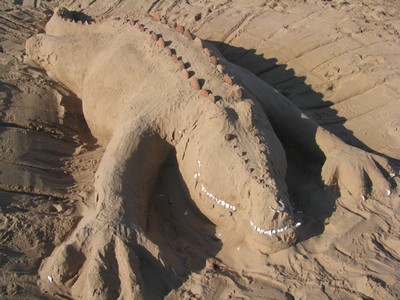
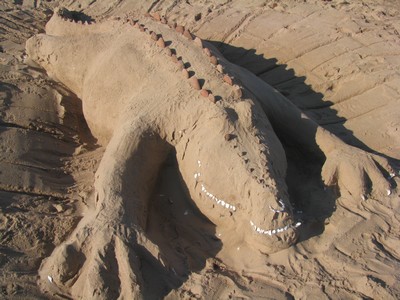
red earth reptile, brackley beach

this is not a review: the anthologist, by nicholson baker


I’ve been reading things recently about not writing as a tool for better writing, which, to me, makes perfect sense given that I believe procrastination (when handled with care) has a valuable (necessary) place in a writerly toolbox. Walks, cups of tea, headstands in the garden, rarely fail to loosen a brain (and a loose brain is a thing of envy indeed).

It’s no wonder then that I so completely enjoyed Nicholson Baker’s The Anthologist where procrastination is the art form.

The narrator, poet Paul Chowder, has been asked to write the introduction to a poetry anthology and for 243 pages he lets us in on every distraction and digression that flits through his head as he avoids doing so.

Or so it appears. In fact, writing the anthology is exactly what he’s doing for 243 pages. The breakup of his relationship, badminton games next door, the comings and goings of a kitchen mouse, are merely forms of life he notices from another plane where he lives and breathes beats and rhyme and the mathematical precision of rhythm. Where everything is light and shadow. Pauses. Enjambment.

What the narrator is actually doing is tearing open the whole world of poetry as he feels it, and staring it down; this takes time. He doesn’t do it on purpose, but still it requires the kind of courage that allows you to stand back from a project, do nothing, all the while hoping to god you’ll do it in exactly the right way for exactly the right amount of time.

The end result is a delicious ‘conversation’ with the reader, full of passion and brilliance, easy humour and cheeky digs (Baker is either really good friends with Billy Collins or he hates him); it made me want to read and re-read a number of known and unknown (to me) poets, including Swinburne to see how he ruined things.

None of it is dull.

Of the Elizabethans, he says: “They really understand short words. Each one syllable word becomes a heavy, blunt chunk of butter that is melted and baked into the pound cake of the line.”

Of Sara Teasdale: “One day she hit her head on the ceiling of a taxi while it was driving over a pothole in New York, and afterward she said her brain hurt and she dropped into a funk and eventually she took morphine in the bath and died.”

When he sees endoplasm on the first page of a twenty page poem submitted by a student he says “I went cold, like I’d eaten a huge plate of calamari.”

(Chowder eventually gives up teaching as a source of income because it depresses him and drains him; he takes up house painting instead, which he finds much more agreeable.)

He talks about the link between weeping and meter, how as babies we cry in a rhythmic way we lose as we grow up. “Poetry is a controlled refinement of sobbing.”

And this about truth: “…you can choose to tell the truth or not to. And the difficulty is that sometimes it’s hard to tell the truth because you think that the truth is too personal, or too boring, to tell. Or both. And sometimes it’s hard to tell the truth because the truth is hard to see, because it exists in a misty, grey non-space between two strongly charged falsehoods that sound true but aren’t.

“I have no one. I want someone. I don’t want the summer to go by and to have no one. It is turning out to be the most beautiful, most quiet, largest, most generous, sky-vaulted summer I’ve ever seen or know—inordinately blue, with greener leaves and taller trees than I can remember, and the sound of the lawnmowers all over this valley is a sound I could hum to forever. I want Roz.”

I love the poetry lesson throughout, the musings on life, the soul baring honesty mixed with just the right amount of sarcasm, but mostly I love the message inherent in the structure: that sometimes procrastination, distraction and a particular kind of diddling about are the only way to loosen our brains enough to let the good stuff come through.

(~Read on the weekend in the company of sweet woodruff tea.)

(~Discovered through this post at Carol Bruneau’s Blog.)

____________________________________________

The Anthologist is available online at Blue Heron Books. Support indies!

power point creativity

Made the mistake today of attending a symposium about building creative communities. Promising keynote speaker, nice room, good food, three hundred and fifty people in attendance, from mayors to gallery owners, curators, writers, artists, librarians, economists, designers, musicians. Everyone keen and ready to listen and learn.

Unfortunately it was anything but creative because the creative types were forced to sit quietly while un-creative “presenters” flashed pie charts on power points and told us our part of the world, our town, was “doing just fine, creatively…see??”

Even the keynote speaker—someone we were told would ‘blow us away’ with his insights—took us instead on a long and uneventful journey through his childhood (and part of his father’s) to his omnipotent present. He then listed all the books he’d written, which, he pointed out, were for sale in the lobby.

More pie charts followed until I began muttering to myself. Finally decided to give it up and sneaked out before lunch. (They’re probably at this moment gnawing on rubber chicken, reflecting between bites—”See how creatively the chicken is rubberized…?”) 

On the way out I wondered about the idea of doing good work versus talking about doing good work, how only the latter is really encouraged because of all that dough to be made in the talking, the teaching, the writing of how-to books, running workshops (there are workshops now to teach you how to run workshops). We live in a culture that keeps society perpetually convinced its individuals are not yet equipped to take action, to think, to even know who they are, much less take the initiative and just do one bold and brilliant thing.

As I opened the doors of the convention centre, sucked in some sunshine and made my way to my car, I remembered something I’d once heard—how some professor was asked to speak a group of students on the subject of How to Become a Writer

He walked onto the stage of the auditorium and took the microphone.

“How many of you are serious, really serious, about becoming writers?” he asked.

Every hand shot up.

“Well, in that case,” he said. “What are you doing here? My advice to you is this: go home and write.”

And then he left the stage.

time sucks?

Lots of complaints these days among writers about the major ‘time sucks’ that technology presents—all that tweeting and surfing and site maintenance in the name of self promotion, when what’s most important—attention to craft—is being left by the wayside.

It all sounds like a new name for an old problem.  Used to be called looking out a window.

True, there are more windows now but I’m guessing those who find discipline hard because of modern ‘time sucks’ would have also been suckers for a nice view. Or a brick wall.

That said, what’s wrong with a little distraction? A walk, a sandwich, writing a post, sending an email, spinning a hula hoop—it’s all a happy and necessary change for the brain. Discipline, I think, is not only about work, but the balance of work and other stuff. The trick is keeping it balanced. And choosing the other stuff well.

Essentially, what it comes down to is that the only thing about time that sucks is the part that’s wasted.

darlings and ground cover

Here’s what I’ve learned this summer: whether you’re gardening or writing, you’re toning the same muscles. Consider the process:

You finally begin work on the new thing in the garden, or on new a scene, and a domino effect begins—those flowers can’t be planted as you thought because the bed is all grassy and overgrown with some mystery ground cover that won’t easily be removed and needs major digging out.

So you dig it out. Then you realize that it’s not all bad, that some of it can be saved. Some of it will make good compost or you can spread it under the spruce trees. The rest really is utter crap and must be bagged and put on the curb on yard waste day.

Of course you don’t have any bags, and the place under the trees needs raking. And even after you get back from the store and you’re done raking, you notice these big gaps all over the place where you dug stuff out. Some of those gaps are really nice, like a zen thing, others need filling with fresh soil.

It’s only after what feels like several lifetimes that you can do this sweet innocent thing of planting those flowers (or adding that scene).

And then you stand back and say, jeezus they look great. And you look at the flowers three hundred times and each time it feels so good. It was a lot of work, but they look great.

Unfortunately the area right beside them suddenly looks like crap.