simon says

 
A boy in his driveway the other day shouts hello as I pass. He says his name is Simon, what’s mine? I say Carin and he tells me he has a Batman tee shirt. He opens his coat. I say that’s some great tee shirt and he says yeah, then tells me he’s seven. Not that I asked. He continues talking, about being seven maybe, or the tee shirt, just chattering away… all of this in only seconds; I’ve barely slowed my stride. His mum is raking leaves, smiling. And in all the chattering somewhere the boy asks… in a way he might ask a chum at school, or anyone… “How old are you?”  His mother’s smile immediately turns into a nervous laugh, she puts down her rake, edges Simon toward the house and tells him that isn’t the sort of question he’s supposed to ask. Meanwhile I’ve answered by saying “Well, I’m not seven!”, as I continue on my way. Also laughing nervously.

And for the rest of my walk all I can think about is why.

Why is that not the sort of question Simon should ask? And is it only not the sort of question Simon should not ask people of certain ages? And how should Simon know which ages those are? And who decides that anyway? And doesn’t the whole way his mother reacted give off a vibe that suggests to Simon, if only subliminally, that there’s something *wrong* about certain ages and THAT’S why we don’t ask.

And if there’s something wrong with certain ages… what, exactly  is that wrongness? I mean if Simon were to ask his mother Why can’t I ask?  what would she say? Something about politeness probably. But why is it polite NOT to ask someone their age when you are seven and you ask everyone ? (And everyone asks you.)

Of course I was taught the same lesson as a kid. (But we’re back to the why… Is it to spare people the embarrassment of admitting they aren’t seven, or twenty-seven or thirty-seven or whatever decade + seven it suddenly becomes an embarrassment to *be*?)

North America’s twisted version of age aside, what really bothered me was my own response, that weird bit of laughter I threw out in order to make Simon’s mother feel okay about the whole thing. By laughing it off, by saying “Well, I’m not seven,” I condoned her discomfort and was party to the stupid lesson Simon was being taught.

Why didn’t I just answer the question?

Conditioning, that’s why. (And, mostly, conditioning almost always sucks.)

The thing is I happen to be a non-ageist kind of person. Even as a kid (just like Simon) I barely noticed someone’s vintage. I still can’t see how it matters. It’s their energy that registers with me. One of my favourite people to hang out with lived to be 101 and it never struck me as an unusual match.

I also have friendships where *I’m* the 101 year old.

And a few in between.

The thing is this: dullness and negativity, ego and bullshit appear at every mile marker. So do joie de vivre, curiosity, kindness, engagement with life, humour, a creative spark and the balls to be yourself. A tedious schmuck at sixty was probably a tedious schmuck at thirty.

Only with better abs.

My walk takes me on a loop and eventually I’m heading back toward Simon’s house. I resolve to tell him my age as I pass. I’ll throw it out, casually, maybe mention that I have a fondness for the colours green and orange and yellow and that I do not  know how to tap dance. Not that anyone asked.

But the leaves in front of Simon’s house are raked and no one’s there.

Too bad. Because I think Simon would have found that particular line of chat quite normal. And that would have been so much better a lesson than the last.

DSC04297


it was never home and it always will be

 
(Schmaltz warning)

Toronto.

Seems like I’ve been coming or going, to and from it, forever.

DSC02443

First time was as a kid visiting family friends who lived on Admiral Road in the Annex. This was before it was The Annex.

DSC02444

And then I moved there myself.

DSC02449

And lived in at least a thousand apartments and houses.

DSC02450

Then I moved away.

DSC02452

And back.

DSC02453

And away again.

And back.

DSC02459

Away.DSC02461

Back.

DSC02463

Away.

DSC02466 DSC02464

I live away now.

DSC02468 DSC02471 DSC02472

But when I visit, and despite all the changes and the traffic and the lack of space and the changes… so many changes… I still remember the places that used to be and how the Annex was just a place we drove to on a Sunday for lunch and the kid we visited had one of the those table hockey games with flippers and levers and we played with it on the third floor and then after lunch walked around Bloor and Avenue Road… a perfume shop and a delicatessen come to mind…

DSC02474 DSC02475

And I remember so much of what came after that.

DSC02478 DSC02481

Changes, yeah.  DSC02484 DSC02485

But this place that was never home, that’s got this reputation for being cold, where when I first moved at eighteen my (envious I wonder now) friends back home said how could I stand the way nobody spoke to each other, nobody looked at each other…

DSC02487

well, every time I come back, this supposedly aloof and unsociable town in flux says… even after all these years… hey, good to see you; how you been?

DSC02490

in this tiny space was everything


Years ago I lived in a tiny furnished apartment on the second floor of an old Toronto house — and in this tiny space was everything I needed.

DSC01232

A single closet the size of a phone booth in which I managed to hang all my clothes and all my coats, as well as store my shoes and winter boots.

DSC01242

A bathroom in the hall, shared with the woman in the apartment next door.
I heard her come and go but we never once, in all the time I lived there, met face to face.

DSC01252

At the end of the street, a fruit and veggie monger. In winter I would sometimes buy expensive tomatoes from some faraway place where tomatoes were grown to be luscious. I ate them with basil and listened to Joan Armatrading and Van Morrison and had a white cat and a bedroom made almost entirely of windows.

DSC01244

I once called a friend to come and eat tomatoes and basil with me and she came, expecting, I think, a whole lunch but it was just those perfect tomatoes.

DSC01275

Basil.

Oil and salt.

DSC01263

Joan Armatrading, and Van.

DSC01266

And it was enough.


this morning, the smell of chrysanthymums

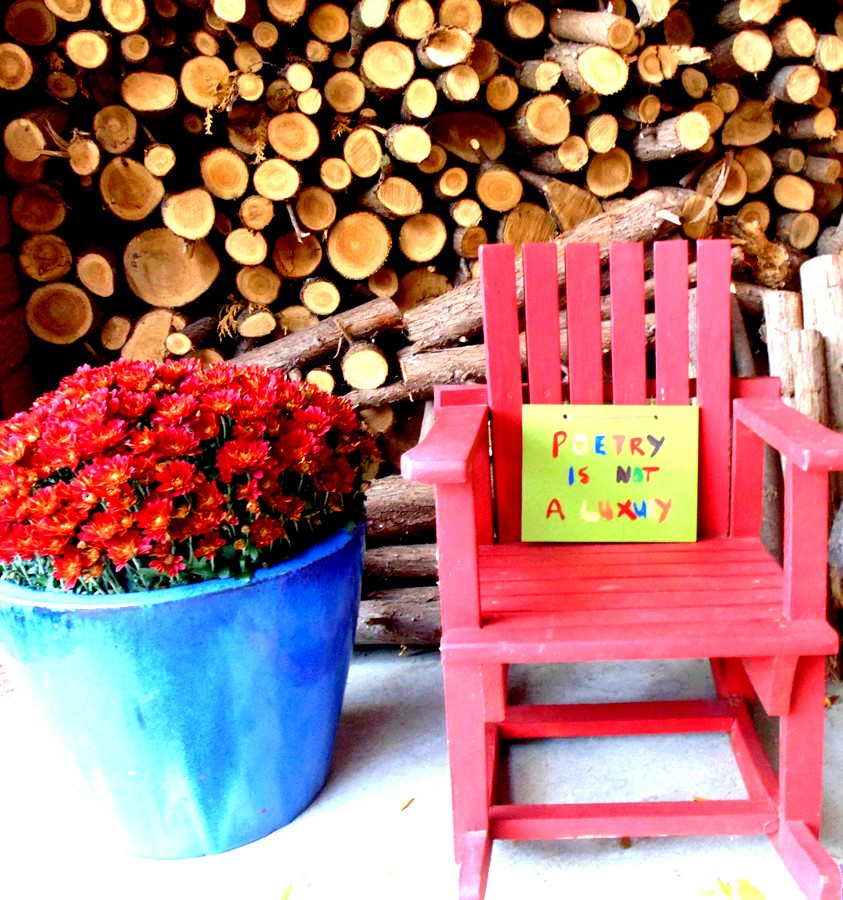
When they were still fresh, a month or two ago, my single pot of blooms took me directly to a wooden fence made by my dad from driftwood gathered at the beach. Planted alongside was a row of perennial chrysanths. Burgundy. Still the only shade I consider ‘real’ and their smell, decades later, is still about summer winding down, jackets, the grass feeling cooler, street lights coming on sooner.
DSC01598

This morning I notice how they’ve faded, they look more bronze than burgundy.

I lean down, inhale, expecting to be on that fence again but it’s a different smell, earthier, a pile of raked leaves from the pear tree (burgundy and bronze!) and some going brown. Leaves I’d raked myself, a few more every day, the pile growing until my dad said it was time to haul them away. (What did he do with them? Burn them? Bag them? Dig them into the garden?)

I only remember the raking and the leaping and the laying, starfish-like on top, staring up through a canopy of bare branches. I remember tossing handfuls in the air and the dewy wetness of the middle of the pile.

That’s the smell this morning. The middle of that sweet pile.
DSC01777


bikeless in ontario

I’ve been thinking about bikes more than usual lately. I haven’t had one in over a year and everywhere I look it seems there are places to cycle or things to gather and bring home in a basket between handlebars. I love my old car and where it takes me that I would never go by pedal power alone but there are just so many places between walkable and driveable that perfectly suit two wheels.

And maybe because I’ve been thinking about them, I happen to see more of them, and not just the usual sort either. The other day I saw a tricycle built for two; this large three-wheeler with two seats and two sets of handle-bars, one behind the other. The couple driving were seniors and it was just the most wonderful thing.

I saw a teen-aged lad on a unicycle a few weeks ago. I wanted so much to stop (my car) and take a picture but I felt it might unsettle him and I didn’t like how that possibility played out in my mind. (How does one even stop a unicycle?)

And there’s a guy, maybe in his fifties, maybe older, who rides/pedals/powers a bike that has steps rather than pedals. Like a step machine in a gym. It’s a standing bike that the rider/pedlar powers by stepping one foot at a time, so that one’s whole body moves up and down. I love this thing. The idea of standing instead of sitting seems vastly more comfortable and, given how much sitting we already do, maybe better for the hip joints.

I think about hip joints more and more every year.

The bikes I’ve had in the past are not the bike I want now. For instance, I do not want the red and white tricycle I loved at age six or seven or eight, which I drove at top speeds, fancying myself the envy of both peers and adults. I’m no longer interested in speed or style.

The one after that was green and huge and originally belonged to my much older and much, much taller sister. I don’t remember ever being able to sit on the seat and pedal at the same time.

Then there was the gift of a brand new golden three speed during my teen years. I rode it but never loved it. I didn’t like the colour and instead of a funky banana seat it had the standard issue kind, seriously uncomfortable. And only three speeds? It served me well though. Spent lots of time riding along country roads looking for places to steal fruit and trees under which to read. It had a utilitarian pack above the rear wheel which I could stuff with peaches and paperbacks.

When I moved to Toronto I bought a rust-coloured bike at Canadian Tire, called it Rusty. When I moved to Edmonton, I took Rusty with me. We had some good times and I wouldn’t have wanted to be there without her. But then I moved to England and left Rusty behind. Sold her, gave her away, I can’t remember and if you don’t mind I’d rather not talk about it… [sniff]

In England I had a big black Oxford bike that I rode through a field to get to Waitrose, and down a cobbled hill to get to the corner shop.

Back in Toronto I had a bike that I can barely remember and when I first moved to the town where I now live I had a ten-speed that was entirely wrong. Ergonomically wrong. For me anyway. For one thing it required me to sit hunched forward, grasping those twisted-under handlebars, which I don’t like. I like normal handlebars and to sit upright like old schoolmarms.

The last bike I had,  a hand-me-down from my mother-in-law, was sky blue and had the right kind of handlebars. I got a wicker basket for it and quite liked it, but the dear old thing was ancient and eventually toast.

All of this to say: I’m in the market for an addition to my list.

Suggestions, anyone?

Makes, models, testimonials welcome…
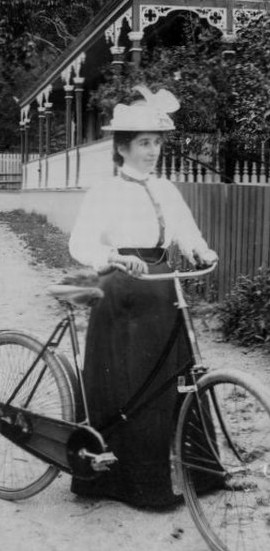
Cyclists_In_Thames_New_Zealand_Ca_1895

WikiCommons knows bikes.


the story of fred (a winter’s tale)

It begins, as most stories do, on a dark and stormy night in Edmonton. Nineteen eighty something. The storm was made of snow and arrived without warning at the end of the work day. Normally, this would have meant nothing more complicated than standing at the bus stop for a much longer than normal period in the whipping wind and infamous Edmonton but-it’s-a-dry-cold  minus forty temps. [They tell you that dry part as if it means your fingers won’t snap off as easily as if it were a wet cold.]

But all was not entirely normal… for that very day at lunch I had purchased a hamster cage.

Why? Because the sign said this: Buy A Cage and Get a Hamster FREE!!

Who could resist?

And so I had walked back to my office carrying, in one hand a hamster cage, cedar shavings and hamster food, and in the other a hamster in a cardboard box. Then I asked a guy at work to please transfer the furry little cherub from box to cage because a) I couldn’t imagine touching it myself, and b) the cherub was rapidly gnawing its way through the cardboard.

The guy’s name was Fred and now so was the hamster’s.

It might have been a reasonable enough series of events were it not for the storm. Suddenly the idea of standing in the but-it’s-a-dry-cold, waiting for a bus that might be hours away, wasn’t on… not with a hamster named Fred in an open-concept cage. I called for a taxi and was told the wait would be at least two hours. Undaunted, I did what anyone in this situation might do—I walked over to the Four Seasons Hotel [Fred’s cage wrapped inside my coat] with the genius plan of hopping into one of the many cabs queued up outside the front doors.

Except there was no queue.

Wait time: hours.

Well, the next logical step is obvious. I took solace in the hotel lounge… Fred on one chair, me on the other. A glass of wine between us. No need to panic. [Animals can sense fear.] We’d simply wait until a cab arrived. In the meantime I ordered something to eat, offered my companion some lettuce, and was grateful no one enforced the No Rodent Rule, [which I’m assuming is one of those things that gets waived during acts of god].

We eventually made it home and Fred seemed content enough with his new digs.

The story becomes considerably duller from here on out, mostly involving a wheel on which he ran several times the circumference of the earth.

I’ll spare you the scampering, squeaking, cedar scented details, other than to say I did, eventually, touch him but never loved the feel of his squirmy rodent-ness.

My tiny-toed flatmate lived to a respectable age and rests in a backyard on the south side.
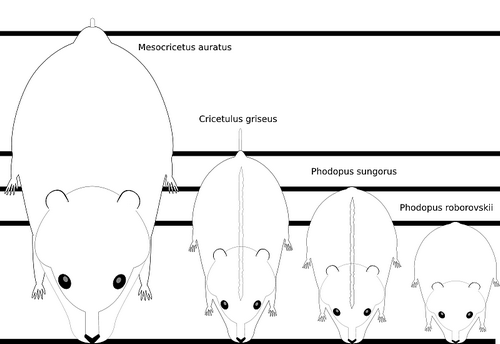
800px-Hamster_-_size_svg

fwiw friday (liverwurst and screen doors)

WHEREIN I RIFF ON MY WORDLESS WEDNESDAY PIC….
because, of course, I wasn’t allowed to speak then.

In this case, a screen door with metal curlicues and a central dog motif. This used to be a popular style—aluminium doors with curlicues and motifs—various dog breeds, swans, horses too. Lots of people had letters to signify the name of their tribe. The house where I grew up had such a door. It was my job to clean the curlicues, but that wasn’t the worst of it. As we were not [alas] dog, horse or swan people, we had a big aluminium M, a constant reminder of a last name I wasn’t crazy about. I thought it was too ethnic. These were the very young days of my youth when being the child of immigrants was an embarrassment. All that salami and homemade jam on my breath when what I coveted was Welch’s Grape Jelly and Campbell’s soup. I longed to be a Brown, a Black, a Smith, a Wilson, people who ate Swanson’s TV dinner instead of goulash. The M was a constant reminder that my people were weird and that my name had to be spelled. And pronounced. And sometimes explained, as in: Makuz? What’s that?

I knew what the question implied. It meant where are you from?  Not me, but my parents, those people with funny accents who fed my friends open-face liverwurst sandwiches on homemade rye for lunch, friends who were often mysteriously ‘not hungry’ next time they came by or, in one spectacular case, who left my house in tears, screaming about being given cat food. When the friend’s mother telephoned a few minutes later, my mum, in broken English, explained about delicatessens. I’m not sure how much was believed but the friend never came over again.

I was pretty sure this never happened to kids named Smith.

Or dog people.
800px-2006-02-05_13-11_100_1202

blackberries and a shrunken sweater — the things that stick

 
I was in Niagara recently, driving past the house where I grew up. An elderly woman was sweeping the front walk. I pulled over and watched, remembered how on that very bit of pavement, next to the stone planter, I wore a bathrobe with pink rosebuds and corduroy slippers and a bowl haircut and wrote my name in sparklers one firecracker night while my dad—in a Hawaiian shirt, cigarette tucked into a wide smile, face tanned and dark hair falling forward a bit, Clark Gable style—scrunched down, arms around me, for a photo.

He built that planter, two of them in fact, from stones I helped him collect at the beach. I see that someone has knocked one of them down and put nothing in its place.

On a whim I get out the car, pace in front of the house. The sweeping woman doesn’t seem to notice but it occurs to me the pacing might look odd so I decide to walk over, tell her I’m not staking the place out; I explain that I used to live here, that my parents lived here forty something years. She asks if I’d like to see around. I wasn’t expecting that, but yes. The woman’s name is Minerva. She’s from Nova Scotia and she says Come along then, my dear.

We start in the backyard. My dad’s gardens, rockeries [more stones from the beach] are wildly overgrown. Trees and shrubs haven’t been trimmed for years, a rose bush has become a tree. The vegetable garden is gone, but the conch shells my parents brought back from Bermuda thirty years ago are still there in a small triangle of white stones beside the patio.  I ask about the blackberries that grew on a trellis and she shows me through a forest of leaves that, yes, they’re still there. She says there’s not much fruit though. I don’t explain about pruning, how that increases yield. She’s smiling the whole time, proud, beaming, clearly in love with this mad wilderness.

We move inside where things are tidy with doilies on furniture, tea cups in a china cabinet. There are homemade quilts and afghans, newly stencilled walls. The bathroom is bright blue with a nautical theme, maybe for memories of Nova Scotia.  A mural of flowers and trees is painted on the inside of the front window. She takes time finding the switch to turn on fairy lights woven among some branches in a large floor vase, a gift from her son. She likes to knit. She shows me a yellow dress for her granddaughter.

The whole time, I’m kind of listening, mostly remembering. She’s made changes, yes, but not as many as I imagined. (She kept a wall-sized mural of a beloved Bermuda beach scene that my dad painted a million years ago.) It’s different, definitely, yet absolutely familiar. We are everywhere here—my mum, my dad, my sister. And we are nowhere. They’re gone, it’s just me.

And Minerva.

And her life in this house. Her son, her grandkids.

And it’s okay. It’s very good in fact. If anyone had to live here, I’m glad it’s her.

We’re oddly connected, all of us.

She tells me to come back anytime.
IMG_9524
I couldn’t find that firecracker night picture, but here’s another. Five hundred years ago, the blackberry trellis in the background. He, wearing a sweater I gave him that my mum accidentally shrunk and that he would not let her throw out.

this explains everything

So I’m in bed Sunday morning reading and loving the stories, the reminiscences of various Canadians in Everybody’s Favourites as they recall special books from their childhood. I make a list of titles to get—for me, for friends, nieces and nephews, ones to browse through at the library. I note that many of the books mentioned I haven’t read and I begin to wonder what kind of childhood did I have??

Then a title jumps out at me: Island of the Blue Dolphins.

I know this book.

I can see the cover, a darkish blue, the illustration of a girl on the grassy edge of a cliff by the sea, a cradle floating in the water. I remember that it’s a slim hardcover and suddenly I’m overwhelmed with a whim to see it, maybe even crack it open again. I go down to the basement, sort through my sadly unsorted kid collection.

I find it.

And I’m right about the cover; it’s exactly as I remember. Only it’s not Island of the Blue Dolphins. It’s a completely different book— Child of the Western Isles, by Rosalie Fry.

No dolphins.

Familiar as I am with the cover, I don’t remember ever reading it but it has drawings [by the author] and so I take it upstairs and snuggle back under the covers and after a page or two… I do remember… and I’m eight or nine or ten again and it’s summer and I’m not sitting on my front porch amongst pots of wax begonias but am right there on one of those wind-swept, wildflowery all-cliffs-and-rocks-and-sea islands off the coast of Scotland wherever Scotland is, and I’m tearing around with Fiona, who was born in the Western Isles, lucky bugger, but left as a child with her family to live in a city where a few years later she became unwell and the doctor ordered her back to the health-giving properties of life by the sea with her grandparents where she adventures about, rows boats, plays with oyster shells, befriends seals and finds a lonely cabin to live in before eventually uncovering the mystery of a long-lost baby brother.
Spoiler alert: there’s a happy ending.

How could I have forgotten this story? I used to want to be Fiona (that is, when I wasn’t wanting to be Nancy Drew). In fact, I think it may be Fiona, Child of the Western Isles, that’s responsible, at least in part, for my love and fascination of watery environs, of gulls and oysters and wind-swept hills. Not to mention lonely cabins and row-boats.

It may even be this story that led me to invent a baby brother one year. When my teacher asked if my parents would be coming to the parent/teacher night, I replied that no, they wouldn’t be going because my mother was in the hospital having a baby, a boy, I said. I’m not sure if I gave him a name. I only remember my mum and dad coming home from the event and telling me how surprised Mrs. Thingy was to see them…

This book, I notice, is one of the handful I own that is stamped with the name of my elementary school and that I possibly forgot-to-return, aka pilfered. So ancient is it that it has a strip of foolscap glued onto the back inside cover with the word Due handwritten at the top and a list of dates written below it in a variety of ink and handwriting styles. March 1st [no year] is the last date. I really can’t give it back [by that I mean I really don’t want to], but I’m thinking I’d almost like to write to the school and pay for the book. [But not the late fines!]

Then again, I wonder… is owning up a noble and good idea or am I just inviting the very-late-and-possibly-pilfered-book-patrol to show up at my door with a warrant?

the happiness vortex

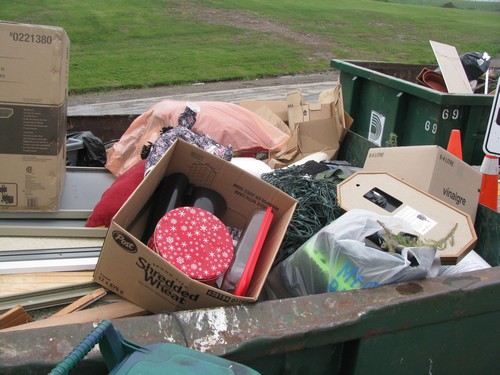
I can’t explain the pleasure I get from visiting the local dump.

Pretty sure it started with weekend jaunts as a kid when my dad would take in a load of old lumber and then nose around for wotnots, spare parts, a hubcap. It was like a free garage sale. That was when you could still nose around and the junk really was mostly junk. Treasures were rare. Now there are fines for scavenging.

Oh the irony.

Because it’s not just plywood that people are dumping anymore. Now the bins are heaped with treasure. You could open several stores daily with the amount of quality goods being pitched.

A woman with a load of furniture tells me she’s a professional recycler, she’ll come to your house, pick up any junk you’re getting rid of, sell what she can, keep what she likes, and take the rest to the dump. She says she’s furnished her whole house this way, including appliances, and makes a decent living on top of it.

I watch a guy toss in two whole bikes.

What are the odds both are broken? And anyway, didn’t people used to fix bikes?

While I’m considering this, another guy tosses in another bike, a tiny one, so tiny it was probably ridden exactly three times. And okay, so the kid’s grown out of it. You’d think there might be someone it could get passed on to… like maybe dear old Sally Ann?

It’s staggering the amount of crap we have in our lives and the ease with which we toss and replace it. In the few minutes I’m there I see more than a few bins replaced or the contents squashed to make room for more. There’s always more. The bulldozers and bin movers and squashers are busy everywhere you look.

Despite all that, I’m oddly happy here.

And it’s not just me. The staff are consistently cheerful. From the guy in the booth when you arrive, to the one who tells you what dumpster to use, the woman in the building that takes cardboard or the guy in hazardous waste, the people you pay on the way out… everybody’s so friendly, so pleased to see you. It occurs to me that I’ve never met one cranky employee at the dump. Ever.

Sure, it could be drugs.

But I have another theory. Isn’t it just possible that all those people letting go of all that stuff, all that purging, creates a giant cleansing vortex? And who wouldn’t be happy in a spanking clean vortex?? By which reasoning it can be assumed that a shopping centre, a place where stuff is accumulated, would be one of the less therapeutic places to work. [It’s starting to make sense isn’t it?]

Anyway—not that anyone’s asking—given the choice, shopping centre or dump, I’d pick the dump.

For the vortex, obviously.

Plus I’m pretty sure they get dibs on the loot.