nature studies

1.  A turtle the size of a small bread plate is trying to cross the road beside the Shoppers Drug Mart. A large crow walks behind, peck pecking pecking at its shell. The car in front gets so close I see the turtle duck. I pull over, blocking almost a whole lane. I get out of my car. The crow flies off and I’m standing beside the turtle, pointing at it, indicating to oncoming traffic in both directions that it should go wide. People smile. No one honks. I’m grateful.

I don’t want to pick it up; I’m partly afraid of hurting it and partly afraid of it hurting me. It occurs to me how little I know about amphibians. They don’t bite do they? My plan, such as it is, is to shuffle along, keep directing traffic until the poor thing gets to the other side. The problem is all these cars. The turtle soon retreats into its shell and stays there. Another car stops, a woman gets out. She says she’s not afraid to pick up the turtle, that she’s got paramedic grade hand sanitizer in her trunk. I continue directing traffic while she takes pictures (oddly, I’m without a camera), then asks me to take one of her holding it. She smiles like it’s an award (and in a way it is) while traffic veers around us. Finally, we get down to business, agree it was probably heading toward a small pond down a grassy bank opposite us. She carries it to the edge of the water and I see its head come out, see the yellow markings under its chin as it scoots into the reeds.

Back at our cars, the woman shows me her paramedic grade hand stuff; she has a whole medical kit, although she’s not a paramedic, she says, just likes to be prepared. In fact, she tells me, not long ago, she helped clean up an elderly woman who’d fallen in a parking lot and scraped herself from head to toe. We get into our respective cars and drive off in the same direction. Eventually she turns into a Timmy’s and I continue on to Canadian Tire.

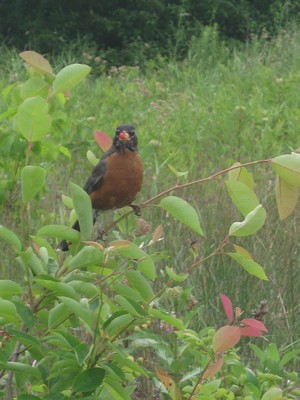
2.  There are baby robins somewhere in our yard. I haven’t seen them but I can hear them. The serviceberries are disappearing and the worms are looking worried. 

3.  I noticed yesterday for the first time that a yellow finch doesn’t fly like other birds. It flies like this: flapflapflapflapflapflapflap… gllllllllllllllllllllliiiide…. flapflapflapflapflap…. gllllllllllllllllliiide. Like aerial running jumps before becoming a wee missile, wings tucked close to its body.

4.  When a fly enters your car at, say, point A, and doesn’t exit (despite open windows) until, say, point X—about 50 kms away—how confused will it be? Will it find its way home or just move into the new neighbourhood? What about its kids? Do flies sleep?

5.  A van cuts me off. I watch as the driver—a guy who hangs his whole left arm out the window, his multi-ring-bedecked hand dangling down the side as if broken—continues to veer in and out of traffic, erratically, cutting off every car in turn, a Baby on Board sign prominently displayed in his back window.

how to help wildlife in spring

Here’s a cut and paste from the recent Toronto Wildlife Centre  newsletter. Lots of good info on how to help urban wildlife this spring.
—————————————————————————————
 
TWC Hotline is already receiving calls about wild babies!

baby fox

While we’re still bundling up against
the cold, animals are starting to have spring babies. Baby animals may look helpless but mom is usually close by.

If you do find a baby animal that you think needs help, please refer to TWC’s website for guidance or call the Hotline at 416-631-0662.

 
How you can support wild animal families.
 
1. Check for nests before renovating or boarding up holes on your property. Raccoons and squirrels for example, find that attics, crawl spaces, chimneys and sheds are safe, comfortable spaces to have their babies. If an access hole is closed and the mother is kept away from her babies, the mother will do all she can to get back inside often causing significant damage in her attempts to reach her young. If she fails, the babies will die.
 
2. Do not trap and relocate animals.  It is illegal to trap and release animals outside of their home territory. Releasing animals outside of their territory can spread disease and the animal does not usually survive the relocation. When introduced to a new and unfamiliar area, a relocated animal has no idea where to find food, water or shelter, and has to contend with other wildlife defending the territory they already occupy. There is also a high risk that wild babies will be left behind. Defenceless without the care of their parents, orphaned babies will die.
 
3. Keep your cat indoors during the warmer months, particularly between April-September. Hundreds of wild animals are raising their young in your neighbourhood during this time, and wild babies are completely defenceless against cats on the prowl.

Many baby birds spend 1-2 weeks hopping around on the ground after they have left their nest, BEFORE they are able to fly. This is a part of their normal “fledgling” period, and though parent birds are still feeding and caring for their babies during this stage, they cannot protect them from cats.

May 9-08 379 3Many mammal species also nest on the ground or in places cats can easily access. Cottontail rabbits stash their babies in a ground nest (which are frequently built in urban and suburban backyards) and for 3 weeks will leave them unattended except when feeding them. The babies are unable to run or hop away if discovered by a cat.
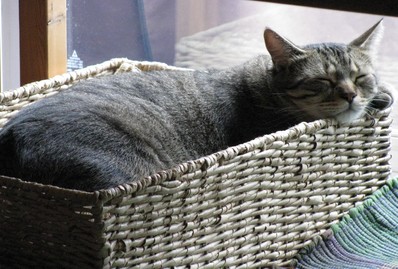
Can’t keep your cat indoors?
Here are some alternatives.

—————————————————————————————

Note: I’m guessing the above piece refers mostly to an urban environment.

Still, the cat issue is a tough one, arguments for both sides. Once upon a time I wouldn’t have considered keeping my cat inside, then circumstances forced the decision (I moved into an apartment that was perfect in all aspects other than in/out access for my cat). She adapted and we lived happily ever after, acquiring other cats, which, because she was, became indoor ones also.

And though I’m in a house now, with a yard, I choose to keep them inside because we’re surrounded by roads and I don’t want to see them squashed beside one. Were we surrounded instead by boundless meadows where they could run about eating up mice and other elements of the food chain (all the while taking a risk at becoming part of the foodchain themselves) I may consider letting them out.

Or not.

trees i have known and loved and some i’ve pined for…


1.  Earliest tree memory: pear tree (no partridges), back yard, age seven or so. Rope. One end tied to branch mid-way up, other end tied to bucket in which sits a bowl of mum’s potato salad. The oil and vinegar kind. No mayo. Me climbing enormous tree. (Proof that memories are distorted; pear trees are tiny.) Me sitting in crook of tree, hauling up bucket, eating potato salad while surveying neighbourhood—particularly Mr. Deluca next door, whose garden is full of car parts instead of flowers, which therefore makes him odd in my book.  Because eating potato salad from a bucket in a tree and staring at the neighbours isn’t…

2.  Living on that tiny island in the Caribbean. No pine, no spruce. We decorate a houseplant. Xmas Eve on the balcony; it’s late and so dark. Ten thousand stars. Then a lone trumpet. Someone’s playing a trumpet down in the valley. Silent Night. Not another sound. Not even wind ruffling palms, not even surf lapping against shore. The whole world has stopped to listen.

3.  For years at the tree farm with a handsaw when the kids were small. Crunching through snowy trails, arguing about which one to kill. Tears because someone wants the twelve-inch Charlie Brown and someone else wants the seven-foot so-perfect-you-may-as-well-go-fake specimen. Every time we end up with neither and give it a name: Quasimodo, Shadrack, Prickles. When the holidays are done the tree carcass has become part of the family and so can’t go out on the curb for pick-up with all the other trees. We place it in the yard, out by the compost, chop it up for firewood years later when we can’t remember which one it is—Shadrack, Prickles?—but we burn its fuel with gratitude and a kind of nostalgia nonetheless.

4.  Sitting at my desk, working, when a very large truck arrives on the street and men get out and hover about the neighbours’ thirty foot spruces that separate our yard from theirs. The men cut branches from the trees, lower branches only, which opens things up, makes more room on the driveway, makes perfect sense.  But then they keep cutting, higher and higher branches until it doesn’t make sense anymore. Too high. It’s getting stupid and ugly. I’ve stopped working, am transfixed, staring out the window as one of the men straps himself into something, a safety belt, climbs trunk with chainsaw. Saws top off tree. Saws top off tree. It falls into the middle of the street with a thud just like death. It feels like death. But then, it is. I want to run outside, scream, cry, ask why? But I can’t move. I’m just stunned that this can even happen, that these trees—there are two—can just be executed because (I find out later) they shed too many pinecones on the driveway and lawn.

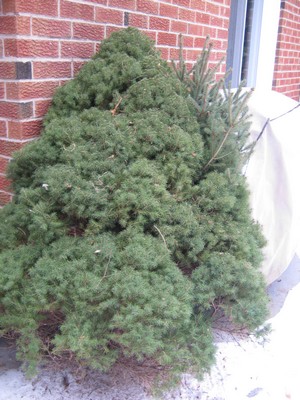
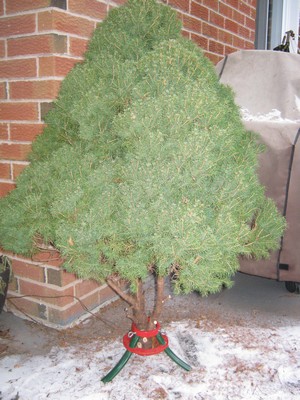
5.  Alberta spruce. Cute and petite when we moved in. Two feet tall. Eventually got so big you had to shove it aside to get to the front door. Often covered in snow or rain. Finally got ridiculous. So we cut it down and with a bit of trimming, voila, this year’s specimen is born. Front lovely. No back.

6. “We had Christmas with the usual one-sided tree from the boy scouts. “If you shove the thing up against a wall,” daddy said, “who the hell’s going to notice?”” –excerpt from The Work in Progress

~

a cougar fighting donkey of my own

 
Ever since I met a woman a few years ago at a B&B in Okanagan Falls who had a lot of donkey chachkies around the place—enough that I ended up asking So what’s with all the donkeys? and she answered with some lovely donkey stories and streams of trivia, all of which become thin and boring in translation/reality because you really had to be there [on holiday, drinking B.C wine around a stone fireplace]—I’ve been slightly mad for the big-eared furry beasts.

In fact, one of my goals is to have a guard donkey on my as yet to be acquired vast country estate. I’ve heard they’re extremely proprietary and can easily take down cougars and other things that prowl about on country estates, vast and otherwise. (Not that I have anything against cougars.)

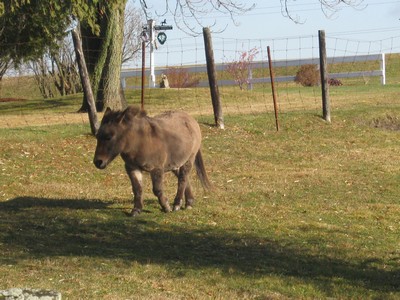
So the other day when I’m driving from point A to point B and pass a donkey standing in a field—which for some reason hardly ever happens—well, I had to turn around of course and take some pictures. I was happy enough just zooming in on the beautiful thing way off in the distance.

Never dreamed it would walk across the whole field…
…right over to the fence
…and stand right in front of me
…which I took as a sign of kinship—it obviously felt my donkey-loving vibes.
A very happy Dr. Dolittle moment.
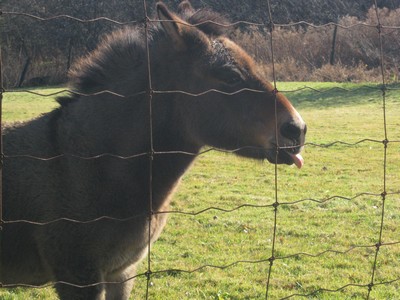
Then it did this.
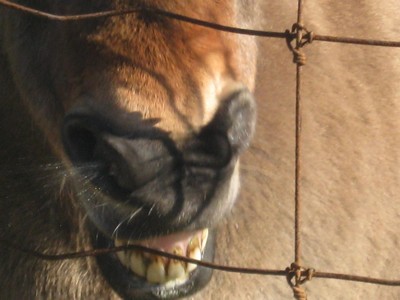
Followed by this.
Being smitten, I chose to take this as a message of welcome, good humour and a general attempt at communication (though I’ve been told it’s more likely a message of If you haven’t got any carrots would you mind getting off my property or you’ll leave me no choice but to do my famous cougar move…)

Which is exactly the kind of donkey you want to have.

bird season

Come October I begin putting out seed for the birds (and the squirrels—and no, I don’t get involved in turf wars; they seem to work it out well amongst themselves—and anyway, I like squirrels).

I used to do special mixes to attract certain birds but a lot of those had some amount of millet which sprouted in Spring and I don’t like grass and it grew in great thick patches—so, out with the millet. Now I serve only the black sunflower seeds which a good vareity of birds enjoy, including the millet loving doves, who simply wait for the sunflower seed crumbs other birds leave behind.

Am feeling more birdy than usual this year because, thanks to info from a birder, poet, artist, bookish Leafs fan, I have happily discovered Bird Studies Canada and have signed up to make note of birds in my backyard this winter. AND, even more exciting, I’m giving a Bird Studies Canada Xmas Bird Count Kit to everyone in my family with kidlets, so they can document the avian visitors to their own backyards over the Xmas hols.

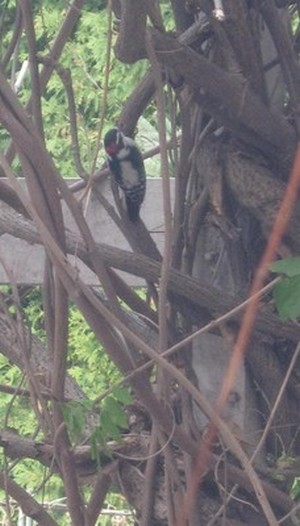
Unfortunately this chap arrived several days before my tabulations begin…

'sort of' red-headed woodpecker?? as seen through the kitchen window

Maybe he/she will come back and be counted. And identified.

~