places to find the moon

“I know where the moon lives now—
At the east end of the sky. Where the tip of Lake Superior meets the future.”
—from Factory Girl, by Jeanette Lynes

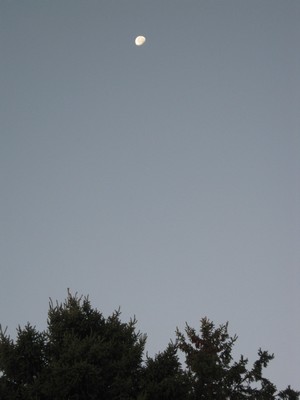
One Moon over One Magnolia

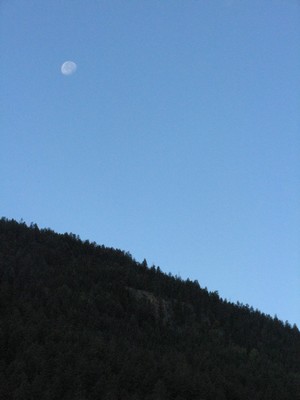
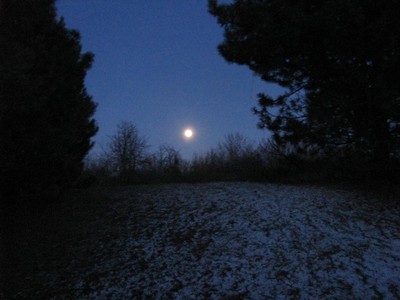
One Moon over More than One Spruce

(three?) Moon(s) over Goody Factory

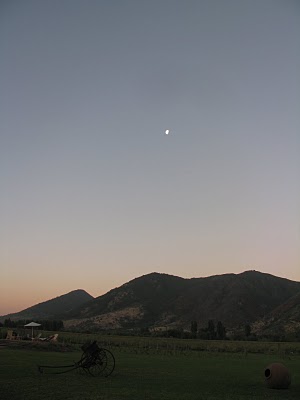
Moon over Mendoza (five hours before earthquake)

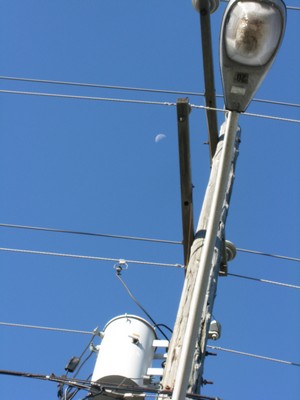
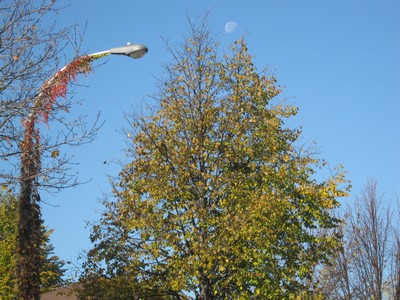
Moon over Streetlight I

Moon over Streetlight II

Moon(Dancing) over Lonesome Windmill

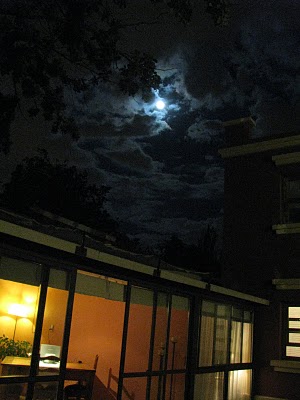
Moon over (very) Distant Patio 

Moongazing Moon

(still-in-its-pj’s-and-clearly-startled-to-be-caught-so-early-in-the) Morning Moon

A few hours later…(more composed, fully dressed) Morning Moon

Good Night Moon

~

all vines are not created equal

No need for panic but you probably should know—

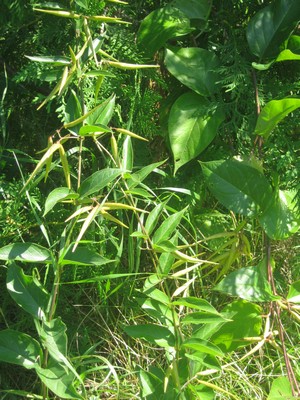
Dog Strangling Vine wants to rule the world.

We mustn’t let it.

There are very few good reasons for using pesticides. This is one. Maybe the only one.

This very badly behaved stuff climbs up trees and bushes and chokes them. Given enough (surprisingly little) time it covers entire ravines. 

Creates fields of itself, wiping out other smaller species (Queen Anne’s Lace, Goldenrod, Asters, Daisies, Buttercups). Not to mention getting in the way of a good walk. Especially if you’re a dog. Hence the name. Worse, it has no enemies; it’s an import that befuddles our native species, though bioligists are considering importing a beetle that might eat it. Hmmm, sounds tricky. (Just noticed the litter in bottom right; didn’t even see that on my walk, so distracted was I by the invasion…)

About this time of year the green pods are turning brown and dry, inside which are milkweed-like fluffs with seeds attached; hard to tell them from the milkweed ‘santa clauses’ when they’re flying about. The bounders.

Thing is you can’t pull this plant out. The roots are deep and can only be killed by a spritz of poison on its leaves. If you see it in your garden, you’d be wise to spritz with merry abandon. Or dig it out. Best done in spring when the things are small, but still, better late than never.

Fore-warned and all that…

~

for samantha

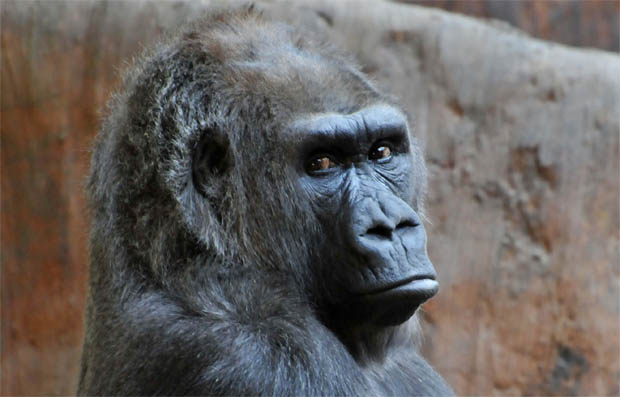
I have a thing for gorillas, but not for zoos, so it’s been years since I’ve had the pleasure of being in the presence of Charles, Samantha, et al, denizens of the Toronto Zoo. And it was a pleasure. I marvelled at how, unlike the orangutans—and people—the gorillas carried themselves with such dignity, grace despite their size, and purpose. 

I remember trying to lock eyes with them—not easy—but when it happened, instead of the thrill I’d expected, I’d feel suddenly humbled by my stupid aim. So now we’re looking at each other, so now what? the gorilla seemed to be saying. Good point, I thought. It’s all about control for us humans. I got you to look at me. I win. This is how small and daft we are by comparison—while they spend their time in much more useful pursuits. Picking nits off each other, for instance.

My anti-zoo stance has been gradual, strengthening every time there’s a sideshow-like marketing campaign to announce the koalas or pandas or dancing white tigers are in town. Or some other spectacle—how about an authentic African Savannah, right here, in Toronto? Because we can all believe that can’t we? Imagine the smiles on the faces of all those African animals…

No one ever mentions the polar bears are still pacing, the elephants are eating jellybeans and the whales are going stark raving mad.

When I heard that Samantha the gorilla died this morning, I felt unexplainably sad and overcome with a kind of regret—the sort one feels when an old uncle passes away who, for whatever reason, you’ve neglected visiting and now it’s too late and you realize you’ve missed something.

While I’d rather learn about exotic animals from books and films produced by a handful of serious folk who respect and study them, than from invading their territory as a ‘tourist’ (eco or otherwise) or hauling them out of it into ours, I recognize that there is something magical when that connection between human and animal is made. At least for the human. I do believe we can be the better for it. It might even have been one of those connections with one of the Toronto gorillas that started my own ‘thing’ for them. And I guess that’s not entirely bad.

Even so, I can’t support zoos, at least not the run of the mill variety that allow for the import of camels and giraffes to Ontario and the export of dolphins to Asia and the Middle East. However, if they were designed to house indigenous animals only, and then for reasons of rescue, safety and rehabilitation, only, well, that would be a beast of a different colour. Our relationship with animals should be something special—when it happens it’s a gift. It shouldn’t be on tap for us to view as merely an ‘exhibit’, as if the very purpose of animals is to entertain us. And oh, of course, teach us. Mustn’t forget how much we’re constantly learning at the zoo and on safari and watching seals jump through hoops while we nibble on hot dogs and wonder what time the elephant rides start. If we really wanted to learn about animals, how about starting with the ones right around us? Cats, dogs, horses, foxes, coyotes, deer. Or how about the ones we eat—chickens, cows, pigs, lamb. We could do well to understand them a bit more and how we all affect one another, before we line up to watch a whale in a tank in the name of education.

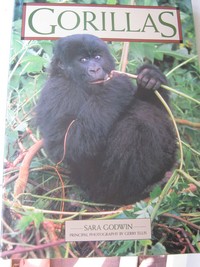
Co-incidentally (I love a good co-incidence) I recently found an excellent book (Gorillas, by Sara Godwin) at the Sally Ann that I’m anxious to pass along to my young niece who has yet to discover the brilliance of gorillas and still thinks they’re scary, a la Godzilla or King Kong (unfair myths if ever there were any). I plan to give her a DVD of Gorillas in the Mist at the same time, and any good documentaries I can find, and then maybe after we’ve read and watched and talked—maybe I’ll take her to the zoo to pay our respects to Samantha’s friends and family.

I’ll tell her why I don’t much like to go there, as well as the magic of making connections, and she might get what I’m saying or she might find me tiresome and un-fun, but either way, I’ll let her take it from there to wander her own path because, ultimately, that’s all any of us can do.

Except the animals of course.

~

“As thoroughly as Homo sapiens as a species has earned James Joyce’s painfully accurate description of “manunkind”, so Gorilla gorilla gorilla deserves the title “gentleman” in a way few humans can honestly claim.”—from Gorillas, by Sara Godwin, Friedman Group


welcome to my achy breaky world

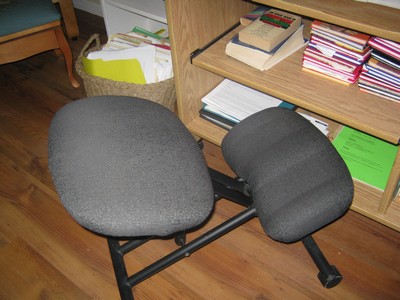
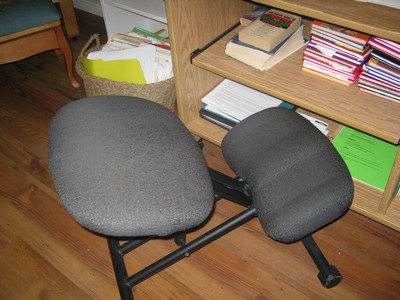
I’m kneeling on a kneeling chair as I write, but I keep sliding off. The chair was recommended to me by my massage therapist, Beth, whom I haven’t seen in almost a year—ever since I got the chair, which I got because I slightly screwed up my hip and back from bad sitting habits in my previous chair whose pricey, ergodynamically correct engineering is completely wasted on me given that I sit cross-legged, or with alternating feet tucked under my bottom.

I remember the instructions for the kneeling chair said something like…  this chair is not made for extensive kneeling; try to keep most of your weight off your knees and on your butt. Maybe it said derierre.

In any case I’ve never really understood how to work it and am pretty sure I’m doing it wrong because my back and hip still hurt. Also my knees now. Makes me long for the days when my only complaint was excruciatingly tight shoulder and neck muscles that even Beth found shocking.

I’m guessing that a certain amount of ache is part of the territory, that anyone who sits for long periods obsessing about semi colons or whether to use the word ‘car’ or ‘vehicle’ is eventually the beneficiary of a few sore parts and maybe also the owner of a few gadgets to help ease the soreness (heat packs, massage thingies, roller wotsits, cedar blocks for yoga stretches, Theraband bands for other stretches—all of which only work, I’ve discovered, if you use them).

Or maybe it’s just me. Maybe I’m a wimp, or have some unique structural problems. (Actually, least said about structural problems right now the better…)

So I got the kneeling chair and what I’ve been doing is alternating between it, the original chair, and a medium sized Theraband ball, which, when I told a physiotherapist I sat on while working, she laughed, called an associate into the room and had me repeat the story so they could share a professional chuckle.

Despite its apparent effect on physiotherapists, the ball works rather well for me. Furthermore, my chiropractor, whom I also haven’t seen since winter, said it should be fine.

Anyway, moving between these three seats I’ve noticed that—in addition to giving me much needed breaks in my position (because it rarely occurs to me to do anything as simple as stand up and stretch)—I’ve developed a preference for sitting differently for different tasks. For instance, revising is best done on the bouncy Theraband and almost impossible to do effectively on the kneeling chair (which I prefer for composing). Emails are more cheerfully answered, and less often misunderstood, if I write from one of various contortions on the ergo chair, whereas, for on-line reading, I go back to the Theraband. And so on.

Here’s what worries me: at some point will I need a fourth chair?

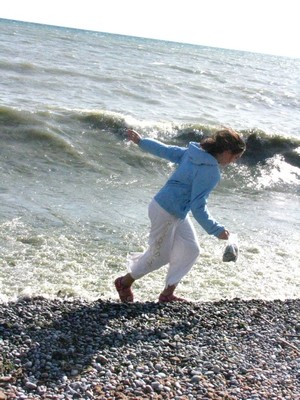
If so, I’m thinking lawn chair (one of the most brilliantly designed chairs of all time). I’m also thinking spiral notebook instead of screen, pen instead of keyboard… seagull voice, negative ions, beach glass, stones for skipping. Lunch in a paper sack.

In fact that may be exactly what my achy self needs. Not ergo wotsits.

And it just occurred to me—that’s twice in less than two weeks my rambling has led to the same place.

Right. Enough kneeling and bouncing and moaning. I’m off.

planting solitude

“How one hates to think of oneself as alone. How one avoids it. It seems to imply rejection or unpopularity. An early wallflower panic still clings to the word… we seem so frightened today of being alone that we never let it happen… if family, friends, and movies should fail, there is still the radio or television to fill up the void.

“…Even day-dreaming was more creative than this; it demanded something of oneself and it fed the inner life. Now, instead of planting our solitude with our own dream blossoms, we choke the space with continuous music, chatter, and companionship to which we do not even listen. It is simply there to fill the vacuum. When the noise stops there is no inner music to take its place We must re-learn to be alone.

“…how inexplicable [the need for solitude] seems. Anything else will be accepted as a better excuse. If one sets aside time for a business appointment, a trip to the hairdresser, a social engagement, or a shopping expedition, that time is accepted as inviolable. But if one says: I cannot come because that is my hour to be alone, one is considered rude, egotistical or strange. What a commentary on our civilization, when being alone is considered suspect; when one has to apologize for it, make excuses, hide the fact that one practices it—like a secret vice.”

(from: Gift from the Sea, by Anne Morrow Lindbergh)