diary of a room (with a view, a pen, and a book)

—Writing from a garret in London, Ontario. 

8a.m.— Gorgeous golden day. Huge trees outside the window. Blue boxes line the street. Yesterday when I arrived, I shoved two arm-less arm chairs together to make a sort of chaise lounge in the 3rd floor bay window alcove, then wrote like mad. It’s quiet here, the only sound an occasional car, glass and tin cans being dumped, and there’s very good food in the restaurant downstairs (I recommend the mixed greens with dried cranberry and pistachio, and goat cheese/yoghurt dressing), a porch also for contemplating, which I did some of after lunch. Mostly on the colour grey. Surprising results.
Today I’m devoting time to reading Emma Donoghue’s  Room, which I brought with me not knowing that Ms. Donoghue lives in London, Ontario. Possibly in a garret?? It doesn’t say on the  jacket.  Anyway, I found that a strangely lovely coincidence.

So because I’m out of my usual routine, and am using a keyboard that is driving me slightly bonkers, I decided that instead of trying to write one coherent post I’ll write several small incoherent ones throughout the day—a sort of real time account of reading progress and life in the garret generally.

Have only just begun the book and, although the rhythm takes a minute to get used to, I’m thoroughly enjoying the narration by a five year old as he introduces us to his world and to his mother.

“I still don’t tell her about the web. It’s weird to have something that’s mine-not-Ma’s. Everything else is both of ours. I guess my body is mine and the ideas that happen in my head. But my cells are made out of her cells so I’m kind of hers. Also when I tell her what I’m thinking and she tells me what she’s thinking, our each ideas jump into our other’s head, like colouring blue crayon on top of yellow that makes green.” (—from p.10 of Room)

While this perhaps should leave me doubting that a five year old can put things into terms that involve cells, it doesn’t— it just leaves me looking forward to finding out how he can.

“Bunnies are TV, carrots are real…” (p.17, Room)

9:15 a.m.— A man walking three dogs on three leads passes a woman walking two children on two leads. Honest to god.

11 a.m.— On the street opposite my window a black cat and an orange cat have been playing together for hours. They cross the road together, jump on stone walls together, stand around the sidewalk, then run off and disappear for a while, together, then reappear, at first just the black and then seconds later, the orange. Seems there’s never one without the other. It’s a very nice little vibe watching them. When do you see anyone, kids even, so consistently, without argument, for this long, enjoy each other’s company? Must take a walk later, have a closer look, maybe say hello.

1:30 p.m.— Smoothed out some wrinkles in the final chapters of the WIP. Celebrated with perfectly cooked Arctic char in mustard and cider reduction, and arugula salad. Am enjoying this garret life.

2:30p.m.— For Jack, the boy narrator of Room, having a grasp of what cells are is the least of his accomplishments (see 8a.m. entry). He’s a little genius who, literally, lives in a world ofhis own making and with the help of his twenty-six year old mother, who’s spent the past seven years living in the trumped-up and sound-proofed garden shed of her abductor, Old Nick. Because of her, Jack has a better grasp of reality, however unreal, than most people. She has, it seems, taken enormous strength from the need to protect and nurture and teach him, in turn, to be strong. Together they’ve invented dozens of games using ordinary objects or just their senses and words. They have rituals and traditions and rhythms to their days. He trusts her completely and is shocked and frightened when he learns that she’s hidden some chocolate to keep as a surprise for his birthday. If there are “hidey places”, he thinks, then there are places for vampires and bogey men. In such a confined space that would be a very bad thing indeed. Secrets are equally not tolerated.

Because he was born in the room (a stain on the carpet marks the spot), and has seen nothing else (other than TV, which he believes is a two-dimensional ‘unreal’ place) this tiny universe makes perfect sense to him. His mother, on the other hand, is becoming increasingly unhappy, concerned that Old Nick will eventually leave them to die, and begins to tell Jack about the ‘real’ world, about her parents and her life as a child. At this point I’m not sure if she’s doing it as a gift to him, some new exciting thought to fill his mind, or a way of consoling her own grieving self.  

“Stories are a different kind of true.” (p.71, Room)

5:45p.m. A few weeks ago there was some flap about how writing in the present tense was a cheap trick employed by three of the six Man Booker finalists, of which Room is one. It struck me as an absurd discussion at the time, even moreso now that I’m reading Room. The reason—for Philip Pullman’s and Philip Hensher’s information—that Room is written in the present tense is because if it were written any other way it wouldn’t have the same brilliantly creepy effect of drawing us into that place in real time, which is a place we don’t want to go but can’t stop peering into. Perhaps I’m in the minority but I enjoy first person, present. Like anything, it has to be done well, and unlike some possibly ‘easier’ POVs, it’s very hard to do well. I’m guessing Donoghue chose it for a few reasons: 1) the story itself demanded that form, 2) the feeling of being there in ‘real time’ works exceedingly well in unsettling the reader, and 3) there is something almost subliminal about present tense, a kind of tacit reminder that what you are reading did not happen then… but is happening still. And for this book, that’s exactly what you need to feel. For many reasons.

6:15p.m.  The orange cat is across the street; I run over expecting to find the black one nearby, maybe capture their extraordinary relationship on film. But the orange is on his own (orange tabbys are always boys). Where’s your friend? I say, and he rubs against my leg, looks up at me and purrs What friend? 

So much for my brilliant cat loyalty theory.

10:30p.m. At about the exact middle of Room the thing I expected to happen at the end happens, and I’m left stunned and thinking: how the bleep will the author sustain the next 150 pages?? Well, sir, she does in the most surprising and amazing way, turning our perceptions about ‘freedom’ upside down and having us look at ourselves in the process. And I don’t care if you hold your breath, gnash your teeth or utter vile words, I will not divulge even one more tiny piece of the story, except to say I loved it so very very much—one of those books that begs to be read again, not necessarily to understand better—because the story is simple and clear—but to benefit from its truth. 

~
this is how it happens…

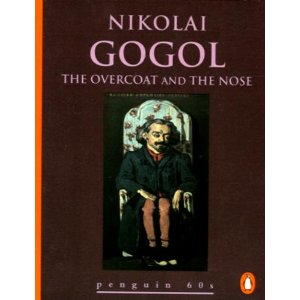
I’m in love with Nikolai Gogol. I say this based on one story in a recently purchased four by five inch book, published by Penguin in 1995—a Penguin 60s—part of Penguin’s 60th anniversary celebrations. The book contains two stories: ‘The Overcoat’ and ‘The Nose’. It was ‘The Overcoat’ I read Sunday morning. And it was then that I fell in love.

Here is a chap with a mighty sense of humour. And that’s always irresistible. Plus control and subtlety and things that really aren’t at all what they seem. The story centres around Akaky Akakievich, a titular councillor—essentially a lowly civil servant in early 19th century Russia—(a whole beautiful long riff is done on how he got his unfortunate name, which culminates in…”The child was christened and during the ceremony he burst into tears and made such a face it was plain that he knew there and then that he was fated to be a titular councillor.”)

In a nutshell, the piece is about a man who needs a new overcoat to survive the winter; he doesn’t ask for much in life and gets even less. But in his way, he’s happy. Though he lives an extremely simple life (the list of his possessions include two buttons that have fallen off some clothing) and has been a devoted employee to his ‘company’ for many years, he has to scrimp and practically starve to save money for the coat and then when he has it, it’s stolen. And no one cares. When he dies he returns as a ghost to steal the overcoats of others.

But of course that’s not what it’s about at all. It’s actually a brilliant political statement that (sadly) still resonates today…

Here is my favourite sentence—

“Even at that time of day when the light has completely faded from the grey St. Petersburg sky and the whole clerical brotherhood has eaten its fill, according to salary and palate; when everyone has rested from departmental pen-pushing and running around; when his own and everyone else’s absolutely indispensable labours have been forgotten–as well as all those other things that restless man sets himself to do of his own free will–sometimes even more than is really necessary; when the civil servant dashes off to enjoy his remaining hours of freedom as much as he can (one showing a more daring spirit by careering off to the theatre; another sauntering down the street to spend his time looking at cheap little hats in the shop windows; another going off to a party to waste his time flattering a pretty girl, the shining light of some small circle of civil servants; while another–and this happens more often than not–goes off to visit a friend from the office living on the third or second floor, in two small rooms with a hall and kitchen, and with some pretensions to fashion in the form of a lamp or some little trifle which has cost a great many sacrifices, refusals to invitations to dinner or country outings; in short, at that time of day when all the civil servants have dispersed to their friends’  little flats for a game of whist, sipping tea from glasses and nibbling little biscuits, drawing on their long pipes, and giving an account while dealing out the cards of the latest scandal which has wafted down from high society–a Russian can never resist stories; or when there is nothing new to talk about, bringing out once again the old anecdote about the Commandant who was told that the tail of the horse in Falconet’s statue of Peter the Great had been cut off; briefly, when everyone was doing his best to amuse himself, Akaky Akakievich did not abandon himself to any such pleasures.”  (—from ‘The Overcoat’ by Nikolai Gogol)

And this in 1842.

And you wonder why I’m in love?

~

the book that started it all

 
My family was not what you would call literary, or even an especially bookish lot. Oh, there were books in the house—some came free with special offers at the grocery store—that’s how we got our partial set of encyclopedia (it ended at EAR–FIS); others were from the Book of the Month Club, which I think my father signed up for to get the free ones then god only knows how many peculiar titles were delivered at full price for god only knows how long before he could figure out how to make it all stop. There were also a few stolen books, mostly from schools my sister went to though I think a few came home with me from the library, permanently. All of it unintentional—I swear.

And it’s not that my parents didn’t read. They did, in their own way. Apparently more when they were younger than when I knew them. My father, who could build anything, and loved the outdoors, once said his favourite book was Robinson Crusoe; my mother was the sewing, cooking, growing vegetables, hanging laundry outside kind of mother who read what she called ‘love stories’—books with pretty blonde heroines on the cover, petting horses in meadows while dark-haired men stood in the background looking confused and handsome.

In any case, ours was a pitiful collection to say the least, and you can probably guess there was no encouragement toward reading, yet I gravitated to it anyway and from a very young age read whatever I could find, the way one might read every dog-eared volume on a dusty plywood shelf while stranded in a cabin for a rainy week a million miles from anywhere. In other words, grateful for anything. Best part in cases like that: sometimes you find a gem or two in the debris.

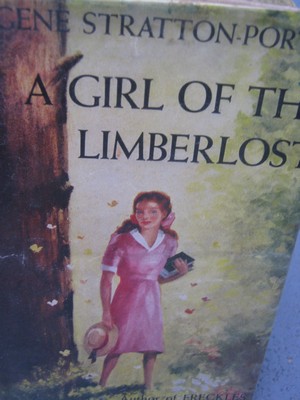
My own possibly pilfered, possibly purchased copy.

One of the highlights on our shelves was A Girl of the Limberlost, by Gene Stratton-Porter, which is stamped with the name of a local school but has a price of $2.50 marked inside in pencil. So it may have been one of the few acquired legitimately.

I read it at about ten, eleven, twelve years old, I’m not sure, but I remember connecting immediately with Elnora Comstock who wore hand-me-down clothes and lived in the woods communing with nature when she wasn’t arguing with her mother. I didn’t live in the woods but I wanted to. I can still practically smell the spice cakes her mother packed in the bucket that carried Elnora’s lunch to school. And I remember how those cakes were one of the few but important signs of her mother’s otherwise unexpressed love. I’ll have to read it again to be sure but I don’t believe Stratton-Porter sentimentalized the mother’s role in any way, which to me was refreshing. A change from all those love stories cluttering up the house, the Cherry Ames, Student Nurse, and books where everybody was so bloody happy and the only problem was something outside the family—a ghost in the vestibule, a murder in the vicarage, etc.  Yeah, right.

It was, I suppose, my first character driven story, one that suggested interior journeys were possible in literature, that it wasn’t all about ‘the other’, meeting someone who changed your life after a series of predictable problems, or climbing the mountain, or solving the murder.

All this reflection, BTW, came as a result of stumbling across a short video at The Guardian. Before that, I hadn’t given ‘the first book’ much thought, nor its many and varied influences on me (too introspective to rattle on about). Maybe the sort of thing that requires a certain age and perspective in order to see it clearly. Anyway, it’s all got me thinking that it’s probably quite often, maybe even always, a book, rather than a person or even an environment, that nudges us around a corner of our early reading. That maybe the love of words is a nature rather than nurture affair, in our DNA, and it’s just a matter of time before we find that book that connects with an inherent understanding or curiosity about the world—and reflects it back to us. True, if we’re surrounded by people who bring us sacks of lovely things to read we may find it sooner, but even if we’ve got nothing but a dusty shelf in a cabin, I’m convinced we will find it.

And then off we go. Never to be the same again. And more ourselves than ever.

Funny how stuff begets stuff.

So, latest dinner party question: what was the first book that made you think differently about books?

~

this is not a review: confessions of an advertising man, by david ogilvy

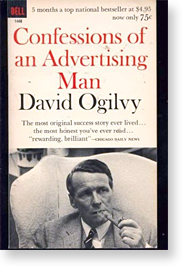
In my ongoing search for the meaning of life, the universe and the great white light, I recently stumbled across Confessions of an Advertising Man by David Ogilvy. Published in 1963 (by Dell), the cover on my copy shows the man himself sitting in a large wingback chair decked out in a three-piece tweed, cradling a lit pipe. You can see the smoke curling away from his lips. He looks every bit the successful, ultra confident, middle aged man who is either on his way to or returning from a double martini lunch where, among others of his ilk, clients or colleagues, he no doubt elegantly chortled his way through a sirloin steak, baked potato and oh-so-many-bon-mots lunch. For what is an advertising man if not a chap full of gin and bon mots?

And it was a chap’s world in them days. Girls (there were no women at the time) were for fetchin’ coffee and lookin’ cute, whether it be while fetchin’ coffee or in ads or—as evidenced by the Laura Petries, Samantha Stevens and possibly Betty Drapers of the world—while preparing perfect hors d’oeuvre to soak up yet more booze consumed by (male) clients and/or colleagues in perfect living rooms with Pledge polished veneers, before serving perfect meals of yet more red meat.

The book outlines Ogilvy & Mather’s beginnings, with, essentially, Ogilvy coming over from the U.K., starting an agency and taking Madison Avenue by storm in his own quietly dignified way. In a style that comes off relaxed and conversational, like he’s smoking that pipe while dictating to some gal in a cashmere twin-set, he offers advice on how to get and keep clients, use illustration, write copy, build campaigns, when to get rid of clients you’ve lost faith in (“I also resign accounts when I lose confidence in the product. It is flagrantly dishonest for an advertising agent to urge consumers to buy a product which he would not allow his own wife to buy.”)—sexism aside, can you imagine how far we’ve regressed if this ethic actually ever existed??

He goes on with anecdotes and suggestions for everything from how to succeed in the business (step by step instructions) to having a restful vacation:

“…Take your wife, but leave the children with a neighbour. Small fry are a pain in the neck on a vacation…. Take a sleeping pill every night for the first three nights.”

I’m fascinated by advertising and happen to believe it can change the world. Already has, but not in the right way. Imagine the difference if, in the past few decades, the amount of money spent on convincing people they should eat at McDonald’s had been spent instead on convincing them that real, honest to god food is sexy and delicious and can make you sexy and delicious.

But then we’d have risked creating a world of happier, healthier people who didn’t need ten thousand products, books and videos to help them become happy and healthy.

And then what?

The world would end as we know it.

Which is the whole point.

But I digress.

A nice element of the book are photos and samples of some of O&M’s more famous ads, such as for Rolls-Royce—the headline of which reads:

“At 60 miles an hour the loudest noise in this new Rolls-Royce comes from the electric clock.”

Followed by 719 words of copy.

Different times.

I guess what remains the same is our hookability, that whatever is presented to us in a certain way, we literally ‘buy’.

An interesting footnote tells us that Dorothy Sayers, Charles Lamb, Byron, Bernard Shaw, Hemingway, Marquand, Sherwood Anderson and Faulkner also wrote ‘advertisements’ at one point—“none of them with any degree of success”. 

While this is ultimately a good outcome, I think it would have been fascinating to see how differently the world might have been shaped if only Byron had opened an ad agency.

~
Note: this post first appeared in August, 2010.

________________________________________________

Confessions of an Advertising Man online at Blue Heron Books.

canada eats


Am celebrating the 143rd birthday of our grand beau pays with my favourite things: words and food. Specifically—words about food. 

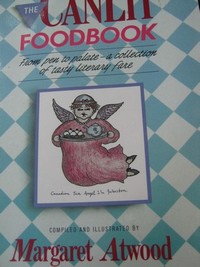
As far as I’m aware (not that I’ve done an extensive survey) I’m the only person I know who has a copy of The CanLit Foodbookwhich, a few years ago, sprang into my arms from the ceiling high stacks at one of my favourite secondhand shops.

Why it’s taken me this long to crack it open, I haven’t a clue.

Assembled in the late 80’s by Margaret Atwood for P.E.N. International and The Writers’ Development Trust, it’s a collection of real and twisted recipes, essays, studies, poetry, fiction, thoughts and observations about food and eating and cooking, as well as reading and writing—about food and eating and cooking—from over a hundred Canadian writers. Or, as Atwood describes it: part cookbook, part “…literary symposium on the subject of food.”

The 200 or so pages are divided into sections [with illustrations by Atwood] such as: ‘Preprandial Prologue: Food as Metaphor’; ‘Cracked Dawns: Breakfast for Barbarians’; ‘Teatime; Strange Innuendoes Over the Cups’; ‘Eating People is Wrong: Cannibalism Canadian Style’; ‘Shindigs: Cocktail Parties, Weddings, Christmases, Funerals and Other Social Disasters’.

Each contribution receives its own brief preamble [again, by Atwood], such as ‘Graeme Gibson’s Right Way with Oatmeal’, about which she says:

Graeme Gibson learned to cook this in Scotland, and does indeed eat it while striding about the room.

Or her introduction to Salutin’s instructions on making toast and tea:

Playwright and journalist Rick Salutin used to have a phobia about cooking, until he mastered this recipe. After that, he went on to other culinary triumphs, such as Heating up Frozen Coffee Cake.

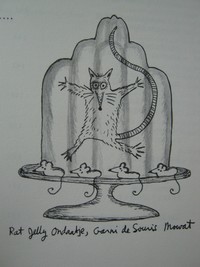
Margaret Laurence makes cauliflower soup, Timothy Findley serves fresh peaches and explains how to cream rodents, while Michael Ondaatje jellies them and Erica Ritter offers an essay on food and dating. There are foodish excerpts from known and not so known novels, precise directions for making Pierre Berton’s version of the perfect black Christmas turkey as well as corned beef hash; Catherine Parr Traill describes the means by which fish are caught and Alice Munro shares her recipe for Maple Mousse.

There is this from Paulette Jiles:

Paper Matches

  My aunts washed dishes while the uncles
squirted each other on the lawn with
garden hoses. Why are we in here,
I said, and they are out there.
That’s the way it is,
said Aunt Hetty, the shrivelled-up one.

  I have the rages that small animals have,
Being small, being animal.
Written on me was a message,
‘At Your Service’ like a book of
paper matches. One by one we were
taken out and struck.
We come bearing supper,
our heads on fire.

~

And that’s just for starters.

Speaking of which, I’m going to begin the reading today with a piece by Mavis Gallant who writes about a meal with one of my favourite painters. And the cooking will begin with Rudy Wiebe’s ‘Warm Potato Salad’…

A happy ‘grand beau pays’day to one and all.

Bon Appetit!

things read in the shade

I probably spent just a little too much time reading on the weekend under this umbrella (no, I take that back; actually, I didn’t spend nearly enough time).

I’ve been thinning out my bookshelves recently, and coming up with some odd and interesting titles in the process—things I’ve either not read or can’t remember reading. (Which makes me think of the old Born Loser comic strip where the husband is increasingly frustrated by his middle-aged forgetfulness, can’t find his glasses, etc., and his pragmatic wife, who says:

“Think of the positives—soon you’ll be able to hide your own Easter eggs.”)

But the point is…

Oh yes. The books.

One of the more unusual titles I’ve unearthed is Just Add Water and Stir, a collection of essays by Pierre Berton, most of which appeared in the 50’s in what was then The Toronto Daily Star. The book is described by the publisher (McClelland & Stewart) as… “Being a random collection of satirical essays, rude remarks,used anecdotes, thumbnail sketches, ancient wheezes, old nostalgias, wry comments, limp doggerel, intemperate recipes, vagrant opinions, and crude drawings

What often strikes me about writing from this era is the intelligent humour, that black and white Gable and Lombard rat-a-tat pace that’s clever without the need for cynicism or the homogenous drum rolls in which much of today’s humour is packaged. People then, it seems, weren’t afraid to be subtle.

I’m also struck by the whole Hey-Honey-Get-Me-a-Coffee-Willya mentality and the (shudder) girdles-riding-up image that conjures.

For example, there’s a section titled “Seven Men and a Girl”. Not a ‘woman’— a girl. Not boys, men. Seven of them. Some of whom include Glenn Gould, Charles Templeton, Russ Baker (“last of the world’s great bush pilots”), Robert Service, Milton Berle. Then there’s the girl—the sole representative of half the population—a prostitute named Jacqueline.

These happen to be among the few serious sketches about lifestyle, achievement and personality, based on interviews Berton conducted. The one about Jacqueline is meant to dispel the theory that all call girls are unhappy. Unlike so many others, Jacqueline, evidently, “has it made”, mostly because—

“…she’s met a man who has given her his name and expects nothing from her but her love. One may well ask why, under this odd arrangement, he too is happy. And again the answer must be that happiness is not an absolute. Jacqueline’s husband spent ten years in prison. Now he has a steady job and a wife who looks after him. For him, this is enough.

Berton writes that when Jacqueline was asked about quitting “her profession”, she said she’d quit tomorrow if her husband told her to.

“But he hasn’t told her, though perhaps some day he may. And I don’t think Jacqueline really wants to quit, anyway.”

In addition to the ‘serious’ stuff, there are parodies and take-offs of society, of education, the press, bureaucracy, smoking, marketing. Smart satirical re-tellings of fables and fairy tales and recipes. Opinions on Dick and Jane, racial origins, thought control.

More than anything, it’s a fascinating romp through a not really that long ago—yet in another lifetime—era.

~

At the other end of the spectrum, I read a poetry collection recently purchased for my nieceThink Again, by JonArno Lawson, (Kids Can Press, 2010). Beautifully illustrated by Julie Morstad, with simple pen and ink line drawings that just so perfectly capture the essence of emerging adolesence—all beauty and innocense mixed with tension and confusion mixed with childlike joy and what’s left of that fleeting childlike wisdom that they are perfect just as they are.

The poems, written as quatrains, may be a little too angsty or introspective on their own, but complemented by the drawings, the book reflects something pure about the young teenage mind that, as grownups, we’d do well to be reminded of now and then.

What I Want

I’ve objected and complained/But it hasn’t done any good—/I don’t want to be explained/I want to be understood.  (from Think Again)


women’s what?

I’m always stunned at the idea that people actually wander about saying things like “women’s literature” and “men’s literature”. Good glory. Who makes these distinctions? I mean is it the publishers, the media, authors, critics, readers?? And what, may I ask, is men’s literature anyway? Penthouse? (Does that even still exist? It’s been so long since I’ve perused the smutty shelf at the local Mac’s.) (Oh, and pardon me if I’m being sexist in a bad way.)

I read Kerry Clare’s excellent post today, which is what started all this off. I’ve heard, and had, these conversations before, but I think Kerry pretty well nails it when she suggests that the tag “women’s writing” has, essentially, been constructed to fill ‘a gap’.

She refers to a review by Alex Good of Lisa Moore’s novel February, in which Good says Moore is “an author of the female body.” I’m not sure what that means. The novel is about a woman who lost her husband the night The Ocean Ranger oil rig sank off the coast of Newfoundland in 1982.

I might not have been inspired to rant on this subject had I not just recently finished reading the book, and loved it.  Because what I loved about it had nothing to do with bleeding, cracked, and milk-squirting nipples (I refer again to Alex Good’s take on the book).

What impressed me was the language, the sentences, the writing for pity’s sake. And the honesty that Lisa Moore was able to tap into. As a widow, a woman, a human being trying to function among other human beings, a parent, a sister, a friend. I loved how she took us to the event and made us see it through the eyes of someone who has tried to make sense of it for twenty five years but there is no sense because The Company has never admitted their fault. Those men needn’t have died. It wasn’t about weather. It was about stupid manuals that weren’t distributed, training that didn’t happen, equipment that wasn’t in place. Moore beautifully shows the searing hopeless frustration of this through the prism of a widow’s jumbled, broken interior, in the chapter titled “The Portal”… where we learn that Helen has been playing the night of the storm over and over in her mind, imagining what might have happened, inviting us to imagine it with her, in control of every element but the final one.

The story could easily be that of a man after losing his wife/partner (just strike the squirting breasts); the human elements of emotion are the same for both sexes. But maybe that’s the problem—do we attribute emotions only to women?

And mindless car chases to men?

An over-simplification, I know. But you get the point.

Hardly seems right on either count.

I agree, of course, that certain books may have primarily women or men readers (also gay or straight readers, young or old readers, etc.) but I don’t think the authors, or their work, can (or should be) be defined by their readership—it’s often those very definitions that act as Keep Out signs to anyone else.

In the spirit of how far have we really come?, I’ll leave you with Margaret Atwood’s delicious take on the subject in a piece called  “Women’s Novels“.

~

Note: post first appeared in April, 2010.

___________________________________________

—Purchase February online at Blue Heron Books.

this is not a review: the anthologist, by nicholson baker


I’ve been reading things recently about not writing as a tool for better writing, which, to me, makes perfect sense given that I believe procrastination (when handled with care) has a valuable (necessary) place in a writerly toolbox. Walks, cups of tea, headstands in the garden, rarely fail to loosen a brain (and a loose brain is a thing of envy indeed).

It’s no wonder then that I so completely enjoyed Nicholson Baker’s The Anthologist where procrastination is the art form.

The narrator, poet Paul Chowder, has been asked to write the introduction to a poetry anthology and for 243 pages he lets us in on every distraction and digression that flits through his head as he avoids doing so.

Or so it appears. In fact, writing the anthology is exactly what he’s doing for 243 pages. The breakup of his relationship, badminton games next door, the comings and goings of a kitchen mouse, are merely forms of life he notices from another plane where he lives and breathes beats and rhyme and the mathematical precision of rhythm. Where everything is light and shadow. Pauses. Enjambment.

What the narrator is actually doing is tearing open the whole world of poetry as he feels it, and staring it down; this takes time. He doesn’t do it on purpose, but still it requires the kind of courage that allows you to stand back from a project, do nothing, all the while hoping to god you’ll do it in exactly the right way for exactly the right amount of time.

The end result is a delicious ‘conversation’ with the reader, full of passion and brilliance, easy humour and cheeky digs (Baker is either really good friends with Billy Collins or he hates him); it made me want to read and re-read a number of known and unknown (to me) poets, including Swinburne to see how he ruined things.

None of it is dull.

Of the Elizabethans, he says: “They really understand short words. Each one syllable word becomes a heavy, blunt chunk of butter that is melted and baked into the pound cake of the line.”

Of Sara Teasdale: “One day she hit her head on the ceiling of a taxi while it was driving over a pothole in New York, and afterward she said her brain hurt and she dropped into a funk and eventually she took morphine in the bath and died.”

When he sees endoplasm on the first page of a twenty page poem submitted by a student he says “I went cold, like I’d eaten a huge plate of calamari.”

(Chowder eventually gives up teaching as a source of income because it depresses him and drains him; he takes up house painting instead, which he finds much more agreeable.)

He talks about the link between weeping and meter, how as babies we cry in a rhythmic way we lose as we grow up. “Poetry is a controlled refinement of sobbing.”

And this about truth: “…you can choose to tell the truth or not to. And the difficulty is that sometimes it’s hard to tell the truth because you think that the truth is too personal, or too boring, to tell. Or both. And sometimes it’s hard to tell the truth because the truth is hard to see, because it exists in a misty, grey non-space between two strongly charged falsehoods that sound true but aren’t.

“I have no one. I want someone. I don’t want the summer to go by and to have no one. It is turning out to be the most beautiful, most quiet, largest, most generous, sky-vaulted summer I’ve ever seen or know—inordinately blue, with greener leaves and taller trees than I can remember, and the sound of the lawnmowers all over this valley is a sound I could hum to forever. I want Roz.”

I love the poetry lesson throughout, the musings on life, the soul baring honesty mixed with just the right amount of sarcasm, but mostly I love the message inherent in the structure: that sometimes procrastination, distraction and a particular kind of diddling about are the only way to loosen our brains enough to let the good stuff come through.

(~Read on the weekend in the company of sweet woodruff tea.)

(~Discovered through this post at Carol Bruneau’s Blog.)

____________________________________________

The Anthologist is available online at Blue Heron Books. Support indies!

letting truth lie

Truth is merely a perception. Memory, a feeling. Right?

In other words, does it really matter that (you think) your sister always got the extra spoonful of fried bacon on her polenta, or why your mum was draped over the ironing board, weeping, that bright Saturday afternoon in June (or was it August?) the year you turned nine or maybe seven and came home with a tadpole in a jar. Or was it a bee?

It´s what we take from it that counts. It´s the part that remains that has all the punch. Even if we made it up.

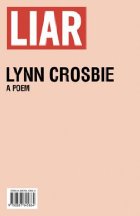
I´ve been thinking about this kind of thing since reading Lynn Crosbie´s Liar, (Anansi, 2006). Though not about being nine or bees in jars—it´s about adult love betrayed—the same principle applies. We remember what we need to, and if we´re lucky we figure out a way to do something with it that allows us to move on.

In this case, Crosbie has chosen to write a poem that reveals love in all its dimensions, including the kind that lingers as something important yet also suddenly somewhat irrelevant

It would surprise you, how seldom I think of you…not hating you as much as what you have done.\ You could be anyone.

Never whiny or even slightly cruel, her prose shows us the world she lived in through the prism, the remnants, of perception; a looking ´back´ at love once it´s  morphed into something clearer, more honest. It´s all memory and feeling; truth and lies in various forms.

It is unpleasant to see people change. It feels contagious, it feels as if it is their own fault.

I am tired of watching women who, in their terror of being left, are changed also.

Large women, as insistent as thunder, made small, their allure recast as repulsion, all of them looking for dust in the corners, freezing sauces, probing themselves with sharp instruments.

Crosbie shares what it´s like to be both betrayed by someone and by oneself. The things we tell ourselves in order to keep what destroys us. We protect the liars by lying to ourselves.

The piece is focussed throughout, without slipping into notes of revenge,  imposing hurt, or issuing blame. Even references to sexual intimacy are muted as if to respect the former lover´s present life.

Clearly, this is not about The Other, it’s about Self. A much harsher truth to face.

Deception itself is pleasing, because it alters you, entirely.\ Then things resume as they were.

Despite knowing her relationship (with the unnamed beau of several years) is crashing, and even though she has, by now, forgotten him ‘in theory’…. It is our life I cannot cross over, as though we sunk our savings into a business that leaked money, that bled us dry.

Heaving, you  began to speak and  blocked out my past.

And then, the end, only realized by his new  beginning and…the tiny anchor of her diamond.

The moment we let someone into our lives, they come equipped with enough ammunition to destroy us,\ though the terms of destruction are unclear.

I had let him see too much. In doing so, he  became disgusting to me.

I especially enjoyed her memories of trying to integrate with him, his family…

I was following your mother around the kitchen, trying to help. Wiping the counter, re-folding the gingham tea towels.\ Have you tried this new Swiffer thing, she asked, and the intimacy of the question disarmed me.\ I was sorting through five different answers when she said, With that place it´s not likely to make a difference.

She, the narrator, remembers watching him as he slept…. watched your eyes drift like fish under your lids.

And her own insanity, her own culpability in things (and I adore her for this, especially)…

What are you doing in there, I would ask. This sort of recollection makes me understand your departure  better.

Maybe the saddest line in the book is when she refers to his marriage to someone else, and hers with him that had no ceremony, but had other markers…

…every day you rushed home to me, without stopping.

Liar is about different forms of betrayal, a love poem and a lesson.

Ultimately, perhaps, it´s a gift to self—and quite possibly the best form of revenge.

(~Read under a large umbrella, next to a small vineyard in the foothills of the Andes.)

this is not a review: help me, jacques cousteau, by gil adamson

Have just read Gil Adamson’s Help Me, Jacques Cousteau, a collection of linked stories narrated by Hazel, an adult looking back on two decades of her life from babyhood to twenty-ish (all seen in present tense, and from a weirdly almost omniscient POV, which, at times threw me off and other times had me convinced there was no other way to go).

Hazel’s family is made up entirely of eccentrics and not one of them knows it. Her father rewires the house whenever he’s nervous, an uncle collects large white animals, which he then takes for rides in his boat, while her grandfather keeps a dead dog in the back seat until he begins to smell it (which, unfortunately, is much later than everyone else does).

Through the ‘younger’ stories, Hazel merely observes and reports (perhaps too much; I would have welcomed more of her), but this, I think, is all part of the apparent ‘nothingness’ of her life as she sees it and, therefore, she’s not really a part of it. There’s a kind of unspecified disillusionment with this family that pays little attention to one another, so immersed are they in their own strange behaviours and coping mechanisms.

Despite it all, there is a strong underlying sense of love, as if everyone is doing the best they can. “My mother and I share a fondness for watching insects from a safe distance.” How they turn out is anyone’s guess.

Adamson’s poetic touches are throughout. A girl has “a mouth like a poppy.”

Clouds “resemble the sand in shallow water.”

Cousins pour out of a car “like fish from a bucket.”

In the very last stories, Hazel the character suddenly comes alive and we’re privy to her feelings and thoughts rather than just what’s going on around her. But of course it’s what’s gone on around her all her life that has shaped her.

The epigraph—”Heaven is a place where nothing ever happens”— ends up having two meanings: in one way, nothing has happened and that’s been the problem; on the other hand, how can a grandfather carting around a dead dog in his car be seen as ‘nothing’…?