grownups from the inside and the outside


A boy draws a picture of a boa constrictor digesting an elephant (from the outside). He proudly displays it to the adults, but they see only a hat.  
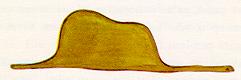
So he draws another picture of a boa constrictor digesting an elephant. This time from the inside.
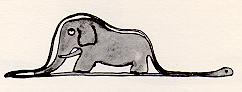
The adults advise him to give up drawing boa constrictors of any kind and to devote himself to geography, history, arithmetic and grammar instead.

“Thus it was that I gave up a magnificent career as a painter at the age of six.”

The boy becomes a pilot and throughout his career spends much time with grownups.

“I have seen them at very close quarters which I’m afraid has not greatly enhanced my opinion of them. Whenever I met one who seemed reasonably clear-sighted to me, I showed them my drawing No 1, which I had kept, as an experiment. I wanted to find out whether he or she was truly understanding. But the answer was always: ‘It is a hat.’ So I gave up mentioning boa constrictors or primeval forests or stars. I would bring myself down to his or her level and talk about bridge, golf, politics and neckties. And the grown-ups would be very pleased to have met such a sensible person.”
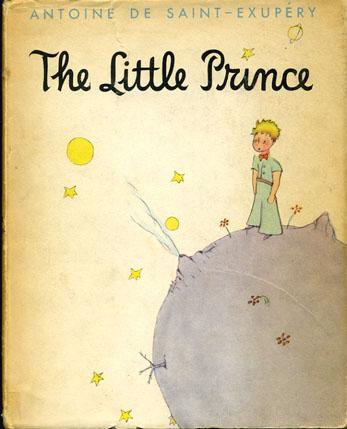
So begins Antoine de St.-Expury’s, 1943 classic, The Little Prince, about a pilot who crashes his plane in the desert and meets a prince who tells him he has travelled from another planet. The prince recounts his adventures, the strange people he met on his journey, the flower he loves and the baobab trees that threaten it.

The story, read as a children’s book is simple.

The real joy, however, is to read it as an adult book, taking pleasure in the satire, the layers of meaning in every sentence, and the revelations about the human condition, all best appreciated through the prism of age.

Children will miss the point entirely.

And that, of course, is the point.

Adults and children see the world differently. But who can say which is the ‘true’ perspective? Bottom line: we have much to learn from each other.

This is the kind of book that ought to be read regularly, and at different ages, as a reminder not to take ourselves too seriously and to hang on to some of that magical childlike wisdom we all once had, ensuring that we can at least entertain the possibility that what appears in every way to be a hat, may very well be a boa constrictor—from the outside.

c’est us, n’est pas?

 
Heremenegilde Chiasson’s marvellous book,
Beatitudes, begins like this:

“those who raise their heads in astonishment at the raucous cry of birds,

those who await the end of twilight,

those who ceaselessly leaf through catalogues and order nothing from life,”

—and continues, in  incomplete single sentences of a few, or few hundred, words, leading us on and on to an (incomplete) image of ourselves: funny, sad, beautiful, unsettling, always true.

“those who are euphoric about the mystery of snow crystals, delicately carrying home their unique fragility on woollen mittens,”

“those who scribble graffiti on their bodies with lead pencils, engraving their story in the secret depths of their skin, scratching themselves until they bleed, making a lie of pen and paper,”

“those who pull off their gloves with their teeth,”

118 pages of ‘those’…

Who would have thought the universe was big enough, that there were so many nuances…needs…differences…samenesses…things that unite us, tell us who we think we are, who we don’t want to become, who we may already be.

This book is a celebration of what it is to be human, a meditation, and a mirror.

this is not a review: at a loss for words, by diane schoemperlen

I happily discovered Diane Schoemperlen’s At a Loss for Words after entering “Writers’ Block” in the subject line of a library search. It is indeed about a blocked writer, but expression through words is not what’s blocked.

Billed (unfortunately) as a post-romantic comedy: narrator meets a former lover after thirty years and they begin a relationship, much of which takes place via email because they live in separate cities.

It’s that simple. And that not simple.

Schoemperlen’s use of lists, daily horoscopes, pointers from self-help guides, actually become part of the narrative, moving the story along at the same time they move (or not) the narrator’s life along, but it’s not really the narrator’s story; it’s the reader’s story. Once we begin to realize the truth of what’s being experienced and the uninhibited hopefulness by which that truth is being conveyed we, the reader, can no longer just observe—we begin to recognize something about it as our own.  And the recognition makes us squirm.

I doubt that it would matter whether the reader is a man or woman, how young or old, straight or not, or what background or part of the world they came from because what Schoemperlen has done is more than tell a story about relationships—she’s deconstructed the obsession of neediness.

The book has less to do with relationships with others, than the way we see ourselves—romance is merely the vehicle Schoemperlen has chosen to convey a much broader truth.

_____________________________________

—Purchase At a Loss for Words online at Blue Heron Books.