this is not a review: slow curve out, by maureen scott harris

 
I’ve read Maureen Scott Harris’ beautiful Slow Curve Out  twice so far—once in a skimming summertime kind of way on the patio where I am prone to being distracted by butterflies and motes of dust and pitchers of watermelon juice. And the second time on a Sunday morning in bed (fortunately motes of dust are so common in my house they are not distracting).

The book, a collection of poems, is divided into three sections.

Well, five, actually, if you consider the opening poem, ‘Walking in Saskatchewan with Rilke’ in which we are being prepared for what’s ahead, i.e. walking in the world with Maureen Scott Harris.

                                                                           —the way
things surge into being, here, claim eyes, claim
mind, claim my very heart, beating and beating,
bird in the breast, this longing for sound—

And the closing piece, ‘Homecoming’, that ends with warning and a powerful two word punch.

In between is Part One: ‘Back Up, Begin Again’, a paean to nature. The rhythm of recurring themes… birds, trees, light, wind, earth, the colour white, flight, dreams, walking and silence, begin in such a way that you don’t even notice the tapestry that’s being woven until you’re right there in the middle of that deeply textured landscape.

If I can get it right
my arms will sprout feathers, and I’ll bring home
the taste of poplars surprised by pale sun.

I read Part Two, ‘The Ten Thousand Things’, as a meditation on sound. The birds,untitled more visual in the earlier section, are now singing, calling, crying; voices enter, cacophonous, raucous, there is holler, hum and mutter; subtle references to songs; bleat and mourn; ghosts are a choir, slippers tap; yodelling fiddle, guitar, the thump of thunder, a siren, Rain and longing—what a racket on the roof!  Even the foliage makes a sound and sound canopies the street.

One day slides into another, sunshine
dissolving clouds which reassemble
overnight, and a whole week has drifted
past in birdsong and silences. Like
the tide going out, then coming in again.

By now we’re immersed in place. We know what’s around us, but do we know our place in  this place?

In Part Three — ‘Another Animal’ – the tapestry is plenty rich, but there’s an additional element: us. Or at least the focus is on us. How we change things, how we  change, how we interpret our  world vs the  world. Some hard truths are revealed and they’re not always the prettiest, but may be the most important.

Remember when we weren’t our own
gods but lived by the grace of animals?

I love this book for its energy, the way it takes me by the hand and, like the narrator in the opening poem, points out the sound, the silence, the colours, the textures and movement of the world around us.

It asks us to consider what it is we see, versus what we want to see.

And this thing, this motion I thought to show you,
tell you, is for the moment only
a smear across the view obstructing and obstructing
like the sheep dog that turns the sheep
in a slow curve out toward the stony pasture, their little hoofed
feet lifting and descending on the rocky path, slippery
in the aftermath of deep snow, a stutter,
like this  this    this    thing

Slow Curve Out, available online at Blue Heron Books. Support indies!


this is not a review: ‘and the birds rained down’, by jocelyne saucier


I haven’t the foggiest as to why fat books are so popular. Is it because there’s more to wade around in, that the reading will last longer? A double cheeseburger vs a cup of soup?

Yes, but,  I say.

Skinny books, being pared down to their sweet essence, have a tendency to stay with you long after the yummy saga of a fat book has slid into the oblivion of a happy gamorph. (After which you’re hit with the craving for another fat book.) A skinny book, on the other hand, often begs to be read again. And the re-reading gets sweeter (and more nourishing) every time.

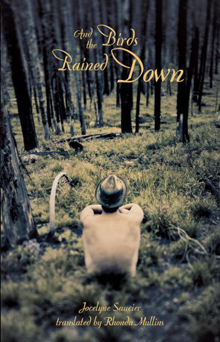
And the Birds Rained Down is a skinny book of the most delicious kind, one of five Canada Reads selections, for which I am truly grateful.andthebirdsraineddown-220

I’ll be honest though. It took me few beats to relax into it and I wondered why this was… because I liked the story. Then it occurred to me: I was reading at the wrong speed; I was looking for something rather than letting the something contained within the pages find  me.

Also, the ‘something contained’ wasn’t what I thought. So I’d never have found it by looking.

For instance, what it’s NOT about is a few feisty and elderly men who have chosen to live in the woods where they rely on their wits and each other and occasional supplies from town courtesy of a couple of pot growers. Neither is it about the two women who arrive, one a photographer, working on a project about survivors of an infamous fire; the other, a former inmate of a lunatic asylum.

Neither is it about a small Northern Ontario community that was devastated by fire, or the way the fire’s effect has touched various unconnected people in the decades since.

It’s not about dogs named Drink and Chummey, or a cat named Monseigneur.

And it’s certainly not about the worry of death, though it’s mentioned a lot and figures prominently. And, well, there is  strychnine.

It is… however, about dignity. How we see people, how we expect or allow them to live. How we can choose to help or hinder or judge. It’s about the kind of communities we want and the kind we build. (A roadside hotel—a rather old and often overlooked shell of a place with an interesting past that still serves a real purpose to those with an appreciation for authenticity—offers a powerful metaphor for aging.)

“I like places that have given up any pretence of stylishness, any affectation, and that cling to an idea waiting for time to prove them right: prosperity, the railroad, old friends… I’m not sure what they’re waiting for. The region has a number of these sorts of places that stand the test of time as they revel in their own dilapidated solitude.”

It’s about respect for generations that have lived lives we can’t possibly understand; it’s about breaking down age barriers.

“The eyes are what are most important in old people. The flesh is hanging, sagging, gathered in wrinkled knots around the mouth, eyes, nose and ears. The face is ravaged, illegible. You can’t know anything about an old person unless you look into their eyes—their eyes tell the story of their lives.”

It’s about friendship and the surprising places it’s found. In one case, in an asylum where one inmate (who had her own baby taken from her) helped another mourn the loss of her child.

“I rocked her baby. That’s how we became friends. I asked if I could rock her baby. She passed him to me very carefully and I took him just as carefully, and I rocked the baby too, for a long time, singing songs to him. And that’s how, taking turns rocking a baby that didn’t exist, we figured out how not to be where we were.”

It is about love and sex in old age and the latter not working quite as it used to. Never mind. There are other ways. Saucier doesn’t shy away from this subject but treats it with exactly the right amount of ‘natural’. We might ask ourselves why this isn’t talked about more… is it just so terribly shocking to know that the elderly feel passion?

It’s about creativity.

The way these men have built their lives, and an unknown stash of paintings in which more is revealed about the artist than ever could be shared in friendship.

And, yes, it’s about death. Not in any maudlin or sentimental way but in the way it’s connected to both life and independence and the choices we make. Not only how we live, but how we die…

“Too many deaths,… Too many bodies, too much black coiled at the bottom of his paintings, never any light, or, if there is any, it’s to illuminate blacked bodies, cries of horror, hands out stretched where death surprised them. No one can live with that deep within. Ted tried to free himself from it, to hurl all of that horror onto the canvas. Maybe he succeeded in a sense. His final painting, the one on his easel, had light—very little a faint glimmer, but enough to created a space from which he could slip away gently. That’s what I hope for him, it’s what I hope for all of us. To slip away gently.”

It’s a book that celebrates the realities of life in its not always perfect perfection. And it does so quite perfectly.

All that in 155 pages.

And the Birds Rained Down, available online at Blue Heron Books.

Cr2015-375-banner


this is not a review: ‘plainwater’ by anne carson


While each of my Not A Review pieces are distinctly not reviews to varying degrees… this one is REALLY not   a review. I haven’t even finished the book. Which is part of this particular Not a Review’s angle.

It seems I have a sort of love/huh?? affair with Anne Carson’s work, of which  I’m only beginning to know. I’m drawn to it, get angry around it, leave it, then I come back and make tea and snuggle up with it again, blissfully content in my confusion until it all becomes too much. And the cycle continues. The addictive element appears to be the occasional bouts of holycrapletmereadthatpartagain! that come over me. In a good way, I mean. (Because there are plenty of moments when I have almost exactly the same reaction in a bad way, as in holycrapwhatthe#@*#isshesayinghere??? )

Is it just me or is there a certain type of poetry that feels like it comes with a fence and a Keep Out sign? Stupidly you stand there thinking it can’t mean you and so you holler let me in!!  Leaping up and down, you try to see over it, try for even the tiniest glimpse but you’re sweating and your feet hurt and you start to wonder: is it supposed to be this complicated?  Is maybe the fence greased?? So it’s in all seriousness when I ask: is there an actual category of poetry designed to make it seem more pleasant to gnaw off your own hand than to turn one more page?

Not that I’m saying I feel this way about Anne Carson. No no no. True, there is the huh?  part of things, but there is also love. (I’m here aren’t I?)

And what I’m happily not reviewing today is Plainwater, published in 2000, and whose entire first section (called ‘Mimnermos: The Brainsex Paintings’)
I skipped because of things like this… “Yes lovely one it’s today forever now what’s that shadow/ unzipping/ your every childfingered wherefrom?

I just wasn’t in the mood for all the leaping.

9780375708428What I did instead was zip ahead to the last section, ‘The Anthropology of Water’, which consists of various pieces, essays… to which I’ve been happily returning each morning for the past few days, champing at the bit to pick up where I left off in ‘Kinds of Water: an essay on the Road to Compostela’, wherein Carson and her travelling companion, identified only as My Cid, walk the Camino, musing on what it is to be a pilgrim, to thirst, to question, to live with faith, or not. To live among people. Or not.

“You come to understand travel because of conversations, not vice versa.”

It’s said, she tells us, that a traveller becomes addicted to the horizon. She tells us that she is a pilgrim, not a novelist, “and the only story I have to tell is the road itself.”  She compares this with telling a story through a character, the difference being that a character moves. “He changes according to the company he keeps…”

I’ve read other writing from the Camino. This is different. Less about the experience, more about the questions posed by the experience.

“… it is an endeavour as old as civilization to set out on a road that is supposed to take you to the very end of things… What do you find there?… Who would you be if you knew the answer?”

She’s writing about the Camino. Or is she? The layers are uncountable.

I was sad when the road ended. But then, it doesn’t really. That’s kind of the point.

So, I approached the fence again. I dipped back into that first section and I’m glad I did but thank god for google because I didn’t know Mimnermos was a Greek elegiac poet from 600 something BC and while I normally wouldn’t care, Carson makes me care.

And all the sections in between… The one that contains miniature essays on orchids and rain and Sylvia Plath. On walking backwards and Ovid. And the section that is a long poem, which seems impossible, and the one after that—poems on various kinds of towns.

I care.

Could it be that we come to understand because of caring, not vice versa?

After all, the writer’s job, the poet’s job, is not to clarify, but simply to make us care.

The copy I’m reading is from the library. This won’t do. Where once I thought I might not even read the whole book, it now seems I’ll be calling my bookseller and ordering my own Plainwater. To love and to huh?  my way through as the moods take me. But then this is the way of love and huh?…

Love always wins.

Plainwater is available on-line at Blue Heron Books. Support indies!


this is not a review: ‘what we see when we read’, by peter mendelsund

That I can’t decide if I like this book best for its visuals or its text is, I think, a big part of the point. After all, the author is associate art director at Alfred A. Knopf, whose designs (according to his bio) have been described… “as being the most instantly recognizable and iconic book covers in contemporary fiction.”

It makes sense then that What We See When We Read  comes across as a crafted, multi-sensory experience.What+We+See+When+We+Read

The subject matter is ‘narrative’… both from a reading and a having-been-written perspective—how narrative is displayed, how it enters our eyes and our minds, what stays with us and why; what we look for, what we find, what we can expect from the writer, and what’s down to the reader.

The paragraphs are bite-sized and pages often contain acres of white space (or, alternatively, are almost entirely black), with only a few bullet points or a single word.

The style is ‘essay-in-fragments mixed with graphics mixed with illustrations mixed with photos, mixed with something like the memoir of a passionate reader’. (May I add that pages have a wonderful satiny feel, serving as a reminder that the physical experience is part of reading.)

In about the middle of the book (pp. 152/53) all is black, and in tiny white print, in an arch from bottom left to bottom right, this quote from Italo Calvino’s Invisible Cites:

“Marco Polo describes a bridge, stone by stone. ‘But which is the stone that supports the bridge?’ Kublai Kahn asks. ‘The bridge is not supported by one stone or another,’ Marco Polo answers, ‘but by the line of the arch that they form.’”

Mendelsund’s use of a visual arch, with reference to an actual arch, to show the theory of narrative arc… is typical of how this book is constructed: he not only explains how we read and what we see while we do it, but he has us walking through the experience at the same time. An obvious move of course, but it takes a minute to realize exactly how it all works and to just relax with it.

In places the book feels almost chatty, as when the author shares his distaste for elaborate descriptions, which he sees as nothing more than ‘misdirection’… “They seem to tell us something specific and meaningful (about a character, a setting, the world itself), but perhaps such description delights in inverse proportion to what it reveals.”

While both aspects of What We See When We Read are equal and both can be seen as simplistic or as layered as you like, I found myself becoming frustrated with the choice, as if I was being asked to read/experience two different books. This may be part of the overall plan to illustrate the reading/visual experience but I find it a tad too much of a muchness, a few too many graphics and ‘design’ elements that begin to have the opposite effect of what they’re intended for—they become less illustrative and more overload of the same multi-senses (which then begin to tune out simultaneously). For that reason best consumed, perhaps, by dipping into now and again, enjoying bits at a time instead of reading straight through.

Bottom line: despite its pleasures, at 417 pages, it feels a little over-done.

That aside, I can see this as a good book club choice. In which case, some knowledge of Anna Karenina and a few other classics would be helpful (various narrative devices are highlighted with examples from a number of books you thought you’d read but actually never have). Helpful but not necessary.

In fact, a book club might be the ideal way to savour it. Whereas the pleasure of some books is not enhanced through sharing, especially with people who see it very differently (read: one person’s exhileration is another person’s sleeping pill), What We See When We Read purports to be neither; it simply wants to be seen and discussed by as many and varying perspectives as possible. And if not everyone reads the whole thing, it matters not one whit. The whole thing can still be discussed, and enjoyment multiplied.

Because, you see, it’s not exactly a book, it’s merely about them. And therefore about us too.

Purchase What We See When We Read, online, from Blue Heron Books.

this is not a review: one hour in paris, by karyn l. freedman


Academic approaches to writing are never my favourite way to tell a story, but in the case of Karyn L. Freedman, Professor of Philosophy at the University of Guelph, it works. Indeed, she may be exactly the right person to have written this-book-that-needed-to-be-written. While it surely must have been tempting to veer too much in one direction or the other, in One Hour in Paris. Freedman has managed, for the most part, to balance facts and eye-opening statistics with what feels like heart on her sleeve honesty about the extreme emotions following a brutal event.

The book is about rape.

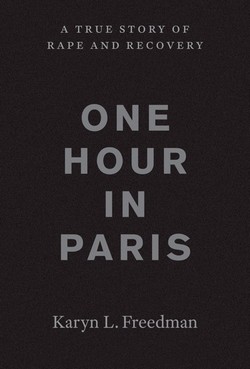
OneHourInParisCoverFinalBut that’s merely the grit, the sand in the shell that gets things going. The pearl that emerges is a story about trauma and how it can be experienced in as many ways as there are people experiencing it. Freedman’s analytical take on the subject works insofar as presenting a case for PTSD through her rape experience and showing us how society’s focus on the rape, or indeed any ‘incident of violence’, instead of the resulting trauma, diminishes the understanding of violence, undermines the victim and slows or even prevents healing.

In other words, we don’t tend to take these things seriously enough. Especially the lingering and messy aftermath of trauma. We give it an acronym, attach it vaguely to returning soldiers or first responders in newsworthy events. We sincerely hope they ‘get over it’, ‘get better’. But acronyms and hope don’t help. Trauma is hard enough to understand for those who are living with its effects without having to deal with the assumptions and judgements of those who have not experienced it, or who may have experienced it differently.

I’m not sure I would have been able to write that last paragraph before reading Freedman’s book. The way she explains the clinical aspects of trauma has given me a deeper and more practical understanding, not a more emotional one, and for that I’m grateful.

Freedman was raped in Paris on August 1st, 1990. The date is repeated throughout the book, to a degree that becomes slightly irritating, until one realizes that’s the point. She can no longer approach August 1st without remembering what happened. The date is embedded in her memory. She doesn’t need reminding. But reminders are there. Every year. And so by virtue of this repetition she shares with us the ‘irritation’ of not being able to forget something she can’t bear to think about.

She writes about the rape, what happened after, emotionally, professionally, how her father was instrumental in helping her case in ways that many other victims would never experience. For instance, the French government flew her back to Paris (from Winnipeg) at their expense in order to proceed with the case… a case which ultimately saw her compensated financially. While the benefit of such privilege tends to suggest that her trauma has been ‘resolved’, what it actually does is ask the question: what about the women that are raped and/or abused every day, citizens and visitors alike, for whom nothing is ever done, many of whom don’t even know who to tell or how to be heard or believed, much less be compensated and see the perpetrator sent to prison. It’s easy to start thinking that for women who receive this kind of privilege, it’s done. But Freedman is quick to point out that it’s not done. She knows she’s privileged, that this is not how it is for everyone. But all that is almost beside the point. The money, while substantial, is a token, the incarceration is merely fair. None of it is closure.

What’s needed is understanding, by society, a change in how we discuss issues of sexual violence against women, and how we understand the very real effects of trauma on the body, mind and spirit.

“… the sense of responsibility held by many rape survivors is at least partly driven by a dominant worldview regarding personal safety and harm. Although this picture is slowly changing, historically, at least in the West, girls have been taught from a young age that the world is basically a safe place and that so long as you are sufficiently careful and intelligent, you can protect yourself from any serious harm.

“Underscoring this narrative is the fact that in our entertainment-saturated media culture, the everday-ness of sexual violence against women is overlooked in favour of sensationalized stories of extreme violence. And because rape is typically experienced in private… the clear evidence of its pervasiveness is obscured from our collective vision….

“So how does the rape survivor reconcile this dominant worldview with what has happened to her? After all, it cannot be true both that the world is a safe place and that you were raped, unless, of course, the rape was your fault.” 
 
**

Any quibbles with the book are insignificant to the larger message.

__________________________________________

One Hour in Paris is available online at Blue Heron Books. Support indies!


this is not a review: are you ready to be lucky?, by rosemary nixon

 
I began reading this book with the idea that it was a collection of short stories. And so, on finishing the first one, the title of which happens to be ‘Are You Ready to Be Lucky?’ I was sad. It was such a merry romp and I liked the characters so much and now they were gone. This was wrong, I thought. Just wrong. And terribly, terribly sad.Are-You-Ready-to-Be-Lucky-Cover

Then I began reading the next story. And I recognized the people. Stella and Roslyn and stupid Duncan the English twit, a personal favourite. (Duncan Bloxham; I mean is that the perfect name?) Good lord, I thought. Good lord…. Could it be??  I flipped forward a few titles…. and, yes, Roslyn, still there! Linked stories!
Oh wot a pleasant surprise.

Trauma behind me, I read. And read and read and read.

I drank peppermint tea with fresh leaves from the garden and put my feet up on the patio table. And hours passed and then the weekend, and clouds scudded by and the tea turned to wine. And I read til I finished this absolute delight of a book.

I will tell you nothing about it because sometimes I’m like that.

I will, however, tell you this: the chances are good you’ll enjoy this merry romp.

“The girl’s husband, thirty-five years her senior, cracks his sixth beer. He too is reading the Sunday Times. But only the pages that say what he wants to hear. The girl tries to remember how this man came to be her husband. How she became the third wife of a man only months after he divorced his second. She makes a disorganized list. It had to do with expensive dinners, a second-hand clothing store in Salmon Arm, with rutting elk, Canadian immigration, telephone calls across crackling wires, tears (his), frightening dreams of attacking ostriches (hers), a domineering ex-wife in England (his first), a suet recipe (bird pudding) using Crisco instead of lard. She adds the man’s talk of foreign places… How when he stood naked he reminded her of the pet turtle she had as a child, of whom she was very fond.”
Are you Ready to be Lucky?  (Freehand Books, 2013)


this is not a review: ‘the m word’, edited by kerry clare

 
Warning: today’s ‘Not a Review’ includes internal organs. But not until nearly the very end.

I’m not normally drawn to mothering books but I like Kerry Clare’s work, so it was impossible not to be drawn to her anthology, The M Word: Conversations about Motherhood. I knew I’d be in the hands of good taste and good writing, even if, as a Childless Woman, I couldn’t actually relate. Well, what happened was this: I found myself not only enjoying the read, but relating. In a major way. Because, as it turns out, the essays are both about mothering and not mothering, about the exultant and the reluctant, the non-mothers by choice, the stepmothers by circumstance, women who will do anything to be come a mother and those who will do anything to not. And in every scenario, the difficulties, joys, fears, the way life is changed for the better and sometimes for the not entirely better. There are celebrations, regrets, and such honesty that it’s really quite impossible not to relate.

In other words, there’s something for everyone. Even me. Because if you’re a woman, you fall into some category where motherhood is concerned. This, whether you like it or not. You have the parts. And if you don’t, that may be the problem, or the celebration, depending on your outlook, your personal goals.

And that it is so personal is what I most enjoyed about the book. The writing, yes, but I wasn’t merely reading, you see, I was being drawn into this conversation, being reminded that yes, I also have a story, some history on this subject. And let’s hear it, the conversation seemed to say, because as you can see, no woman is excluded from this club, for here is a truth: if you’re a woman it’s pretty hard not to have a few thoughts on the motherhood thing.m-word-cover
The book is arranged alphabetically, which happens to fit nicely with its ‘lettery’ title, but more importantly it allows for accidental juxtapositions rather than any kind of predictable narrative.
I read it backwards.

Michele Landsberg in the Afterword, on the surprising role of grandmother: “Even though I haven’t had to consider the effect of a child on my lifestyle, the negative or the positive, less is said about that—guilt? It’s interest/improving to help understand friends who’ve been through it because still decades later they talk about it.”

And on over-thinking, a beautifully rendered piece by Julia Zarankin. “If I have a baby in March, when should my husband begin taking driving lessons?”

Sara Yi-Mei Tsian considers the implications on her work: “Motherhood is a study in conflicts, which is why it attracts me as a writer.” and this… I just love this: “…there is a certain nugget of truth… that all writers would like to avoid. We cannot give voice to a character based on someone real without silencing, at least in part, the person who inspired us.”

Patricia Storms presents a graphic essay about the joy of “working for” kids and living without them. And how that’s not something a lot of people seem to understand.

Kerry Ryan on ambivalence about motherhood: “Do you have to have a maternal instinct from the get-go, or does it kick in with your breast milk? And if not, can you wing it, or is your child destined to become a serial killer?”

Heidi Reimer begins with ambivalence, then an adopted daughter, then gets to the “bone of my bone”, “the flesh of my fleshness” when she gives birth and experiences a different kind of love. “I had made a person! I would never do or become anything more important than this.” (Actually, that statement made me wonder about generations past. Did they feel this rush of omnipotence? Now there’s a conversation.)

To her credit, Reimer is painfully honest when writing about these differences.

“I am in love with Aphra, a feeling as effortless and unstoppable as breathing. My relationship with Maia is more akin to an arranged marriage: I made a choice I believed was right, and through that choice, over time a bond solid and close and beautiful as grown. A connection inextricable. If I am sometimes aware that this love was a choice, if that choice is sometimes taxed, so, too, are my relationships with almost everyone I love. Of the several people integral to my existence, Aphra is the only one who came from my body.”

On single motherhood: Fiona Tinwei Lam writes, “Not wanting to be married didn’t mean I didn’t want to have a child.”

And from Ariel Gordon, the need to protect her writing time and space and the choice to have only one child. “When it came right down to it I didn’t think I could be a working writer with more than one child. And I was unwilling to take a break when my writing and my writing life—the time I spent in the company of other writers at readings and conferences and retreats—were finally starting to gel.”

I admire her conviction, the wisdom to know her limits insofar as achieving her goals and how she sees there is more to give her child than a brother or sister to grow up with… but it’s interesting that the ‘maternal’ concern is still there.  “And so, even though the girl won’t have siblings to lean on… I’m hoping that she can lean on the texts I’ve left behind.”

Nicole Dixon chose to not have kids for a variety of reasons, not the least of which is an over-populated planet and consumerism run amok. More diapers and toys don’t help the situation. She justifies her position with a desire to allow herself to be a good citizen in so many other ways. that parents may not always put first.

“People often think that saying no to having kids means saying no to life. My choice not to have kids, however, is a choice made from love. I’ve realized that the legacy I want to leave on the earth after I’m gone is as small a mark, as tiny a footprint, as possible… My choice not to have kids does not close me off from my community or my planet. Instead, it allows me to nurture my own life and to mother everyone’s mother, Earth.”

Most are young or youngish mothers. Myrl Coulter is perhaps the single entry from a very different generation, and this is nice to see. Her piece on unwed mothers in the 60’s is especially moving. She was eighteen and in love with a seemingly nice guy. But marriage didn’t make sense. She became a ‘girl in trouble’ and was whisked away to one of the maternity homes that existed from the 1940’s through the 80’s.

“To call these places maternity homes is highly ironic: maternity homes were not homes nor did they function to promote maternity. They were institutions to house and hide those deemed maternally inappropriate. Also known as homes for unwed mothers, they were busy places in those days. Winnipeg, a small city, had three.”

These girls were not just thought to have made a bad decision one night in the rumble seat, but their whole character was judged and they were vilified. They were also thought to be without maternal instincts yet, curiously, they were denied contact with the babies they delivered, which only proves that everyone, even judgmental pricks, realizes the connection between mother and child.

**

So yes. I read, I enjoyed, I related, I remembered, and the remembering led me to a few other words. The N-D word for instance, as in Near-Death, because it seems fallopian tubes are not a welcoming environment for growing children and near death follows for the host but, before that, after much mysterious pain, internal bleeding, a severe drop in blood pressure and eventually, in the Emergency Department through an increasing haze as one slowly drifts away, the words: you’re pregnant. The only time I would ever hear that sentence where the ‘you’ was me. I remember it was oddly euphoric, even as I lay nearly dying.

The S word is also in my repertoire. Stepmother. I keep forgetting. Easy enough to do in a society that likes its consumers clearly defined as demographics and that doesn’t apologize for the twisted version of things that results when we slap a narrow label on something as big as ‘mother’.

The bottom line is this: The M-Word does what the best conversations do… it shares the stories of others while reminding you of your own.

**

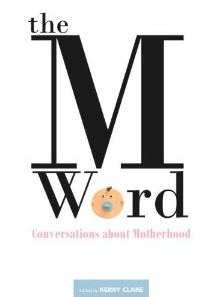
Small note: If forced to offer a quibble it would only be with the choice of colours for the cover. In an effort to leave the pink and blue behind as we move forward, I’d have preferred anything but.
this is not a review: pondlife by al alvarez


I’ve been talking a lot about this book ever since having read it in less than 24 hours, unheard of fast for me. Mind you, it’s written as diary entries so it’s hardly heavy going. And, just to be clear, it’s not the speed at which I read Pondlife  that I’ve been talking about, although I mention it every time, but the quirky wonderfulness of its pages.9781408841006

As I said, diary entries. Each noting the temperature of the Hampstead Heath ponds where the author has been swimming daily, and year round, for something like sixty years. Seventy by the time we get to the end of the book (which goes from 2003 to 2011). This is referred to as ‘cold water swimming’… also madness, but the former is the official term. Have I mentioned that the ponds are outside?

I mean, they’re ponds. Ducks and everything. (Also magpies, grebes, moorhens, thrush, coots, swifts, hawks, heron, terns and more; he watches them as he backstrokes his return to shore and his descriptions of them are some of the loveliest bits of the book.)

“The terns were fishing for breakfast: soar, pause, then the sudden plunge. They seem to fall apart as they hit the water and, for a moment, they’re gone. Then they surge out and beat upwards again, scattering drops of light. If angels existed they would look like terns…”

The water temperatures in January and February go down to  30′ F.  This does not deter the cold water aficionados (of which, surprisingly, there are more than just Alvarez)… they happily report that on the coldest days the water is actually warmer than the air, as if making the obvious case for slipping into your Speedo and joining them for a dip.

Thing is they don’t ‘dip’. Some wear wetsuits (Alvarez is a purest; he goes in bare nekkid but for the swim trunks) but all swim, that is, stay in for many, many minutes. Alvarez spends as close to an hour in the water as he can… the time does shorten in the coldest temps.

At first I read this as braggadocio. It felt like the swimmers were competing, that the reason they never miss a day, or rarely, is because they don’t want to be seen by the other kids as wimps. After all, you don’t swim year round outdoors unless you pride yourself on your heartiness. And there are those that surely do it from some exterior motivation like that, but I don’t think Alvarez is one of them or, if he did, he changed his focus somewhere along the line.

He has a bum ankle, a source of much annoyance to him. Walking becomes increasingly difficult over the eight year span of the ‘diary’ and the only time he doesn’t hurt is when he’s swimming. He refers often to the way the cold water rejuvenates, makes him feel ‘reborn’ and how it feels to emerge from it.

“…you are… naked… feeling the weather on your skin… it strips away the comforts and protections that Shakespeare called ‘additions’.”

He is also having a difficult time accepting the changes that come with age. An ex-athlete and serious rock climber, he hates having to slow down, give things up. The swimming is the last of his athletic pursuits, and while that’s the book’s overall theme, and perhaps his original idea for keeping notes, as the years pass, he changes in ways he couldn’t have expected and seems almost reluctant to share those bits, as if the book was becoming something he hadn’t planned. Of course these are the best moments, witnessing the study of his own reluctance.

“I like the water cold. It reminds me I’m still alive.”

This could be about swimming, about his passion for it, his solace from it or addiction to it (because surely it’s that), but it turns out it’s about something else entirely, something that, I’m pretty sure, comes to him as a surprise in the writing. If you ask me, it’s about the way cold water makes some things disappear while bringing others into sharp focus. It’s a way of seeing and feeling the world. Some people run. Some meditate.

He admits that he’s keeping a journal with the idea of it becoming a book, although doesn’t ever delve deeply into his own psyche so I sometimes wondered what it was that he wanted to record (I would have liked a little more reflection, actually; and I would have LOVED knowing about the psyching up that’s necessary to dive into water at 30 F). Still, something in the very fact that he’s sharing these private moments suggests he’s exposing the very essence of who he is. Ultimately, this intimacy without personal details, is what I liked best, leaving interpretation of pain and pleasure up to the reader. What I liked least was his curmudgeonly way of seeing past his aging body… but that may be an unfair judgement; he complains but he also hobbles—after recovering from a stroke, and still with a painful ankle—through snow and across ice to swim alone in frigid water.

The structure of the book should be mentioned for its magical qualities—the repeated reports of weather, birds, flora, fauna, water temps, ankle soreness—sounds dull but is just the thing that kept me reading. I’ll admit that early on when, for the umpteenth time he began with weather, I considered giving up, or at least skimming the rest of the book, but then I’d decide to read just one more entry and then the next. That’s the magical part. Bordering on the hypnotic, something about the rhythm created in that structure mirrors the act of swimming… that movement through what seems to be nothing new… only to come out oddly refreshed.


Support indies: Pondlife  can be purchased on-line at Blue Heron Books. 

this is not a review: ‘toxin, toxout’, by bruce lourie and rick smith

My intention was to skim through this book (subtitled: Getting Harmful Chemicals Out of Our Bodies and Our World) as I assumed there wouldn’t be tons of new information, i.e. we pretty much know that chemicals + bodies and/or environment = bad. What I was looking for was not confirmation, or more to grumble about, but some clear and realistic ideas as to what can be done about this noxious issue—not what the purveyors of chemical-laced products should do, but what WE can do. Us. The simple folk. The minions with wallets. The ones who say we care.

Turns out this is precisely what Toxin, Toxout  serves up… a do-able plan for the minions. Along with some eye-opening background as to how and why all that chemical ooze exists in the first place. (Bottom line: we are a species of sheep-like beings that too often chooses cheap and convenient and lots of it) Also clarification on things like the importance of ‘organic’, which is not just to put less crud into our own bodies, but to allow agriculture to work in a way that’s beneficial to a whole chain of events, including environment and economy.

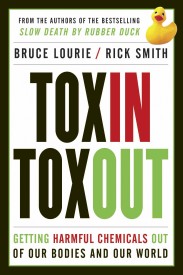
Toxin-Toxout-canadian-cover-e1384688557263I especially liked the conversational tone of the book and that it’s not smothered in stats, nor is there any fear-mongering or the drama of doom and gloom. It’s simply well-researched (a bounty of footnotes and source material provided) and straight-forward in its message: yup, there’s a lot of bad stuff out there but we can make a huge difference by what we choose to buy. Of course corporations and government hope we’ll never figure this out, or believe it…

Best of all, Lourie and Smith remind us that it’s actually possible to improve the world. That WE are not necessarily at the mercy of THEM, nor do we have to wait for THEM to smarten themselves up. WE can begin today  to create change by the purchases we make. And the path to doing this is a simple one. Really, REALLY simple… 

So, no, I didn’t skim. I devoured every page in fact, and am happy to say the book’s info-factor is surpassed only by its offer of serious hope to a seriously growing problem.

Three thumbs up.

Here are some excerpts.

Photos are mine. (Wanted to find a mountain of cell phones but apparently they live in China where they’re sent by the boatload to pollute the air, land and water horribly as they’re broken down and re-shaped into toys and other novelties we don’t need and shipped back to us.)

Another image that’s missing is what’s happening in the oceans with all the plastic.

*

“I like to describe organic agriculture as the hundred-year diet. It’s a system of agriculture that perpetuates itself, that creates a healthy ecosystem that will in turn continue to support plants in the long term, so you’re not in this deathly cycle of creating short-term nutrients—which then can contribute to pest infestations that need to be counteracted by immediate and short-term chemical pesticides, which then kills the life in the soil, which then requires another synthetic input. Just like we need to give our bodies the right tools and conditions to do their detoxifying jobs, organic tries to enable and facilitate the natural predators and the natural nutrition and micro-flora and fauna that should be in the system.”

img_9442

“A smartphone is replaced, on average, every 18 months, and by 2015 over a billion smartphones will have been sold world-wide. And they don’t just sell themselves: In 2012 Samsung and Apple spent over three-quarters of a billion dollars on advertising campaigns trying to convince us to buy new ones. How much did they spend dealing with the e-waste from the phones they encouraged people to toss out?”


“The big issue isn’t simply what kinds of stuff we should buy; it’s the fact that we need to buy way less stuff, period.”

img_7847

“We need to be working on all fronts to stem wasteful production  and consumption. And consumers are part of the equation… the big issue isn’t simply what kinds of stuff we should buy; it’s the fact that we need to buy way less stuff, period. Furthermore, that stuff—whether it’s a car, a soft drink or a smartphone—needs to be regulated by governments, not by the companies who have no interest apart from endless growth in sales. These regulations need to cover what the products contain and how they are disposed of.”


“If there is one simple thing that every human can do to improve environmental conditions, it is to stop buying bottled water.”

DSC00200_1 DSC00199_1


“The rules of the game we’re playing now are best defined by the Malcolm Forbes maxim: “He who dies with the most toys, wins.” We need a different game, with different rules—perhaps “Those who use the least stuff win.” And our economic and regulatory systems need to reinforce that motto with another one—such as this: The more you use, wasted, pollute and discard, the more you’ll lose financially.”

img_7845


this is not a review — ‘in the spice house’, by marnie woodrow

 
Only just recently discovered this quirky and quite lovely book, published in 1996—another testament to the riches that are CanLit and the fact that so many gems are present for but a moment, before the next thing takes its place… for but a moment.

In other words, it’s easy to miss a few.

I divide books into four categories: new-new, old-new, old favourites, and books I’ve heard nothing about and got merely on a whim. Often, that’s where the treasures are found and, to be honest, it’s my favourite pile. No prejudice nor expectation, no hoopla to live up to… a book from this pile can just be a book.
[Is it just me or does it seem that titles receiving the most hoopla are very often the least hoopla-worthy, while so many gems fly under the radar….]

Blather aside, in the spice house was a delicious find indeed. And a much-needed palate cleanser from the recently hoopla’d.

The food references are not accidental.

Each story [there are 16] in this collection centres around or focuses on or incorporates food and relationships in bold and unexpected ways, which, in my world, is more important than plot. Although there’s plenty of that detail also.

In ‘Mamamilk’ a woman is confronted by a child she lost due to neglect and other slovenly habits. ‘Belly’ is a bit of sarcastic pleasure about home ownership. It begins: “I’m holding a brunch in honour of my lucky friends, the ones with two-car garages and split level lives.” [FYI: brunch takes an ominous turn.]  ‘Suck’ is about a chef who loses all self control while watching people eat, and ‘King Cake’ offers up traditional New Orleans fare along with some distinctly original revenge. In ’32 Flavours’ a rapist rues the day he walked into an ice-cream parlour. ‘To Market To Market’ takes us on a ride in more ways than one, and in ‘Obvious Need and Senseless Longing’ Elizabeth David’s death leads to a dangerous romance with the knife obsessed. It begins, “I gave up drinking in favour of buying cookbooks.” 

The shortest piece is ‘One Lip’, a sort of fairy tale about the end of love and its inherent difficulties.41twt9hKaVL__SL500_AA300_

The longest, ‘Madame Frye’, is about an unhappily married woman who works in a fish and chips shop and longs to go to Bora Bora or have an affair with a patron named Melinda, whichever comes first. It takes the form of something like diary entries, alternating in the wife’s voice and that of her ultra savvy daughter Penny [it’s her voice that makes it].

The stories are short, bite-sized things, and written in prose that feels like a conversation over lunch with some wonderfully wild and free-thinking companion who never uses the same voice twice in her ‘tellings’—here, listen to this one, each narrator seems to be saying as we sip our Chardonnay, break a piece of baguette, lean forward.

And then we start on the cheese, the olives, order some more wine, all the while leaning in even further…

Viva long-lost gems.