hey there


I’m in no hurry to go back to shaking hands.

Hugs, yes. (Though I have some thoughts on that too.)

But the handshake I think we can maybe scrap forever.

Ugh. I’m thinking suddenly of all the hideous hands I’ve shaken and some really awful handshakes, the limp wrist affairs, the sweaty palms, the vice grips. The creepy lingering ones. Yeah, enough.

“Hello, nice to meet you” can so easily be accompanied by a nod or pirouette, a short expressive dance, a tap dance!, hand over heart, an elbow or ankle bump, a high pitched yip! or big toothy grin. It’s endless really.

Think of all the colds we’d save ourselves.

And the pleasure of meeting would be so much more pleasurable.


kindness unwrapped

My new favourite pastime is noticing the ways of kindness, what it is, how it becomes, the way people find or make their own versions of it, the sheer, sweet miracle of how the pandemic has inspired so much goodness and despite how tired everyone is there seems to be no wearying of being kind in extraordinary ways. It doesn’t feel like we are giving up on that. On the contrary, we seem to be getting better at it.

Not only in the giving and receiving, but in the recognizing.

Because it doesn’t always come as a box of cookies or slab of cheese. (Though either are entirely acceptable.)

For me, the awareness often comes as a surprise, a sudden sense of delight when I’m really not expecting delight and maybe lasting only a few moments but long enough to breathe differently, walk differently, to be in awe of how important we are to each other. Which of course is the true gift.

Possibly the very best of it is in fact wrapped up in something so ordinary that the one giving has no idea they’re giving kindness because it’s only a conversation, a compliment, a smile, a few minutes of listening, a pretzel made with sewing machine and catnip, a couple bags of potato chips (Covered Bridge brand from New Brunswick), a wayward puppet, a mouse saved, a jar of soup delivered, the title of a song that when played changes a morning, a page of typewritten text taken from a book that might make a day, a painting of peace and kayaks, a note left on a porch, a painted stone, a spontaneous book club for two, or (only) a cup of tea…

this is not a review: the fiction of politics

I didn’t intend to read two books back to back where women, politics, and arrogant men figure prominently but then I think if you have the first two ingredients, the last one is often a given.

Interestingly, both books take their stories from real events.

Kerry Clare’s Waiting for a Star to Fall, was the first of the two.

The overall premise having been inspired by Toronto politician Patrick Brown’s undoing. Forgive the pun. Told from the perspective of Brooke, a twenty-three year old political assistant who is smitten with the glossy veneer of politics and the (older) man behind the curtain in a way that may resonate one way with anyone who has long since been twenty-three (i.e. as cringing reminder of youth and the easy influence of someone ‘important’; gratitude for crumbs of attention; status by association; the way innocence walks into moments that experience would recognize for what they are and head for the hills) and resonate another way entirely with anyone who IS currently twenty-three (i.e. as fair warning). At its heart, a story about the abuse of power, both heartbreaking for what we recognize in Brooke’s naivete, and inspiring for the realization that this is how we learn. Sometimes it hurts.

Petra, by Shaena Lambert, is the little (to me) known story of Petra Kelly, founder and champion of the Green Party. Narrated partly in the voice of a former lover, the book is eye-opening in its account of the party’s origins, initial efforts against nuclear weapons and various other causes being championed such as climate change, feminism, humane treatment of all living things. The book opens in the farmhouse that serves as party headquarters and which beautifully sets the tone for what the party stood for, i.e. no fancy office building necessary. This is grassroots politics at its finest and well portrays the era of the 1980’s, the important work being done, the challenges Kelly, especially, faced, as well as the commitment of those doing the work, all the while revealing relationships and personalities, the struggles, the egos and ultimately, the betrayals.

I won’t spoil the pleasure but I will say that it has one of the best closing scenes I’ve read in a very long time

toasting toast

Can we please talk about toast?

I think we NEED to talk about toast.

More than ever.

It’s come up as a subject at my house and with a friend or two in the last little while and I think that’s no accident, because there are no accidental toast conversations. There’s a reason it’s knocking on the window of my psyche.

Toast is sanity.

And comfort.

Not to mention that a well toasted piece of bread is something you remember for possibly ever.

For example, those people in the country, that farmhouse we visited, me and some friends when I was a teenager. One of my friends knew them, said they wouldn’t mind if we dropped by unannounced. It was late, something like 8:30 or 9 p.m. (even then I had an abbreviated sense of ‘late’). It was a couple, a man and a woman, much older than us, they might have been 40, and whether or not they minded us popping in at the wee hours wasn’t apparent. They welcomed us, put the kettle on, and made toast. I remember that little plate with six or eight or maybe ten slices, buttered, on the table of this almost rundown farmhouse kitchen. I can’t remember how it tasted, what stays with me is simply that they served toast. It seemed such an odd thing– why not cookies or a slice of cake, muffins, crackers and cheese? And yet… it was perfect. It was possibly all they had on hand. And it was something. And they wanted to offer something. And it was perfect.

But that’s not my first memory of toast. The first would be the cinnamon toast my sister taught me to make.

Simple recipe:

SLATHER gobs of butter on toasted bread.

Sprinkle heavily with brown sugar and cinnamon.

Take to big fat overstuffed chair.

Settle in to watch Gilligan’s Island.

In some elementary grade we were asked to write a short essay on How To (do something). Then we each had to stand and read what we’d written. I stood. I began with the title: How To Toast Toast. Before I’d read more than a line or two I noticed kids were laughing. I kept reading, happy the piece wasn’t as dull as I’d thought but when I was done the teacher had a kind of tsk tsk look on her face. How was it possible to toast toast she wanted to know. The implication being I hadn’t thought carefully enough about my subject before I launched into the writing. It actually took me a minute to understand everyone’s problem with it and even then all I could think was how is that more important than these valuable directions???

When my sister moved out to what I thought was a wonderfully derelict furnished apartment that she entirely Lysol sprayed, the kitchen had one of those ancient toasters with ‘wings’ that come down and you lay the bread in, toasting one side of it at a time. It had a thick cord wrapped in frayed black fabric and it felt a little like taking your life in your hands every time you used it but it made the BEST toast ever.

Sometimes, if the stars are aligned just so, you can stumble upon a diner that makes toast almost as good as a winged toaster.

Fast forward decades to the hills above Penticton, B.C. where once upon a time lived a man with a donkey and a mill, who made such exquisite loaves of sourdough that when toasted could make you cry and we stuffed our suitcases with it and have forever called it, and any good toasted sourdough since… donkey bread.

So many other tidbits… the love you can express with a heart-shaped piece of toast, for example. TOAST FINGERS, or soldiers as they’re called in the UK where I first encountered them. And speaking of the UK, the way they do so much ‘on toast’ that toast should have its own food network.

A British friend has only recently informed me that there is something called a toasting fork. People use it for marshmallows and sausages as well. But I wouldn’t. I would dedicate such a noble stick solely to bread because I trust said friend who assures me that done properly there is no better way to toast toast than this.

Yes, that’s right, I said it, Ms. Thingy from whatever grade that was and who will forever be part of my toasted memories.

p.s. This toast post is NOT COMPLETE without a moment for this.

yellow cup

Yesterday a cousin sends pictures of alpine snow heavy on branches, mountains, rooftops, and me here in the rain feeling snow envy, sending a message back to her… “A slice of heaven!” I write and forget my laundry on the line and then this morning I open the blinds and see snow heavy on branches and rooftops and the morning light is just starting and I put the kettle on and go out to the porch, my laundry frozen and me here in coat and boots and a bright yellow cup, lemon balm tea as the sun rises through a slice of heaven.

IMG_0860

IMG_0862

this is not a review: ‘sixpence house: lost in a town of books’, by paul collins

Paul Collins is an American who claims some connection to the UK via parents who are British (but have lived in the States a long time; he doesn’t say how long). In any case he and his wife leave San Francisco with their young child and move to Hay on Wye in Wales, the ‘town of books’ and home to the Hay Festival.

We are not entirely sure why.

There he, Collins, meets a number of local village folk including Richard Booth, the chap who started the whole bookstore thing (at one point there were something like 70+ book shops in this wee town) and is madly eccentric, a terrible businessman but brilliant book lover. Collins magically gets a job working for him for (I’m not sure how long… he’s vague on dates) and (surprise!) eventually leaves Wales to return to the States.

In there somewhere is a flimsy attempt to buy a house [in Wales]. Which never happens for one reason or another and mostly, I would assume, because Collins and his family have no desire to stay. This is never stated outright but by virtue of how things transpire, or don’t, how the whole adventure that was supposed to last forever is suddenly over and he’s just glossing over the fact that they’re dashing back to the States, well, it smacks a bit of a) a realization that they aren’t cut out for Welsh village life, or b) that this was all a half-hearted effort at best, a sort of stab at ‘A Year in Provence’, something to write a book about if all else fails. I lean toward option (b) because it really doesn’t feel like he ever gives the place a chance.

Worth reading?

Not a complete waste of time. He writes with some humour and until the part where they up and leave (a schmaltzy return to America by the way, on a British passport for some reason and the U.S. immigration officer giving him a seriously hard time and TELLING him that he is an American and that he should be travelling on a U.S. passport… all a little over the top)… but until this daft and sudden ending, in the interval when you are still being lulled into thinking they might be sincere about making a go of it, it’s not the worst read.

While he notes many comparisons between life in the States and life in this tiny Welsh town, much of this is presented as isn’t it all so quaint and quirky, in a way that caters to mostly to an audience who rarely if ever travel far from their homes or are even aware, via books or other means, that life outside their universe (i.e. in other countries) is indeed different. And pleasantly so.

That said, there a few lovely bits throughout.

On remembering: “It is hard to know just how many times we have been exposed to a word, a face, an idea, before we have it.”

Litter in Literature: “The only civilian is a single forlorn custodian, who stands with his rubbish stick at the ready. He is waiting to spear the first crumpled crisps packet that flutters out of some pensioner’s string bag.”

Fun Fact: Phyllis Pearsall is the creator of the London A to Z map. She moved to London in 1935 after a divorce, thinking to become a portrait painter. “And so she did; but of a place, rather than a person.”

Wisdom: “No situation is so dire that it cannot be interrupted for tea.”

Trivia: The English tit bird “discovered that if they pecked through the foil cap on milk bottles, they could suck down a cream feast so sumptuous that they could barely stagger away afterward…” (bottlecaps were duly redesigned)

Warning: “To look for a specific book in Hay is a hopeless task; you can only find the books that are looking for you, the ones you didn’t even know to ask for in the first place.” [There is only one new-books bookshop in the town of Hay.]

Reading recs: Mercy Philbrick’s Choice, written by Helen Hunt Jackson, who was friends with Emily Dickinson. Published while Dickinson was still alive and unknown… “an extraordinary fictional portrayal of artistic isolation…”

On a VERY interesting moment in publishing history: Collins talks about a No Names Series put out by Thomas Niles (Publisher), “which published new works by writers like Jackson, Louisa May Alcott, and Christina Rossetti anonymously, allowing the works to stand or fall in review columns on their own merits. It is hard to imagine hype-hungry publishers undertaking such a  project today.”

Comparisons: Lots of comparisons with American and UK life, media, TV, radio, literature, values, ways of conducting oneself (shouting ‘Hi’ in the street isn’t done, for instance). Of a British TV game show he writes about prizes like egg timers and frosted drinking glasses. [Oh I would love such a frosted glass!]

On magazines: the difference being that U.S. home décor mags look like no house that exists, all lighting and staging, while British décor mags have actual lived in rooms, comfortable untidiness included.

Very funny riff on showers. Collins remembers showers as a child in the U.S. where he’d pretend he was flying a single jet plane, rain whipping into the cockpit, being pounded by enemy water canons or riot police, etc. and wonders what children in the UK imagine… “Perhaps they pretend that they are standing under a rusted and leaking pipe in an unlit boiler room. Or that someone is weeing on them from a great height.”

Having living in the UK for several years, I read such pithy comments on the doings with affection, being reminded of both the charm and the charming eccentricities of British village life. 

That said, the ending was ridiculous and left me feeling like the Emperor was buck naked. Like the whole thing was a planned exercise, a process he went through simply in order to get the material to write a book. Which of course people do all the time. But the best of those books reveal something important or surprising gleaned in the process, something that changes or enhances their lives or world view. The problem with this book is that the author seemed to take next to nothing from the experience.

Except a book. (Of pithy observations that really have nothing to do with ‘getting’ a place.)

What really boggles my mind is how, as a writer, you derive so little from the experience of living in a town of bookshops, a town that is wholly dedicated to books and readers and writers, and has a few other notable qualities as well...

Overall, feels like a bit of a missed opportunity for the author. As well as his family. As well as the reader.

and just when

When you’re out in the garden feeding the birds and saying good morning to the solstice day and you look through the cedars and see a bit of pink and you wonder if it will turn cherry red because the sunsets and sunrises have been so brilliant recently and you decide to head to the lake just in case

and just when you think it might get pinker the sky clouds right over and goes grey grey grey

but you stay because there’s no one else there except in the distance a woman and a small dog who you eventually pass and you both say good morning and you think you should have said happy solstice and just when you’re kicking yourself for not, along comes a guy with a terrifying looking large dog who also says good morning and this time you say it, happy solstice, you say and his face is mostly hidden by a hoodie but you can see he has a beard and a moustache and the dog is muscular and on a short leash and then the guy smiles very big, and says yeah

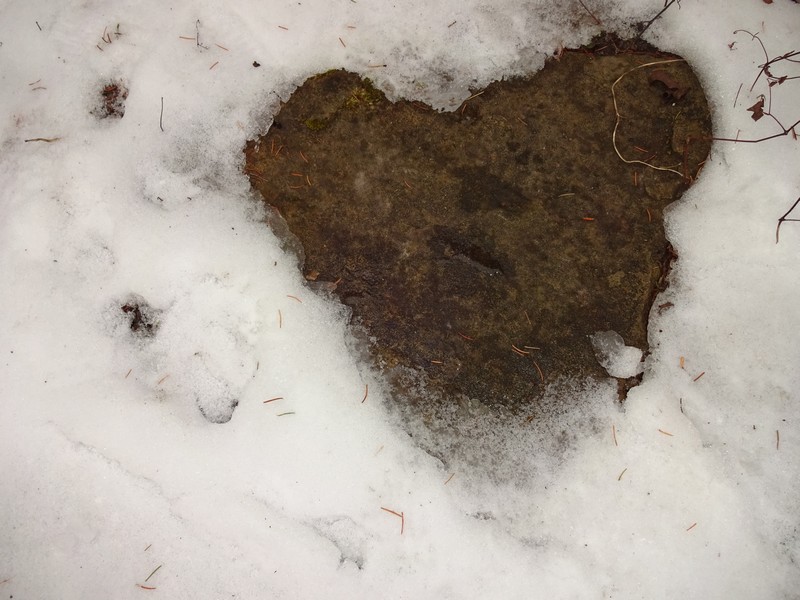
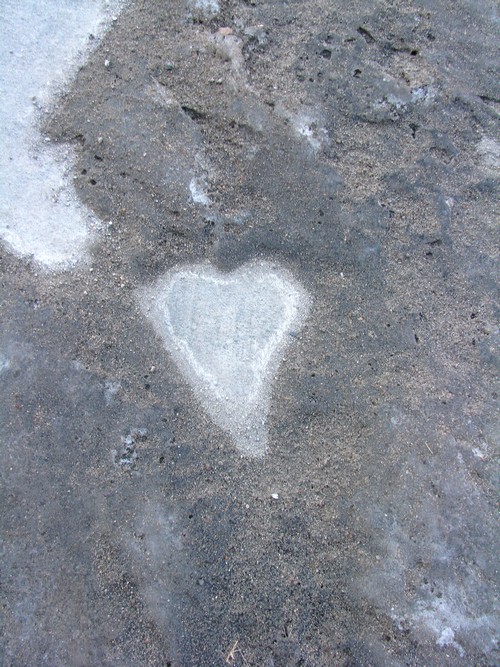
and you have the feeling this is the first he’s hearing of it and you decide to walk right to the end where the big rock sometimes gets swallowed by waves, the rock where you sometimes leave a small stone as a gift for whoever, for the universe itself, and just when you decide that if you find a heart-shaped stone you will leave that as your solstice gift, you look down and see a huge one frozen into the sand

and you pry it loose and it’s cold and you’re not wearing gloves so you move it from one hand to the other until you get to the big rock and en route you see a daisy but you have no hands to take a picture so you decide you’ll do that on the way back

but then you get distracted by a still smoking bonfire as if maybe someone was there before sunrise on this day of light… which is lovely but better if they’d left less of a mess

and this thinking about litter is distracting and just when you realize you’ve passed the place where the daisy would have been and you’re thinking it’s too bad you missed taking the photo because who will ever believe you saw a daisy on a December beach

you find a rose

and then a chrysanthemum

and so on


and you would like to wonder how they got there but really you don’t care because you are more delighted with the gift of them to you, than whoever they might have belonged to before

and you find beach glass in all three colours and there is, not exactly, driftwood, but it will be one day, and you remember how your dad made lamps and tables out of it and just when you realize it’s impossible to see any version of the stuff without thinking of him

you remember growing up on the other side of this lake, coolers filled with potato salad, lawn chairs and learning to swim, walks with your mother to pick rose hips for tea from bushes that grew wild near the beach and your dad gathering stones to build rockeries, and you think how you could never have known or guessed then that one solstice morning you would be walking on the opposite shore thinking about any of that

and the sky is still wonderfully grey.

a december story, involving a hamster (and, of course, miracles and snow)

It’s the 1980’s.

I’m working in Edmonton in a small office downtown. There are only three of us, one of whom is almost always on the road. Which leaves me and Wendy.

It’s the middle of December.

At lunchtime I take a walk. I notice it’s starting to snow.

I duck into a five and dime, possibly a Woolworths or similar, the kind of store where the shoes are next to the tablecloths which are next to the vacuum cleaners which are next to the gift boxes of Black Magic chocolates.

I find myself in the pet aisle where there is a sign announcing Free Hamsters. All you have to do is buy a cage with an exercise wheel, a water bottle, a supply of cedar chip bedding material, food, and a food dish, and they throw in the hamster for free. Seems too good to be true, but IT IS TRUE. And so, some minutes later, I’m back outside carrying a hamster in a cardboard box in one hand and a giant bag of all its worldly possessions in the other.

The snow has picked up.

Wendy is only slightly amused when I explain my good luck at stumbling upon a hamster sale, and not at all impressed. Turns out she doesn’t like hamsters. Wendy is a country girl who puts such things under the heading of ‘varmints’.

Sometime later that afternoon Wendy says How are you going to get it home? She means on the bus. Because the bag of supplies and the cage and the cardboard box is a lot for a crowded bus. Plus she says, it’s snowing like crazy.

Moving the hamster from box to cage would make things a lot more manageable. Problem is… I don’t like the idea of touching the hamster and neither does Wendy.

Miracle Number 1: Fred Goodchild, a restaurateur from a few doors along, who has come in to see about his account. He says the snow’s so bad things are shutting down, which explains why no one else has been in that afternoon to see about their account.

On a whim I ask Fred Goodchild if he will move my hamster, some of the cedar bedding, and all of the accoutrements into the cage.

Which is how my hamster comes to be christened Fred.

By the time we leave work the snow is a full-on blizzard. The streets are more or less empty of traffic, the buses are running very slow if at all. If it were just me I’d stand outside and wait in line but in my new role as a hamster mother I realize there are responsibilities I hadn’t counted on. In other words, I’m not at all sure how long or at what temperature a hamster actually freezes.

It feels wise to get a cab instead.

[I should mention that I’d recently applied for and received my first ever credit card, the timing of which is miracle #2, which is no small detail as the story unfolds]

There’s zero chance of hailing a cab on the street so I walk to the nearest hotel, where the doorman tells me the wait is a minimum two hours.

And that is how Fred and I come to spend the better part of our first evening together in the bar of The Four Seasons Hotel, me drinking fine brandy and tea and eventually ordering a cheese plate and salad, bits of which I lovingly shove through the wires of his cage on the seat next to mine.

I have no memory of anyone commenting on Fred’s presence or complaining about the squeaking of his exercise wheel. No one asks us to leave (miracle #3). Nor do I recall even thinking it odd to be dining with a hamster in the swankiest joint in town.

A cab finally comes. I pay with my shiny new credit card. It’s a long slow ride but we make it home safely (which feels like miracle #4). I set Fred’s cage on a table in my living room in front of a painting I think will give him a sense of the outdoors and where we can watch reruns of M.A.S.H. and Mary Tyler Moore together.

And we do.

And I think what in the world is better than to be home safe and warm, me with a belly full of brandy and cheese, a hamster and his squeaking wheel, the air scented with cedar shavings.

Such was the magic of a stormy night in Edmonton in December.

[I’d like to add that I was young and not yet given to thinking about the sadness of hamsters being imprisoned, though I do like to think I liberated him from life in the pet aisle. It’s something. And his cage was eventually upgraded and I learned to touch him and hold him and even though all this was before the invention of googling how to make a hamster ultra comfortable I do believe he had a contented life inasmuch as a hamster living an unnatural life can be content. That, and we’ll always have The Four Seasons…]