
♦
Other (not always) wordless friends:
Cheryl Andrews
Allison Howard
Barbara Lambert
Allyson Latta
Elizabeth Yeoman
♦
Other (not always) wordless friends:
Cheryl Andrews
Allison Howard
Barbara Lambert
Allyson Latta
Elizabeth Yeoman
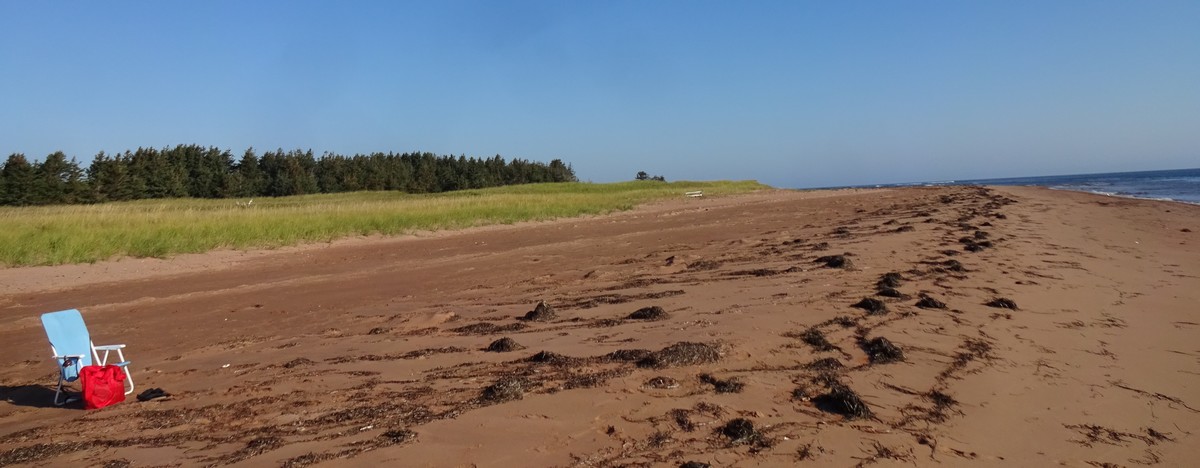
When I come back from the east coast it’s usually sand and shells that come with me, the memory of cormorants flying a thin line above the ocean at sunset, the embrace of solitude in all that surf and space and horizon, the pleasure of spending time on red dirt roads that lead sometimes to a new beach where (I once overheard someone say) there is nothing to see.

But this time it’s more than the tangible, the feathers and stones, that have stayed with me… it’s the two women at the shared lunch table at Point Prim who have not only heard of the obscure Ontario town where I live but who lived there too, twenty something years before moving to PEI.
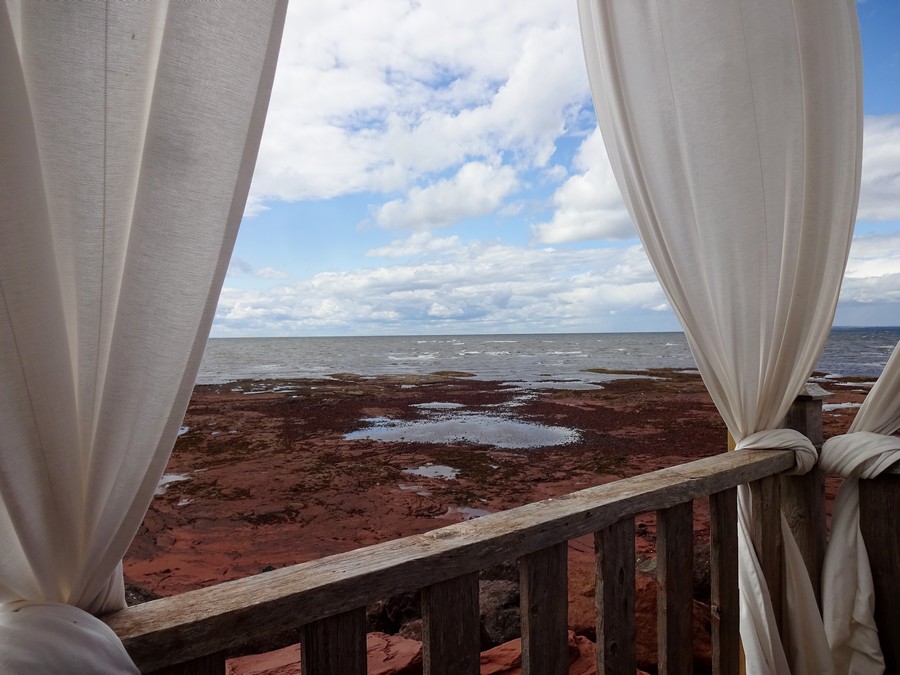
The guy who works at the lighthouse (also from Ontario) who says the ferry crossing over to Nova Scotia should be okay but calls ahead to check and then gives me his card and says if it isn’t I can phone and yell at him.


It’s the young man and his guitar who sings about the girl he left behind in Moncton, and a chef on the same boat, making free blueberry crepes.
And the owners of our B&B who tell us they’ve had 1200 people stay in their not so very large home in the past year and then invite us for a glass of wine.
And the photographer at breakfast, on his way to the Cabot Trail, and next to him a slightly addled couple with almost no sense of direction who you wonder how they drove here from Alberta and you just pray they’ll find the lobster supper they’re heading for in New Glasgow, and next to them the American who says her favourite part of Canada is the gasp, which, after a few questions, we understand to be The Gaspé.

The woman who runs the local co-op art gallery.
And the woman who runs a magical world of love, laughter and literature for people of all sizes.

The person who takes time to show us a ‘hotel’ room in an old railway car at Tatamagoush and the guy behind me in line at the Charlottetown Dollar Store who’s talking to someone in front of me about the number of frogs dying in ponds and rivers because of pesticide run-off from farmers’ fields.

It’s the group of elderly tourists, German maybe?, who arrive at Brackley beach as I’m sitting on the wooden steps, hello, hello, hello, they all say in passing and then take pictures of each other… and how there’s always one in every group that tears away from the herd, seeking a moment of solitude. The way that one plays at the edge of the water and jumps backward with all the joy of a child when the waves roll in as he knew they would.

And the woman who works at the tourist place in St. Peters who tells me that most restaurants are closed at this time of year and when I ask So where do the locals eat? she replies, Well, at home of course…
It’s the server who says that winter on PEI is so quiet the speed limit on certain streets changes from 50 to 70. It’s everyone on the beach, including the guy who asked if I was Nicole Picot, the Minister of something for New Brunswick. (I am not.)
The discovery of George S. Zimbel while waiting out a rainstorm after seeing the wonderfulness of an exhibition that included Montgomery’s manuscript for Anne of Green Gables.

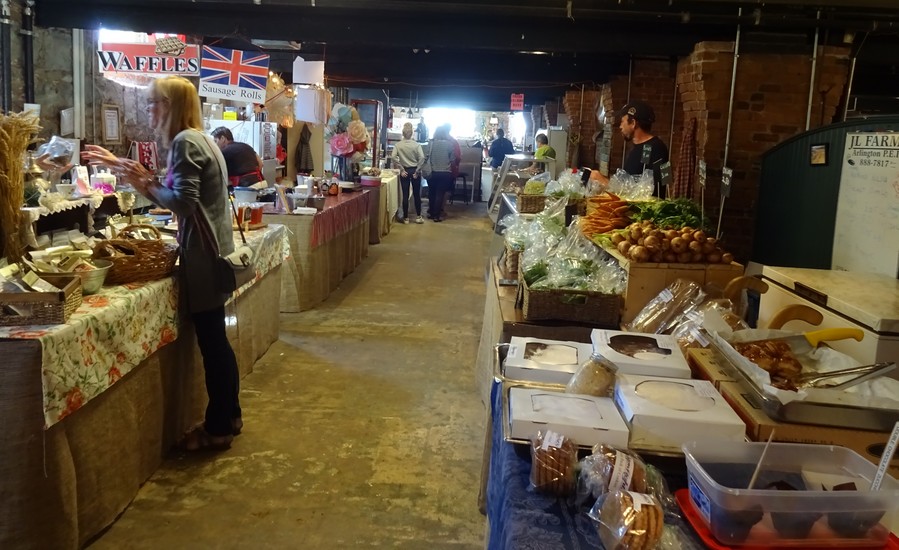
Familiar faces wandering around Summerside farmers’ market and a woman who sells me bags of freshly picked dulse.

The seaweed fanciers at a seaweed workshop where seaweed is fondled and used to paint seaweedy scenes.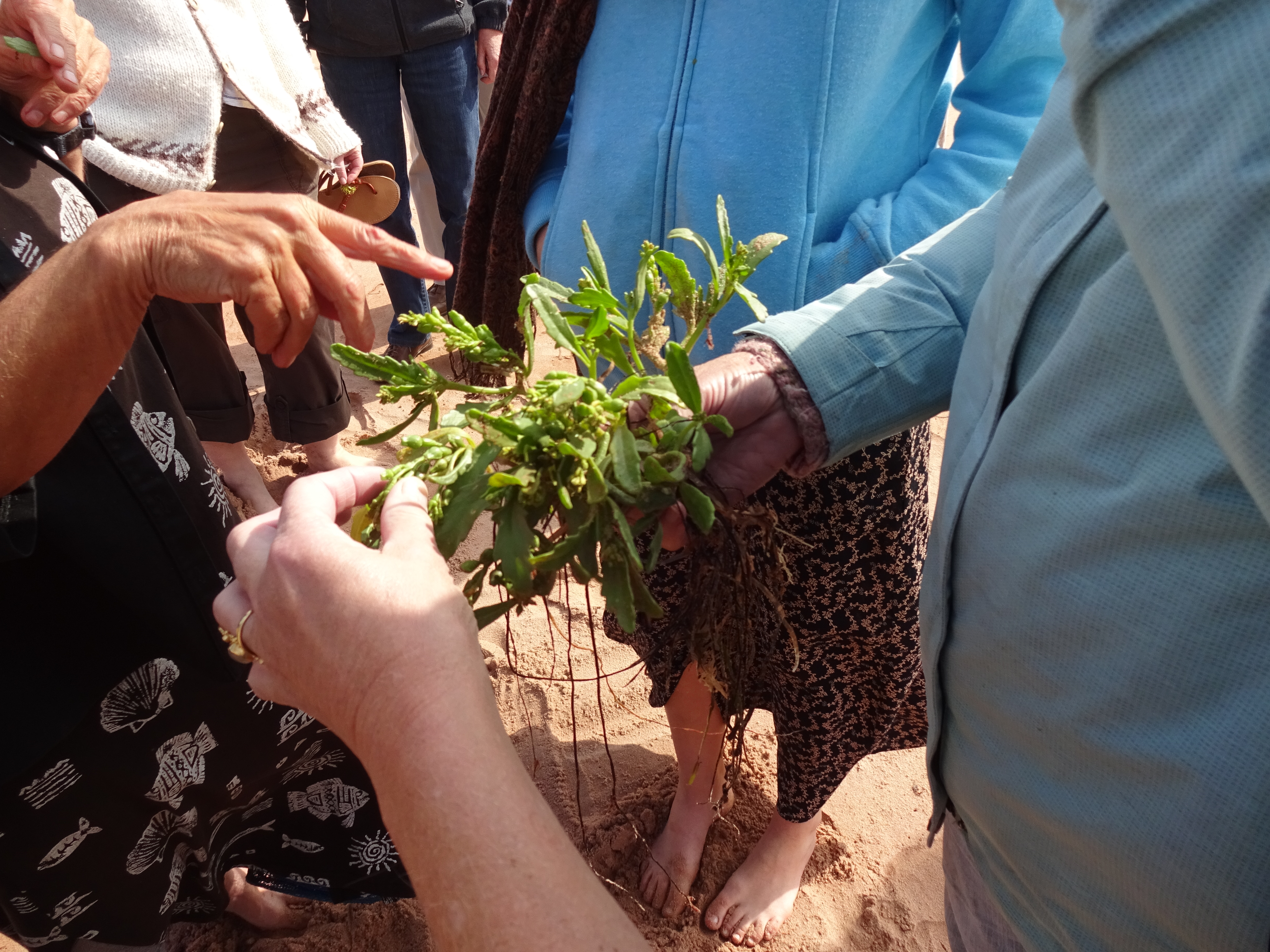
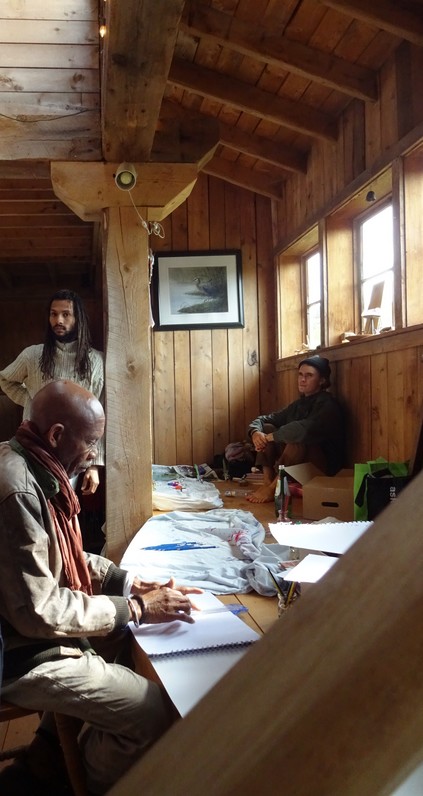
The couple who, on a dockside patio, check their phone for info on Acadian history and then one of them reads out loud… loud enough for us all to hear. Go ahead, ask me anything.
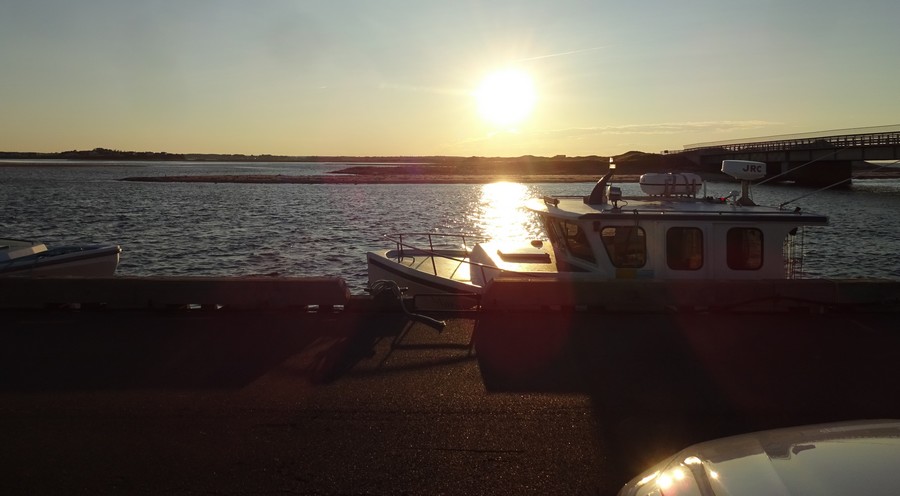 The woman who is almost my friend and the warmth of her welcome.
The young people who on this beach of red sand discuss having once been on a beach where the sand was black but can’t remember where that was…
The people from the south shore who come to the north shore and stand in line for fish. But only on weekends.

And lovely Arthur from Florida, originally from Boston, embarrassed about Trump… and the equally charming people he’s travelling with and how they meet up each night to play cribbage.
Barb and Barry from Milton who in not more than ten minutes not only introduce themselves but list everywhere they’ve been on this driving holiday (because they’re retired; he from the fire department, she from banking), everywhere they’ve played golf, hiked (they “did” four hikes in Fundy in one morning “plus saw the tide thing”), where they’ve spent every night (because every day and every night are laid out in advance), as well as how one daughter who has a new boyfriend is studying in Guelph to be a vet while the other is working as a teacher in the U.K. but her landlord is giving her a bit of a runaround at the moment because his email has been hacked. The daughter happens to text while Barb is sharing all this so Barb texts her back then reads me the text her daughter sends in return. The landlord problem seem to be resolving, albeit slowly.
(The next day Barb and Barry announce “they have done the entire shoreline” of PEI. They also “did” Greenwich but can’t remember much and sadly have terrible things to say about the lovely woman at the St. Peters tourist place. Felt she was holding out on them about there being few places open to eat.)

The wedding party who take photos on the dunes beside the signs saying don’t climb the dunes and the guy who parks his car almost on the dunes at the sweetest beach but only steps out for a second, long enough to take a shot of the lighthouse then drives off.
A woman who made a museum of the place LM Montgomery boarded while she taught school and the view from her window.
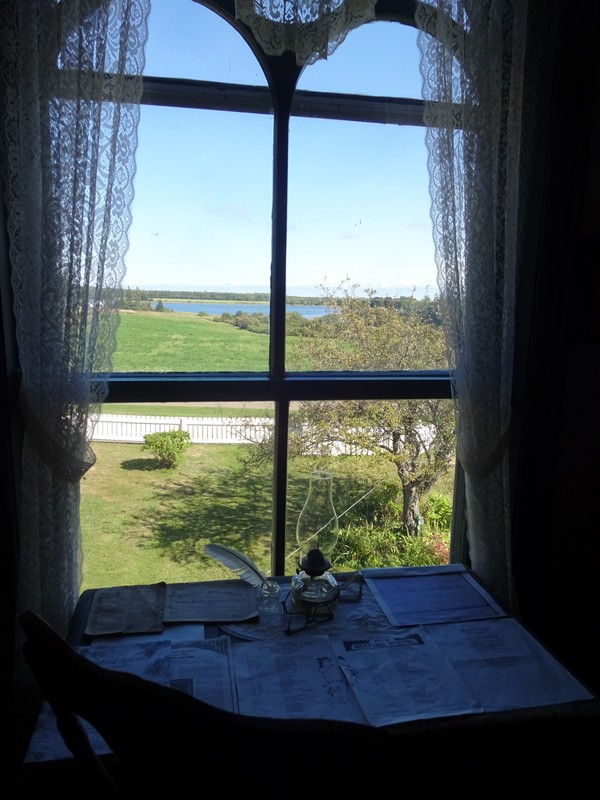
A guy who knits socks.
A guy and his food truck.

A cat named Charlie (because cats are people too).
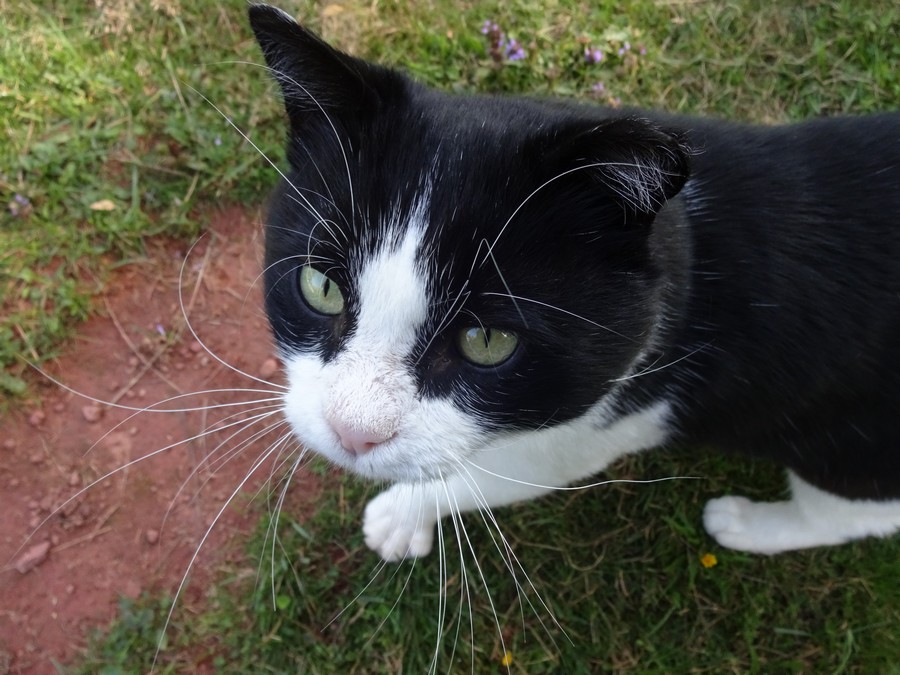 And his not necessarily best friend.
The painter who tells me about the land she’s just bought where she wants to build a studio. I tell her I’d love to move here.
She says do it, buy the property next to mine, I’d like to have good neighbours.

♥
 My idea was to sketch the scene in front of me, the no-cloud-blue-blue-sky and various shades of much darker blue sea, the roll of waves, another line, and the line on the sand that’s as far as the waves roll in, the wet gleam of
 what’s left behind on tide tamped smooth red sand and beyond that more sand, dry and loose, a single black rock among a scattering of tiny white specks that are broken shells.
But then P. arrives and before that frisbee players threaten the safety of those not watching and P. has watermelon and the wind and the sound of surf, people going in for a splash or just strolling… distractions. And P. and the watermelon and a seagull watching us and, really, I can’t draw a seascape worth a hill of beans anyway, so this instead.
If you look closely you can see it all. Except not the sweet baby behind me or the man drying off in front of me and his wife still in the water with her sunglasses or the woman reading… or the girl doing handstands, landing in perfect bridge pose.
(PEI, last week)
♦
Other (not always) wordless friends:
Cheryl Andrews
Allison Howard
Barbara Lambert
Allyson Latta
Elizabeth Yeoman
Kerry Clare recently wrote a piece about the prospect of not necessarily coveting a house or even lamenting the impossibility of owning one in Toronto any time soon. She wrote about being a happy renter in her city of choice, about living close enough for her husband to stroll to work, close enough to walk the kids to and from school and how everybody’s home at the same time to have dinner together.
You wouldn’t think this would inspire negative comments, but then you’d be silly. Because, it seems, everything inspires negative comments.
It’s actually stunning to watch, anthropologically, this need humans apparently have to take things personally. How almost anything can be interpreted as a slight against something else. In this case the fact that she’s coming out as a contented renter is really pissing off a lot of people who own, which begs the question why? If you’re happy in your world why does it trouble you that others are happy in their different worlds?
This isn’t about lawns or renting or owning, it’s much bigger. Sadly, the emotions triggered by the small stuff may suggest an intolerance also to the bigger stuff… race, class, gender, religion, age, and all those other isms.
So what is it? Are we wired to create divisions? How else to explain this constant sorting of them from us. And why don’t we get that there is no them? There’s only an us. Some of us like lawns. Others of us don’t. Some of us like bubble gum flavoured ice cream and others of us have taste. (Ah, see that? That’s exactly how easy it is…)
Also, don’t we get tired of it all? The sides, the I’m right you’re wrong, no I’m right you’re wrong, no me, no me… the incessant, uninformed griping about The Other. Do we ever get beyond it, smarter, more broad-minded? Or does our brain function max out at self-righteous smugness?
For the record, Shirley, (tho’ I doubt this makes us kindred spirits) I live in a house probably similar to yours. I didn’t always. For more than a decade I lived in Toronto in various apartments similar to Clare’s. I also lived in a council flat in Oxford, a pretty house on a hill in the Caribbean, an impossibly tiny bachelor in an Edmonton basement. Had you asked, while I was living in any of these spaces, I’d have told you I was content with my world, not just the structure of where I lived, but the lifestyle it allowed me to live.
Because that’s what it comes down to: are you happy with your life/style?
The point, Shirley, is that I would love it if we all stopped categorizing everyone. We are all of us ever-changing bits of various things based on where we’ve been and where we happen to be at the moment. Today’s renters are tomorrows owners. Or not. And vice versa. Who cares. We deal as best we can. And if someone’s managed to make their own version of lemonade (or bubble gum ice cream) then maybe we can celebrate that instead of telling them iced tea (or vanilla, obvs) is the way to go…
Finally, Shirley (are you still there?), I think it’s important you know that not everyone who lives in a house needs a lawnmower. And that you surely, Shirley, do not speak for me.
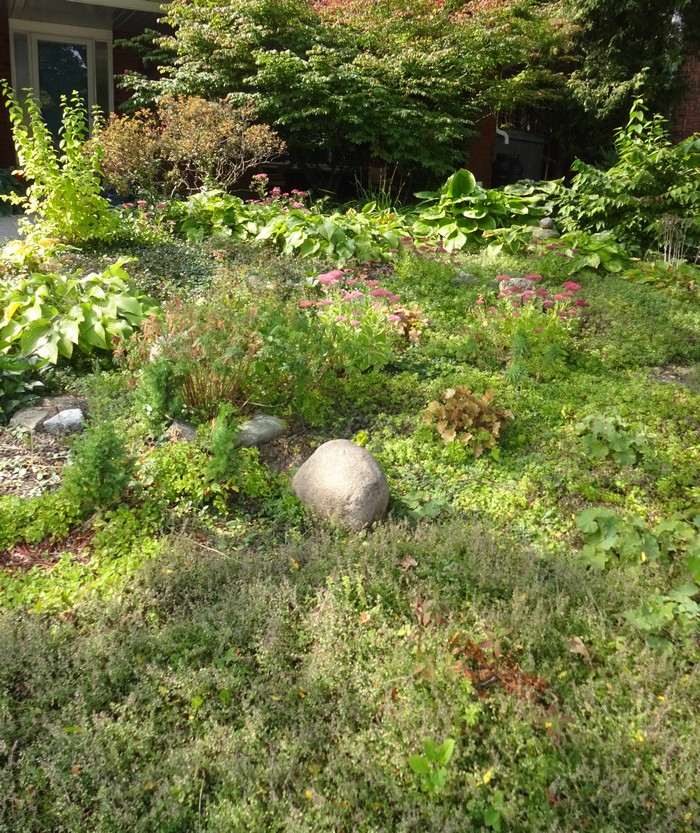
* The title for this post is a riff on Kerry Clare’s response to one of the comments her piece inspired and it amused me no end.

new pencil case.
new pencil crayons. (but only if last year’s Laurentiens are mostly stubs)
old pencil sharpener.
old compass. (I know! I can hardly believe it either. Also, here’s a link for those who haven’t a clue what I’m talking about. Used for drawing circles on notebooks and binders… & possibly had other applications.)
new eraser. (which will soon be tatooed with sharp end of lead pencil)
miscellaneous pens and pencils from kitchen cupboard near phone.
Hilroy notebooks. (which I WILL SWEAR to keep pristine ALL YEAR)
new binder (which I WILL SWEAR to keep pristine ALL YEAR)
binder paper
new set of dividers
(and in one spectacular year, a full colour metal Flintstones lunch box)
What am I missing??
♦♦
(greetings from the last century)
♦
Other (not always) wordless friends:
Cheryl Andrews
Allison Howard
Barbara Lambert
Allyson Latta
Elizabeth Yeoman

Long before digital anything… when dinosaurs still roamed the earth and water bottles were not yet common (or even invented?), I sat in the courtyard of an ultra swanky hotel in southern Florida. Service was abominable. We waited ages and ages for an initial glass of water, never mind the wine and the meal. Polite questions did no good. The attitude of staff was even worse than the service. But the courtyard was beautiful and it was a perfect southern Florida night, i.e. not too sticky or buggy, so we stayed and waited and waited and waited for our meal. Given all that time on my hands I decided to make a few notes in my travel journal, just personal notes (this was before blogs, before the internet, truly the dark ages it was). Something about the act of pulling out a notebook and writing caught someone’s attention and before we knew it the manager appeared at our table asking if there was anything he could do for us. Well, we’re waiting for our meal, we said… And just like that, presto bongo! our meal followed. The manager returned (several times) to ask how the meal was and was there anything else he could do. No, no, we’re fine, we said, and he said well, maybe after we’d eaten we’d like a tour of the hotel because he’d personally love to give us a tour of the hotel. Um, okay… we said, a little confused. The wine and dessert and tea were comped and the tour was comprehensive and complete with much ass-kissing, which neither of us could understand… until we realized he thought I was a food writer. Because, apparently, who else would write in a journal?
This was before the days of taking pictures of meals and sharing every food experience, when the power of print via pen and ink had clout.
Like I said, it was a long time ago.
~
(Southern Florida, ’90s)
♦
Other (not always) wordless friends:
Cheryl Andrews
Allison Howard
Barbara Lambert
Allyson Latta
Elizabeth Yeoman
I’ve said this before… my favourite books are those where nothing much happens other than whole worlds change.
Oh my lord did I love this book of nothing and everything.
In a nutshell:
Louis Waters and Addie Moore are widowed, long time neighbours, who really only have a passing knowledge of each other’s lives, in the way of neighbours who have shared a street for decades. Aware but not involved.
They’re both good people. And, now, perhaps, also lonely.
 The book opens with Addie knocking on Louis’ door and asking if he would be at all interested in sleeping with her. She means it literally. No funny business, just pj’s and slumber. Oh, and talking. That’s really what she’s looking for, that special kind of conversation that only happens when you’re lying in bed next to someone.
He accepts.
He continues to live in his own house in the same way he’s been doing for years, but at night he goes over to Addie’s for a single beer while she has a glass of wine and then they brush their teeth and hit the hay.
(The tooth-brushing is not incidental. Remember this is a story where nothing and everything happens. The details of life are beautifully wrought.)
Once in bed they talk.
At first, of course, it’s all awkwardness, but it evolves into something so essential to their well-being that neither of them can imagine living any other way. They’re not a couple but they’re more than friends. They come to reveal everything to each other in ways they never did in their marriages.
But people being people soon begin to pass judgments, especially those people unhappy in their own lives. Louis and Addie don’t give a fig. If anything the judgements only cause them to judge themselves (which is such a healthy reaction) and when they don’t find anything sinister about themselves they take it up a notch and begin hanging out together in public. Not necessarily an easy decision given how the elderly are made to feel they don’t count, that they hardly have a thought in their heads worth hearing.
Addie and Louis know this is the way old people are seen but they don’t see themselves or others this way. They have such wonderful, admirable balls.
A really charming part of the book is when Addie’s six year old grandson Jamie comes to live with her while Addie’s son Gene and his wife try to fix their marriage. Louis and Addie and the boy become a kind of family unit (along with Ruth, a friend of Addie’s) and Jamie is nourished in a way he’s never experienced. He stops crying, he’s able to sleep at night. Life is good.
All of which royally pisses off Addie’s son when he hears about all that happiness. He decides to pay a visit, assumes (the truly wonderful) Louis has nefarious intentions, chastises his mother for her lifestyle and takes Jamie back home well before his marriage is anywhere near fixed. Then he forces Addie to choose between her relationship with Louis and her relationship with her grandson.
This is one of those deliciously slender books, easily read in a day, spare writing yet saying all that needs to be said, in the way of the best conversations. Satisfying to the core. I would read this one again and again for the layers it reveals and the questions it asks us to consider about family, friendship, intimacy, community, loyalty and aging. For starters.
Haruf is new to me but I’m already looking for more of his earlier work.
♦
Available online at two of my favourite indies — Hunter Street Books and Blue Heron Books.

There is always a guy with a guitar on a cross country train.
It’s never Gordon Lightfoot or Eric Clapton.
~
(Toronto to Edmonton, nineteen eighty something)
♦
Other (not always) wordless friends:
Cheryl Andrews
Allison Howard
Barbara Lambert
Allyson Latta
Elizabeth Yeoman
Classed as ‘stories’ on the cover, I began reading Dawn Dumont’s Glass Beads in tiny slivers, a page here, an opening paragraph there, trying to find a story that hooked me, a place to begin since for some reason I didn’t choose to begin at the beginning. The truth is I almost stopped reading because these little snippets of things weren’t grabbing me. All I gleaned was that each story was about very young people and various kinds of young people angst.
But something about Dumont’s writing style kept me reading… just one more snippet, and then another. The rawness of the characters (they felt like people I knew, maybe in some cases people I once was), the way she captures voice and her superb handling of dialogue (which soon begins to feel less like reading and more like eavesdropping), all of it coming across so true… and before I know it I’m flipping to the beginning of the book and starting again from there.
In a nutshell: the stories follow four friends over the course of fifteen years, through the angst of teenhood to the angst of young adulthood.
So what makes it special?
Dumont’s writing. It’s as simple as that.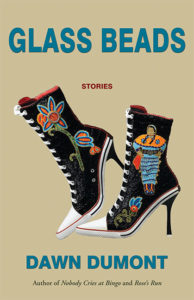
Also, she taps into a universal feeling right off the bat in the opening story, “Kokum’s House”… with a line about how if you’re told something often enough, no matter how sad….“tears don’t come after a while.”.
The tone of the book is….. let me tell you a story about people.
That the characters are indigenous isn’t incidental.
Not for one moment do we forget these are Native kids growing into Native adulthood and that there are issues, events and problems that are specific to them and to no other culture (starlight tours). But neither do we forget for a single moment that there are issues, events and problems these characters experience that are universal (the floundering of youth, drugs, alcohol and parties), and it’s the way she blends things that gives the book its power.
Dumont has written what might be one of the hardest stories to write, one that features a specific culture (it could as easily be a specific race or religion, a sexual orientation… anything that isn’t WASP and cis-gendered) without shining a light on that ‘difference’ or making the difference the story.
It’s not about being indigenous any more than a story with white characters is a story about whiteness.
It’s about Nellie who is level-headed and wise and not especially the popular one, the one who “… had never worked as a waitress but she had delivered beers to her dad in the big chair.” And Everett, who womanizes and drinks too much and to whom she’s emotionally drawn.
It’s about Julie, whose attractiveness is part of the reason she succeeds and part of the reason she fails.
“What other people wanted came naturally to Julie and they weren’t complimenting her so much as expressing their desire to have it.”
It’s about these indigenous kids looking at Cosmo and Chatelaine, reading about diets and fung shui, just like everyone else.
It’s about Taz who strives to climb the ladder of Native politics and lands a job with the federal government, in land claims. He calls himself a hired gun. “I come in and bury the Natives in paperwork.” He says it pays well but a comment puts it into perspective. “Enjoy that blood money.”
It’s about what works and doesn’t work on reserves. The band that neglects to send tuition, resulting in a student being unable to register for college.
It’s about how there’s a perception that being in the city will be different than being on the reserve, “… he won’t drink in the city because being away from the reserve will allow him to make connections… he would be building things, not tearing them apart. Crow’s Nest was behind him along with all of his sad eyed friends and their growing guts and whining that the chief and council sucked but never doing anything about it.”
And it’s about reality.
“But the people in the city turned out to be exactly like the people on the rez. There was always another party, another reason to turn it up.”
Dumont doesn’t put a glossy sheen on anything. She admits there are problems on reservations, with Native governments, people with all kinds of differing views. There isn’t one Native Culture. But neither does she shy away from softness. The sense of community is strong and comes through.
Toward the end of the book, when the characters are young adults, a more adult focus on what’s happening within communities comes to light. In one scene, men just shooting the shit, eating Chinese food, the tone becomes serious when talk centres around how the Assembly of Chiefs has lost connection to what’s important.
“I see that our people are getting arrested, locked up, committing violence or getting dumped by the side of the road – I see the young kids on the streets wandering – where are their parents? Why aren’t they at home? – like how I was at home at their age, doing my homework, watching TV with my family… that’s where kids should be… because pretty soon they’re not kids anymore, they’re adults and then we’ve lost them.”
Native youth…. youth is what’s important.
“That’s what those fuckers should be focusing on.”
The title, Glass Beads, doesn’t have a corresponding story, leaving me to wonder what the reference is. My interpretation is the idea of trading… what we trade, what anyone trades, for what they hope will be a good life.
And how we forge ahead when that trade turns out not be an entirely a fair deal.
While the stories are stand alone quality, they’re so much more when standing together. For that reason I prefer to think of the book as a novel.
And I would absolutely recommend starting at the beginning.
♦
Glass Beads is available at Hunter Street Books and Blue Heron Books.
Support indies! (These are two of my faves.)
♦♦
Thanks to one of the comments I picked up a copy of Nobody Cries at Bingo, and not only loved it, I think it ought to be essential *Canada150* reading. What a brilliant way she has of presenting modern indigenous life so that it feels simply like life, no labels, yet we feel the difference. Such subtleness, and that humour….
“Auntie and Mom looked at one another and shook their heads. What had happened to kids these days? Back in their day, a kid was lucky to get to go anywhere. Growing up in a family of twelve, you were lucky if your mom remembered your face, never mind took you to bingo. And if you did want to go to bingo, it wasn’t just a quick five-minute drive, it was a two-day journey involving a horse, a wagon and three portages. Now those were days when people appreciated bingo…”

A guy playing guitar next to a basket of chanterelles, which to this day I regret not buying. The next day I go back, no basket. So in my broken french I ask if there will be more and he shrugs almost sadly and says something like ils ne sont pas mes champignons, madame….
The expression on the fish monger’s face when I enter his tiny shop, wave at the air and say (enthusiastically): mon nez est tres joyeux!
The woman at the b&b whose english is on par with my french (which makes me so happy) and where, after determining that I do not mind that my room has only a shower and no tub (this alone feels like it took the better part of twenty minutes), I receive la cle and decide this tiny quirky space with a bougainvilla covered porch, tivoli lighted tree and room with a tiny humming fridge and a most magnificent view of the parking lot is so very much better than the place the tourist office recommended, which, instead of bougainvilla on the porch, had three grouchy old men sitting in rockers.
My dinner of smoked salmon from the fish monger, which I eat on the rocks at the beach as the sun sets.
The older woman, swimming in the cold water of the harbour — pure joy — and the way, ten or so minutes later, she’s joined by another woman and they hold hands, jump and bob about in the waves.
A child playing at the shore and the slant of late day sun on his face.
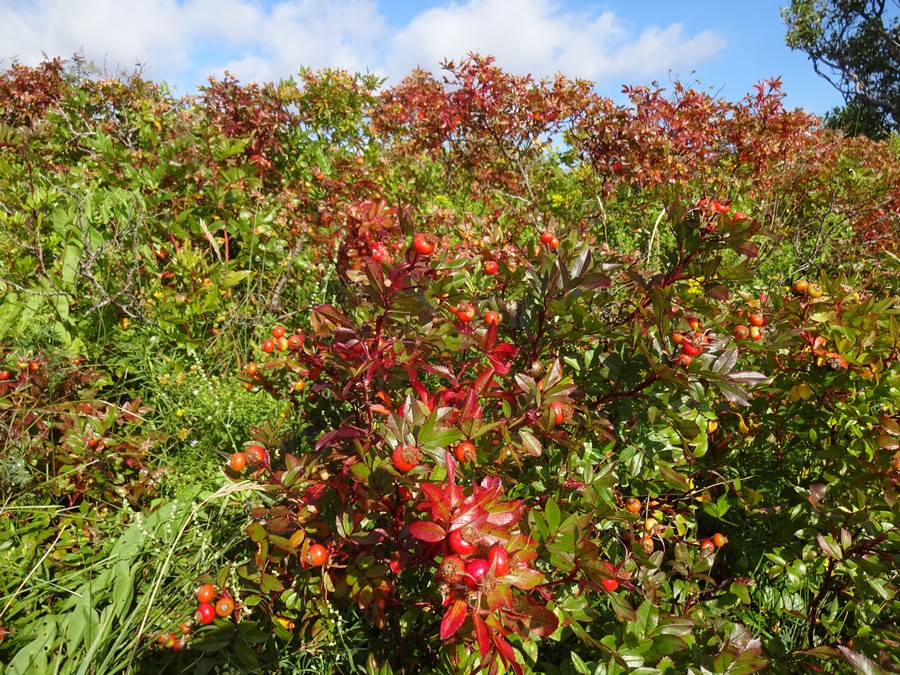
The rosehips I pick and bring home to mix with calendula and borage flowers for tea.
The food, everywhere. (I vow, again, to improve my french if only to be able to at least order a meal without feeling like an eejit in this kingdom of cuisine.)
The long fields of long Kamouraska grass.
A tree outside the museum, covered in knitting.
This patio on the water, and that one… hidden in a garden.
The bakery!
The small lights of a boat across the river pose questions: where has it come from? where is it going in this dark night? The best guess is that it’s coming for dinner.
The curious note I make in my journal — cafe avec caffeine, et sans caffeine. Curious because I don’t drink coffee.
And this, copied from somewhere…. dans la vie, il n’y a pas de hasards, il n’y a que des rendez-vous.
(Driving back from PEI, September-almost-October, 2015)
♦
Other (not always) wordless friends:
Cheryl Andrews
Allison Howard
Barbara Lambert
Allyson Latta
Elizabeth Yeoman
 Matilda Magtree