no labels

Over at Fitch Happens, Sheree Fitch has written an interesting post on the question of what is children’s poetry? and why it’s even a question—in the end determining that “children’s poetry is poetry”… to which I say hallelujah, thank you and yes. I couldn’t agree more and would only add that society’s analysis of art, generally, combined with the impulse to categorize, complicate and impose labels on everything, serves no purpose that I can see except to make me tip over with the weight of it all.

Moving slightly beyond poetry—and if it must be defined—then, okay, what is a children’s book, story, poem, song…?

I suppose it’s something created with the child-nature in mind, however that doesn’t mean its appeal needs to be limited to children. I collect picture books because they’re gorgeous works of art on many levels and I love reading them for their whimsy, humour and joy as well as their philosophy and depth; they remind me of aspects of life, who we are, what’s important, in a way that nothing else does.

I’d like to think that children, also, are benefiting from reading outside the ages suggested on the backs of books—both higher and lower ages—and that teenagers are including both middle grade and adult books among their choices, and vice versa in all directions.

When we read as children, or are read to, we take away one thing, but if we dare to (are allowed to/allow ourselves to) come back to the same book as an older child, a teenager, an adult, we get something entirely different (or—also very nice—are reminded of the original insight). As with any art form, we take from it what we need at that moment.  When we read to our children, that’s one thing, but my hope is that we don’t read children’s books only because we have children, but because we were children, and because there’s bits of us from that enchanted time we’d be wise to try to hold onto.

Labels are useful for publishing houses, bookstores and libraries but we mustn’t let that limit our choices, for ourselves or our kids (or the gifts we give each other; I love giving picture books to adults).

Consider those merry chaps, those pre-label Grimm Brothers, who wrote at a time when stories weren’t specifically for children and whose stories can absolutely be consumed by all ages and then consider what’s been done to the original “faerie tale”— Disney is a good example of “kiddifying” work. In commercial hands stories quickly become shlock, so much candyfloss.

Maybe THAT’S what we’re talking about when we talk of “kid stuff”.

But that stuff isn’t the real goods—because real words are ageless. And because everyone knows once you’ve discovered the real thing you’ve discovered it for always.

~

From the Re-Run Series: orginally posted November, 2011.

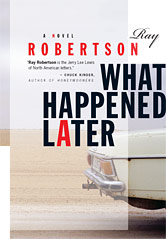
this is not a review: what happened later, by ray robertson

 
My favourite books are always those where not much happens except entire universes quietly change. Both the characters’ and mine.

Ray Robertson’s What Happened Later is such a book. I read it twice last year. Each reading brought me deeper into the language with layers yet to be discovered.

It’s all about the sentences.

Written in two story lines—the first, a fictionalized account of Jack Kerouac’s last road trip, a kind of going home, to find his ancestral roots in Quebec. The second, a fictionalized account of a boy named Ray Robertson who’s trying to get away from home—1970’s small town, Ontario—and find a copy of On the Road.

In alternate chapters and distinct voices, the stories weave back and forth through time—and not much happens. Except life. On every page, in very sentence—every word is full of what feels like absolutely raw truth—not fact necessarily (it’s fiction, right?), but truth. 

The chapters play beautifully off each other—from the innocence and simplicity of Ray’s life and his introduction to Jim Morrison:

“Before Jack Kerouac could change my life, Jim Morrison had to save it. Every Almighty needs an ambassador down below to do his dirty work. Mine wore tight brown leather pants and shouted out his rock and roll couplets like it somehow actually mattered.” 

—to Kerouac’s bennies for breakfast, falling down drunk with booze and resentment, guilt; his brilliance in offering up what every story needs:

“… a flesh and blood body on the other side of the book telling the story and not just a bunch of nouns and verbs and adjectives held together under house arrest by a bully bunch of rules of composition some mastermind mammon cooked up to keep everybody talking and thinking and living the exact same way. Because ask yourself this, Mac: Were we born and do we suffer and do we die just so we can all sound the same? What a spit in God’s eye, that.” 

The book begins close to the end of Jack’s life and close to the beginning of Ray’s, but ultimately, we’re left mid-stream in both, knowing how each will end. Along the way we see Kerouac in a new light as he mourns the loss of a Georgia pine, holds a kitten up to see the moon, asking aloud how science could explain that; we discover tenderness, vulnerability, and a man whose greatest desire was “…to be Cervantes alone by moonlight.”

I can’t think of a better shape or tone for this book. There’s an almost physical sense of movement with each chapter—from the jaded ‘star’ who’s had anything but a normal life, desperate to get away from society’s narrow-minded idea/treatment of ‘fame’—

“Remember how last week you were a spontaneous prose poet, a singular bard of bop, a lyrical visionary declaiming a previously unknown hipster-rich American underbelly? Yeah, well, now you’re a sloppy, undisciplined, self-indulgent media creation prone to sentimentality, immorality, and obvious sensationalism. Next, please.”

—to Ray, living in this tiny, loving world of grandparents, leather sleeved sports jackets; where he so sweetly sings the national anthem to his father in the bathroom; a place where his greatest career challenge is climbing the ladder of the Sears sales team; a world of wry observations—when he accidentally kisses his own shoulder while making out with his first girlfriend, he reflects “…but that’s okay too…”. This mini philosopher, obsessed with finding the answers to life through Kerouac—all such delicious irony.

Despite my love of the fiery, gorgeous, richly written Kerouac chapters—at the close of each, I found myself turning the page, eager and curious to read more of young Ray, and immerse myself in the very different but just as honest tempo of his life. In many ways it’s Ray’s story, but not completely, because to tell either of the two on their own would render both less.

—This is my part of the movie, let’s hear yours.  Jack Kerouac, Tristessa  (Epigraph, What Happened Later, by Ray Robertson, 2008, Thomas Allen)

~

From the Re-Run Series:  originally appeared in February, 2010.

(at)eleven with steven mayoff — fatted calf blues

“Eating is our earliest metaphor, preceding our conciousness of gender difference, race, nationality, and language. We eat before we talk.” ~Margaret Atwood from The Can Lit Food Book

From the start, food has featured large in my friendship with Steven Mayoff. We met at the inaugural Seawords workshop series on PEI, in 2009. A brilliant experience and a magical place where words and the business of words were the daily focus from early morning til night.

But it’s the food I remember most.

Oysters right off the boat, lobster, patios with beautiful watery views, roadside chip vans selling fresh-from-the-red-dirt spuds, mussels ten thousand ways, a tiny mom and pop diner on a Charlottetown side street that made the kind of perfect toast I haven’t eaten since I was a kid, and the giant bowl of cioppino Steve and I shared at one exceptional place he kept suggesting I try: The Dunes (officially now one of the top ten places I’ve ever eaten; and I’ve eaten a lot).

Food continues to find its way into most of our e-conversations, if only as a closing comment—and due to Steve’s powers of description, I can sometimes almost smell what his foodie-extraordinaire wife, Thelma, is fixing for dinner (especially hard on the days I’m having sauerkraut).

Despite the title, Fatted Calf Blues is not about food. But in my world, all good books inspire culinary thoughts at some level.

The meal inspired by Fatted Calf Blues can be found at the end of the Q&A.

~

1.  What literary character did you identify with as a kid?

SM:  As a kid the only literary characters I knew came from TV and movies, such as The Wizard of Oz or Winnie the Pooh. I actually walked around with a posse of imaginary cartoon friends (Huckleberry Hound, Yogi Bear, etc.) like we were some kind of street gang. They were my confidants.

I didn’t do very much reading, although I do remember picture books about mythology and dinosaurs. And I remember being fascinated by book spines on our shelf and strange titles like Tropic Of Cancer and Nine Hours To Rama and unpronounceable author names like Kazantzakis. There was also a book about the Holocaust that had gruesome photos of shrunken heads and lampshades made of human skin. That certainly caught my attention.

The first books I remember actually reading were The Apprenticeship of Duddy Kravitz and Catcher In the Rye in high school. Of those two, I’d say I identified more with Holden Caulfield: the loner, the outsider, someone with a rich interior life. Duddy was more of a go-getter, which is not how I saw myself, although the influence of Richler’s book is still with me. Salinger influenced me more with his short stories.

2.  Can you recall your earliest poem, story or finger-paint-illustrated trilogy?

SM: I remember making a finger painting when I was probably around 5 or 6 years old and having my sister, who was around 19, ask me what it was called. I’m pretty sure I said something like “Snakes of Love.” I knew it was a grown-up thing to say and my sister was both amused and shocked.

I drew a lot as a kid, mostly super heroes and later on rock bands. I didn’t start writing poems until my last year of high school. I had three published in the school literary journal. One was a description of a pair of construction boots “looking at the world through unlaced eye-holes” or something like that. Another was some kind of meditation on the contradictions of labels while trying to figure out my identity. I can’t remember the third. I was also into writing song lyrics as a natural outlet for being a frustrated musician. I didn’t attempt a short story until my late twenties.

3.  Are there recurring themes in your writing that surprise you?

SM: I’m surprised when any kind of recurring theme arises, because I don’t think that way. I’m not even sure what the recurring themes are. Alienation, I guess. Ummm…good hygiene? Seriously, I do notice things in retrospect that, more often than not, don’t surprise me. But I am a great believer in what Wayson Choy said: “I know I am a writer because until I’m writing I don’t know what I know,”

4.  Do you work to a routine, a schedule, a daily word count?

SM: The only real routine I work to is the urgency in my head that I have to get something done. How that happens is anyone’s guess. There’s no particular schedule I follow, except that I try to write every day, usually in the afternoon or evening. The idea of a daily word count makes me want to blow my brains out. I know the professional thing is to see writing as a job, but I’ve always resisted that. I worked at various jobs for most of my adult life, so I’m happy not to have one now. In one way I kind of envy writers who say they wake up and bang out so many pages or words first thing in the morning. Waking up is a long process for me.

5.  What is a favourite passage from any book?

SM: “Listen: Billy Pilgrim has come unstuck in time.” from Slaughterhouse Five. It’s a simple sentence (I suppose I should say “deceptively simple”) that leaves a lot to the imagination. It could be describing the most liberating experience or the most horrifying nightmare. Surprising how often those two things go hand in hand.

I’d have to say that sentence (as well as the book and Vonnegut in general) really influenced my writing. The whole idea of coming unstuck in time is a kind of madness where one discovers that linear time as we understand it doesn’t exist and everything – past, present and future – is happening all at once. That’s what fiction and the writing process is for me: a kind of madness where truth reveals itself, but not in any coherent way, until I begin writing and trying to make some kind of sense of it. I learn things about my characters and the situations they are in (and also about myself and what is important to me) as I slowly organize the events and give shape to the story.

6.  What was the best advice you ever received as a writer?

SM: When I was in high school I asked an English teacher what I needed to do to become a writer. He looked down at me soberly (he was a giant of a man with very blue eyes) and said: “You have to suffer.” That scared the crap out of me and maybe even deterred me a little, because I didn’t know what “suffering” entailed. I thought of that when I published my first book, Fatted Calf Blues, (I even thanked that teacher in the acknowledgements). In retrospect, I like to think he was really telling me to go live my life so that I’d have some experience to enrich my writing. I appreciate the fact that maybe he was just treating me like an adult and giving me the real information, thinking it would either scare me off or inspire me. And it did both.

7.  The opening story, The Most Important Man, sets the tone of ‘displacement’ that runs through the collection, personal discomfort, shown through discomfort with the physical space the characters occupy. This leads me back to the theme question: was this intentional, something you were exploring, the idea of ‘not fitting’… or did you recognize the thread only after the stories were written?

SM: To be honest, I didn’t realize there was a thread until you just mentioned it. While promoting FCB I was asked what the connecting idea of the stories was and I usually tried to bluff my way through and say all the characters were searching for some notion of home. “Displacement” is probably a better answer. Anyway, these things only become evident after the fact. I never or rarely think about them beforehand. But again, in retrospect, the themes of displacement and looking for a home are very personal for me, so it only seems natural that they would creep into my writing. I’m obviously attracted to those kinds of stories, so I have no doubt an unconscious part of my creative process preplans some sort of exploration of those themes.

8.   A couple of the pieces are written in either the voice or POV of a woman; what were the challenges with that, if any?

SM: I can’t think of any real challenges. I invest myself in my characters and try to be a kind of witness to their lives. I never think to myself something like: “what would a woman do here?” because I’m looking for the humanity in the character, although I do believe there are specific differences in the attitudes of men and women. Men might have more difficulty expressing themselves and women might be more open about their feelings, but people as a whole don’t voluntarily give out too much information without some prodding. So discovering any character’s voice or POV entails me searching for the right buttons to push.

9.  If the title story were made into a film, who would you like to see play Mavis Jean? (Any other casting ideas?)

SM: That’s a very timely question as I have just returned from the Screenwriters’ Bootcamp that happens every year in Charlottetown and is sponsored by the Island Media Arts Cooperative (it’s only open to Atlantic Canadian writers). I was in an adaptation workshop with renowned story editor, Ken Chubb (he was involved with the Canadian horror film Ginger Snaps and the CBC mini-series Dragon Boys). I’m trying to adapt the story Fatted Calf Blues into a screenplay and it has been a long process. After this workshop, I now find myself back at square one, although I have a better idea of how to go about it.

Mavis Jean: Hilary Swank, Tara Spencer-Nairn (also, Nancy Roberts, although she is older, would be interesting)

Milo: Michael Cera, Elijah Wood

Two-Gun Billy: Chris Cooper, Nicholas Campbell

Vesta:  I used to think Jackie Burroughs was pefect, but she’s passed away, so my alternative would be Toronto actor, Barbara Gordon. Or even Sissy Spacek.

10. Why short fiction?

SM: It has the expansiveness of prose, but matched with the precision of poetry. It is a kind of postcard portrait that allows you to glimpse life beyond its edges. Every short story should be a kind of map you might find in a mall that says: You Are Here.

11. Choices:

Coffee or tea?  Coffee. I do like a nice caffeine buzz.

Lyrics or prose?  Lyrics. My fantasy job is to be a lyricist in a rock band like Keith Reid in Procol Harum or Pete Sinfield in King Crimson. (I bet you will have to Google these). The next novel I want to write will have a lyricist as its narrator and a series of song lyrics to complement the unfolding story.

Ocean or river?  River. I live right by one and I think a river has more metaphorical mojo.

Pen or keyboard?  Keyboard. I find it more playful. I like tapping things. Also, it placates the frustrated musician in me. I’m the Elton John of hunt-&-peck.

Kundera or Beckett?  Kundera. His quote: “The present moment is unlike the memory of it.  Remembering is not the negative of forgetting.  Remembering is a form of forgetting.” from his book of connected essays, Testaments Betrayed, helped me get a handle on my novel manuscript, Blessing and Song (which I’m currently shopping around).

Scrambled or Poached?  Poached. On toast. I have it rarely, so it’s a treat.

Editor’s Note: Food and Drink inspired by Fatted Calf Blues

Beer Steamed Mussels (aka moules) and frites with an icy cold selection from

The Gahan House Brewery

~

Steven Mayoff was born and raised in Montreal and now makes his home on
PEI. His fiction and poetry have appeared in magazines across Canada and the
US, as well as in Ireland, Algeria and France. His story collection, Fatted
Calf Blues, won a 2010 PEI Book Award, was shortlisted for a 2010 ReLit
Award and was a Finalist for the (Maritime) 2011 CBC
Cross-Country Bookshelf.

His web site is www.stevenmayoff.ca

From the Re-Run Series: originally posted in April, 2011.
this is not a review: burt’s shawarma, by kathleen winter

Rhonda has been angry and unhappy for a long time. It doesn’t help that she lives on the outskirts of a town whose claim to fame is being the nation’s teenage suicide capital “…just past the point where the Pinegate Pizza won’t deliver”. Nor does it help being married to Dan, a farmer with a soul as romantic as a milking machine. God bless him though, he’s one of those guys who thinks that duty and maintaining a roof over one’s head is enough. In his own out-to-lunch way, he tries. He’s probably in as much pain as his wife but it matters to him less or it matters in a different way. He takes solace, not in conversation, not in reaching out to her, but in immersing himself ever deeper in the work of livestock, insulation, leaks in the barn. Nothing personal… these are merely the things that matter.

Part of her knows he won’t change yet another part continues to believe he’s capable—if he tried—of finding a way in. She’s waiting for the moment where he’ll sit down next to her in his cowshit covered clothes and say to her:

“…Why don’t I get a shower and make you a cup of tea? Hoffman’s elm is like us, isn’t it? I’m sorry you’ve been lonely inside. Let me touch you? Not with my paws—with the word rain, the colour green, with eating bread and sitting here till a yellow bird comes and eats the crumbs.”

She’s starved for him to merely try. 

When Dan suspects (correctly) that Rhonda is having it off with Burt, the local ‘exotic’ who runs a Lebanese cafe, and who thinks Rhonda is perfect, he buys her tulips for Valentine’s Day. This is huge in their dry and loveless union and enough to keep it going for another painful stretch, despite her apathy.

“…she no longer cares that her vinyl toilet seat has torn pieces that stick up and prickle her butt.”

While she realizes the thing with Burt can’t last, she takes some comfort in the knowledge he can be replaced. By which logic, so can Dan, albeit with a bit more difficulty and anyway, what would be the point?

“You can tell about the state of anyone’s marriage from their medicine cabinet,” she tells her sister Bett. Her own has empty calamine lotion bottles piled in with rubbing alcohol for ears pierced fifteen years ago, ancient antibiotics, blunt useless tweezers and a stack of wrapped soaps with cobwebs on them from the Holiday Inn in 1989, which was the last time she and Dan took a trip together, and that was to bring home a trailer for getting show cattle to the fall fair. She doesn’t care about the fence Dan promised to make for her garden twenty years ago. She doesn’t care that Dan had an affair when the kids were little, or that there has never been chemistry between Dan and herself. She doesn’t even care that the magic with Burt is dying out. Bett calls him an interim phase and that’s fine by Rhonda. What matters is that her anger, her poisonous anger, has drained away, thanks to Burt. She watched her mother carry the same anger, panicked when she realized she had it too, knew one day she was mad as hell at her whole life and it looked like there was nothing she could do about it. Burt stopped the time bomb with his hideout, with its cool walls and blue shadows where she didn’t have to do things from morning till night in which she had no interest. She will feel relief deep down, be able to breathe deep down, whenever she thinks of Burt even after this is over, which it almost certainly is already, with no illusion of anything permanent. No one has mentioned Rhonda helping Burt run his cafe, but not in the same way that no has ever mentioned her helping Dan run his farm.”

— excerpts from ‘Burt’s Shawarma’, from the collection BoYs, by Kathleen Winter

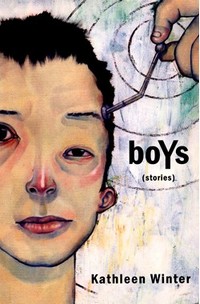
Three Impressions Overall: delicious ironies, entire worlds sympathetically drawn in mere pages, and the kind of truth that makes you squirm as it pulls you forward, then leaves you pretty much where you thought you’d be left for pretty much the reasons you thought you’d be left there. Only thing that’s changed is that now you’re aware of the ‘why’. It may not feel like enough but of course, truth is always more than enough. (And may I say I love the cover of this gorgeous collection.)Note: this post first appeared in May/2011 as part of Year of the Short Story (YOSS) celebrations.

Now part of the Re-Run Series.

______________________________________________

—Purchase boYs online at Blue Heron Books.

unchaining myself from the desk (aka: it’s planting season)

Am taking some time off, and off-line. A few weeks.

Not that I won’t be writing or [eventually] sharing… just want to be loose for a while.

Also lots to be done in the garden. Those cucumber seeds won’t plant themselves.

So I’ve lined up a few re-runs—

—Some favourite book posts, and the At Eleven Q&A chats I’ve done so far— with Steven Mayoff, Karen Shenfeld and Teri Vlassopoulos. [More chats to come this summer.]

Hope you’ll enjoy this wee retro spin on things.

In the meantime, if you’re looking for me, I’m the one in the floppy hat with a fistful of weeds.

define treasure

A few weeks ago I got an email from Allyson Latta, asking if I’d be interested in participating in her Seven Treasures series, which, she explained would amount to simply listing a few items that, for whatever reason, I couldn’t part with.

I was delighted with the idea of course, honoured to be asked.

At first what came to mind were the obvious things when one hears the word treasures—i.e. pirate loot and pots of gold.

But given that I live in a world of stones collected from the beach, feathers that appear magically at my feet, and a few pieces of art… there’s not a lot of lootish takings to list. And anyway, things that can be bought are never the real treasures, the value attached being purely arbitrary, an abstract created by some vague entity. Not to say that a treasure can’t have monetary value, but I think that quality is incidental, secondary at best.

So next my thoughts went to treasures so valuable they don’t need mentioning—the people and animal ones.

But they don’t need mentioning. (Have I mentioned that?)

Which brought me to the most interesting list of all: treasures I didn’t know were important to me until someone asked.

I was surprised by what surfaced. (The bowl I ate popcorn from as a kid? Are you kidding me? This is what I’m attached to??) But no, of course not the bowl, but what the bowl represents, what I think about every time I see it in my own cupboard and remember its position on the second shelf above the flour and sugar tins, in my mother’s. I remember where I ate that badly burned popcorn, made in a beat-up aluminium pot (used only by me for, um, badly burned popcorn)… what I watched on TV, the pages I turned with buttery fingers; I remember the coolness of the basement, the sound of my dad’s lawnmower through the window, my mother sewing in another room. I can’t remember the bowl being used for much else. Maybe it was, but it felt like mine. How privileged I feel now to have been given this ‘space’ of my own—space the size of a bowl—yet large enough to hold the sound of my mother’s sewing machine.  No one, including me, could have guessed what a gift it was.

It’s always this stuff that matter most, things that connect us to ourselves in ways we hardly know, and that might otherwise be lost.

So this is what the lovely Allyson has so beautifully and thoughtfully presented on her blog.

My seven were first up.

And I see that Rebecca Rosenblum’s seven have just been posted. (Oh that spider plant! Of course. How could she ever get rid of it? It’s like a tiny striped pet!)

Lovely idea, this. And such fun. Both the writing and the reading. And a great question to ask yourself or family and friends. I sent an email to a few friends recently and was amazed with what they wrote back.

Happy excavating!

it’s just that they’re everywhere…

Hello, Sigmund. It’s me.

Yes, again.

I’m fine, really. No, really I am. I’m over the whole, you know… thing. I don’t even think about it anymore. Ever. Except when I’m walking around and I look up and there one is. Have you noticed how they’re everywhere?? Is it just me? They’re everywhere, right?

It’s just that I don’t really understand what the problem ever was. I mean, the guy could make anything. He built real houses, the on-the-ground kind, the kind people live in, have keys for. He tore apart and rebuilt the inside of our bungalow at least twelve hundred times. Nothing was ever a problem. Give him a few pieces of wood, some nails, and he could knock you up whatever you wanted. A couch, bookshelves, carport, fence, spice rack—the sky was the limit.

So you’ll excuse me if I find it hard to fathom that when I made my (what I still believe to be miniscule) request, he stood there and said—as if this made any sense at all: sorry, kiddo, the pear tree isn’t big enough for a tree house.

I can tell you, Sigmund, I nearly dropped my ice cream cone right there and then. Neopolitan.

Oh yeah? I wanted to say. Well, dad, it sure as hell looks big enough from where I stand…

But I didn’t say anything. Shock probably. And then he went whistling off in some direction, and eventually I took my neopolitan and my skipping rope and went slurping off in another, and that, I guess, was supposed to be that.

Thing is, Sigmund. Every other tree in the world is big enough… have you noticed?? Every other tree.  In the world.

But it doesn’t matter.

I’m fine.

Really.

I’m going to have a lactose-free cone now. Vanilla.

And if you don’t mind I’d like to be alone.

Best treehouse ever…? Click here.

That—in a pear tree—would do nicely thank you.
Is that asking too much??

(Late addition, because I will keep adding them as I find them: tree villa)


how to spend three days in niagara

 
Oh Niagara. How I do love thee. Let me count the bottles of wine and bushels of fruit.

—If you can, begin your Niagara love-in on a Thursday. Less traffic but close enough to the weekend to feel celebratory.

Begin with lunch en route, in Ancaster, at the Mill. Don’t worry if it’s raining, the room is all windows and made for watching rain fall while you eat. Have the pickerel and chips and Soiled Reputation salad greens with shaved black radish, carrot, fennel and Dijon dressing. Just have it. Order a glass of Tawes Echo chardonnay. And don’t forget the rain.

On the way to Hamilton—where you will spend a few happy hours strolling through the Art Gallery—stop at a roadside nursery and buy seeds: arugula, mesclun, radishes, beets, carrots, chicory. And one asparagus plant for the cats to eat until the goldenrod in the garden is big enough to pick for them. [Cat grass just sticks in their throat and makes them gag.]

If you’ve missed the William Kurelek exhibit poor you.

Later, stop at Bryan Prince Books. Listen as the amazing and cheerful staff chat with customers by phone, in person, with each other, with the elderly man who toddles in, a paperback in his hand, and says it turns out he already read this book, can he return it and choose something else, and the amazing and cheerful staff say of course you can, Henry, and within two minutes Henry has chosen a hardcover, the title of which I can’t see, and happily pays the difference, and then toddles back outside, smiling, all flat cap and walking stick.

Consider stopping  for something just because a place looks like fun and you can see cupcakes through the window not to mention that you’re anxious to read what you bought at Bryan Prince. But, really, you have to admit you’re still full from the pickerel. Press on instead.

Take a picture of a fountain made for both mid-range and ground level thirsts, and smile at the woman who shakes her head as she passes and tells you that’s a silly thing to take a picture of…

Drive to your hotel in Niagara-on-the-Lake, which is one of your favourite places in all of the world and is privately owned and run by family that seems to enjoy what they do—and it shows. Go off season for good rates and fewer tourists. No one likes tourists… blech blech. You of course are not one.

Change and go for a swim.

Immediately.

Have a late dinner in the sports bar. Have a sublime thin crust pizza. Or quinoa salad.

And then… at last… climb into a most comfy bed and read that book you bought at Bryan Prince.

In the morning, swim. You will have the pool to yourself if you go at the right time. I’d like to tell you precisely what that time is, but I don’t know. Try to work it so you’re done your swim just before the aerobics class comes in, although, according to one of the women, you’re welcome to join them.

Have breakfast at Liv. Complimentary smoothies start things off. Might even be chocolate banana…

Have the eggs benny.

Begin the wine tour with Niagara College Winery, a teaching facility as well as winery and where they’ve built a whole new beautiful building—one of the loveliest features being a wall of wines, a bottle from each of the wineries in the area.

Visit the College greenhouses where you would love to be a student, and buy a small pot of oregano and a large potted snake plant. One to eat with eggs, the other because it’s happy minding its own business in the shade and has no appeal for cats.

Visit Staff Winery and be met by Brix, the happy giant puppy. Buy some Toute Sweet chocolate to go with the Baco Noir.

Visit Tawse Winery because they are bio and love talking about life without pesticides. And so do you. Buy some Riesling.

Drive to Beamsville via the back roads and pull over to walk or stretch or breathe fresh air whenever the mood strikes. Do not be tempted by the chocolate in the back seat.

Stop for lunch at August Restaurant, where even though the last customers are leaving because it’s twenty to three and they close at three for a couple of hours, the staff says don’t be silly, come on in. And the music is wonderful and no one will rush you and the waitress—who is charming and pleasant in exactly the right way—will tell you she started off as a customer and she loved the food so much she begged them to let her work there for free. Or meals. Or something. I think she gets paid now. She is a gem. And she’s not kidding about the food.

Think to yourself: at this moment I am completely and utterly happy.

Say it out loud if you’re with someone.

Drive slowly back to the outskirts of NOTL, where your comfy bed awaits for a short nap.

Stretch.

Shower.

Walk from your hotel through the gardens of Niagara College, to the College’s beautiful restaurant, Benchmarkwhere you will be surrounded by windows and wonderful views, culinary students eager to ply their newly learned skills, and food that has never failed to satisfy. Afterwards, you will be grateful you’re walking back to the hotel, but sorry it’s only less than ten minutes.

The final day [which may well be Saturday] wake and swim and have breakfast at Liv and walk through the grounds, then say your goodbyes to this delightful home away from home and promise to come back soon.

Discover a new winery. Make it a small one, off the beaten path–one that looks like nothing much from the outside, yet on the inside awaits a brilliant chat with owners and some excellent Riesling to add to your ever-growing Riesling cache.

Drive to St. Catharines and go directly to the Farmers’ Market. Buy arugula and blue iris, freshly caught trout, and whatever else demands to go home in your carrier bag. Then walk over to Hannelore’s Book Shop where, if you know the place well, you can navigate through the stacks and find just what you’re looking for. If you’re a newbie, give yourself time and enjoy the adventure. [Note: Hannelore has no website. She’s too cool for that. But anyone will be able to tell you where to find her.]

You could of course have lunch at the market or at any number of places downtown, but on this day you have a hankering for a lakeside table, so take yourself off to Port Dalhousie [where only the locals know how to pronounce it] and treat yourself to the joy at Treadwell, where the food is local and, I swear—it doesn’t matter what you have—out of this world delicious, where the staff is welcoming and smart and so happy to see you and you wonder if the house across the road might come up for sale so you can eat here every day.

Eat slowly. Sip your wine. Make this last. You won’t want to leave.

In fact what you’ll want to do is order the appetizer again for dessert. [And don’t think you haven’t done this before…]

If you’re so inclined, walk over to the beach, take a ride on the carousel if you dare. Be careful. Some of those critters move.

Eventually the QEW will beckon and it’ll be time to head home but not without first stopping at Foreign Affair to sample their unusual amarone wines and walk about the grounds of Vineland Research Centre, which used to be the Experimental Farm your parents took you to on Sundays when outings on Sundays meant suits and ties, hats, gloves, patent leather shoes and that horrible pink plaid pleated skirt that made climbing trees very difficult.

Have I mentioned it’s still raining?

Have I mentioned it matters not at all?
Greenhouse at Vineland Research Centre

◊♦◊

More Travel:

Montreal
Stratford
Prince Edward Island
Miami
Peterborough
Chile
Vancouver