
with thanks, always

Last year I was with my mother on November 11th for Rememberance Day ceremonies at her nursing home. I remember how much she enjoyed the outing, slept through the whole shebang. This year, she’s no longer here and at 11 a.m. I found myself somewhere far less reverential, in a busy shop, running late. I don’t wear a watch and didn’t know the time until a bugle suddenly sounded from outside; a few people looked at each other as if wondering what they should do, I mean, in the middle of a store and all, in the middle of shopping. But no one ignored it.

And then—unlike a fire bell where you assume it’s probably not even real—everyone, every single person, just stopped what they were doing. No one came in or went out. The cash registers were quiet, people stood still, stopped talking. I don’t think anyone even looked around. It was just this amazing group action, this vibe of tacit reverence, and whatever individual things were going through individual minds was overshadowed by a kind of collective understanding. Though still taken by surprise in many cases, and distracted to some degree, people were nonetheless willing—seemed grateful even—for the opportunity to recognize this moment, and to do so in a public space—a space that too often keeps people separate. Just for this moment, all of us, strangers from countless backgrounds, saw each other in a different light, one that reminds us that on possibly the only level that really matters we are deeply connected.

And I think we liked that thought very much.

For that and so much more, hats off to the men and women of the past and not so long ago, who did their best on our behalf in the insanity of war.

More than ever, here’s to peace.

what happened to jumping in?

I’m watching a woman vacuum leaves. She’s strapped on a sort of large black bag, something like what newspaper boys and girls used to carry on their rounds, before their parents started driving them. The bag is attached to a long, fat nozzle which she points at the leaves she’s raked into a pile. At first things seem to go well enough. When the pile is sucked up she turns off the machine and empties the black bag into a paper sack intended to be put out onto the curb.

But it’s not quite that simple. 
 
You can’t imagine the difficulty she’s having transferring the leaves from the black bag to the paper one. It takes forever and it’s all a bit of a mess. When she’s done she sucks up the trillions of escaped leaves then rakes up another pile for vacuuming.
 
Now she stops to empty the black bag again but it won’t detach from the nozzle. She fiddles with it for several minutes until the neighbour guy who doesn’t miss a thing saunters out his front door with his hands in his pockets all nonchalant like he wasn’t watching from the window. He offers to help. You can see that he covets her large nozzled leaf sucking machine and is annoyed that he didn’t get one first but pretty soon relief replaces envy as he realizes the thing is a new-fangled piece of crap, unlike his trusty old-fangled leaf blower, which he uses to blow every single leaf off his lawn and onto the street where they’re left in great drifts, free to find their way onto other people’s lawns [possibly causing unpleasant muttering amongst those neighbours who don’t covet leaves as worm food or mulch].
 
The guy has now patted the woman on the shoulder in a good luck with that stupid thing you just wasted your money on kind of way. He chuckles as he almost heads back to his own house but decides to first offer up some long-winded verbosity that I can’t hear but the woman looks bored and irritated and who can blame her? She still has a whole lawn to rake and suck and transfer from one bag to another. At this rate it make take all night. I want to yell: you live on a ravine, for god’s sake—put the leaves in a wheelbarrow and dump them under a tree!
 
The guy goes home.
 
The woman turns the vacuum back on.
 
Then off.
 
Something else is wrong.
 
She fiddles with it.
 
Turns it on.
 
And off. Fiddle fiddle.
 
She does this several more times. On. Off.
 
Meanwhile, the rake is right there. Leaning against a tree. The paper bag is still half empty. It’s getting dark out.
 
On. Off. On. Off.
 
It’s so sad. The rake is just there…
 
This is what I call an alien moment. Things we do that make we wonder how we might appear to someone other than ourselves, to, say a spaceship that happens to be passing by. We’re all guilty in different ways. And not guilty at all of course. Given that we’re only human.
 
The first time the alien thing occurred to me I was at a Sandals resort in St. Lucia where I lay in the sun, slathered in oil (an alien moment right there), watching a couple ride about on those giant paddle boats, my sun-addled brain thinking: hmm, looks like fun until they got semi-stuck, and bobbed about helplessly against this gorgeous backdrop of land and sea, turning in endless circles, waving their arms madly and arguing about how to correctly manoeuvre their fluorescent plastic containers.  
 
Alien moments are times when it strikes me as not that far-fetched to imagine we aren’t the most intelligent life form in town, and that should the little green men and women be looking out their spaceship windows, they could be forgiven for thinking yes! this is it, the perfect time to swoop in, launch an attack, never more confident about their chances of taking over the planet…
 

since i was up anyway…


Lovely as it is to have this extra hour today, I kinda like dark mornings and lighter nights and wonder why we switch back and forth anyway.

Didn’t it have something to do, several thousand years ago, with an agricultural lifestyle — farmers and children needing to get up to feed livestock or walk twelve kilometres to school, every single one of them getting crankier by the day as they bumped into low slung beams and fell into wells until someone with a bit of clout said: I have an idea, let’s rearrange the daylight by mucking about with the clocks.

To which I say fine, but the world is less agrarian now and the lightbulb has been invented and everything. And furthermore, I prefer dark mornings and lighter evenings so I’m often tempted not to Fall Back… but one must conform in these things or one finds oneself missing many buses. Still, if anyone out there is taking a survey, would you please put me down for LET’S JUST PICK ONE TIME FOR PETE’S SAKE AND STICK WITH IT.

Until sanity prevails however… Happy Return to Bright Mornings!

epigraphs, dedications and other things worth mentioning up front


This book is for
my wife Diana and our siblings Carol, Fiona, James, Neil, Adam, Charles and Jo-Jo, together with any others whom I may have inadvertently overlooked.
~ Douglas Sutherland, The English Gentleman’s Child (Penguin Canada, 1979)

The names of all the white people who worked at the Indian schools mentioned in this book have been changed. The events actually happened. We genuinely regret any inadvertent similarity between these fictitious names and the names of real persons.
~ Jane Willis, Geniesh: an Indian Girlhood (New Press, Toronto, 1973)

This book is dedicated to the humble cod. May its fate be a lesson to those who would be humble. Let the meek and tasty stand on guard.
~ CODCO,  The Plays of CODCO (Peter Lang Publishing, 1992)

I was thinking about the way a girl had talked to me on her houseboat in Chelsea, and the way two girls had talked in a singles bar in New York, and the way a German girl had talked in Hamburg, and the way the women used to talk on Saturday night on the last bus from Liverpool to Prescot, when I was a conductor, and the way Germaine Greer and Betty Friedan and Kate Millett and Shulamith Firestone and Marion Meade and other stalk through their books, when it struck me that I had hardly ever heard women talk like this in the theatre; there was a silence like Siberia.
Then in Doris Lessing’s The Golden Notebook I read this sentence: “I thought there here is a fearful trap for women, but I don’t yet understand what it is. For there is no doubt of the new note women strike, the note of being betrayed. It’s in the books they write, in how they speak, everywhere, all the time.”
And so, Old Flames.
~E.A. Whitehead, Old Flames (Faber & Faber, 1976)

Author’s Note: I am not I; thou art not he or she; they are not they.
~Evelyn Waugh, Brideshead Revisited (Little Brown and Company, 1946)

truth

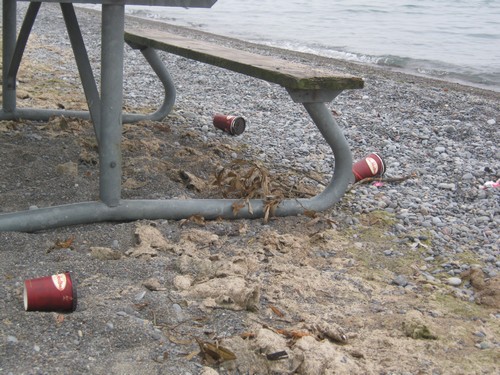
I was at the beach the other day looking for a picnic table I remembered seeing months ago, in summer, that had Truth written on the seat— I wanted to take a picture of it.

The table had been on the sand, close to the water, but now it was gone. Well, it couldn’t be gone, it’s a big heavy picnic table, I thought, it had to be somewhere; somebody must have dragged it onto the grass nearer the barbeques and swings so I wandered about looking for it among the maybe thirty tables—I remembered bold black lettering in magic marker, easy to read—but I couldn’t find it.

Then it occurred to me that despite its bulk it was made of wood and technically could have been burned or broken and after checking every table twice I had to admit there was no reason to assume it should still be there.

But I checked a third time.

And then I saw it. The lettering had faded to almost invisible—I’d never have noticed had I not been looking for it especially.

Thing was, it didn’t say Truth. 

I remembered now.

Truth would have been a fine thing to write, but I’m not sure the single word would have caught my attention the way this had. I remembered reading the bold lettering on that lovely summer day and feeling sadness and shock and wonder at how alone this person must be despite any number of friends. I wondered: where were they now and how were they now, and how would they be…

I remembered feeling helpless, and angry that anyone should feel so alone, hopeful that whoever it was would find the strength they needed, and that we, that society, too, would find the intelligence and compassion needed to understand in a meaningful way. 

Funny how I remembered it all as Truth.

What it actually said was: I wish I was born a girl.


from the bookshelves

 
The culling continues.

New shelves = less space for books = the slow process of reading obscure things in order to make Keep/Toss decisions.

This weekend’s obscurity mission turned up one toss and one brilliant gem.

The toss: a paperback on the monarchy in which one learnt (among other things, how to use words such as ‘one’ and ‘learnt’) that the Queen travels with dozens of merrymakers (many many more than one can even bloody believe), including a Yeoman of the Plate Pantry and a Yeoman of the Glass and China pantry. Yes, they travel with her, and no, the plate guy cannot do china. (And the fact that one does not know the difference between plates and china is exactly why one is not in the monarchy.) Also a hairdresser, footmen, Household Cavalry troopers, ladies in waiting and maids for the ladies in waiting, various clerks and secretaries and personal assistants. A page for pity’s sake. To name but a few. Oh, and her own water supply, which deeply offended the Austrians on a trip to Vienna, given all that fresh mountain stuff they have there.

The gem: A Tough Tale, by Mongane Wally Serote, which I’d paid 99 cents for at Goodwill who knows when and had never read. I was blown away; published in 1987, it’s one long poem about life under apartheid but contains not a whiff of anger. Frustration, sadness, disbelief at the depths humanity can sink, yes, but no rage, no resentment. In one passage Serote refers to the futility of complaint by comparing what’s happening in his country to a mother who’s gone mad, “…you would rather help her to sanity than just talk about her madness.”

My favourite bit comes near the end and though not quite the last word, it could be. It stops me dead and I read it over and over again before I can carry on with the last few pages. I keep thinking about the ‘gift’ of sudden freedom, the reality of And Now What?—that all important question after liberation of any kind, including that currently being experienced in Libya, Tunisia, Egypt and elsewhere, the ‘freedom’ given to the aboriginal people to live in their corrugated houses of mould, the freedom of an abused woman who, after somehow finding the courage to walk out, after the women’s shelter, the counselling and a bag of clothes, one day finds herself holding a set of keys, opening the door to her new home and standing, with the memory of her bruises, in an empty room.

… one morning
my people will hang on a sunrise
as a child after falling would to its mother;
the morning
we shall stand face to face with the sun
like a woman would
who has been raped and raped and raped
a woman whose eyes will stare
whose face will be there without expression
for indeed
many words, many deeds and many things
shall have lost their old meanings;
we shall stand face to face with the sun
we shall hang on a sunrise
perch on the dawn of a day
leaving behind us
so many dead
wounded
mad
so many senseless things
we shall have buried Apartheid—
how shall we look at each other then,
how shall we shake hands,
how shall we hug each other that day?
ah
how shall we smile and laugh
what first words will we utter?
We are a wounded people
so many nights
have we huddled into our dark night
hurt
crying
learning to fight anew
so many nights—
what shall we look like when that sunrise
comes?
what shall we do with its first minute
first hour
first day?

from A Tough Tale, by Mongane Wally Serote

this is not a review: the forgotten waltz by anne enright

Oh, Anne Enright. I do love your words so. The way they lie there on the page, end to end, magically forming sentences. I’m sure it’s all quite effortless of course, this brilliant way you have of conveying things. I have no doubt it’s as simple as wandering about your life, observing, thinking, mulling, fashioning bon mots almost accidentally as you shine your shoes or select grapes from the fruit monger’s stalls, and then having them fall out of your head, the words I mean, clunk clunk, onto the pages at just the right time in just the right order. Oh look! you might exclaim, That’s exactly what I meant to say, exactly what I was thinking, I don’t need to change a comma… someone peel me a grape…

The Forgotten Waltz, Enright’s most recent novel, begins simply, with a glance over a shoulder and a child. It’s classic girl meets boy. Gina meets Sean. Both are married. Both of them not especially unhappy or happy, not especially well matched or mismatched.  And then there’s the child—his, Evie, who is not quite right—a tendency towards seizures or something never clearly defined—a situation that parallels Evie’s eventual role in Gina’s life, and vice versa. There is little emotion expressed yet it’s all about emotion, driven by a thirst for it and then regret in its inevitable passing and morphing into something resembling real life. The way things do.

What gives the book a delicious tilt is the vantage point Enright chooses to tell the story, i.e. from Gina’s current status happily (happily?) living with Sean. The thrust of the story is her recollection of the affair, its building blocks and motivations, the changes that occur, things given up and left behind in the pursuit of what feels like love and in fact may well be. The eager or reluctant, sometimes regrettable, tradeoffs and surprises en route, hidden costs and, most importantly, the thing no one ever thinks of: the landscape at the end of the day— the stuff that comes with as well as that which is forgotten once the music stops and the lights come on.

… In which case, Evie’s room is like something after the tide went out: dirty feathers, scraps of paper, endless bits of cheap, non-specific plastic, and some that are quite expensive:

Do you know how much those fucking things cost? says Sean, going through the compacted filth of the Hoover bag, looking for a game from her Nintendo.

My stuff, on the other hand, does not matter. A Chanel compact, skittering across the floor, my phone pushed off the arm of the sofa, the battery forever after temperamental.

Gawd, says Evie.

She does not say ’sorry’, that would be too personal.

Evie was always a bit of a barreller, a lurcher; her elbows are very close to her unconscious. At one stage they were going to have her checked for dyspraxia, by which they just meant ‘clumsiness’, but I guarantee you I have seen her move with great finesse. In this house, she is only clumsy around things that belong to me.

She eats nothing she is asked to eat, and everything that is forbidden. But she eats. Which I consider a minor miracle. She filches, she sneaks and crams. She waits—a bit like myself indeed—until her father is not there. The place we meet most often is at the fridge door.

Two months ago, when Sean was at the gym and Evie was complaining I had finished all the mayonnaise, I tossed my bag on the kitchen table and said, ‘Why don’t you go and buy your own fucking food?’

Not pretty, but true.

Evie looked at me, as though noticing me for the first time. Later that day, she said something to me—something that wasn’t just a whine, like, ‘Why don’t you have Sky TV?’

She said, I can’t believe you have so many shoes.

And I had to leave the room to stuff my knuckles in my mouth, and pretend to bite into them, behind the door.

—from The Forgotten Waltz, by Anne Enright (McClelland & Stewart)

read me a story… no, wait, don’t

“Readings can be tricky affairs,” Irish author Aidan Higgins wrote. “There’s nothing more calculated to cause a gritting of the teeth, a shudder of the spirit or even a rising of the gorge than to be voluntarily confined in a Function Room to endure an hour-long ranting by the author in person, of predigested matter now regurgitated, delivered in a monotonous drone. It is enough to make a cat laugh or a dog throw up.”

So begins a piece by Douglas Bell in Saturday’s Globe, in which he goes on to wonder why readers “…who experience the writer’s work as an entirely private matter turn out in such numbers to experience it again as a public performance?”

Good question, though I’m glad they do. While it’s true that a bad reading can make you look around for something tall to jump off, a well executed one can be great fun, enhancing the private read and giving another dimension to the work. Also, not everyone at a reading has read the book; for many it’s their introduction. This is a good thing, no? People who haven’t read it are likelier to buy it. Which is why I can’t understand authors who don’t make the most of these events by making it an event rather than a dry reading. How hard is it to offer up a little background to the story, for instance? A bit of chat. A merry anecdote or two about the research or the way such and such a character wouldn’t take no for an answer. Anything.

Granted, public speaking and/or reading is an art and some people are just easier with it than others (recently heard Claudia Dey ‘do’ How to Become a Bush Pilotnow there’s an event; and the first time I heard Ann-Marie MacDonald, well, you forget she’s reading, you think you’ve bought tickets to a one woman play) still… readers seem to fall into three categories.

1/ Naturally brilliant (usually meaning they’ve taken the time to prepare and treat the whole business in a professional manner even if they appear ultra casual).

2/ Naturally enervating (often due to an over-infatuation with one’s own voice).

3/ Naturally somewhere between brilliant and enervating (a tolerable scenario, but why not, with just a soupcon of effort, be so much more… I mean we can all read the stuff ourselves… what the audience wants is not to hear the words but to experience the book through the experience of the author).

I say all this as if I know what I’m talking about. As if I spend my days poncing about entertaining the masses. Pay no attention. Just random thoughts on how maybe to enhance a fairly essential aspect of the The Process, for both reader and listener.    

Additions to the list would be welcome!

—  use a mic if you’re a soft speaker or if the room warrants it; it’s a rotten business to have to strain to hear

—  unless you’re reading a whole short story (in which case, dear god, please make it short) let the audience know a bit about the overall premise of the piece/book

—  best not to read the dullest bit even if it has the cleverest words; action is good, humour is best

—  mark up places to pause, and then pause there (you will not come off looking like a dork, honest)

—  slow down; however slowly you think you’re reading… slow down

—  preface and/or break up the reading with those afore-mentioned bon mots and asides to the audience

— leave time for questions, and have a few favourites from past readings that you can share to get things started

Finally, as an audience member, pack a few general questions— even if we haven’t read the book we can ask about the subject matter, or what inspired the writer to begin the project. It’s always so painful when no one raises their hand for the first five minutes. Heart-breaking if it goes on any longer.

Happy reading, happy listening.

Let’s see… I think I’ll start with the bruschetta…