remnants

Until last year I had a whole cupboard full of fabric, bits of things from the sewing I used to do—couldn’t bear to part with any of it because, oh I don’t know, maybe my passion for making culottes and drapery would re-ignite at any moment?? Not likely. Apart from the occasional pillow slip (and then only if I happen to find really great fabric) I leave the sewing to my newest best friend, a tailor named Pam.
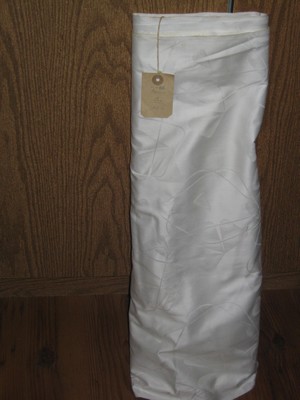
So it was easy letting it all go—everything, that is, but one bolt of white damask I’d salvaged when cleaning out my mother’s house a few years ago. She’d bought it when dinosaurs roamed the earth and I was still living at home; I recall chatter (arguments?) between her and my dad about the price, the quality, was she nuts? It was the only time I remember her buying something non-essential. I knew from the start this wasn’t just fabric.

She made a round tablecloth for her kitchen table and, years later, when I had a place of my own, a small square one for me. Despite its supposed exquisiteness, I didn’t like it much… but what could I do? It was The Damask, the crown jewels of our family. I thanked her and dragged it around to every place I lived.

For her part, that was all she did with it. The rest, metres and metres, was kept tucked away for—as it turned out—ever. Price tag still in place ($47.50). Too precious to use. An act of insanity that I realize I’ve perpetuated. At least once a year I consider pitching it but have never been able to get past its mythology. Or maybe it was how hard she fought to defend her right to buy it. Those were the days when women had to defend such things.

In any case, this year I’m on a serious de-cluttering mission, which includes not only chucking the stuff that’s easy but the stuff that’s hard. 

The Damask must go.

Because it’s not just a bolt of fabric, it’s a nefarious force attracting other remnants—it’s already attracted a small collection of fabric ends from a vest I had Pam make for Peter this Christmas (scraps I’ve kept in case he burns a hole in it with a cigarette even though he doesn’t smoke and even though he has a closet full of clothes that have never been burned by any object, lit or otherwise).

Okay. The vest remnants I’ll pitch.

As for the other—

Last year my mother had a stroke and now sleeps 24 hours a day in a nursing home, in and out of dementia, past giving a flying fig about The Damask or anything else. Perfect time to get rid of it—who would care?

Oddly… me, as it turns out.

True, I don’t want it in its lifelong form: neatly folded and yellowing, an irritant being shuffled from one place to the next. Nor do I need another tablecloth. But my perpetually sleeping mother—well, it suddenly occurs to me that she could do with a crisp new duvet.

In a damask cover of exceptional quality.

~

this is not a review: close to spider man, by ivan e. coyote

 
Somewhere in Ivan E. Coyote’s collection Close to Spider Man ( 2000, Arsenal Pulp) Coyote describes the Yukon sun shining bright but ‘heatlessly’ and then wonders if that’s even a word. Not that it matters because the way it’s presented, it becomes one and it sticks and the next day when I’m skiing on a bone chilling morning in the sunshine of a blue blue sky, I think how very heartlessly  it shines. And I know that every time I encounter that particular kind of day I’ll remember Coyote’s reference and even though it was to a northern sun, specifically, the way it was presented it, it applies, generally, to all suns.

Coyote does this a lot. And not just with large objects in the solar system, but with teensy details right here on terra firma where stories cover pretty general ground—childhood, family, neighbourhood, school, first love, friends, being misunderstood. And while these subjects resonate universally, they’re actually specific to a girl growing up in a small northern community, with the mind, body, spirit, soul, of not merely a girl, but also a boy.

None of which, in the reading, ever feels strange. The beauty of Coyote’s writing is its straight-from-the-hip truth, which over and over again takes the specific and makes it general so that the reader forgets there are differences. At least long enough to see the similarities.

One beautiful scene has Coyote giving the eulogy for a beloved grandparent. When the attending priest mistakes ‘her’ for a guy and suggests s/he join the priesthood, Coyote is tempted to straighten him out with a one-liner but opts instead to respect the dead grandmother’s high opinion of the church and thank him for the compliment.

The circumstances may be unique and the situations unusual, but at the heart of everything, Coyote manages to remind us, we’re all dealing with the same basic stuff: kindness, respect, compassion, decency.

Or their opposites.

In No Bikini  Coyote accidentally passes for a little boy at swimming class by wearing only a bikini bottom—and for purely practical reasons keeps up the charade because… “It was easier not to be afraid of things, like diving boards and cannonballs and backstrokes, when nobody expected you to be afraid.”

In Three Left Turns  Coyote is six years old when a little girl, thinking Coyote is a boy, wants to kiss. Coyote wants to kiss the girl back but feels it’s wrong unless Coyote admits that she’s not a boy. It doesn’t end well—all the more heartbreaking when you think a six year old is already aware of society’s narrow (and punishing) rules on who to love.

Coyote, whose work includes five story collections and a recent novel, self describes as a kitchen table story-teller. I love the quality of “ordinary” in that. That even though the stories… about gender roles, how they develop, how judgments are passed, and the pressures we put on one another, knowingly or not, seem directed at an element of society that is seen as ‘different’, we soon recognize ourselves in the difference.

The hope is that maybe from there we can begin to see the similarities.


perhaps special powers

“My friend Cody, the legendary creature with painted nails and black ringlets that reach halfway down his back. It is rumoured that he is a hermaphrodite, that he possesses extra plumbing, perhaps special powers. I have never asked him, because it is none of my business, and Cody has never inquired about the bulge in my own pants. He is a creature of immense grace and beauty, and that is all I need to know.

“I take Frances into the cafe where Cody works, to introduce them to each other with all the pomp and circumstances reqiured when in the presence of royalty.

“”Cody, I’d like you to meet my godson, Frances. Frances, this is Cody.”

“But Frances doesn’t acknowledge Cody, or his ringlets, or his fingernails at all. Something else more pressing has caught his attention. He reaches his small hand up to caress the fabric of Cody’s silver velvet shirt, tight and shimmering over his slender torso. Frances smiles in wonder to himself and his mother places her hand on my shoulder, and laughs like a leprechaun.

“”That’s my boy,” she says, and for a second I am unsure whether she is referring to Frances, Cody, or myself, but it doesn’t matter, because we are all where we belong. Home.””

from ‘Red Sock Circle Dance’, from the collection Close to Spider Man, by Ivan E. Coyote.

art lesson

In a recent round of POCALOGS to my young niece, I sent a postcard of Van Gogh’s Sunflowers—with a question, which, if answered correctly would win her a prize.

The question was: what is an unusual or interesting fact about the artist?

Her answer (painstakingly googled no doubt) came by email.

his name is vincent van gough and interesting facts about him are
He Suffered from Schizophrenia and Other Mental Health Problems.

Then a minute later, another email—

and he only had one ear.


georgia and me

In 1992, I was given a little Georgia O’Keefe themed engagement calendar booklet thingy when such, now archaic, novelties were what every sensible person carried around with them. However else would you manage your days if not to write appointments, etc. in ink (a liquid, usually blue, stains something awful)…

As it happened I didn’t use mine to note appointments or meetings or social events—which is probably a story in itself—what I did instead was use it to note the titles of books I wanted to read.

Thing is I rarely consulted the list. I just kept adding to it and when I’d filled the pages I put the booklet in a drawer and began making lists on napkins and pizza flyers. The way you do. (Until someone gives you another little booklet—because it’s just the sort of thing you never walk into a dollar store and buy for yourself.) Recently, however—and it’s only been 19 years—someone did give me a new tiny notebook, which has freed me from pockets full of scribbles and shredded tissue and allows me space to begin making a new list I won’t get around to reading for a decade or two.

In any case, it’s time to say ta ta, Georgia. It’s been a slice and all that, but you’re really just part of the clutter now. (How a heart hardens over time, eh?) The contents of Georgia, however, are gold. But as long as she lives in a drawer, I won’t be aware of that gold.

So I’m listing Georgia’s contents, over at the other blog, a list I can share with friends, et al.  Technology makes this possible, god bless it, while ink—though I’m madly in love with it still—is such a private thing, and where books are concerned, I really think the more ‘sharing’ the better…

~

a sense of presence

“A railway station, especially a large one, is something like a home: it acquires a certain aura after it has been used. I do not believe in ghosts or haunted mansions but I am always conscious when I enter any old building of the unseen presence of those who came before. It does not matter if the furniture and bric-a-brac have been stripped away; a sense of presence remains—a feeling, an echo perhaps, that tells you lives were lived here, tragedies enacted, triumphs rewarded, loves consummated, and that this building knew the cycle of birth, life, and death, of hope and despair, of sadness and joy. You cannot experience any of this when you enter a brand new structure. Freshly completed edifices lack a soul. It is the older ones, the ones who have served their purpose over the years, that rejoice in this kind of psychic patina. The sense of history, the feeling of nostalgia, the echoes of the past can never bey worked into an architect’s blueprint.”  (From ‘A Feeling, An Echo’—an essay on the *near demise of Union Station, by Pierre Berton)

*Because of a period of underutilization and a prevailing fashion for all things modern—a la the CN Tower at the time—there was serious talk during the early 70’s of  demolishing Toronto’s Union Station. It really is quite stunning how stupid we humans can be. Fortunately, there are a handful that occasionally get it right. And in this case at least, sanity prevailed.

~
a new place for old stuff

I have too much stuff. I want less. In fact I want what Alix Kates Shulman describes in Drinking the Rain—to find out “how little I need in order to have everything.”

And so as I get rid, I thought I’d commemorate the debris that has no real meaning but is mysteriously difficult to part with—like a peculiar little boy doll in navy breeches that I bought during the 80’s. Can’t remember from where or even why, yet every time I try to pitch this unnamed thing that I have no special fondness for, I can’t. (The best I’ve done is getting him into a bag for the Sally Ann once. I dropped it off, drove away, then a kilometre or two later I turned around, went back, opened the bag, fetched him out and drove us back home.) Not sure what this means. But it’s very bloody weird, no?

Happily, I’m old enough to be more curious now about the why of hanging on to these things than to actually keep hanging on to it. Curious also about what there is to learn from the process of disentangling myself.

—And whether or not I’ll ever be able to say goodbye to breeches boy.

~
a new place for old stuff

I have too much stuff. I want less. In fact I want what Alix Kates Shulman describes in Drinking the Rain—to find out “how little I need in order to have everything.”

And so as I get rid, I thought I’d commemorate some of the debris with a project—The Stuff Stories—where I try to understand why things that have no real meaning are difficult to part with—like a strange little boy doll in navy blue breeches that I bought during the 80’s. Can’t remember from where or even why, yet every time I try to pitch this unnamed thing that I have no special fondness for, I can’t. (The best I’ve done is getting him into a bag for the Sally Ann once. I dropped it off, drove away, then a kilometre or two later I turned around, went back, opened the bag, fetched him out and drove us back home.) Not sure what this means. But it’s very bloody weird, no?

Happily, I’m old enough to be more curious now about the why of hanging on to these things than to actually keep hanging on to it. Curious also about what there is to learn from the process of disentangling myself.

—And whether or not I’ll ever be able to say goodbye to breeches boy.

~

The Stuff Stories, a de-cluttering project of the storied kind.