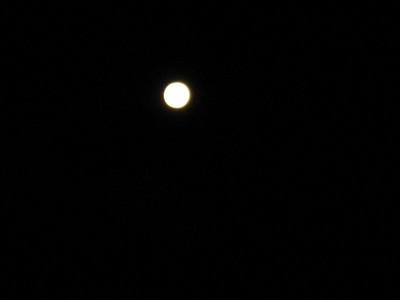
The moon this morning.
So perfect and heavy and all bare naked and bright-eyed again at 7 a.m., like last night didn’t happen, like it wasn’t a bit of a tart, shades of red all over her, showing off behind the earth’s shadow until the wee hours…

~
1. Earliest tree memory: pear tree (no partridges), back yard, age seven or so. Rope. One end tied to branch mid-way up, other end tied to bucket in which sits a bowl of mum’s potato salad. The oil and vinegar kind. No mayo. Me climbing enormous tree. (Proof that memories are distorted; pear trees are tiny.) Me sitting in crook of tree, hauling up bucket, eating potato salad while surveying neighbourhood—particularly Mr. Deluca next door, whose garden is full of car parts instead of flowers, which therefore makes him odd in my book. Because eating potato salad from a bucket in a tree and staring at the neighbours isn’t…
2. Living on that tiny island in the Caribbean. No pine, no spruce. We decorate a houseplant. Xmas Eve on the balcony; it’s late and so dark. Ten thousand stars. Then a lone trumpet. Someone’s playing a trumpet down in the valley. Silent Night. Not another sound. Not even wind ruffling palms, not even surf lapping against shore. The whole world has stopped to listen.
3. For years at the tree farm with a handsaw when the kids were small. Crunching through snowy trails, arguing about which one to kill. Tears because someone wants the twelve-inch Charlie Brown and someone else wants the seven-foot so-perfect-you-may-as-well-go-fake specimen. Every time we end up with neither and give it a name: Quasimodo, Shadrack, Prickles. When the holidays are done the tree carcass has become part of the family and so can’t go out on the curb for pick-up with all the other trees. We place it in the yard, out by the compost, chop it up for firewood years later when we can’t remember which one it is—Shadrack, Prickles?—but we burn its fuel with gratitude and a kind of nostalgia nonetheless.
4. Sitting at my desk, working, when a very large truck arrives on the street and men get out and hover about the neighbours’ thirty foot spruces that separate our yard from theirs. The men cut branches from the trees, lower branches only, which opens things up, makes more room on the driveway, makes perfect sense. But then they keep cutting, higher and higher branches until it doesn’t make sense anymore. Too high. It’s getting stupid and ugly. I’ve stopped working, am transfixed, staring out the window as one of the men straps himself into something, a safety belt, climbs trunk with chainsaw. Saws top off tree. Saws top off tree. It falls into the middle of the street with a thud just like death. It feels like death. But then, it is. I want to run outside, scream, cry, ask why? But I can’t move. I’m just stunned that this can even happen, that these trees—there are two—can just be executed because (I find out later) they shed too many pinecones on the driveway and lawn.
5. Alberta spruce. Cute and petite when we moved in. Two feet tall. Eventually got so big you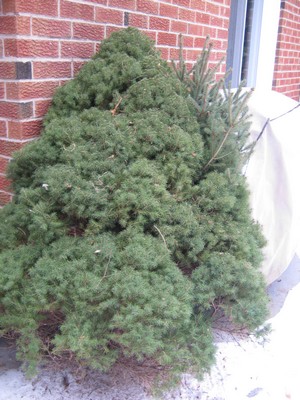 had to shove it aside to get to the front door. Often covered in snow or rain. Finally got ridiculous. So we cut it down and with a bit of trimming, voila, this year’s specimen is born. Front lovely. No back.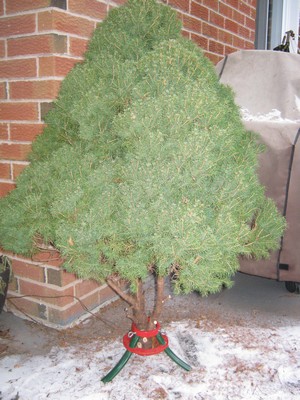
6. “We had Christmas with the usual one-sided tree from the boy scouts. “If you shove the thing up against a wall,” daddy said, “who the hell’s going to notice?”” –excerpt from The Work in Progress
~
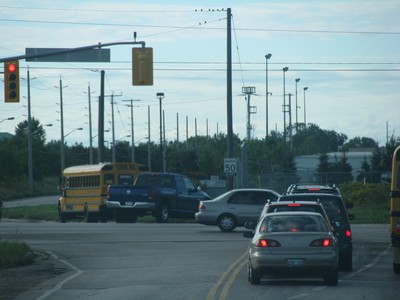
Is there a name for a fear of school buses?
Whenever I see one I think of an unfortunate grade five field trip to Martyr’s Shrine in Midland, which involved lunch en route. The details are unimportant—let’s just say it was a long time before I wanted another egg salad sandwich.
I blame it entirely on the bus.
 I remember heat and diesel fumes and kids screeching and shouting and black leather seats stuffed with something like concrete and how you could feel every pebble and bump on the three hour road trip.
All of which made it difficult to read.
I hadn’t yet learned that reading in a moving vehicle makes me woozy. Or that the whole point of everyone singing was to ward off the woozy in the first place…
There was much ewwwing in my direction after the egg salad. Mortifying of course, but there was also less general shouting and screeching, which at least improved the ambience a titch.
Yin yang.
I remember almost nothing of Martyr’s Shrine. It may be a big white building, it may be orange stripes. I think there are stairs and flower beds and I do recall a pile of canes somewhere and being told they belonged to people who’d come and been ‘cured’ by saying a prayer. I don’t remember doing so but if I’d been smart I would have taken the opportunity to say a little something for the trip back.
It seemed eons before I saw another school bus—or maybe I was just blocking them out. Then a few months ago, I notice I’m on some kind of Laidlaw route—following, passing, waiting behind, at  least a dozen school buses each morning—each one a reminder of egg salad gone bad. I braced myself for life in a very uncomfortable world.
Oddly though, as time goes by and, annoying as the bloody things are with their little stop-sign power trips, habit of driving the speed limit, and the way they linger at railway crossings—which is so creepy and only makes everyone else wonder if they know something we don’t—it’s actually turning out to be a good thing, a kind of exposure therapy. The more I see them from the outside the less I think about their butt-numbing acoustically horrible bump bump bumping endlessly stopping and starting and stopping and starting and stopping and starting diesel spewing nausea tub insides.
So, yeah, the more the merrier, I say.
In fact, I can hardly remember the whole Martyr’s Shrine fiasco. Martyr’s Who? What egg salad?
See?
So nice to be moving on.
~
“How, specifically, does motivation affect creativity—both the generation and the editing of ideas? It matters where the drive comes from. All driven writers focus on their work. But people driven by intrinsic motivations such as curiosity and enjoyment have a relationship to the product of their work different from those moved by extrinsic motivations including praise, money, and a constantly varying world of punishments. Someone who is fascinated by language attends to details and to the overall texture of a writing project more than she will if she is writing simply to satisfy the public. While strong intrinsic motivation increases creativity, surprisingly, adding extrinsic motivations—even positive ones—can actually decrease creativity. If that is true, paying a writer may paradoxically make him writes less well. Reward may encourage the writer to stop work as soon as he or she has completed the minimal amount necessary for the reward, resulting in what the economist Herbert Simon calls satisficing. Extrinsic motivation may also have a negative effect on creativity by distracting the subject’s attention from the task to thoughts of reward or punishment.” —from The Midnight Disease: The Drive to Write, Writer’s Block, and the Creative Brain, by Alice W. Flaherty (Houghton Mifflin, 2004)
~
 ~
~
“Does his first venture into prose herald a change of direction in his life? Is he about to renounce poetry? He is not sure. But if he is going to write prose then he may have to go the whole hog and become a Jamesian. Henry James shows one how to rise above mere nationality. In fact, it is not always clear where a piece by James is set, in London, or Paris or New York, so supremely above the mechanics of daily life is James. People in James do not have to pay the rent; they certainly do not have to hold down jobs; all they are required to do is to have super-subtle conversations whose effect is to bring about tiny shifts of power, shifts so minute as to be invisible to all but the practised eye. When enough such shifts have taken place, the balance of power between the personages of the story is (Voila!) revealed to have suddenly and irreversibly changed. And that is that: the story has fulfilled its charge and can be brought to an end.
“He sets himself exercises in the style of James. But the Jamesian manner proves less easy to master than he had thought. Getting the characters he dreams up to have super-subtle conversations is like trying to make mammals fly. For a moment or two, flapping their arms, they support themselves in thin air. Then they plunge.”
—From Youth, by J.M. Coetzee
~
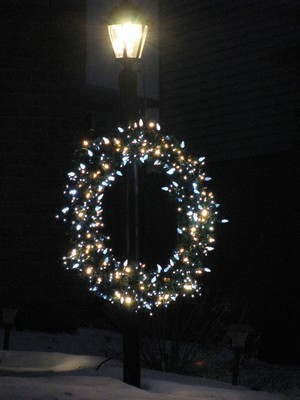
Morninglight

Daylight

Nightlight
~
1. Open a box of Jello.

2. Wet index (or other) finger.
3. Stick finger into Jello powder.
4. Stick finger into mouth.
5. Presto. Instant Lik-M-Aid—and just like that I’m back to pre celsius temps—something in the low 80’s with a gentle breeze—decked out in baggy yellow shorts and a striped tank top, a bandaid on my knee, another on my elbow, reading Richie Rich on the porch or riding my sister’s green two-wheeler hand-me-down that was so big I had to choose: pedal or sit. Impossible to do both at the same time.
(Incidentally, I notice it’s now called Fun Dip and comes with a dipping stick, which is depressing because you know this change occurred to avoid having children stick germy fingers into their mouths—to which I say how are they supposed to develop immune systems if they aren’t occasionally putting fingers into their mouths?? Especially during summer—the universal Lik-M-Aid season—when the more multi-coloured your index (or other) fingers are, the healthier you will grow!)
6. Take your fingers out of the Jello powder—you’re a grown up, for heaven’s sake! It’s winter. Get over it. Boil water. Make Jello. Eat it in the bathtub.
~
I love book shopping for the very young—it gives me a reason (not that I need one but it helps) to wander about the picture book aisles at length where I inevitably find something to add to 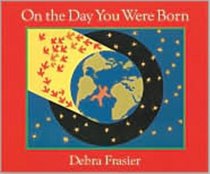 my own collection. My latest discovery being Debra Frasier’s On the Day You Were Born.
Beautifully illustrated (by Frasier) in bold earthy colours and simple lines. The text is written as a poem of welcome and tells what the various elements of nature—wind, trees, tide, moon, stars, sun—were doing to prepare for ‘your’ arrival on the planet. (The trees, for instance “…collected the Sun’s light in their leaves, where, in silent mystery, they made oxygen for you to breathe…”)
Frasier is new to me, so I looked her up and found that ‘connection to nature’ is a theme close to her heart. I’ve already called my bookseller with a list of titles just for me—as well as gifts for friends and family, both young and older.
“On the event of your birth
word of your coming
passed from animal to animal.
The reindeer told the Arctic terns,
who told the humpback whales,
who told the Pacific salmon,
who told the monarch butterflies,
who told the green turtles,
who told the European eel,
who told the busy garden warblers,
and the marvelous news migrated worldwide.
While you waited in darkness,
tiny knees curled to chin,
the Earth and her creatures
with the Sun and the Moon
all moved in their places,
each ready to greet you
the very first moment
of the very first day you arrived….”
—From On the Day You Were Born, by Debra Frasier.
~


and the last of our garden tomatoes
~
 Matilda Magtree