I’m making a list of people to invite to the perfect dinner party.
I wouldn’t say no to this guy either.
~
You may find this surprising, but I can go months and months without ever seeing a border collie. Shocking, I know. And then last week I saw at least a dozen—two of them right in my own neighbourhood. The first, a beautiful long haired black and white running loose down the sidewalk while his human rode a small motorbike on the street in what would be the bike lane if city planners actually planned things. The dog was smiling and his coat was gorgeous in the sunlight and I wanted to take a picture but didn’t think fast enough or, rather, they were moving too fast. They stopped at the corner store just as I, in my car, was turning to go the other way. My instinct was to turn back, jump out, say hello!, tell them how they were a lovely sight and what a great dog and how I’d be smiling for minutes and minutes afterwards. Possibly longer.
But I was late going where I was going so I didn’t.
The very next day I saw another, or maybe the same one. This time walking on a lead held by a human on foot. Not as exciting, but still… Curious, this border collie ‘invasion’, I thought.
Even more curious coming as it did just a day before we went to the sheep dog trials outside Woodville. (You’re forgiven if you don’t know what the blazes I’m talking about.)
Sheep dog = border collie
Trial = an event that originated in the UK for lonely shepherds to get together with other lonely shepherds, talk shop and compare herding techniques via their faithful pups (originally a chap’s thing, though now it seems there are as many women as men shepherds)

It’s the opposite of animal cruelty, if you’re worried about using animals as entertainment. These are all working dogs, this is what they do every day, and what they love to do—herding is an instinct. The farmer trains the dog to understand directional commands via a high-pitched whistle and so controls the herding process, i.e. the direction they move and which of them are penned or separated from the others (for say, medical attention, milking, or any number of reasons).
How it works—the dog tears across a gigantic field to a group of sheep that spectators can’t even see clearly, herds them back through various fences then runs out to get a second lot, brings them back and deals with any bolters. Then they have to separate them out, five here, a couple there, and finally, get three in a small pen.

It’s a brilliant, old-fashioned system, one that creates an amazing relationship between farmer and dog, lovely to behold. (You can tell these dogs are loved, to the point they even have their own little splash pools, pseudo ponds, for regular ‘swim breaks’ whenever they like—even if that happens to be in the middle of herding.)
All of this has zip to do with pedigree or appearance. The dogs are of various ages, they might be unattractive, have three legs (there’s actually a famous three-legged one), it’s all about heart and bond between farmer and dog and how much the dog likes his job. Having said that, these are probably among the happiest pups in the world—there’s not one unpleasant or worrisome note to the whole event. In fact, you get the feeling that if humans hadn’t invented trials, border collies would have.
Anyway, a lovely day, made even nicer with a picnic on the grass under a large umbrella, where, I’ll admit, I casually entertained a few thoughts of leaving it all to buy a whistle and start making some serious feta.
The point of this post, in case you’re wondering, has escaped me.
—Oh to have a wee border collie to herd the random thoughts that bounce round my brain…
~
And hot.
And steamy.
And I’m so tired of people saying summer’s over because the CNE is on or school’s around the corner or the dollar store is selling Halloween costumes. (I was stocking up on manilla envelopes, though I’m not sure why I feel the need to explain…)
Pay no attention. This is what you need to do…
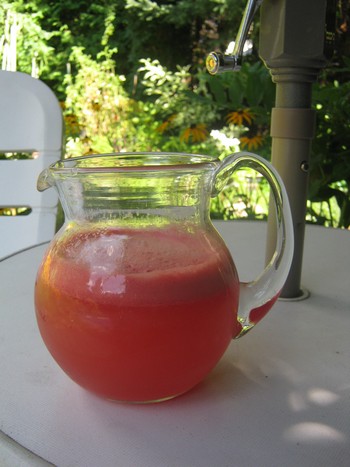
Buy a watermelon.
Better still, if you have a juicer, make a jugful (especially good if you end up with a slightly underripe melon that isn’t great eating).
Chill, drink outside.
Do this once a week—and enjoy the rest of the season. (No matter what anyone says, there is a whole ‘nother month of it!)
~
In my ongoing search for the meaning of life, the universe and the great white light, I recently stumbled across Confessions of an Advertising Man by David Ogilvy. Published in 1963 (by Dell), the cover on my copy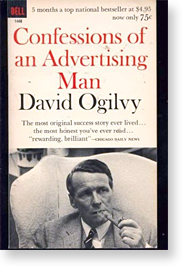 shows the man himself sitting in a large wingback chair decked out in a three-piece tweed, cradling a lit pipe. You can see the smoke curling away from his lips. He looks every bit the successful, ultra confident, middle aged man who is either on his way to or returning from a double martini lunch where, among others of his ilk, clients or colleagues, he no doubt elegantly chortled his way through a sirloin steak, baked potato and oh-so-many-bon-mots lunch. For what is an advertising man if not a chap full of gin and bon mots?
And it was a chap’s world in them days. Girls (there were no women at the time) were for fetchin’ coffee and lookin’ cute, whether it be while fetchin’ coffee or in ads or—as evidenced by the Laura Petries, Samantha Stevens and possibly Betty Drapers of the world—while preparing perfect hors d’oeuvre to soak up yet more booze consumed by (male) clients and/or colleagues in perfect living rooms with Pledge polished veneers, before serving perfect meals of yet more red meat.
The book outlines Ogilvy & Mather’s beginnings, with, essentially, Ogilvy coming over from the U.K., starting an agency and taking Madison Avenue by storm in his own quietly dignified way. In a style that comes off relaxed and conversational, like he’s smoking that pipe while dictating to some gal in a cashmere twin-set, he offers advice on how to get and keep clients, use illustration, write copy, build campaigns, when to get rid of clients you’ve lost faith in (“I also resign accounts when I lose confidence in the product. It is flagrantly dishonest for an advertising agent to urge consumers to buy a product which he would not allow his own wife to buy.”)—sexism aside, can you imagine how far we’ve regressed if this ethic actually ever existed??
He goes on with anecdotes and suggestions for everything from how to succeed in the business (step by step instructions) to having a restful vacation:
“…Take your wife, but leave the children with a neighbour. Small fry are a pain in the neck on a vacation…. Take a sleeping pill every night for the first three nights.”
I’m fascinated by advertising and happen to believe it can change the world. Already has, but not in the right way. Imagine the difference if, in the past few decades, the amount of money spent on convincing people they should eat at McDonald’s had been spent instead on convincing them that real, honest to god food is sexy and delicious and can make you sexy and delicious.
But then we’d have risked creating a world of happier, healthier people who didn’t need ten thousand products, books and videos to help them become happy and healthy.
And then what?
The world would end as we know it.
Which is the whole point.
But I digress.
A nice element of the book are photos and samples of some of O&M’s more famous ads, such as for Rolls-Royce—the headline of which reads:
“At 60 miles an hour the loudest noise in this new Rolls-Royce comes from the electric clock.”
Followed by 719 words of copy.
Different times.
I guess what remains the same is our hookability, that whatever is presented to us in a certain way, we literally ‘buy’.
An interesting footnote tells us that Dorothy Sayers, Charles Lamb, Byron, Bernard Shaw, Hemingway, Marquand, Sherwood Anderson and Faulkner also wrote ‘advertisements’ at one point—“none of them with any degree of success”.
While this is ultimately a good outcome, I think it would have been fascinating to see how differently the world might have been shaped if only Byron had opened an ad agency.
~
Note: this post first appeared in August, 2010.
________________________________________________
Confessions of an Advertising Man online at Blue Heron Books.
Because I’m more than a little claustrophobic, the other day I wondered what would happen if I got stuck in the bathroom while Peter was in Florida. The new doorknob he put on (not that I’m saying he’s not handy at home repairs) sucks. And sticks. And if I couldn’t get it to turn while he was away, what would I do? What if no one heard when I yelled out the tiny second floor window into our woodsy backyard (trees absorb sound don’t they?). Plenty of water, that’s a good thing. No food. Bad. There are books in the bathroom—there are books in every room—but my reading glasses live in a coffee mug on my desk. Note: get a set of magnifiers for bathroom. What about the cats? How long would they survive without Herring and Sardine Supreme… Turkey Delight… fresh crunchies?
Oh god. This is terrible.
Note: outfit bathroom with screwdriver, bag of chips, phone; teach cats how to work snap-off lids.
By the way—just curious—if no one’s home, why am I closing the bathroom door??
~


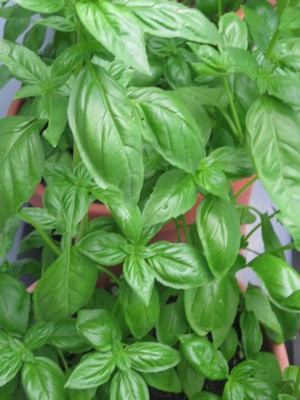
Take 2 cups of it, in fact (from your local farmers’ market if you can, or better still, pick it yourself on a sunny day). Tightly packed. Put in food processor. Add a few pinenuts. A tablespoon, two. Or none. Or walnuts. Half a cup of olive oil. A whoosh of salt and by a whoosh I mean about an eighth teaspoon, no more than a quarter (you can always add later). Garlic cloves. Three, four, five, depends how big they are, how much you like garlic. But more than five large ones would just be silly.
Puree.
Place in small tupperwares and freeze. I use single serving yoghurt containers, covered with saran wrap (and an elastic band to hold it in place). This recipe will fill two such containers.
Don’t worry about imprecise measures. You can’t go far wrong here. What you’ll have, no matter how you do it, is a little preserved ‘summer’ to enjoy in December.
~
Confession: I like picture books.
I still remember the delicious weight of them as I’d lug a stack out of the school library, the anticipation of getting them home, the pleasure of sitting surrounded by them, on my bed, on the floor; every one of them smelled the same—of what? other people’s PJs? warm bed covers? snacks? Nothing smells like picture books from the library—the result, perhaps, of a particular intimacy with many—and those pages, soft from turning, being turned, and turned back again…
I remember laughter at some point. Not mine, someone else’s; comments and laughter at the stack of big square books clutched to my chest as I made my way home in falling down socks and MaryJanes (sigh; book snobbery begins early). Seems other kids had moved on to the abridged Heidi or whatever. At least publicly. Privately, I realize now, they would have still been read to at night. But no one read to anyone at my house; it was every man for himself, which I didn’t find odd in the slightest. Never crossed my mind in fact until Peter and I, a few years ago, were talking about a book I’d bought for a nephew and he said how he’d loved that one being read to him.
Read to you?
By then, of course, I understood that children were read to, I’d read to a few myself, it just hadn’t clicked that someone might have read to me…
Maybe that’s why I didn’t have any sense of categorizing books as childish, or being for babies. I read what I liked. No one chose for me.
Having said that, I did eventually move on to Heidi and beyond, but I didn’t outgrow my love of big square books, to which I returned as an adult and which I now appreciate for what they actually are: bite sized literary gems of art and poetry, illustrations worthy of a gallery—prose, poetry, humour and life lessons, worthy (no, better than worthy) of sharing shelf space with the likes of any zennish tomes written by the ubiquitous ‘life coach’.
I have a small collection, which would be larger if I didn’t keep giving copies away to small people—although I’ve noticed many of the kids in my life are getting to that Heidi age and may not return to the pleasure of PBs for another few decades.
All of this to say, my most recent (truly) gemmish discovery is The Sound of Colors, by Jimmy Liao, a Taiwanese writer and artist who embraces the small in life and makes it expandable enough for all ages.
The story is about a nameless girl in a nameless place who is going blind and finds her way, through the dark tunnels of a subway system (what a strangely perfect vehicle), back to colour and light and life. And then back underground. The degree of actual darkness or light around her not much mattering, she realizes—it’s what she ‘sees’/hears/feels/carries within her as memory and sensation that makes all the difference.
The ‘paintings’ are beautiful—packed subway cars in primary colours, box cars painted with Matisse dancers, bright geometrics, giant green mazes (that “if you look hard enough, there’s always a way out“), elephants in apple printed capes, whales for sleeping on, a caged crescent moon—all this and more juxtaposed with the real world of grocers and traffic and mobs of people.
Then there’s the text:
“Trains rumble and clank and rush past me.
Which is the right one?
It’s easy to get lost underground.
I wonder where I am and where I’m going
and if I’m getting closer to what I’m searching for.
A little boy asks me how to get home.
“I’m looking, too,” I tell him.
Home is the place where everything I’ve lost
is waiting patiently for me to find my way back.”
And that’s just a tiny slice of the middle.
I’m not sure the kids I know are the right age for this book at the moment—they’re in that awkward stage of being both too old and too young at the same time.
Fortunately, I do know a few adults who’ll love it.
~
“For some time now many people, and publishers, have been asking Gertrude Stein to write her autobiography and she had always replied, not possible..
“She began to tease me and say that I should write my autobiography. Just think, she would say, what a lot of money you would make. She then began to invent titles for my autobiography. My Life With The Great, Wives of Geniuses I Have Sat With, My Twenty-five Years With Gertrude Stein.
“Then she began to get serious and say, but really seriously you ought to write your autobiography. Finally I promised that if during the summer I could find time I would write my autobiography.
“When Ford Madox Ford was editing the Transatlantic Review he once said to Gertrude Stein, I am a pretty good writer and a pretty good editor and a pretty good business man, but I find it very difficult to be all three at once.
“I am a pretty good housekeeper and a pretty good gardener and a pretty good needlewoman and a pretty good secretary and a pretty good editor and a pretty good vet for dogs and I have to do them all at once and I found it difficult to add being a pretty good author.
“About six weeks ago Gertrude Stein said, it does not look to me as if you were ever going to write that autobiography. You know what I am going to do. I am going to write it for you. I am going to write it as simply as Defoe did the autobiography of Robinson Crusoe. And she has and this is it.”
—From The Autobiography of Alice B. Toklas, by Gertrude Stein.
~
Sometimes it only takes one perfect day to re-jig and re-wire yourself, to see things in perspective again. Thing is you can never plan such a day—it just appears out of ordinary moments that turn magical for unknown reasons. Like yesterday when we played hookey and drove to Stratford with tickets for Michel Tremblay’s For the Pleasure of Seeing Her Again—the first ‘moment’ occurring when a detour in town led us to Romeo Street where we decided to stretch our legs awhile at Gallery Stratford. Co-incidentally, the main exhibit, ‘Natural History’ was about the evolution of zoos, a subject recently on my mind. One element of the installation was a two minute video of a deer and a wolf 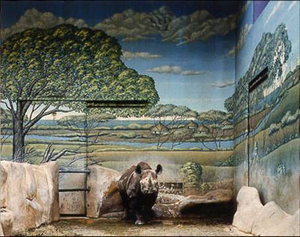 together in an empty and windowless room. Extraordinary to watch their behaviour, their eyes and breathing—so anxious are they in this unnatural space that they forget they’re prey and predator and become strangely equal in their discomfort. In another area are framed photos of animals in various North American zoos, their cages essentially ’empty rooms’ but for the jungle murals, or fake rocks, which may make the audience perceive the space as much more tolerable but (we can assume) does squat for the animals.
After that we went downtown and browsed Inuit art, stopped by Rocky Mountain Chocolate  to inhale, visited the tea place (which could surely convert the staunchest coffee drinker) for supplies to re-fill our larder with lapacho bark, peach flavoured oolong, powdered rooibos and the various assams that Peter fancies. Then on to lunch at Woolfy’s where the staff was delightful, the wine list excellent and well priced, and the Lake Erie perch crispy battered, delicate, and served with a delicious homemade ketchup. I’m not even going to mention dessert…
Finally, the play—a complete joy (but when is Tremblay not?). The premise being the playwright’s memory of his mother—a wildly passionate woman, dominant, loud, gossiping, yet loving and nurturing, who is also a master storyteller.
When, after 90 minutes (no intermission), it ended, I was stunned and horrified. Surely this was a mistake, it couldn’t be the end. Not like that. There must be an intermission.
But the lights came on and the actors took their bows. Ridiculous, I thought. Everything had been so brilliant up until then, every word, gesture, I wanted it to go on another hour at least, maybe two.
As we filed out of the theatre I seriously thought of writing Tremblay and pointing out his shocking error in judgment. Cher Monsieur Tremblay: Tout etait tres bon, sauf… I would begin. Then use google translate from there. Shuffling toward the exit, I was just getting to the part where I’d offer up my suggestions to improve the ending… when I suddenly understood.
I won’t spoil things with details but let’s just say if you leave feeling like it’s all over too quickly—yeah, it is. And that’s just the point.
Good things are always over too quickly.
However, if we’re lucky, and paying attention, sometimes those bits of ‘magic’ linger, just long enough to change us a tiny bit for the better.
—tout etait bon indeed.
~
 Matilda Magtree